Smithsonian Collections Blog

Highlighting the hidden treasures from over 2 million collections

Collections Search Center
Showing posts sorted by relevance for query preservation. Sort by date Show all posts

Monday, April 22, 2013

Perseverance in Preservation

“…let us save what remains: not by vaults and locks which fence them from the public eye and use in consigning them to the waste of time, but by such a multiplication of copies, as shall place them beyond the reach of accident.” 

This April 21st through the 27th is Preservation Week, a national movement working to increase awareness of the importance and scope of preservation needs of cultural institutions.  

While museums, libraries and other archives are dedicatedly working to protect historical artifacts and documents, the combined conservation needs still greatly exceed available resources.  In 2004 the first comprehensive assessment of the preservation needs of national collections was conducted by Heritage Preservation and the findings were staggering.  Over fourteen thousand organizations were surveyed, including 450 of the 500 largest cultural repositories in the U.S.  Eighty percent had no paid staff for collections care, and 71% indicated that caring for collections would require more training.  One hundred and ninety million artifacts are already in need of conservation treatment. Of the estimated 4.8 billion artifacts held by institutions, 1.3 billion are in danger of being lost.  

When Joni Mitchell sang “Don’t it always seem to go / that you don’t know what you’ve got ‘til it’s gone,” she was sounding a concern shared by people across the globe.  While the need for preservation will never disappear, the options for protecting treasured assets are far greater than they were in the recent past.  With the dawning of the digital age, preservation options for most artifacts now include virtual representations.   As technology continues to improve the process of creating digital copies or surrogates, efforts toward the digitization of cultural artifacts continue to expand.

With the launching of the Digital Public Library of America (DPLA), the electronic records of state and regional digital libraries will be searchable and accessible from a single online point.  In addition to bringing information access to an unheralded level in the U.S., DPLA also aims to encourage community digital preservation efforts.  Planned services include assisting local communities in the digitization of cultural artifacts.  One possibility is a “mobile scan-van” service that would allow local residents to scan their old photographs and other personal paraphernalia (which is especially exciting to someone whose childhood is currently archived in a shoebox). 


Image from the Thomas Warren Sears Collection, Archives of American Gardens, Smithsonian Institution.
At the national level, cultural institutes like the Smithsonian will continue to create and preserve digital representations of unique collections.  One example is the Thomas Warren Sears Collection. Thomas W. Sears was a prolific landscape architect – during nearly 60 years of practice he designed landscapes for playgrounds, parks, and private residences as well as urban housing developments, army camps, and cemeteries.  His zeal for his profession was equally matched by his passion for his hobby – photography.   Operating nearly a century before the ease of the digital camera, he photographed a collection of over 4,600 black and white glass negatives and lantern slides.   His images cross continents and eras with subjects ranging from street scenes to countrysides, private gardens to public parks, and from grinning children to somber adults.

Unidentified woman in Annapolis, Maryland, circa 1900-1901. Thomas Warren Sears, photographer.
Smithsonian Institution, Archives of American Gardens, Thomas Warren Sears Collection

Orchards (designed by Gertrude Jekyll), 1906. Thomas Warren Sears, photographer.
Smithsonian Institution, Archives of American Gardens, Thomas Warren Sears Collection
Some negatives from this fascinating collection had the misfortune of being composed of nitrate, an unstable, toxic and highly flammable material (its use as movie film led to multiple deadly cinema fires in the 1920s).  In the 1990s, these negatives were copied and the nitrate negatives destroyed for safety considerations.  Preservation efforts such as this may be unglamorous, but the reward of protecting the past is priceless.

- Jessica Hemphill, Archives of American Gardens, Intern, Winter 2013


Saturday, October 2, 2010

From Analog to Digital – Magnetic Tapes

I am responsible for the Smithsonian Institution Archives Oral History and Videohistory Collections, so like many of my colleagues, I am wrestling with the transition to the digital 21st century. Five years ago, we switched to digital recording of new oral history interviews. Within the next few years, it will no longer be possible to purchase analog audio and video magnetic tape. Manufacturers no longer make tape recording machines. But the various archives at the Smithsonian have large legacy collections of analog recordings that we need to preserve and wish to share with our audiences on the Internet. The SI Archives Institutional History Division is carrying out a digital preservation initiative to remaster our oral history and videohistory collections into digital format, for both preservation and outreach purposes.

Reels, Cassette and Micro Cassette
Courtesy of SIA

For the past five years, we’ve been studying new developments and making decisions about how to best go digital – what types of software, file formats, equipments, etc. – lots of new technical information to absorb! For our audio and video, we chose open source software in uncompressed formats that professional archivists accept as a preservation standard. We also looked for file formats that were cross-platform, that is, can be played on Windows, Macintosh and Linux platforms.

Oral History Collection audio interviews conducted by History Division staff were conducted on archival quality reel-to-reel tapes, but we have also taken in a variety of other tape types. Our audiotape collection contains an array of formats and sizes, from mini-cassettes to cassettes to 3”, 5” and 7” reel-to-reel tapes, recorded at different speeds, numbers of tracks, monaural vs. stereo, etc. We chose to convert all of these to a single preservation format of .wav files at 96 kHz 24 bit and store these preservation files on our server and on two brands of archival quality CD/DVDs. For reference and outreach purposes, we produce compressed .mp3 files which can be readily emailed or uploaded to the Internet, like we have done for the National Museum of Natural History's Centennial Website. The .mp3 format files are smaller, widely used, and fidelity is adequate for normal listening.
 
U-Matic,VHS Cassette and Consumer brand Analog Cassette
U-Matic,VHS Cassette and Consumer
brand Analog Cassette
Courtesy of SIA
The Smithsonian Videohistory Collection also contains a variety of formats, from multi-track 1” open reel tapes, to BetaCam, DigiBeta, ¾” U-Matic tapes and VHS cassettes. We convert all the analog formats to motion jpeg 2000 format as .mfx files, with high quality MPEG-2 files, stored as .mpg files, as our preservation format. Given their large size, storage poses a problem. A one-hour color stereo U-Matic tape, when converted to an .mfx file, can be 10 gigabytes in size. Since we have almost 300 hours of video, with original and reference copies, and duplicate storage files, we need hundreds of terabytes of storage space. We are currently using Linear Tape Open [LTO] high density digital magnetic tapes for storage, not an ideal long-term storage format, but necessary until we acquire the necessary hard drive storage capacity. We also produce Windows Media Video and Real Media copies for reference and outreach. These are stored on our server and two brands of DVDs. We’ve already been able to use both our oral history and videohistory interviews on the National Museum of Natural History 100th anniversary website. See Stories of the Museum for some examples.
 

Samma Solo Equipment
Courtesy of SIA
For both types of files, we retain one set of LTO tapes and CD/DVDs on site and store the other at our offsite storage at Iron Mountain. We carefully document each step – where, when, how digitized, brands of LTO tapes and CD/DVDs, file names, file sizes, file type, etc. All of this data is helpful for future archivists who will manage this collection.


While it might seem logical to start our digital conversion with our oldest tapes, for our audio tapes we started in the middle. We found that reel-to-reel tapes from the 1980s exhibit “sticky shed,” while our 1970s tapes were still quite stable. We started with the most problematic tapes and then turned to the oldest tapes and moved forward. A digital preservation project needs a project plan with a priority list based on several factors – not just age – including tape condition and potential for research or other use.


The benefits of digitization are many – new preservation formats, a limited number of formats to work with, ability to share excerpts of the collection on websites and in public programs, and ease of reference when you can email an .mp3 file or post a Windows Media Video file to an ftp site, rather than copying tapes and mailing them out. While it may seem daunting initially, a program carried out over several years soon yields great benefit in the stability and accessibility of your collection.


Pamela M. Henson, Institutional History Division, Smithsonian Institution Archives

Monday, October 18, 2010

From Analog to Digital – Oral History Transcripts


Samples of Oral History Transcriptions
Samples of Final Proccessed
Oral History Transcriptions
How do you digitize tens of thousands of pages of paper without any extra staff or funding?  It’s a daunting task but we’re almost done with our project.  In an earlier blog, I talked about how we are digitizing analog magnetic tapes in the Smithsonian Institution Archives Oral History and Videohistory Collections.  We are also digitizing our transcripts of these interviews, for both preservation and access/reference purposes.  We want to ensure that existing word processing files are preserved in a format that archivists will be able to access for decades to come.  We also plan to prepare electronic reference copies to deliver to researchers and make available on our website.  We have well over 20,000 pages of transcript in our collection, so this is a challenging task.

We have three types of transcripts:  1) typewritten documents on acid free paper created in the 1970s-early 1980s; 2) word-processed documents in DOS file formats and hard copies on acid free paper created in the late 1980s-early 1990s; and 3) word-processed documents in Windows file formats created since the mid-1990s.   All the transcripts include a finding aid to the interviews, copies of deed of gift forms, images, and an index, and some include appendices.

We first had to decide on preservation and access formats.  For preservation, we create Rich Text Files, which do not retain formatting, and PDF files, which do retain formatting.  Both are open source and cross-platform.  For access, we decided to use PDF files that would retain formatting, could include security features, and could incorporate supplementary materials such as images.  PDFs are a widely used consumer format that can be opened on Windows, Macintosh and Linux platforms. 


Sandy George SIA Volunteer Creates PDFs
Since there are only two of us in the IHD, with many demands on our time, Courtney Esposito and I had to decide where to begin in this very large collection.  We started in the middle, with the DOS files, since we wanted to preserve these currently inaccessible files electronically in an archival format.  Stored on 3” and 5” diskettes, they were transferred to a network server using old disk drives.   An Electronic Records Program intern, Courtney Brucato, tested file conversion programs, selected one that worked best with our array of Samna, WordStar, WordPerfect and Word files.  She then converted each file into a Rich Text File and text PDF file.  Out of hundreds of files, less than ten did not convert.  She documented the problems she encountered, such as commands removed from a file so the conversion could proceed.  We have stored these files on a preservation server and burned them to CD/DVDs to store offsite at National Underground Storage. 

We next created Rich Text Files and text PDF files for the modern Windows-based word-processed files and also stored them on the preservation server.   The PDF files include images and appendices. 

We have a large legacy collection of typewritten paper transcripts, with no word-processed files.  We also had a few paper transcripts for the DOS-file era that did not convert successfully.  At this time, we lack the resources to either keyboard in electronic transcripts or OCR scan them, since OCR scanning requires a significant investment of time for proofreading, correcting, and formatting.  We scan these into image PDF files, primarily for access, but also to have a preservation electronic file.  These image PDF files cannot be searched, but do retain the formatting of the paper transcripts and can contain images and appendices.  Two interns, Katherine Egan and Caitlin Adams, spent many hours scanning these paper transcripts into image PDF files, double-checking to see that all pages were scanned correctly. 
  
PDF of Walter Shropshire's Oral History Interview
PDF of Walter Shropshire's
Oral History Interview

While the scanning is time-consuming, it does not take all that much longer than producing a photocopy, and once done, we don’t ever have to run the paper transcript through a scanner/copier again.  We can now attach transcripts to an email for reference – something that takes a minute rather than an hour.  We see this as a “green” option, saving mountains of paper and toner.   If a researcher wishes to print out a full copy, he or she can.  We also plan to post PDF transcripts of unrestricted interviews on our website when it is redesigned within the coming year. 

 As with our analog tapes, the benefits of digitization are many – new preservation formats, a limited number of formats to work with, ability to share excerpts of the collection on websites and in public programs, and ease of reference when you can email an attached file.   We’ve carried this project out over the course of several years and are pleased with the results in both preservation and accessibility of these collections.  We’d be interested to hear how other oral history collections are dealing with the digital transition so please comment and let us know your ideas.  The October Archives Month Blogathon has been a wonderful way for all of us to learn about what colleagues are doing and how they are getting things done!

Thursday, September 8, 2011

Preservation of the Jorge Prelorán Collection

As part of an ongoing effort to safeguard the work of Argentine filmmaker Jorge Prelorán, several films are being preserved at specialized film labs.  Preservation work on three ethnographic films - Casabindo, Iruya, and La Iglesia de Yavi - was recently completed by Film Technology Company, thanks in part to a grant from the Smithsonian Latino Center.  These films document culture and religion in rural northwestern Argentina, capturing a vibrant mix of indigenous traditions and Spanish colonial influences.


Two of Prelorán's films -- the classic Imaginero and the experimental short Claudia -- will be screened later this month at the University of Maryland, College Park.  The screening will be held at 5pm on Friday, September 30 and is free and open to the public.  It has been organized by the university's Graduate Field Committee in Film Studies; visit their website for details. I will be present to introduce the films and give an overview of the Prelorán Collection. It's an exciting screening for me because it will be the first showing of the newly-preserved and very delightful Claudia (film buffs please note that we will screen from video rather than 16mm, but I promise it will look beautiful all the same).

Imaginero was preserved by HSFA last year with support from the Smithsonian Latino Center.  Preservation of Claudia was made possible by the National Film Preservation Foundation.

As each film is preserved, the new 16mm preservation internegative and optical track will go into freezing storage, and selections from the new video copies will be digitized for online access.  Below is a clip from Iruya, which documents the village's 1966 celebrations in honor of its patroness, Our Lady of the Rosary. The clip shows some of the festivities and features Spanish-language narration from one of the participants.


La Iglesia de Yavi documents religious activities, as well, but the film also takes time to explore the extraordinary church itself.  This clip features Spanish-language narration by the church's caretaker. (Many of Prelorán's films have English-language versions. These two, unfortunately, do not, but we hope it may be possible to create versions with English subtitles in the future.)


For more information on Prelorán's films and a more detailed description of the process of film-to-film preservation, please visit the HSFA's web exhibit on the Prelorán Collection and read an earlier post on the successful preservation of Hermógenes Cayo (Imaginero).

Karma Foley, Human Studies Film Archives


Monday, March 28, 2011

Archives Fair Lecture Series is Online!

American Archives Month may have been in October, but we'd like to announce that the lectures presented on the day of our Archives Fair are now available for consumption!  To view all the lectures click here.

Lecture Series Schedule

10:00-10:30am - The Most Famous Man You’ve Never Heard Of: Dr. J. Horace McFarland
Publisher, rosarian, writer, preservationist, City Beautiful advocate—J. Horace McFarland (1859-1947) was a driving force behind the establishment of the National Park Service but is barely mentioned today. Find out what his collection at the Archives of American Gardens reveals about his prolific professional career.


Presented by Archives of American Gardens, Museum Specialists Joyce Connolly and Kelly Crawford


10:30-11:00am - The Russell E. Train Africana Collection: An Archival Safari through Photographs, Sketchbooks, Manuscripts and Other Materials from the Smithsonian Libraries
An overview of materials on African exploration, travel, big game hunting, and natural history acquired by the Smithsonian Institution Libraries in 2004 from the private collection of the Honorable Russell E. Train, a former judge and chairman of the World Wildlife Fund. The lecture will focus on various issues related to the archival management of the Collection, including finding aids, cataloging plans, grant projects, social media applications, and preservation needs.


Presented by Smithsonian Institution Libraries, Special Collections Cataloger Diane Shaw


11:00-11:30am - Out of the Box: The Archives of American Art’s Lawrence A. Fleischman Gallery
With over 16 million items—from passionate love letters to liquor store receipts—the Archives of American Art is the largest collection of primary source material on the history of American art. It presents three thematically centered exhibitions each year in the Lawrence A. Fleischman Gallery, located in the Donald W. Reynolds Center for American Art and Portraiture. Mary Savig will provide an overview of the Archives’ exhibition program, including how staff continue to address the challenge of engaging visitors with archival material.


Presented by Archives of American Art, Archives Specialist Mary Savig


11:30-12:30pm - Cultural Stewardship at the National Museum of the American Indian Archives Center
An overview of the history of the collections and highlights of current projects at the preeminent repository documenting the historical and contemporary lives of Native peoples throughout the Western Hemisphere, concerning Native art, culture, knowledge, politics, events, and social movements. The NMAI Archive Center takes an active role in fostering collaborative relationships with the tribal communities whose materials they hold and curate. The presentation will provide examples of how the repository has implemented culturally responsive care of indigenous archival material through respect, reciprocity, and consultation.


Presented by National Museum of American Indian Archives Center, Head Archivist Jennifer O’Neal


12:30-1:30pm - The Chief S.O. Alonge Photographic Collection: Royal Court of Benin photographer, Nigeria, 1926 – 1989
The Chief S.O. Alonge Photographic Collection at the National Museum of African Art spans six decades (1926 - 1989) and represents a dynamic, continuous record of the Royal Court of Benin, Nigeria. As the Royal photographer to the Oba of Benin, Akenzua II (1933-1978), Chief Alonge documented the ritual, pageantry, and regalia of the Obas, their wives and retainers for over a half-century. In 2009, Smithsonian Collections Care and Preservation Funds (CCPF) enabled the Elisofon Archives to rehouse, preserve and duplicate over 2,000 images in the collection. This presentation will focus on highlights of the collection and the conservation of over 150 glass plate negatives and 1,800 large format film negatives for preservation and access. In 2010-2011, CCPF funding will allow the Archives to conserve Alonge’s photographic albums and photographs, including a number of original hand-colored prints. Some of these vintage prints will be showcased in a major photographic exhibition on Chief Alonge’s photography at the National Museum of African Art in 2012.


Presented by Eliot Elisofon Photographic Archives NMAfA, Senior Archivist Amy J. Staples

1:30-2:00pm - Intermission


2:00-3:00pm - Documenting World Cultures at the National Anthropological Archives and Human Studies Film Archives
Archivists at the NAA and HSFA will present the history, collections, research, and current projects underway at one of the world’s most significant repositories of archives relating to indigenous cultures and the history of anthropology.


Presented by National Anthropological Archives and Human Studies Film Archives, Photo Archivist Gina Rappaport


3:00-4:00pm - The Scurlock Photographs Project: Challenges in Preservation, Cataloguing, and Access
Processing problems and solutions with a large collection of identified acetate film negatives, some of which are badly deteriorated, and mostly unidentified photographic prints—plus business records and memorabilia. The Scurlock Collection documents the prolific work of a Washington, D.C. photography studio that spans much of the twentieth century.


Presented by National Museum of American History Archives Center, Curator of Photography David Haberstich


4:00-4:30pm - Put Away… and Not Forgotten
IT Archivist Riccardo Ferrante will speak about the basic principles used to manage your digital records and digitized collections well.


Presented by Smithsonian Institution Archives, Director of Digital Services and IT Archivist Riccardo Ferrante


4:30-5:00pm - Preservation of Videotape
Collections Care Manager Sarah Stauderman will discuss the issues surrounding the preservation of videotape including format obsolescence and magnetic media deterioration, and provide strategies for preservation actions.


Presented by Smithsonian Institution Archives, Collections Care Manager Sarah Stauderman


Rachael Cristine Woody
Freer|Sackler Archives


Wednesday, April 4, 2012

Smithsonian Libraries Preservation Week TweetUp

It's an SI Libraries Tweetup!

Do you like old books, even ones with crumbling bindings and damaged paper? Do you want to learn some tips for basic book repair? Have you ever wondered how libraries prepare for dealing with disasters that put their collections at risk? And (most important!) do you like to tweet? If you're an active Twitter user in the DC area who follows @SILibraries, and if you'd like to explore behind the scenes at the Smithsonian Institution Libraries' Book Conservation Lab, you might be in luck. The Smithsonian Libraries is holding a TweetUp for Preservation Week on Thursday, April 26, 2012 from 12:30-3:00 p.m. at its Book Conservation Lab in Landover, Maryland. Ten lucky applicants will be selected to participate. The deadline to register for the TweetUp is April 6, 2012, and details are available on the Smithsonian Libraries website.


However, even if you are not part of the group selected for the TweetUp, you can still learn about the basics of book preservation from these resources on the Association for Library Collections and Technical Services website. You can also follow the TweetUp discussion on Twitter on April 26th using the hashtags #SILTweetUp and #Preswk.

L'Assiette au Beurre, v. 7, before treatment
 
And if you'd like to know more about how libraries, museums, and other cultural organizations prepare for emergencies and respond to disasters, look for information about May Day 2012, sponsored by Heritage Preservation: The National Institute for Conservation.

Plate from Exposition universelle de 1889, being treated with paper washing
 
Various Smithsonian units will be highlighting issues on preservation and disaster preparedness in the months of April and May. You can also ask questions about collections care any time on the Smithsonian Insitution Archives website.

Shown above:

Detail, Blue Jay, plate 15, from Mark Catesby, The Natural History of Carolina, Florida, and the Bahama Islands,  published in London between 1731 and 1743 (call number fQH41.C35 v. 1 SCNHRB Cullman Library)

Volume 7 of the French magazine, L'Assiette au Beurre, published between 1901 and 1912, which recently received preservation treatment in the Smithsonian Libraries' Book Conservation Lab. This copy is from the Cooper-Hewitt National Design Museum Library (call number fAP103.A848 v. 7 CHMRB Cooper-Hewitt National Design Museum Library)

 Plate from Frantz Jourdain's Exposition universelle de 1889 (Paris: Librarie centrale des beaux-arts ; New York : J.W. Bouton, [1892]), undergoing paper washing treatment (call number fNA7105 .J68 1892 CHMRB Cooper-Hewitt National Design Museum Library)

--Diane Shaw, Special Collections Cataloger, Smithsonian Institution Libraries

Monday, April 25, 2011

Broken Glass Plate Negatives: Storage and Imaging

April 24th-30th is National Preservation Week and May 1st is MayDay! Both events are created and hosted by archives and librarian entities in order to raise awareness for the care and emergency preparedness required for collections.

According to the Association for Library Collections and Technical Services (ALCTS) website:

"ALA encourages libraries and other institutions to use Preservation Week to connect our communities through events, activities, and resources that highlight what we can do, individually and together, to preserve our personal and shared collections. Last year, over 65 events took place nationwide. View the 2010 Preservation Week Events in the U.S. in Google Maps. ALA would like to thank the founders, partners, and sponsors of Preservation Week for their generous support."


Make sure to check out the Society of American Archivists and the ALCTS's website for more details on how to participate and view links to helpful hints and tips that you can use for your archives, professional or personal!

Today, the Freer|Sackler Archives is participating by raising awareness for broken glass plate negatives, and to point you to resources on how you can properly store and image these gems.

Below, first photograph is a broken glass plate negative, set with dividers to hold all the shards in their proper place to prevent further damage or loss of image.  The second photograph is the broken glass plate negative scanned in-house with hardly a trace of all the broken fragment lines.  This set helps to illustrate that although a glass plate negative may seem broken beyond repair, you can still scan a beautiful image from it with patience and tender loving care.

Stored
Imaged

Gulistan Palace [?], [1870s - 1930s] 1 11 Negative number 35.6 Caption: Bagh-i Atabeg
Antoin Sevruguin photographs collection, Freer|Sackler Archives.

You too, can save the images captured on broken glass plate negatives.  View the below resources for step by step guidance:

"Conservation Tip No. 4: A Method of Rehousing Glass Plate Negatives," Archives Outside blog.

"Storage of Glass Plate Negatives," Interpreter, Minnesota Historical Society, July 1999.

See sister blog The Bigger Picture, "Walking on Broken Glass," for more on broken glass plate negatives at the Smithsonian.


See other posts in the Smithsonian Collections Blog related to "Preservation."

Citation of Image:
Gulistan Palace [?], [1870s - 1930s] 1 11 Negative number 35.6 Caption: Bagh-i Atabeg
Antoin Sevruguin photographs collection, Freer|Sackler Archives. 

Rachael Cristine Woody
Freer|Sackler Archives

Monday, June 24, 2019

Announcing the Launch of Transcription Center Sound Projects


We are excited to officially announce the Transcription Center’s (TC) latest feature—transcription projects of digitized audio recordings from around the Smithsonian!

The inclusion of sound into the Transcription Center has been requested by volunpeers and Smithsonian collaborators for many years, and we’ve been working hard with developers, archivists and museum staff, and other stakeholders to make this possible.


NMAH-AC0055-0000086, Archives Center, National Museum of American History, Smithsonian Institution.

So far, we’ve launched the first set of TC Sound projects from the National Air and Space Museum Archives, Smithsonian Institution Archives, Archives of American Art, and the National Anthropological Archives and Human Studies Film Archives. Over the next two weeks we’ll be posting even more projects from additional Smithsonian units (including the Center for Folklife and Cultural Heritage,Ralph Rinzler Folklife Archives and Collections and the Anacostia Community Museum Archives), and diving further into featured collections and audiovisual (AV) materials more generally. Alongside our Smithsonian colleagues, we will be sharing background information on audio recordings, behind-the-scenes videos on audiovisual archives, and tips and tricks for transcribing sound. Follow along with #TCSound on our social media channels (Twitter, Facebook, Instagram, and YouTube) to learn more--and while you're at it, check out the Smithsonian Press release announcing the launch of TC Sound.

As we move forward with audio recordings, our Transcription Center team is also working on adapting the platform to incorporate transcription projects of moving image collections (TC Video!), which will be released later this year.


The Impact of TC Sound (why this so important and so awesome):

As the first federal crowdsourcing project to include audio recordings for transcription, we are looking forward to broadening the scope of collection accessibility and readability alongside dedicated volunpeers. Since the launch of the Transcription Center in 2013, over 13,200 volunpeers have transcribed and reviewed more than 460,000 pages of digitized Smithsonian textual materials. This work makes the content within these collections readable and searchable in Smithsonian Collections Search Center database, unlocking historical details for researchers around the world. The inclusion of sound projects in TC will further this work – resulting in even more accessible collections, and presenting even more opportunities for collaborative discovery.


AV Cold Storage, Human Studies Film Archives, National Museum of
Natural History
, Smithsonian Institution
The Smithsonian holds over 290,000 analog audiovisual items in their collections--including more than 150,000 audio recordings--dating from the late 19th century to the present, and ranging in format from wax cylinders, to audio cassettes, films, and reels. Only a portion of these have been digitized and made available to the public. Yet as we know from our extensive work with textual materials, digitization does not equal access.
Transcription offers one solution, making the individual words and stories within digitized materials searchable online. Audiovisual collections present even greater barriers to accessibility. Due to limited staff resources, outdated and obsolete media, and the nature of historical archival donations and collections more generally, descriptive information for audiovisual collection content (or metadata) is often incomplete or unknown altogether. Additionally, without captions, audio and moving images that have been digitized remain inaccessible. Transcription of these materials will not only unlock the historical richness within sound recordings to all interested individuals, regardless of the ability to play or hear the audio, but will also help Smithsonian staff better advocate for the preservation and continued care of these important, but fragile, collections.

Currently, the Smithsonian Institution Archives, alongside other Smithsonian units, is conducting a number of projects related to the present state and future needs of our audiovisual collections. The first phase of a pan-institutional survey of audiovisual collections, consisting of analog film, audio, and video held across the Institution, was completed in 2017. Proposed by the Audiovisual Archivists Institutional Leadership (AVAIL) group and funded by the Collections Care and Preservation Fund (CCPF), this project provides a foundation for the Smithsonian to develop strategies for the preservation and care of these materials. The final report for this survey was released in March of 2017, and identified group-level data on formats, condition, and storage environments, along with areas of greatest strengths and needs in preservation practices. Findings highlighted the great risk audiovisual collections face due to degradation of media formats and obsolescence of playback equipment, the need for digitization and adequate storage to prevent permanent loss (which experts agree could occur within as little as a decade), and lack of audiovisual preservation staff throughout the Institution. Initial work is underway in response to the audiovisual collections report, including an ongoing project with the Digitization Program Office’s Mass Digitization to digitize (and thus preserve) two collections of radio program recordings from the Smithsonian Institution Archives and the Archives of American Art. Once completed (projected to be end of summer 2019), these recordings will be imported into Transcription Center as TC Sound projects. The work of volunpeers on these projects, as well as other TC sound collections, will support and advance AV pan-institutional efforts by unlocking the content on these obsolete formats, making it accessible to all, now and in the future.

Please note: this data is from the 2017 Audiovisual Survey; current statistics and data have increased. 


Join the TC Sound Effort:

As with all projects in Transcription Center, any interested individual with internet access is welcome to dive into TC Sound! You can browse ongoing projects by heading to transcription.si.edu/audiocollections. If you simply want to transcribe, just grab some headphones, choose any current project, and start typing. To transcribe, review, and track your Transcription Center work, sign up for an account (just click “sign up” in the top right of the website and enter a username and email address). Either way, just be sure to first review the “TC Sound” instructions, where you’ll find step-by-step how-to’s for transcribing sound, video tutorials, completed example projects, and a printable instructions cheat sheet.


Reach out to your fellow volunpeers and Smithsonian staff with questions, discoveries, and other comments anytime through our social media channels or by emailing us at transcribe@si.edu. We can’t wait to see what we uncover through #TCSound as #WeListenTogether!

-Caitlin Haynes, Coordinator, Smithsonian Transcription Center 


Sunday, July 18, 2010

The Best Of 100 Blog Posts from the Smithsonian Institution Archives, Libraries and Special Collections!


The Reader, (painting). Cassatt, Mary, 1844-1926, painter. Inventories of American Painting and Sculpture, Smithsonian American Art Museum.
Dear Readers,

This is the Collections Search Center - Smithsonian Institution Research and Information System blog; where Archivists, Museum Specialists, and Librarians around the Smithsonian blog to you about their new collections, current works in progress or whatever catches their eye.  Our authors are from 11 different units around the Smithsonian Institution, providing a strong show case of diversity of our work and collections.  It is our goal to bring you (our readers) collection highlights, unveil hidden collections as they become online, and relate to current events with historical artifacts, art work and research materials from the past.

This post is to commemorate our Blog hitting 100 posts!  When we began this endeavor in earnest at the beginning of March 2010, we had no idea what to expect nor how to measure the success of our mission.  Now almost 6 months in, I think we're starting to get know you, and ourselves a little better.

Social media has demonstrated itself as a fluid yet stable means of communication across the world.  Various web platforms have emerged that aid people in easy and frequent communication and sharing of information with each other.  Conversations now have the possibility to engage globally; while the idea that any information worth sharing can be easily found and disseminated by the masses.  The Smithsonian Institution's museums, libraries, archives, and special collections have entered the arena with the goal to allow further unencumbered access to our collections and ourselves as collection care-takers; further unveiling our hidden collections and making them available for user interaction.


This Blog's mission echoes that of the Smithsonian Institution: to increase the diffusion of knowledge.  By highlighting new collections, hidden collections, and collections as they relate to current events, we further reveal our work and our collections for your consumption. 

With that in mind, I have compiled for you a "Best Of" series featuring 1 post from each of this Blog's 11 contributing units.  The posts here are stellar examples of how Smithsonian Institution archivists, librarians and museum specialists have helped this Blog meet its mission by writing about their work and their encounters with the collections.  Please enjoy reading about these posts' behind the scenes facts, author quotes, and comments from you!


This post is spectacular because it challenges the stereotypical view of cowboys.  It blew my cowboy misconceptions out of the water as I read with ferocious appetite Hector Bazy's own account of being a negro cowboy.  Post authoress Jennifer Morris adds,

" I really enjoyed writing "Hector Bazy, the Negro Cowboy" post because it provided me with an opportunity to introduce the public to a rare manuscript that offers an account of a real black cowboy's life.  I hope this document gives new insight and interpretation of the experiences of the American cowboy, often a subject of romance and myth."

These comments for "Hector" affirm that Jennifer achieved her goal of offering new insight on the romantic cowboy image:

Anonymous said... No doubt about it!! This is great information and I think more people should follow their heart - just like Hector Bazy. Keep up the great work! May 21, 2010 9:59 AM

Anonymous said... What a wonderful read, thank you so much for making it possible to view this and other works on-line. Steph,UK. May 26, 2010 3:31 PM


(98) Gazing through sulphurous vapors into the crater's frightful depths Aso-San, Japan. 1904 or earlier. [graphic], is part of the larger Henry and Nancy Rosin Collection of Early Photography of Japan, 1860 - ca. 1900. Freer Gallery of Art and Arthur M. Sackler Archives, Smithsonian Institution.

I (Rachael Cristine Woody) am the blogger for the Freer+Sackler Gallery Archives, and I can tell you this post was inspired by current events.  The eruption of Icelandic volcano Eyjafjallajokull left several of my colleagues stranded in international airports across most of Europe.  The inability to do anything constructive for them, I went to the Collections Search Center to do a pan-Smithsonian collections search on "volcanoes."  I was pleasantly surprised and inspired by the amount of volcano images we had!  The post ended up being wildly successful in part because it was picked up by USA Today blogger Harriet Baskas for her Blog: Stuck at the Airport.com.  Make sure you check out original SIRIS post to read the reverse side of this stereograph, which provides a powerful literary description  of Aso-San.


Our frequent youtube poster Karma Foley expanded our blogging diversity with her frequent and skilled use of providing audio and visual snippets of her collections. 

Karma explains, "The SIRIS Blog is a wonderful outlet for sharing news and information about our collections that don't really "belong" anywhere else.  When we received the video master of the film preservation work for "Hermógenes Cayo", I was blown away at how beautiful it looked and felt very proud to have been able to assist in the preservation of such an important film.  (Just to be clear, HSFA does not do the actual film-to-film preservation in house; the work was done by Film Technology, a lab in California.)  Film preservation is a pretty abstract concept for most people and I wanted to be able to show the results.  A "before-and-after" video clip is not appropriate for a SIRIS catalog record, but the blog was the perfect place to show it off.  Also, as an archivist one has to be factual and objective when describing collections but naturally in the course of our work we come across materials that move, inspire, or amuse us.  It's nice to have a place where we can be subjective and say, "Hey, look at all the amazing things we have!"

Karma's Imaginero post elicited the following comments:

Stone said... I hope to be able to see this exhibit. Should be very interesting. I'm also looking forward to seeing the exhibit on The Gay civil rights. Thank you! April 8, 2010 10:51 PM

Anonymous said... Fantastic post! Thanks so much for adding the video clip--it's amazing to see the difference. Thankfully now, in many years to come, researchers will still be able to appreciate the original intent of the video in the restored version. April 9, 2010 11:50 AM

Anonymous said... Great example of why preservation is so important. May 10, 2010 8:30 PM 


Acee Blue Eagle Papers 1935-1959. Blue Eagle, Acee 1907-1959 Creek Pawnee. National Anthropological Archives, Smithsonian Museum Support Center.

Jennifer Murray's post on native recipes was a huge hit among you and our peers!  This post was a wonderful example of what you can find in the Archives.  Jennifer does a great job at presenting the collection object in a way that resonates with you.  We are all familiar with recipe books, and our traditional family recipes; this post brings a familiar quality to the Oklahoma Indian Cook Book while at the same time educating and amusing our readers. 

Jennifer's post had these thoughtful comments:

Anonymous said... Fantastic! I laughed out loud at the "serves 30". And I love the phrase "IDLE GOSSIP SINKS SHIPS". Not sure I'm brave enough to try any of the recipes! March 30, 2010 10:25 AM

Anonymous said... I loved this post! Funny and informative. But it would be nice to include a wine recommendation for the chicken mousse. April 14, 2010 12:43 PM


Scurlock Studio Records, ca. 1905-1994, Archives Center, National Museum of American History.

The Archives Center houses one of my most favorite photograph collections, the Scurlock Studio Records.  Archives Center blogger David Haberstich treats us regularly to these poignant images, but this post has perhaps the best I've seen yet!  This photograph (as with all Scurlock photographs) has infectious romantic warmth that allows readers to move beyond the skin color and connect to the sincere emotions like a mother and daughter's love for each other, as shown in this post.

Reader Daniel shares with us, "It's interesting to think about how images of motherhood have been communicated in particular contexts and towards particular ends - I think they have been as celebratory as they have been heart-breaking."

"The portrait of Mrs. E. P. Shaw and her daughter - to my surprise - reminded me of another photograph depicting a mother and her children: Dorothea Lange's FSA photograph, 'Migrant Mother.' Both share a sense of intimacy and tenderness which, as you note, has been commandeered by industries interested in encouraging us to express our feelings and appreciation through the celebration of market transaction."

"The imagery and affect associated with motherhood and maternity is interesting to think about, as it has near constant explanation. I'm curious about its associations too - to body form, sentiment, and character, all throughout the twentieth century. It's exciting stuff!" May 17, 2010 10:34 PM


Speaking of diversity, who knew Native American dentistry would be such a popular topic?  From these comments it's clear Leuman M. Waugh has a fan club!

Anonymous said... Great post! I will think of this when I am the dentist on Monday! April 15, 2010 5:16 PM

Anonymous said... Love this guy! April 16, 2010 10:08 AM

Anonymous said... My in-laws lived two doors from Dr. Waugh, after he retired to Betterton, MD. I spent many cocktail times with him from 1961 until his death in 1972. We enjoyed many "martoons" as he called a martini at each residence. He gave my wife I an 1856 harmonium which I have since passed on to my daughter. Dr. Waugh was a fun and spirited person to be around. July 14, 2010 9:43 PM

The Diana Davies Photograph Collection, 1963- [Series XI: Social Justice: Peace Movement, Civil Rights Movement, Poor People's March, ...]Ralph Rinzler Folklife Archives and Collections Center for Folklife and Cultural Heritage: Photographing Social Justice: The Work of Diana Jo Davies

The Folklife Archives is perhaps our most surprisingly diverse archives under the Smithsonian.  I had originally thought their archives was primarly of a music - folkways persuasion, but posts like this one on Diana Jo Davies shows yet another hidden depth of their archives, and therefore the depth of the Smithsonian as a whole.

To see more Social Justice images taken by Diana Jo Davies, click here.
Model for Girl Dancing [sculpture] / (photographer unknown). Vonnoh, Bessie Potter, 1872-1955, artist. American Sculpture Photograph Study Collection, Photograph Archives, Smithsonian American Art Museum.Smithsonian American Art Museum - Inventories of American Painting and Sculpture: Bessie Potter Vonnoh and Lost-Wax Casting

I am always envious of Nicole Semenchuk's posts.  She has such beautiful images to work with in the Inventories of American Painting and Sculpture, and she never fails to alliterate the beauty of both the artist's technique as well as the finished product.  In this post specifically Nicole describes a recent book on Bessie Potter Vonnoh and provides examples and discussion on the artist's technique, elaborating on the process and how it differs from other artistic processes.

Smithsonian Gardens - Archives of American Gardens: Mathematics in the Garden

Gardening has proven to be a popular category of posting, and this one in particular remained popular for weeks after it's initial post.  Authoress Kelly Crawford explains, "I was inspired to write this post after helping a researcher find images of gardens that had connections to science for a flower show exhibit called, ‘Beautiful Science, Beautiful Gardens.’ This research request forced me to think of all the ways that gardens intersected the sciences. When I shared the list (which included geometry) with one of my volunteers and she reminded me of Three Gates, a garden that was inspired by the Fibonacci numbers and golden ratio. After learning April was National Mathematics Awareness Month, I thought that this garden would be a perfect to highlight for a blog post about math and the garden."

Anonymous agrees... Math and Garden? This is really a surprising “odd couple”! I have always associated Gardening with biology and art, but have forgotten the important math component! I now love gardening even more! April 13, 2010 7:25 AM  


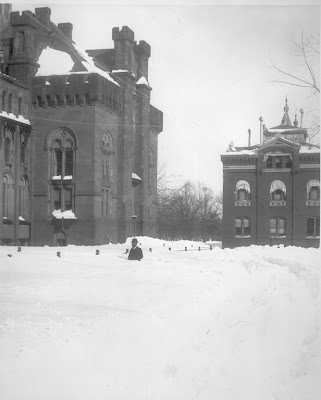
Smithsonian history posts are always popular ones, and it helps that Courtney Esposito has a talent to always pick out historical artifacts and relate them to current events.  This post came in the midst of our blizzard winter, as Courtney explains her inspiration for her posts, "I enjoy writing for the blog because it sheds light on not only the collections but the unique stories about the Smithsonian. It is a great way to show how all of the different parts of the Institution work together. I think showing the public that Smithsonian materials, old and new, can relate to their lives in a variety of ways and creates an understanding their world!"

This post also demonstrated how we and the readers could have a conversation surrounding the collections via this social media:

Anonymous said... Other colleagues of mine were all debating the previous worst blizzard for federal employees, and all had different opinions. Thank you SI Archives for settling this debate with your thorough snow history! February 25, 2010 9:38 AM

Anonymous said... What happened during the blizzard of 1966? March 1, 2010 4:26 PM

Courtney Esposito said... After snowing the over the weekend (January 29 and 30, 1966) A Washington Post article from Monday, January 31, 1966 states: "Except for emergencies, Federal and District Government employees are excused from reporting for work this morning." Later in the day officials excused employees for the entire day. Thus, non-essential Smithsonian staff members, who were federal employees, were excused from work. I haven't found any information thus far on whether the Museums were closed that day or not. However, I did learn that the Zoo was closed until at least February 2, 1966. Several Zookeepers stayed at the Zoo to care for the animals. March 5, 2010 8:58 AM 


[Garden scene with dancers, to be used as the set for a miniature theater] [graphic]. Engelbrecht, Martin, 1684-1756. Cooper-Hewitt, Smithsonian Institution.

Despite being the minority as a librarian, Diane Shaw never fails to amaze with her posts on unique artifacts, whether in between or outside of book covers! 

Diane elaborates, "The SIRIS Blog presents a great opportunity to publicize the opening of new exhibitions featuring library and archival materials at the Smithsonian. "Paper Engineering: Fold, Pull, Pop & Turn" highlights a collecting strength of the SI Libraries that few people previously knew we had.  As one of the catalogers who has worked with these materials, it was particularly delightful for me to see how ingeniously these complicated and artfully designed books are displayed in the exhibition. The Engelbrecht tunnel book with the garden scene depicted in the SIRIS Blog entry consisted of six flat panels inserted in an envelope when it came to me for cataloging. It is absolutely dazzling to be able to see the book on display now in the gallery, assembled by our conservator and exhibition team in the format that its 18th century creator originally intended."

I hope you enjoyed the "Best Of," and thank you for allowing us to share our joys of working on our Nation's collections.

Rachael Cristine Woody
Archivist
Freer Gallery of Art and Arthur M. Sackler Gallery Archives
woodyr@si.edu