Smithsonian Collections Blog

Highlighting the hidden treasures from over 2 million collections

Collections Search Center
Showing posts with label Photographs. Show all posts

Tuesday, August 30, 2022

Women Photographers in Africa: Lynn McLaren

The Eliot Elisofon Photographic Archives (EEPA) is pleased to share the Lynn McClaren collection as part of the Women Photographers in Africa initiative. Eluned M. Demarest – better known professionally as Lynn McLaren (1922-2008) – was an American photojournalist whose work was published in National Geographic, Time-Life, Newsweek, and the New York Times and helped global audiences visualize foreign cultures and landscapes. Her collection (EEPA 2007-009) of 648 color slides (35mm), 38 color transparencies, and 10 black-and-white prints has been digitized and will be available online later this year.

Born in Brooklyn, New York in 1922, McLaren graduated from Vassar College and the Missouri School of Photojournalism. In stark contrast with the experiences of even other working women at the time, she enjoyed a long career that permitted her to travel around the globe. Also photographing parts of Asia and Europe, her collection at the EEPA depicts Kenya and Tanzania in 1966. While the collection represents only a fraction of McLaren’s more than 50-year career, it samples several genres, compositions, and subjects that define both her artistic eye and professional portfolio. 


[Lugongo] sisal estate near Tanga, Tanzania

Photograph by Lynn McLaren, ca. 1966, EEPA 2007-009-0336. Lynn McLaren Collection, Eliot Elisofon Photographic Archives, National Museum of African Art, Smithsonian Institution


Trade and agriculture of major crops and exports along the Swahili coast, including cotton, sisal, and mangrove poles, are represented extensively in the collection. Wide views of cotton and sisal plantations capture their vastness and suggest economic significance of the crops to the region, while expressive portraits of plantation workers locate the humanity within those vast landscapes and economies. Also included in the collection are numerous images of landscapes and animals seen in several East African "game parks," now known as conservation areas or national parks.


Carrying sisal stalks before processing, Tanzania

Photograph by Lynn McLaren, August 1966, EEPA 2007-009-0601. Lynn McLaren Collection, Eliot Elisofon Photographic Archives, National Museum of African Art, Smithsonian Institution


An environmental portraitist, McLaren enjoyed photographing people in their natural surroundings. She was particularly drawn to compositions of people in doorways, and she often turned her lens toward domestic and women’s lives. McLaren’s point of view may noticeably depart from that of her male counterparts in subject matter, composition, and gaze. It also may depart from the points of view of African photographers, photographers of color, and non-journalistic photographers. Inherent to photographic mediums, the collection represents the photographer’s way of seeing her subjects.


[Arab man wearing kofia seated in front of carved door], Lamu Island, Kenya

Photograph by Lynn McLaren, February 1966, EEPA 2007-009-0061. Lynn McLaren Collection, Eliot Elisofon Photographic Archives, National Museum of African Art, Smithsonian Institution


As an extension of the photographer’s eye, the camera lens necessarily captures the photographer’s point of view from their own cultural standpoint. The EEPA’s collections are unique among those of the larger National Museum of African Art because they primarily represent documentary and tourist photography by non-Africans, whereas the museum’s permanent collection items are generally created by Africans. This nature is important to understanding these photographic collections since critics describe photography as inherently voyeuristic and the camera as a tool of colonialism. A collective imagination of Africa and Africans as culturally homogenous at best and uncivilized at worst has been shaped by outsider photography published for the consumption of curious (if voyeuristic) outsiders, like much of McLaren’s work that reached global audiences through publications like National Geographic.  

As an American woman photojournalist, her images represent a gendered, racialized, and inquiring way of viewing two African nations during an important political period. While other collections in the Women Photographers series depict the peak of colonization as far back as the 1920s, McLaren’s images capture Tanzania and Kenya’s immediate postcolonial years (1961 and 1963, respectively). Several shots of Senator Robert F. Kennedy’s 1966 visit to Tanzania (EEPA_2007-009-0692) depict this transitional period. Although the Women Photographers arguably symbolize colonization in embodiment and medium, they also underscore how gender modifies gaze.

Leah Minadeo

Wayne State University, School of Information Sciences

Leah Minadeo is a graduate student of the MLS program at Wayne State University. During Summer 2022, Minadeo volunteered with the Eliot Elisofon Photographic Archives as part of their practicum, cataloging Lynn McLaren’s collection (EEPA 2007-009) and Marilyn Heldman’s collection (EEPA 2016-005) as part of the Women Photographers in Africa initiative. 


Tuesday, July 19, 2022

The Evolution of Anthropological Research in Documenting Diversity: How Anthropologists Record Human Life


By Muna Ali and Ashley Ray     

Documenting Diversity: How Anthropologists Record Human Life is an exhibit that outlines the ways in which anthropologists have utilized changing technology to record various aspects of human life. The exhibit is organized into four sections: film, photography, paper, and sound. It includes the equipment used for documentation such as rolls of film, video cameras of various ages, wax cylinders, phonographs, and multiple notebooks. The objects shown in the exhibit come from the National Anthropological Archives (NAA) and the Human Studies Film Archive (HSFA), respectively. The NAA is a product of a 1965 merger between the Smithsonian Institution’s Bureau of American Ethnology (1879-1965) and the Department of Anthropology (1883-present). The collection holds anthropological material produced by anthropologists including fieldnotes, journals, manuscripts, correspondence, photographs, maps and more [1]. The NAA contains one of the largest archival collections related to North American archaeology, ethnography, indigenous artwork, and historical photographs in the world. The HSFA, a sister repository to the NAA, was founded in 1975. The HSFA possesses an audiovisual collection that documents the history of filmmaking worldwide, as it relates to anthropology. The documents and equipment included in this exhibit are a key part of tracking the evolution of the study of anthropology through time. One might even say that the documents are a more accurate representation of the attitudes of the researchers rather than the people they are attempting to record. In the following sections, we will explore two examples in which these attitudes are apparent. 

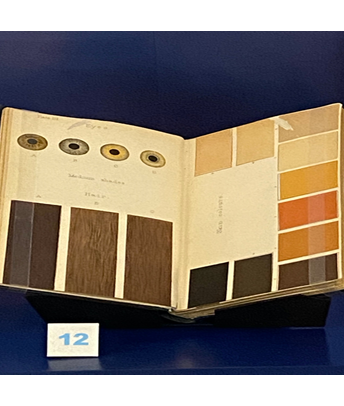
Garson & Read’s Color Swatch 

Underneath the exhibit’s “Documenting on Paper” section, a sample color swatch is displayed prominently across two pages from the 1899 work Notes and Queries on Anthropology by John George Garson (1854-1932) and Charles Hercules Read (1857-1929) [2, 3]. The exhibit designates the color swatch as “a practice borrowed from geology to describe skin, hair, and eye colors” [2]. Similar to the techniques used to classify geological typology, soil compositions, or categorical distinctions based on shared general characteristics, late 19th century anthropologists erroneously figured a scientific typology of humanity could similarly be created, based on variation in color. Both Garson and Read were affiliated with the Royal Anthropological Institute of Great Britain and Ireland, with Read being appointed as the RAI’s President in both 1899 and 1917 [3]. Given anthropology’s complicated history with ascribing meaning to differences in human physical characteristics in the late 19th century (and prior), it’s certainly no surprise that anthropologists who replicated such rhetoric found themselves in positions of intellectual authority.

Garson & Read’s color swatch, as depicted in Notes and Queries on Anthropology, Smithsonian Libraries & Archives. 

Critiques of Garson and Read’s color swatch were generally limited to its inability to provide universal descriptors. In the September 1913 edition of a journal titled Folklore, reviewer John H. Weeks even provided suggestions on how to improve the color swatch through “standardise[d]” colors, as “scarcely two men will call an intermediate shade by the same name” [5]. Despite institutionally affiliated anthropologists such as Garson and Read perceiving the color swatch as an intellectual innovation, this exhibit vehemently rejects such attempts to seek meaning in physical differences, declaring “such techniques falsely assumed skin color as a meaningful marker of difference” [7]. The color swatch’s inclusion within the exhibit addresses troubling legacies in anthropology in a compelling manner: the exhibit distances our contemporary understanding of anthropology from harmful conclusions drawn during anthropology of the past, while simultaneously acknowledging that such conclusions are inextricably linked to the field.  

“No. 7 Song with Lacrosse Game” from Menominee Music by Frances Densmore 

In the “Documenting Sound” section, visitors will find a manuscript with marbled edges. The book is opened to a page of sheet music at the top, labeled “No. 7 Song with Lacrosse Game,” followed by an analysis of the notation. The description for this document states that this is a manuscript of “analyses and translations” of songs recorded and translated by ethnomusicologist Frances Densmore (1867-1957). The manuscript, Menominee Music, was published in collaboration with the Bureau of American Ethnology of the Smithsonian Institution in 1932. This book is one of many published by Densmore throughout her career of studying and advocating for the preservation of Native American music [6].  
 

“No. 7 Song with Lacrosse Game” from Menominee Music by Frances Densmore, 1932.
Smithsonian Libraries & Archives

There are many examples of non-Western forms of music that do not have a system for written notation. Instead, these songs are passed down orally, generation by generation, with each adding slight changes to a particular piece [7].  

From a musicological standpoint, there is the question of whether it is even possible to accurately notate Non-Western forms of music using classical Western notation. And perhaps whether one even should. Western musical notation is limited in what it can and cannot represent. It was designed with western instruments in mind and thus lacks the ability to fully accommodate the nuances of other instruments. On top of that, Western music relies largely on major and minor scales while non-Western music utilizes more diatonic and chromatic scales, differs greatly between the two groups [8]. As one composer aptly describes, “The Western system of notation is governed by rigid elementary mathematics inherited from the ancient past,” meaning that the Western system of notation is only ever able to create an imperfect outline, and the nuances of pitch and rhythm must be added in by the performer. Imposing the limiting Western system of notation on other forms of music creates a document that cannot fully capture the intricacies of the original piece [9].  

In summary, though the document has its flaws, that does not mean it is without value. On the contrary, it is more constructive to view this document as a type of translation which is inherently transformative and results in an end-product that cannot be identical to the source material. Documents such as this are valuable in that they offer a glimpse at what music was like at a specific point in time. In addition to that, present-day members of the Menominee Tribe could potentially use this manuscript to recover songs that may have been lost, suppressed, or erased from public consciousness and, more importantly, the community itself. It is the reader’s responsibility to read critically and remember that culture, and music, are dynamic and ever-changing.  

Densmore was able to mitigate weaknesses in her work of the types explored in this section through inclusion of audio recordings in her research. Densmore’s use of both aural and written mediums is an apt example of the ways anthropologists have adapted to emerging technologies so that methodologies are improving as well as the capacity to accurately record human life. 

Anthropology as an Advancing Field 

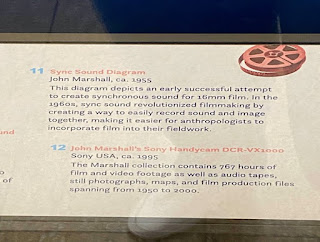
The thematic structure of the exhibit based on medium—along with its more general focus on technological advancements aiding anthropological fieldwork—presents anthropology to the general public as a constantly transforming field. The selection of objects within the exhibit is particularly effective in conveying this: for instance, in the “Documenting on Film” section, the description for Object 11, a diagram on synchronized sound from 1955, is placed strategically next to object 12, a 1995 Sony camera [4]. Visitors are able to easily envision advancements in recording tools used for fieldwork merely through the two descriptions’ adjacent positions. What’s particularly interesting about the position of these two descriptions is that objects 11 and 12 were used by the same individual, anthropologist John Marshall, exactly forty years apart. This choice allows for the exhibit to portray individual anthropologists and anthropology more broadly as advancing in the wake of major shifts in technology.

Photo of Exhibit Description, National Museum of Natural History, Smithsonian Institution. 

Overall, the exhibit addresses anthropological discoveries in four mediums: photography, paper, sound, and film. Additionally, on the left side of the hallway, photography, paper, and sound are in one display case, while on the right side, an entire display case is solely dedicated to anthropological film. Given the heightened importance of ethnographic film in anthropological fieldwork, the exhibit’s choice to have film presented separately from the other mediums is certainly advantageous. The choice to separate film from the other anthropological mediums is also indicative of the two repositories mentioned in the exhibit: the National Anthropological Archives and the Human Studies Film Archives. Although the two repositories are closely related to one another, they operate separately. Visitors can envision the physical constraints in having the exhibit spread across two sides of a wide hallway in the context of the separate nature of the two repositories, ultimately complicating the expression of these four mediums as a coherent whole. Regardless of its physical limitations, the exhibit is successful in highlighting changing attitudes and technologies throughout anthropology’s history.

Acknowledgements

Documenting Diversity was co-curated by Diana Marsh, a former NMNH postdoctoral fellow who partook in a three-year long NSF-funded project on NAA collections, and Joshua A. Bell, who serves as NMNH’s Curator of Globalization, Director of the Recovering Voices Program and Acting Director of the National Anthropological Archives. The exhibit was made possible by close collaboration between the NAA, HSFA, Smithsonian Libraries, and Smithsonian Exhibits.


By Muna Ali and Ashley Ray

Natural History Research Experiences (NHRE) Interns
National Anthropological Archives, National Museum of Natural History 


Sources:

[1] “Documenting Diversity,” Smithsonian Libraries and Archives, accessed June 20, 2022, https://library.si.edu/exhibition/documenting-diversity. 

[2] Erdöl, Das " “Dr. J. G. Garson.” Nature 129 (1932): 931. https://doi.org/10.1038/129931a0 

[3] Balfour, Henry. “Sir Charles Hercules Read, July 6, 1857-February 11, 1929,” Obituaries. Accessed June 2, 2022. https://www.therai.org.uk/archives-and-manuscripts/obituaries/charles-hercules-read 

[4] Bell, Josh and Marsh, Diana. Documenting Diversity: How Anthropologists Record Human Life. Washington: Smithsonian National Museum of Natural History, 2020. https://naturalhistory.si.edu/exhibits/documenting-diversity-how-anthropologists-record-human-life 

[5] Weeks, John H. Folklore 24, no. 3 (1913): 392–97. http://www.jstor.org/stable/1255441. 

[6] “Frances Densmore (1867-1957).” Smithsonian Institution Archives. 2005. https://siarchives.si.edu/research/sciservwomendensmore.html 

[7] Pasler, Jann. “Sonic Anthropology in 1900: The Challenge of Transcribing Non-Western Music and Language.” Twentieth-Century Music 11, no. 1 (2014): 7–36. doi:10.1017/S1478572213000157. 

[8] Robertson-Wilson, Marian. “The Challenges of Notating Music in General and Coptic Music in Particular: Observations of a Professional Cellist, Composer, and Linguist.” Library of Congress Web. https://www.loc.gov/item/ihas.200156229/

[9] Zon, Bennett. “Music in the Literature of Anthropology from the 1780s to the 1860s.” In Representing Non-Western Music in Nineteenth-Century Britain, NED-New edition., 48–68. Boydell & Brewer, 2007. http://www.jstor.org/stable/10.7722/j.ctt14brrwv.9.


Saturday, May 21, 2022

One Picture is Worth A Thousand Stories

By Adam Gray, May 2022


Rehearsal of the toka dance in Yoohnanan on the island of Tanna, September 1974. Kal Muller films and photographs of Vanuatu (New Hebrides), Tanna Island slides, Slide roll #56.

In the 1960s and 1970s, Vanuatu (then known as the New Hebrides) was on the brink of independence from French and British colonial governance. The culturally and linguistically diverse archipelago in the southwestern Pacific Ocean, with over 100 languages spoken across multiple islands, had been governed as the New Hebrides under a joint French and British “Condominium” administration since 1906. Ni-Vanuatu political resistance, which incorporated expressions of traditional culture into the movement for independence, would go on to achieve independence for the nation in 1980, establishing the Republic of Vanuatu.

The Human Studies Film Archives, part of the National Anthropological Archives (NAA) at the National Museum of Natural History, recently digitized a group of 29,000 photographs taken by photographer and author Kal Muller in the midst of these transformations in Vanuatu society. (1)

The making of the photographs also took place against the backdrop of changes in the tools and methods of anthropology. In the mid-twentieth century, a new generation of relatively portable and inexpensive film and audio equipment, such as the Nagra III tape recorder and Arriflex film cameras, offered anthropologists new opportunities to incorporate photography and film into their research. The establishment of institutions such as the Film Study Center at Harvard University (1957) and the National Anthropological Film Center (1975) at the Smithsonian contributed to the development of “visual anthropology,” an academic discipline that incorporates the production and analysis of images, as well as the study of how people use and produce images, into studies of cultural phenomena.

Muller’s photographs are part of the Kal Muller films and photographs of Vanuatu (New Hebrides), which also contains 15 hours of uncut film footage, over 50 sound recordings, and a small amount of correspondence. (These portions of the collection are not digitized.) The collection will be of interest to Ni-Vanuatu communities interested in their history, traditions, and local knowledge, and will prompt discussions about the history and theory of visual anthropology.

A group of women and girls, possibly in Lendombwey village, island of Malekula, in December 1968. The photograph appears to show the production of one of the sound recordings in the collection. Kal Muller films and photographs of Vanuatu (New Hebrides), Vanuatu slides, Slide roll #147.

Kalman “Kal” Muller, a photographer and author with an interest in anthropology, spent several years during the late 1960s and early 1970s living with and photographing communities on several islands of what is now the Republic of Vanuatu. Though he did not have the formal training of an academic anthropologist, Muller’s skill as a photographer, along with ties he developed with local communities, brought him into contact with some of the people and institutions that played key roles in promoting the use of film in ethnographic research: Muller collaborated with American anthropologist and filmmaker Robert Gardner (1925 – 2014) and the Harvard Film Study Center to film the naghol (in Bislama; land dive, in English) carried out by the Bunlap community on Pentecost Island, resulting in the film Land-Divers of Melanesia (1972). He also received support from the National Anthropological Film Center. The Film Center, which in 1981 was relocated within the National Museum of Natural History and renamed the Human Studies Film Archives, acquired Muller’s photographs and films shortly after they were made. (2)  In 2019, the Archives acquired an additional group of Muller’s photographs from the Harvard Peabody Museum, now incorporated with the previous acquisition.

Cinematographer (possibly Muller) films a group of men, possibly in Lendombwey village, island of Malekula, in January 1969. In correspondence from December 1968, Muller states that he was in Lendombwey village, island of Malekula, filming men in a grade-taking ceremony, and this image may relate to those events. Kal Muller films and photographs of Vanuatu (New Hebrides), Vanuatu slides, Slide roll #180.

In the years since Muller made these photographs, anthropologists--as well as archives and museums that hold knowledge created by and about indigenous communities--have re-examined the assumptions, concepts, and power dynamics intertwined with the production of anthropological images. Photographs don’t just provide evidence of cultural phenomena; they provide a means of exploring questions of memory, history, and interpretation. Like other materials found in archives, they can be valuable resources for cultural sustainability and community-based research activities. One photograph can be used to tell a thousand stories. 

The photographs Muller created during his time in Vanuatu, alongside the films, sound recordings, correspondence, and other documents in this collection, form a complex and voluminous group of images that hold complex layers of information and value. As in other archival collections, the different components speak to each other: correspondence between Muller and E. Richard Sorenson, the inaugural director of the National Anthropological Film Center, points to the interplay between individuals, institutions, and local communities which resulted in the production of the films and photographs; the films contain footage that would be edited into Land-Divers of Melanesia; the photographs show expressions of Ni-Vanuatu heritage, images of western filmmakers and anthropologists shooting film and recording sound, as well as urban and festival scenes in Vanuatu shortly before independence, making them records of the diversity of Ni-Vanuatu culture and of anthropologists’ attempts to represent that diversity.

Men construct a tower for the naghol (land dive), likely in Bunlap, South Pentecost, Pentecost Island, October 1968. Kal Muller films and photographs of Vanuatu (New Hebrides), Vanuatu slides, Slide roll #15.

Before putting the digitized photographs online, the NAA reviewed them to identify culturally sensitive content in order to prevent such images from being made public. As it does with all of its collections, the NAA extends an open-invitation to individuals and communities represented in the NAA to engage in collaborative efforts to improve how it describes and stewards those materials. The NAA looks forward to the conversations that the digitization of these images will enable.

The finding aid for the Kal Muller films and photographs of Vanuatu (New Hebrides), along with the digitized photographs can be found here. To learn how you can access parts of the collection that have not been digitized, get in touch with an archivist at hsfa@si.edu.

Notes:

(1) As Muller himself can be seen in some of the images, apparently at least one other person took some of the photographs; unfortunately, the NAA has not been able to identify the additional photographer(s).

(2) Muller also worked with the Film Center in an effort to produce films and photographs of religious ceremonies practiced by the Huichol of San Andres Coamiata, Jalisco, Mexico. The resulting materials are also held by the Human Studies Film Archives. Former Smithsonian Department of Anthropology Graduate Fellow José Carlos Pons Ballesteros has written an informative series of blog posts about his research with that collection here.

Sources Consulted:

“About.” The Film Study Center at Harvard University, Accessed April 26, 2022. https://filmstudycenter.fas.harvard.edu/about/.

Chio, Jenny. “Visual anthropology.” Cambridge Encyclopedia of Anthropology (2021). DOI: http://doi.org/10.29164/21visual

Foster, S. and Adams, Ron. "Vanuatu." Encyclopedia Britannica, March 10, 2021. https://www.britannica.com/place/Vanuatu.

“The History of ARRI in a Century of Cinema.” ARRI, Accessed May 12, 2022. https://www.arri.com/news-en/the-history-of-arri-in-a-century-of-cinema

“History of the Film Archives.” National Anthropological Archives, Accessed April 20, 2022. https://web.archive.org/web/20001022013618/http://www.nmnh.si.edu/naa/guide/film_history.htm

Jolly, Margaret. “Custom and the Way of the Land: Past and Present in Vanuatu and Fiji.” Oceania 62, no.4 (June 1992): 330-354. https://www.jstor.org/stable/40332509

“Nagra III.” Nagra Audio, Accessed May 12, 2022. https://www.nagraaudio.com/product/nagra-iii/

Ruby, Jay. "The Professionalization of Visual Anthropology in the United States: The 1960s and 1970s." Visual Anthropology Review 17, no. 2 (2001): 5-12. DOI: https://doi.org/10.1525/var.2001.17.2.5

Schäuble, Michaela. "Visual anthropology." The International Encyclopedia of Anthropology (2018): 1-21. DOI: 10.1002/9781118924396.wbiea1969


By Adam Gray, Contractor, Human Studies Film Archives

Submitted by Daisy Njoku, Anthropology Archives, National Museum of Natural History


Monday, March 21, 2022

Women, Cameras, and Images

By David Haberstich

In recent years the Smithsonian Collections Blog has featured numerous posts about women photographers represented in Smithsonian collections. For instance, I’ve blogged about the photographers Katherine Joseph, Dawn Rogala, and Melody Golding, whose work is in the NMAH Archives Center, but now I want to highlight a much earlier Smithsonian effort to celebrate women in photography. The National Museum of American History (then the Museum of History and Technology) featured female photographic artists in a series entitled “Women, Cameras, and Images” in 1969-1970, initiated by Curator of Photography Eugene Ostroff. Although three of these photographers were famous, even legendary, and already included in general histories of photography, two were comparatively unknown at the time. Prints by all five are in the museum’s Photographic History Collection, acquired in conjunction with their exhibitions. This program was an early attempt to emphasize the contributions of women to twentieth-century photography via a series that combined three famous photographers, who utilized standard photographic techniques to achieve their unique personal vision, with two younger, relatively unknown artists who experimented with “obsolete” photographic processes, combined with hand techniques, to interrogate assumptions about the nature of photography. Indeed, Betty Hahn later challenged standard notions about photography (and the nature of her multi-media variations) in the very title of her book, Photography…Or Maybe Not. *

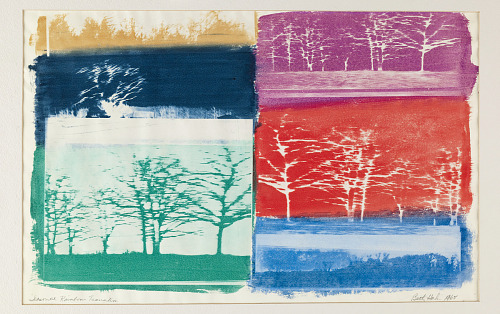
Betty Hahn (b. 1940), "Seasonal Rainbow Transition," gum bichromate with paint on paper, 1968. Photographic History Collection, National Museum of American History.

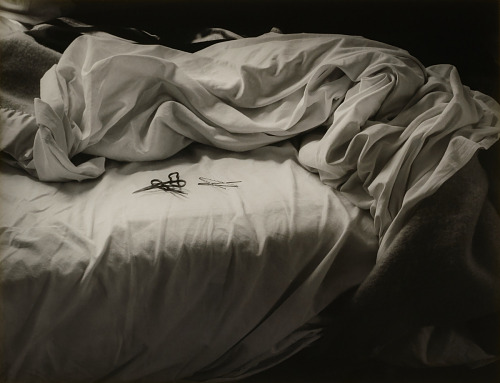
All four exhibitions were accompanied by poster-checklists and formal, if modest, openings. The first show in the series, “Women, Cameras, and Images I,” was a retrospective of Imogen Cunningham’s classic imagery. I well remember her sly humor and witty sarcasm at her opening: she was delightful, and it was especially gratifying for me after my failed attempt to meet her during a trip to San Francisco.

Imogen Cunningham (1882-1976), "Unmade Bed," gelatin silver photographic print, 1957, printed 1957, Smithsonian American Art Museum.

The second exhibition, “Women, Cameras, and Images II,” combined the work of Betty Hahn and Gayle Smalley. I had met Betty in graduate school at Indiana University and vaguely knew Gayle, who had graduated from the Rochester Institute of Technology five years before I had. Their work was very different from that of the other three women, employing radically new approaches to the medium. Hahn was one of the first photographers to experiment with “obsolete” photographic processes, including gum-bichromate, and combined photography with textiles, sometimes adding hand-work, such as paint, needlework and embroidery, which in her words represented a homage to the unsung women who traditionally practiced such stereotypically feminine “crafts.” Independently, Gayle Smalley combined photography with hand printmaking techniques. Hahn’s and Smalley’s prints were colorful, semi-abstract, and often playful and humorous, heavily influenced by contemporary printmaking.        

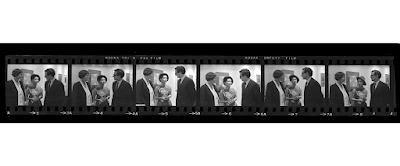
Above: Gayle Smalley (left) and Betty Hahn (center) talking with Eugene Ostroff at the opening of their exhibition, 1969. Smithsonian photographer unidentified.

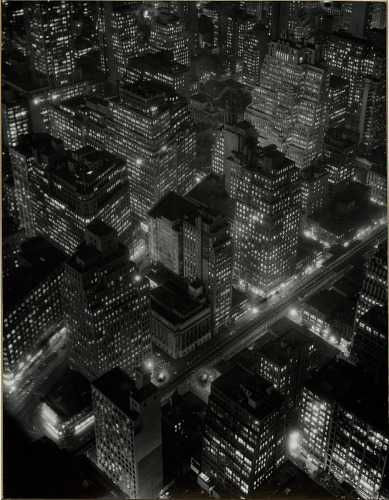
“Women, Cameras, and Images III” was devoted to the work of Berenice Abbott, whose long and influential career ranged from documentation of New York City to the development of techniques for  scientific photography, in which she was an important pioneer. Unfortunately, we lacked funds to bring her to Washington for the opening, and I think she never quite forgave me.


Berenice Abbott (1898-1991), "Night Aerial View, Midtown Manhattan," 1933, gelatin silver print. Photographic History Collection, National  Museum of American History.


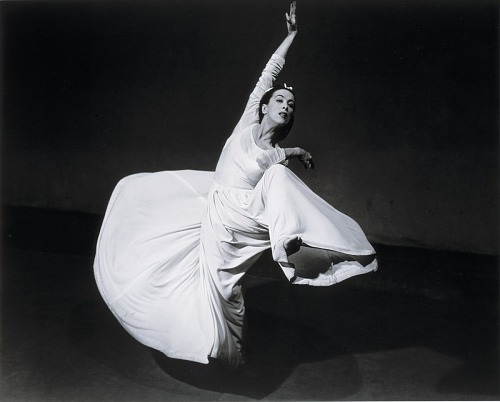
Barbara Morgan was the artist of “Women, Cameras, and Images IV.” Noted for her photographs of Martha Graham’s dancers, a major component of the exhibition, she worried about the design of the show, and explained her concern with rhythm and flow in the placement and sequencing of the framed images. I was tempted to let her develop the layout or collaborate with me, but was warned not to permit her participation lest it delay the opening. It was a nail-biter for me as I hung the show, fearing that she didn’t fully trust my curatorial eye, but I needn’t have worried: she was pleased and pronounced it a huge success, telling me “You got it!” She had been honored previously in a similar retrospective solo exhibition at the Museum of Modern Art, curated by my photo-history mentor, Peter Bunnell, and pronounced my design “better.” At social occasions for several years afterward she proudly introduced me as “the man who hung my Smithsonian show, you know,” and we had a lovely and rewarding friendship.

Barbara Morgan's photographs have been collected not only by NMAH, but also by the Smithsonian American Art Museum (SAAM) and the National Portrait Gallery (NPG). This is also true for the work of Imogen Cunningham and Berenice Abbott. However, NMAH was the first Smithsonian museum to collect and mount exhibitions of their work. 

Barbara Morgan (1900-1992), "Martha Graham--Letter to the World--(Swirl)," 1940, gelatin silver print, printed ca.1980. Smithsonian American Art Museum, gift of Virginia Zabriskie. 

However, the series, which originally was intended to continue for another year, foundered and ended when some photographers objected to being “classified” or identified as “women photographers” within a special series, as if each photographer's work couldn't stand on its own merits. Similarly, I recall hearing certain women criticize the creation of Washington’s National Museum of Women in the Arts for what nowadays some might call bad “optics,” appearing to relegate female artists to a separate category rather than striving to integrate them in greater numbers into existing art museum awareness and practice.

Opinions, perspectives, and tactics intended to promote social change often themselves change with the times and the politics of culture, however. In 1970 we found that for some women photographers, the prospect of inclusion in a series of gendered exhibitions (curated by men) entitled “Women, Cameras, and Images” could be interpreted as more demeaning than celebratory, perhaps suggesting mere tokenism. Controversial “optics!” By contrast, the emphasis on equity in the 2020s has regularly employed group solidarity and separation as a logical, effective tactic to highlight marginalized groups and their members’ individual stories--for example, through Black History Month and Women’s History Month. I recently noticed a current exhibition at Lehigh University entitled “Hear Me Roar: Women Photographers II,” reflecting the similar strategy of the Smithsonian’s “Women, Cameras, and Images” exhibitions of the tumultuous late 1960s. I couldn't help smiling.

David Haberstich, Curator of Photography

Archives Center, National Museum of American History 

Thursday, February 24, 2022

The Iconic, Controversial Sidney Poitier: A Tribute for Black History Month

By David Haberstich


Actor Sir Sidney Poitier, Feb. 3, 1977, photograph probably by Robert Scurlock. Gelatin silver acetate  negative, Scurlock Studio Records,Archives Center, National Museum of American History.


Above is a photograph from the National Museum of American History Archives Center’s Scurlock Studio Records, probably taken by Robert Scurlock, showing famed actor Sidney Poitier besieged by young fans seeking autographs. More than any other African American actor, Poitier (who died in January this year) helped to integrate Hollywood. I first saw him many years ago in his 1955 film, Blackboard Jungle, and recall his magnetic performance vividly. I viewed it again recently, perhaps finding fault with the screenplay, but no less awed by Poitier. He played an unruly teenager who comes to his white teacher’s aid during a deadly classroom brawl at the climax of the film.


Poster for "Lilies of the Field." Copyright © 1963 by United Artists. Scan via Heritage Auctions. Cropped from original image. Public Domain,

He was the first African American to win a “best actor” Academy Award for his performance in Lilies of the Field (1967). Despite the acclaim he received, he was not universally admired by African Americans. The Black critic and playwright Clifford Mason famously denounced him as “dishonest” in a New York Times article, “Why Does White America Love Sidney Poitier So?” (Sept. 10, 1967):  “I submit that the Negro (or black, if you will), image was subverted in these films much more so than it was in the two films he seems worried about.” Playing Porgy in Porgy and Bess was one of the roles that concerned Poitier, supposedly accepting it against his better judgment as the price for being allowed to play such roles as the heroic Virgil Tibbs in In the Heat of the Night. What Mason liked about the Porgy character was that “at least we have a man, a real man, fighting [for] his woman and willing to follow her into the great unknown, the big city, poor boy from Catfish Row that he is.”

        “But he remains unreal,” Mason continued, “as he has for nearly two decades, playing essentially the same role, the antiseptic, one-dimensional hero.” The critic was disappointed that the Virgil Tibbs character had no apparent love interest to certify him as a “real” man. Furthermore, he minimized the significance of the famous slap which Tibbs gives a white bigot, complaining that it occurs only after the bigot slaps Tibbs first. Perhaps Mason had not yet heard Poitier declare that he had insisted that his character should respond with a retaliatory slap, refusing to continue without it. I found the scene riveting, not only for Tibbs’s sudden explosion of righteous pent-up anger, but for the expression of startled, befuddled disbelief on the face of the racist sheriff, played by Rod Steiger. At first I thought the tears and sniveling of the white “aristocrat” in the aftermath of the slap were overdone, but later decided his reaction was perfect symbolism. For the first time, these figures of white oppression were beginning to realize that their comfortable world might be crumbling.

Apart from Poitier’s acceptance of film roles that Mason and others found troubling, the actor’s life was a rags-to-riches story that I find inspiring. First, he nearly succumbed to a premature birth while his parents were working in Miami, Florida. As a barely literate Black teenager from Cat Island in the Bahamas, he suffered racist indignities in the Jim Crow South of Miami, then moved to a slightly more congenial New York City, where he toiled as a dishwasher while seeking a better job. He tried to join the American Negro Theatre, initially failing in humiliation due to his shaky reading skills. With timely coaching from a friend, he quickly solved this problem, then embarked on a personal campaign to suppress his Bahamian accent and hone his acting skills. Eventually he acted on Broadway, then found his niche in film, especially with his break-through role in Blackboard Jungle. His subsequent roles explored many aspects of the Black man in white society. His prominence in Hollywood echoed aspects of the real-life civil rights movement of the mid-twentieth century, not only through the impact of Guess Who’s Coming to Dinner? on the previously taboo topic of interracial marriage. Moreover, he was an active participant in the civil rights struggle, risking arrest or worse by helping to deliver $70,000 to Freedom Summer volunteers in 1964.

Poitier’s achievements beyond acting are extensive, including directing films and publishing memoirs and a novel. He was also a diplomat, serving as Bahamian ambassador to Japan (1997-2007) and concurrently to UNESCO (2002-2007). He was even granted an honorary knighthood by Queen Elizabeth in 1974. In 2009 he was awarded the Presidential Medal of Freedom by President Obama. Perhaps his most satisfying honor was the acknowledgment by younger Black actors that he had broken ground and opened doors for them. Denzel Washington gratefully cited Poitier’s contributions while presenting him with the Honorary Academy Award in 2002. His remarks were followed by sustained, enthusiastic applause from the audience.

        Broadway theaters dimmed their lights in honor of Sir Sidney Poitier on January 19, 2022.


David Haberstich, Curator of Photography

Archives Center, National Museum of American History

Monday, January 24, 2022

Living Documents and Historic Postcards of Guinea

By Haley Steinhilber

Writing? On an archival document?! Traditionally, archives are known for their dedication to preserving original photographs, documents, and visual materials in their original condition and order—but what happens if the donor invites collaboration?

When former USAID Foreign Service officer Stephen Grant donated his annotated copy of Images de Guinée (1991) to the Eliot Elisofon Photographic Archives (EEPA) in 2020, he hoped that the book should remain open for others—specifically Guineans and those with ties to Guinea—to share in the margins their own reflections of the historic postcards.

Adding to a collection is not a rare occurrence. In fact, Grant himself has donated over 10,000 photographic postcards from Côte d’Ivoire, Egypt, Senegal, and the Republic of Guinea in separate instances in 2001, 2018, and 2020. The EEPA also accepts new donations to the African Postcard collection (EEPA.1985-014) every year, continuously altering the make-up of the collection. One of the many things that makes Images de Guinée unique is the concept of a typically static item (a book) remaining active in a concept known as a “living” document. 

A living document is a text that is continually edited and updated, and perhaps limited by a set of frameworks.(1) This term has been applied to materials like the United States Constitution, but it can also refer to a website like Wikipedia, the digital encyclopedia that allows account holders to update articles freely.(2)  In the context of the archive, a living document can be a way for visitors to connect in a more personal way—no longer an observer, but an active participant in history making. 

In a 2020 interview with museum staff, Grant explained how postcards helped him relate to others in the countries where he lived: 

I learned something about introducing oneself when you go abroad for the U. S. government. You can say your name, and shake hands, and that’s it. Or, soon after you meet someone, you can surprise them by pulling out of your pocket a small stack of picture postcards of the country and see how your new friend or colleague reacts. There will be astonishment that you have these items in the first place; most people throw away postcards.

Secondly, the person will invariably make a comment comparing what the scene looked like in the past, and looks like today. Thirdly, for more impact, show the postcards simultaneously to children, young adults, and older adults, and listen to their different reactions! Picture postcards open up conversations. They provoke the beholder to compare the past with the present. They prompt unsuspectedly rich exchanges in a family setting.

When Grant helped put together the book of postcards in 1991, he had already been collecting postcards for over 10 years. He was inspired by an exhibit at the National Library in Abidjan, Côte d'Ivoire, in 1980, which featured hundreds of old picture postcards of the country. In turn, while living in Guinea as a USAID officer, Grant inspired others with his own postcard exhibit, which took place at the Franco-Guinean Cultural Center in Conakry. The exhibit attracted around 1,700 visitors in March 1991.

German Ambassador to Guinea, Dr. Hubert Beemelmans, was so taken with the exhibit that he approached Grant about turning it into a book. They could repair and use a printing press at the Catholic Mission in Conakry—they only needed the staff and supplies.(3) Beemelmans requested money from the Ministry of Foreign Affairs in Bonn, Germany to buy paper, ink, materials for binding, and to train additional local staff on the printing press. Postcard collectors from France, Bernard Sivan and Pierre Dürr, also provided images from their large collections. The resulting publication became the first book published in Guinea in the private sector. All previous publications had been printed by the Patrice Lumumba National Printing Office, according to Seydouba Cissé, the Assistant Director of National Archives in Conakry.
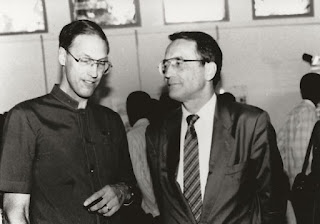

Stephen Grant (left) speaking with German Ambassador to Guinea, Dr. Hubert Beemelmans, at the postcard exhibit, 15 March 1991, Conakry, Guinea. 


From the beginning, the book was grounded in remembering Guinea’s past. As Dr. Beemelmans writes in the preface (translated from French): 

The past is the foundation of the present and future. Humankind and nations that ignore their past do not know each other and do not know where they are going. One can criticize the past, but at the end of the day one must accept it or at least come to terms with it...This book is the memory and the messenger from the past...This book is intended to appeal to those Guineans and foreigners who love Guinea and want to know its past in order to better understand its present and be able to accompany its future.

At first, only Grant’s fellow contributors wrote in the book: the collectors Sivan and Dürr, printer Augusto Bindelli, and Seydouba Cissé, Assistant Director of the National Archives in Conakry. But soon, Grant began inviting others to leave inscriptions before he departed for his next assignment in Indonesia. 

What resulted was an assortment of experiences, from fellow USAID officers to local politicians and educators to a descendant of one railroad family in Conakry. The inscriptions date from 1991 to 2020, when Grant invited the current Ambassador from Guinea to add his own recollection to the book. 
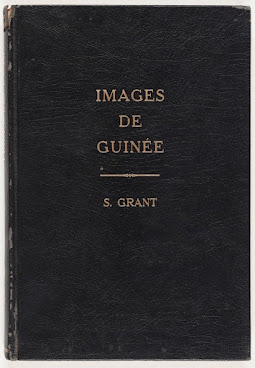

Stephen Grant’s leather-bound annotated copy of 
Images de Guinée
, 1991.
The cover was designed by Annick Grant.
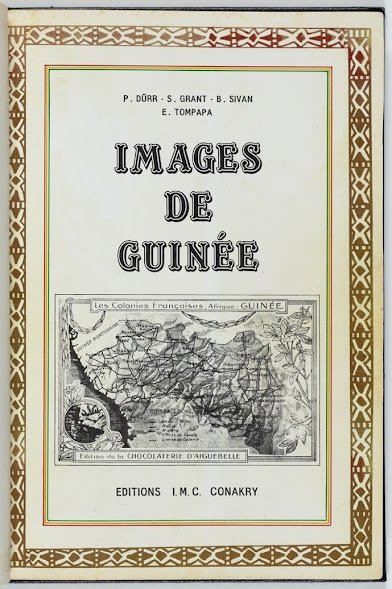


From the Pages of History

Education For All 


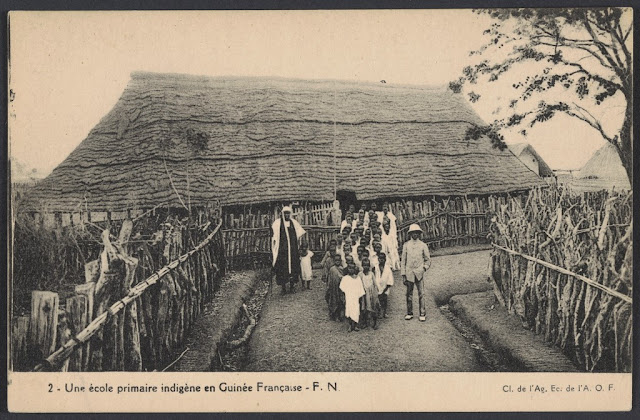
Une école primaire indigène en Guinée Française - F.N. [An indigenous primary school in French Guinea], Ag. Ec. De l’A. O. F., c. 1910, Postcard, collotype, EEPA 2001-001-0940, Stephen H. Grant Postcard Collection, Eliot Elisofon Photographic Archives, Smithsonian Institution.

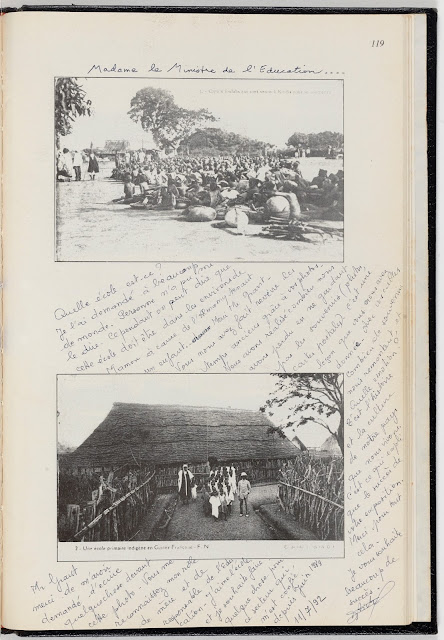
Page 119 of Images de Guinée, featuring postcard and text from inscription by Aïcha Bah Diallo, 2. Une école primaire indigène en Guinée Française - F.N. [An indigenous primary school in French Guinea], Ag. Ec. De l’A. O. F., c. 1910, Postcard, collotype, EEPA 2001-001-0940, Stephen H. Grant Postcard Collection, Eliot Elisofon Photographic Archives, Smithsonian Institution.

Mr. Grant, thank you for asking me to write something about this photo. You recognize my role as mother and responsible for education. I love school and aim to do something significant for this sector with which I have been entrusted.

Which school is this? I’ve asked a lot of people. Not one could tell me. Nevertheless, I am leaning toward the region of Mamou because of the Moslem leader (almamy) holding a child. 

Thank you, Mr. Grant. You have led me to relive the olden days thanks to your photos. We realize how much we have lost by not saving mementos (photos, postcards). With your cards, how many memories come back, and with what emotion! It is the history and the culture of our country that we relive. This is what explains the triumph of your exhibit. Thank you for that. I wish you good luck. 

--Aïcha Bah Diallo, President of the Network for Education for All in Africa, and former Minister of Education of Guinea. Original French:

Mr. Grant, Merci de m'avoir demandé d'écrire quelquechose devant cette photo. Vous me reconnaissez mon rôle de mère et de responsable de l'Education. J'aime l'école et je souhaite faire quelquechose pour ce secteur qui m'est confié depuis Juin 1989.

Quelle école est-ce? Je l'ai demandé à beaucoup de monde. Personne n'a pu me le dire. Cependant on peut dire que cette école doit être dans les environs de Mamou à cause de l'Almamy tenant un enfant.  Merci Mr. Grant. Vous nous avez fait revivre les temps anciens grâce à vos photos.

Nous avons realisé combien nous avons perdu en ne gardant pas les souvenirs (photos, cartes postales). C'est une leçon que vous nous avez donnée. Avec vos cartes combien de souvenirs nous remontent et quelle émotion! C'est l'histoire et la culture de notre pays que nous vivons. C'est ce qui explique le succès de votre exposition. Merci pour tout cela. Je vous souhaite beaucoup de succès.

Diallo braids several themes into her inscription—her role as a mother, a friend to Grant, and an elected local official entrusted with the education of the community. She writes about connecting with others around her and asking about the history of the school, which further highlights Grant’s observation that the postcards inspire conversation. 

Nostalgia of the Railroad

During the 1930s when the Conakry-Niger Railway was a real railroad, you could count more than ten trains per day from Conakry to Kankan and back. My father was a station master at Kolenté where I was born. My father trained five other members of our family as station masters. Of the thirty or so stations in the Conakry Niger, my parents occupied half a dozen.
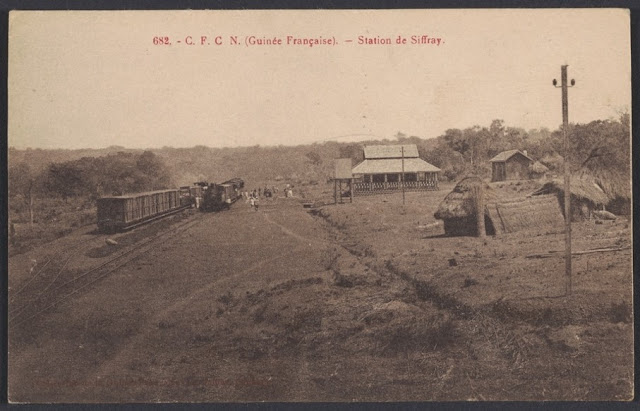

Image Caption: 682. C.F.C.N. (Guinée Française) - Station de Siffray [ C.F.C.N. Chemin de fer, Conakry, French Guinea - Siffray Station, Collection de la Guinée Francaise, A. James, Postcard, collotype, c.1907, EEPA 2001-001-1032, Stephen H. Grant Postcard Collection, Eliot Elisofon Photographic Archives, Smithsonian Institution. 

I spent several vacations at Siffray station (Dagomet) where my father's last little brother served as a station master for a long time. In short, I experience a great admiration for this beautiful collection characterized by discipline and perseverance exceptionally moving for connoisseurs.

I like the rails, I like the train, I like the stations, I like everything related to the railroad because I belong to the family of railway workers. Thank you, Mr. Grant, for this beautiful work which makes me very nostalgic. Thank you for your warm friendship.

[El Hadj] Tafsir H. Thiam, 6/30/92, Deputy Director of Peace Corps in Conakry and child of prominent railroad family in Guinea


Guinée - Une Station de chemin de fer. [A railway station.], unknown photographer, c. 1910, Postcard, collotype, EEPA 2001-001-1057, Stephen H. Grant Postcard Collection, Eliot Elisofon Photographic Archives, Smithsonian Institution. 

Pendant les années 30 lorsque le Chemin de fer Conakry-Niger était un vrai chemin de fer, lorsqu'on pouvait compter plus d'une dizaine de trains par jour de Conakry à Kankan et retour. Mon père était chef de gare à la Kolenté où je suis né. Mon père a formé cinq autres membres de notre famille comme chef de gare. Sur la trentaine de gares que comptait le Conakry Niger, mes parents en occupaient une demi douzaine.

J'ai passé plusieurs vacances à la gare de Siffray (Dagomet) où le dernier petit frère de mon père a servi pendant longtemps comme Chef de gare. En bref, j’éprouve une grande admiration devant cette belle collection caracterisée par une discipline et une perseverance exceptionellement émouvantes pour les connaisseurs.

J'aime les rails, J'aime le train, j'aime les gares, j’aime tout ce qui est lié au chemin de fer car j'appartiens à la famille de cheminots. Merci Mr. Grant pour cette belle d’oeuvre qui me rend très nostalgique. Merci pour votre chaude amitié.

In this recollection, nostalgia infuses every word Thiam writes. From the Siffray station where he spent several vacations with his uncle, to the crowded platform that reflects a typical day on the railroad, the impact of these two postcards of the railroad draws memories of his family history that may not have been written down elsewhere.

The Familiar Crocodile 
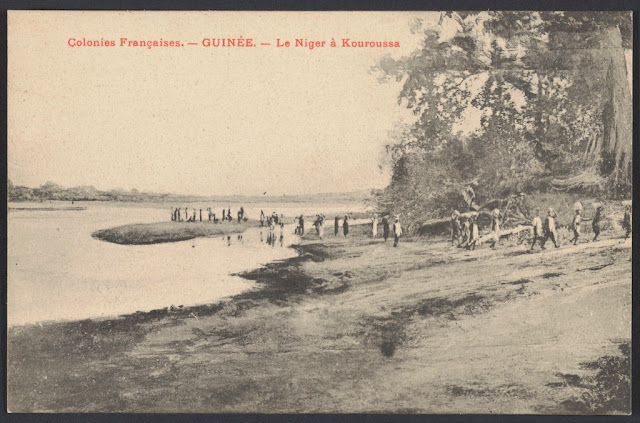

Colonies Françaises-- Guinée - Le Niger à Kouroussa [French Colony – Guinea - Niger river at Kouroussa], unknown photographer, c. 1910, Postcard, Collotype, EEPA 2001-001-1135, Stephen H. Grant Postcard Collection, Eliot Elisofon Photographic Archives, Smithsonian Institution.

Boda Kudu:

 A little downstream, there was a familiar crocodile, guardian of all the children of Kouroussa. He hunted any foreign crocodile, but alas! also munched on the foreign children who ventured into his domain.
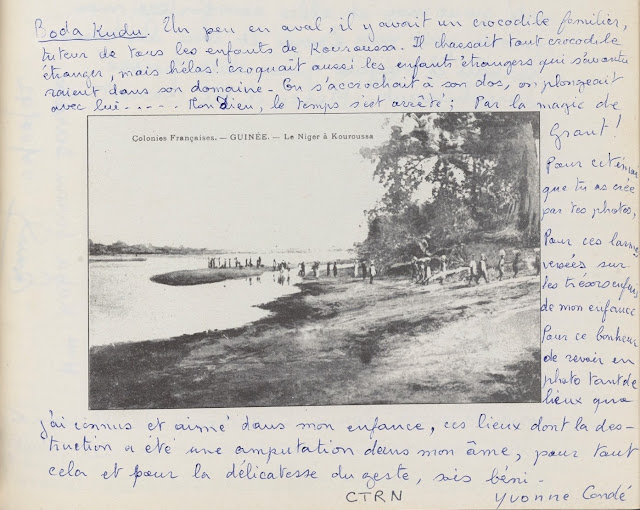

Page 89 of Images de Guinée, featuring postcard and text from story by Yvonne Condé, Colonies Françaises- Guinée - Le Niger à Kouroussa [French Colony – Guinea -- Niger river at Kouroussa],  EEPA 2001-001-1135, Postcard, Collotypes, Stephen H. Grant Postcard Collection, Eliot Elisofon Photographic Archives, Smithsonian Institution.

We would hang onto his back; we would dive with him ... My God, time stood still. By Grant‘s magic! For this emotion that you created by your photos, for these tears shed on the fled treasures of my childhood, for the happiness of seeing again in photos all the places that I knew and loved in my childhood, those places whose destruction has been an amputation in my soul, for all that and for the delicacy of the gesture, you are blessed." - Yvonne Condé - Key member of the Comité transitoire de redressement national (CTRN). She is also responsible for the writing of Loi fondamentale in 1990.

Un peu en aval, il y avait un crocodile familier, tuteur de tous les enfants de Kouroussa. Il chassait tout crocodile étranger, mais hélas! croquait aussi les enfants étrangers qui s’avanturaient dans son domaine. 

On s'accrochait à son dos, on plongeait avec lui... Mon dieu, le temps s'est arrêté; Par la magic de Grant! Pour cet émoi que tu as créé par tes photos, pour ces larmes versées sur les trésors enfuis de mon enfance, pour ce bonheur de revoir en photo tant de lieux que j'ai connus et aimés dans mon enfance, ces lieux dont la destruction a été une amputation dans mon âme, pour tout cela et pour la délicatesse du geste, sois béni. - Yvonne Condé

This entry is particularly interesting in the context of Guinean politics. Condé, a key member of the Comité transitoire de redressement national (CTRN), shares a story almost like a fairy tale--about a place that may not exist anymore, or perhaps she is far from home. As a member of the organization trying to establish democracy in Guinea, Condé describes this allegory of a territorial crocodile.

Into the Future, As We Look Towards the Past

Although these are just a few examples, each of these inscriptions marks a separate significance to the postcards. The work for improving education, steady livelihood through a stable career on the railroad, or the treasures of childhood and reflecting on change in Guinea. How many other countless memories of the past could be provoked by these images?

Advances in technology and digitizing collections provide more options for archives to connect with the communities they serve, to preserve history, and invite collaboration. Over the last few years, EEPA has worked to digitize and catalog postcards from Grant’s postcard donations in 2001 and 2019. In the future, the EEPA will provide access to the full collection of historic postcards from Guinea and other African countries for folks to inscribe. Soon, anyone with access to the Internet (and a device) can view the historic postcards.

If you are interested in sharing your own memories of Images de Guinée or sending a message to the EEPA about the postcards below, please send an email to elisofonarchives@si.edu with the subject line “Images of Guinea.”

Due to Covid-19, the EEPA is currently closed to the public. In accordance with Smithsonian Libraries and Archives, it will reopen to visitors and researchers projected January 2022. Please email the Eliot Elisofon Photographic Archives to set up a visit to view the physical Images de Guinee. 

Notes:

 1. Shanahan, D.R. A living document: reincarnating the research article. Trials 16, 151 (2015). https://doi.org/10.1186/s13063-015-0666-5

  2. Marshall, Thurgood. "The Constitution: A living document." Howard LJ 30 (1987): 915. Kitchin, Heather A. "The Tri-Council Policy Statement and research in cyberspace: Research ethics, the Internet, and revising a ‘living document’." Journal of Academic Ethics 1, no. 4 (2003): 397-418.

  3. Phone call with Stephen Grant, October 2021. 


Haley Steinhilber, Photo Archivist

Eliot Elisofon Photographic Archives, National Museum of African Art

Also visit Stephen’s website at www.stephenhgrant.com

More from the Stephen Grant Postcard Collection


Collection de la Guinée - A. James, Conkary. 82 – Conakry (Guinée Française). Le Ramadam: Le Salam (4e phase). [Guinea Collection – A. James, Conakry. 82- Conakry (French Guinea) Ramadan: Salam (4th phase).] Photograph by A. James, c. 1932. Postcard, Collotype, EEPA 2001-001-0917. Stephen Grant Postcard Collection, Eliot Elisofon Photographic Archives, National Museum of African Art, Smithsonian Institution
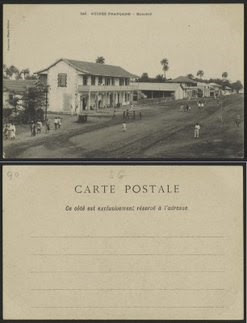

549. Guinée Française - Konakry [French Guinea, Conakry], Collection Fortier Dakar, c. 1906, Postcard, Collotype, EEPA 2001-001-0972, Stephen Grant Postcard Collection, Eliot Elisofon Photographic Archives, National Museum of African Art, Smithsonian Institution


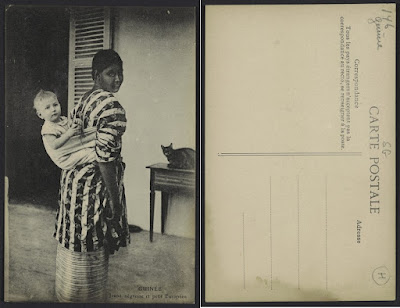
"Jeune négresse et petit Européen," French Guinea, unknown photographer, c. 1910, Postcard, Collotype, EEPA 2001-001-0981, Stephen Grant Postcard Collection, Eliot Elisofon Photographic Archives, National Museum of African Art, Smithsonian Institution


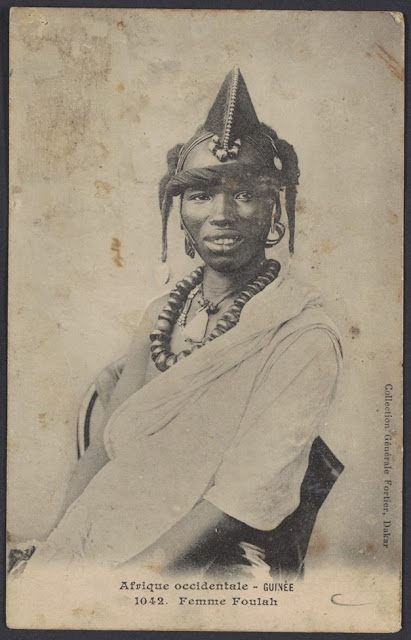
Afrique occidentale - Guinée[,] 1042. Femme Foulah [West Africa, Guinea, 1042. Foulah Woman]

Collection Générale Fortier, Dakar, c. 1911, Postcard, Collotype, EEPA 2001-001-1176, Stephen Grant Postcard Collection, Eliot Elisofon Photographic Archives, National Museum of African Art, Smithsonian Institution