Smithsonian Collections Blog

Highlighting the hidden treasures from over 2 million collections

Collections Search Center
Showing posts with label Libraries. Show all posts

Thursday, October 25, 2018

Adventures in Description and Discovery: Who was Miss Mix?

Smithsonian Libraries was digitizing a book to make available online. While reviewing the book’s description (the MARC encoded catalog record) to check for any errors, a question came up about the author. The mystery related to her authorship of the natural sciences text, when everything else by the same author seemed to relate to music. Was it the same Miss Mix?
Image of Jennie Irene Mix from page 343 of Broadcast Radio, volume 7. Source: Internet Archive
The book in question was Mighty animals; being short talks about some of the animals which lived on this earth before man appeared. It primarily discusses dinosaurs and uses colorful language, photographs and illustrations to appeal to young readers. The illustrations, as seen below, are dramatic. According to the author’s obituary in Radio Broadcast, the text was also used as a supplementary reader in public and private schools. The Director of the American Museum of Natural History, Dr. Frederic Lucas, wrote the introduction.  He commented:
…It is a very interesting history, “for there were giants in those days of old” and Miss Mix tells us how they swam through the seas, splashed through the marshes, and tramped over the hills of the ancient world. More than this, Miss Mix shows us how they looked, these strange beasts that lived in a time when there was no human being to look at them.
He ended the introduction with a warning to save the few animals we have now, for “there may be no Miss Mix to tell about them” in the future. But who was Miss Mix?

Her writing is easy to find, but her biographical details are not. It required more research that usual to discover Miss Mix’s basic information. I went down a rabbit hole, deciding that Miss Mix was giving me an opportunity. She did not have a name authority record in several of the emerging and existing systems we work with at the Smithsonian. I decided to complete my research and create records in some of the systems.
“How a dinosaur was buried in the rock” [page 31 and page 43] from Might Animals. Source: Biodiversity Heritage Library.
Researching Miss Mix
I began my research with a Google search, and learned that Miss Mix was involved in numerous areas of mass media, including radio in the 1920s. She was a trained classical pianist, worked as a music critic for the Toledo Times and Pittsburgh Post, was an editor of the Radio Broadcast (Magazine), and a radio critic. She also penned a novel, At Fame's Gateway; the Romance of a Pianiste. She has been quoted in some more recent publications, relating to women in journalism and early radio broadcasting. They are clues to a fascinating life. Beyond these professional details, her personal history is surprisingly hard to track down.

For someone so visible professionally, why was there so little personally? No Wikipedia page? It felt like there was a story to reveal. I next learned that she was likely born during the Civil War, worked at the dawn of radio until her death at age 63. In order to confirm basic details like birth and death information, I searched Ancestry Library Edition and found seemingly confusing results: a Jennie Irene Mix born circa 1862, 1872, and 1882. It appears at some point she decided not to age past 40; in the 1910 and 1920 census, she listed her occupations as journalist and music critic but listed “40 years old” as her age, decades apart. Through Find a Grave, an online database of cemetery records, I confirmed birth and death years for her, 1862 – 1925. Additional online searching uncovered she was born in Cleveland, Ohio. One year after becoming editor of the Radio Broadcast (Magazine), she passed away in 1925. It appears she never married.
Cover of Broadcast Radio, volume 7. Source: Internet Archive.

Creating records for Miss Mix
First, I created a Library of Congress Name Authority record for her; each piece of information in the record must be cited. This made it very easy to re-purpose the information to create records for her in other platforms like…

Smithsonian units have been involved in Wikipedia for several years now, hosting Wikipediathons to improve the quality of information in the online source. Miss Mix did not have a page, so I learned how create a stub biographical page.

Though Wikidata has only been around six years, it has been working quickly to develop relationships with institutions like the Smithsonian, to test out and strengthen its data and organization. Institutions are studying its structure as they look at ways to manage collection description as Linked Data. I created a Wikidata record for Miss Mix.

VIAF is a project managed by Online Computer Library Center (OCLC) which aggregates name authority records from institutions around the world, including Library of Congress. VIAF is particularly appealing because it creates a “name cluster” with multiple variations of a name, assigned to an Identifier. Records from institution contributors are ingested weekly, but the process of ingesting and quality control with existing records can take varying amounts of time. Through Miss Mix, I began to understand how long this process could take.

Smithsonian is one of several institutions that are involved in the formation of a new archival name authority called the Social Networks and Archival Context. I edited an existing record for her in SNAC.

According to Miss Mix’s obituary in Radio Broadcast:
A woman of striking personality, Miss Mix had a peculiar talent for transferring her personal charm to her work, which was one reason for her great popularity with the readers of RADIO BROADCAST. It is interesting. To note, also that, in the newspapers, her writings were almost as widely quoted as those of Professor Morecroft in 'the March of Radio.'
I look forward to seeing who else might be intrigued and document more about Miss Mix.

Interested in Learning More? 
Here are some resources:


Lesley Parilla, Cataloging and Bibliographic Access Librarian

Friday, October 12, 2018

Flashback Friday: Behind the Scenes at Smithsonian Libraries

Smithsonian Institution Archives, image number MAH-3666. 
The library in the United States National Museum Building, now known as the Arts & Industries Building, was located in the Northwest Pavilion. This space was later know as the Jewett Room after Charles Coffin Jewett, the Smithsonian's first librarian. Later, this room housed the rare book collection. John Murdoch, Librarian of the Smithsonian Institution, sits at a desk. Murdoch was formerly the Assistant Librarian of the National Museum Library and succeeded Miss Jane A. Turner as Librarian on April 1, 1887.


Lisa Fthenakis, Program Assistant

Tuesday, April 3, 2018

How Computers Came to the Smithsonian Libraries

In the beginning, few offices at the Smithsonian used computers. The Smithsonian Astrophysical Observatory used MIT’s IBM 704 to calculate the orbit of the Russia's Sputnik satellite, another office used an IBM 360 to keep track of grant applications, the Fiscal Division (accounting office) was running some programs on an IBM 1440, and the natural history museum was just awakening to the tremendous potential of collections automation. Yet there was another area well suited to computerization: the Smithsonian libraries. A copy of a book in one library was the same as a copy in another library. The information about one book was similar to the information about another book --- title, author, publisher, publication date, etc. This made it easy to devise data formats that could be applied to all libraries. The Library of Congress pioneered a format called MARC (MAchine-Readable Cataloging).

Mary A. Huffer, Acting Director of Smithsonian Institution Libraries who introduced computer automation,
in the Catalog Room of the Smithsonian Central Library in the National Museum of Natural History.
Smithsonian Institution Archives, Image Number OPA-68-26A.
At the behest of Smithsonian Secretary Ripley, the libraries scattered throughout Smithsonian museums and offices were brought under one central office – the Smithsonian Institution Libraries (SIL). This office mandated a conversion from the Dewey Decimal system of cataloging books to the Library of Congress method. Some of the branch libraries were in bad shape, both in regard to physical condition and cataloging. The Zoo, as an example, “had a little library in two or three rooms of an old house [Holt House] --in fact, some of the books were shelved in the men's room, and they had to go knock on the door to get in this cubbyhole of this old administrative building.

Cataloging and purchasing books were both expensive and labor-intensive. They were obvious early candidates for automation. The Acting Director of SIL, Mary A. Huffer, so far as we know, had no background in computer technology. Yet she was to prove remarkably resourceful in automating the libraries. She sought advice and software from the Interior Department, the Atomic Energy Commission, and the National Air and Space Administration. By March 1965, she had a long-range plan in mind:

Our first application will be the business application in our acquisitions program. We have to keep a tally of 80-some accounts, and we are one of the few units where purchase orders are written and go out directly, so we are trying to tie our system into the Fiscal system and to coordinate these to relieve our acquisitions people of some of this record-keeping.
As soon as we get over the purchasing hurdle we are going to tie in our gift and exchange program. Then we are going on to our serials [like scholarly journals]. Then, we hope, perhaps, circulation. Because of programming difficulties, the last thing we are going to try and pull in on this will be our catalog card production.
We want to start card punching in the next six to eight weeks. We will be building up on punch cards information to go into the retrieval system and into the catalogs. Eventually we hope we will even produce book catalogs and do away with the maintenance of all these separate catalogs in various buildings, reading rooms, special subject collections, and so on.

The library trained its own staff to punch the cards that would be fed into the computer’s hopper to avoid to having to correct the work of unskilled punchers. In a surprisingly short time, the library could report significant improvement:

Late in June, 1965, an IBM-29 key punch was installed in the acquisitions section, and during fiscal 1966 all purchase orders were printed on the computer in the Smithsonian’s data processing unit. The ADP program now provides computer-printed purchase orders, bi-weekly reports on the status of various accounts, receiving cards, book labels, Library of Congress card order slips, and temporary catalog cards.

Retirement party for Mary A. Huffer, Assistant Director of Smithsonian Institution Libraries (SIL), with Russel Shank, SIL Director. Smithsonian Institution Archives, Image Number 74-2487. 
Mary A. Huffer was succeeded by Russell Shank in September 1967, as the first Director of the libraries. He connected the libraries to OCLC, which furnished cards formatted according to Library of Congress specifications. This saved the libraries not only time and money, but also errors in entering data. But the Smithsonian libraries had moved into the digital age well before library automation packages were available.

John Churchman, Computer History Project Volunteer


Thursday, October 12, 2017

Throwback Thursday: Microfilm Memories

Man microfilming newspapers. Scurlock Studio Records, Archives Center, National Museum of American History.
A “Throwback Thursday” seems like an ideal time to contemplate that quaint photographic technology called microfilm, which nearly everyone assures me is obsolete in the face of digital technology. Many gazillions of rolls of microfilm are being supplanted in libraries and other repositories by digital copies. Internet searches on microfilm indicate that it is dead or dying. Yet just this month I found advertisements for new, sleek, futuristic (and expensive) microfilm cameras. I haven’t researched this apparent contradiction (fake news or fake advertising?), but it is clear that microfilm is hardly as popular as it once was as a means of (a) preservation copying or (b) miniaturization. As Bob Horton, the Chair of the National Museum of American History's Archives Center notes, "One of the biggest reasons people prefer digital to microfilm is we all carry the capacity to read digital images in our pocket – reading microfilm is a bit more challenging."

I first became fascinated with microfilm while researching its rather romantic history (think microphotography for espionage) for our museum’s exhibitions on the history of photography years ago. Later I took a course on microfilming as a preservation tool from the Northeast Document Conservation Center, partly because the Archives Center had inherited an ancient Recordak microfilm camera from the Smithsonian Institution Archives and I wondered if we had a use for it. I experimented with it, and exposed and processed some film. As a favor to Dr. Alixa Naff, donor of the Archives Center’s Naff Arab American Collection, I filmed two books borrowed from other institutions, adding one microfilm to her collection, and establishing the other, the History of Young Men of Deir-El-Kamar and Suburbs: Account Book, ca. 1926-1950, as a separate collection. Although the latter has been used by researchers, no one ever asked to purchase a copy of the entire microfilm until this month. In order to fill the request, I’ve had to consider whether a microfilm copy or asking the requester to pay for a digital version would be most suitable.

Microfilm has been criticized because so much of it is of dismally low quality, especially in terms of operator errors such as skipped pages. Operator errors were often blamed on the evils of the mind-numbing repetitious work. After using a microfilm camera myself, I became convinced that a culture of speed and a production-line mentality actually caused the operator fatigue, boredom, and carelessness that produced many mistakes. I explored the benefits of slower, meticulous filming—for which the old-fashioned microfilm camera was actually well-suited. On one hand, the classic Kodak Recordak camera seemed primitive because it lacked a variable-aperture lens. On the other, uniform exposure was achieved by altering the light level with a rheostat; the camera, perfected in the 1930s, had a built-in light meter! It also had an auto-focus feature, plus a rangefinder for greater precision, meaning that one could change the height of the camera without refocusing. You could take the time to match the camera height to the size of the item being photographed (as any conscientious photographer using an ordinary camera on a copy stand would do to make lecture slides), yet without seriously impeding the production level and rhythm of microfilming. It seemed to me that the practice of framing each object individually, utilizing the autofocus feature, could in itself aid consistency.

Speaking of speed, when we began scanning the Archives Center’s Scurlock collection negatives, it was clear that microfilming was much faster than scanning! Through a pilot project with a contractor, several thousand Scurlock negatives had been microfilmed, and we later obtained sample scans of impressive visual quality from a few frames, giving us both preservation surrogates and versatile digital versions.

My favorite feature of the Recordak was its variable frame size, combined with an automatic, compensating film wind. If you desired, you could produce a sequence of frames of different sizes, such as a vertical image on the film, followed by a wide panorama. I discovered that most microfilmers seemed unaware of these nifty features, generally setting the camera height for the largest item in a particular job—for example, a newspaper page—then never adjusting the camera height for smaller items. The user of the film was expected to change the viewer magnification, thereby contributing to microfilm-viewing fatigue. It seemed to me that the technical advantages of microfilm camera design were seldom exploited to good advantage. I know: that concern may be moot nowadays.

The Archives Center’s Scurlock collection includes photographs showing microfilm camera operators at work, as above, evidently with the familiar Recordak cameras.


David Haberstich, Curator of Photography
National Museum of American History, Archives Center


Thursday, March 23, 2017

A British Ambassador in the Natural and Cultural Landscapes of Washington


The Castle (Smithsonian Institution Building) with grounds as landscaped by Andrew Jackson Downing. This illustration is from a publication of 1920, Washington the Beautiful. The National Mall was later created to be a long, open expanse of lawn, replacing the curvilinear paths and plantings of the mid-19th century. 

The District of Columbia, in the century following its selection by President George Washington as the site for the permanent seat of government, had a difficult history. The streets were muddy and unpaved, animals roamed about, the canal along what is now Constitution Avenue was a fetid sewer, a slaughter house was near the White House, and there was little in the way of infrastructure. Destruction that occurred from the War of 1812 and the chaos of the Civil War overwhelmed the city’s scant resources and contributed to the Federal capital’s sorry state. There were calls to have the Capital moved elsewhere. Washington City began to become more established with the creation of the Territorial Government in 1871, led by Alexander “Boss” Shepherd, although that municipal organization soon collapsed under scandal and bankruptcy.

The “City Beautiful” movement, growing out of the 1893 World Columbian Exposition, inspired, in part, the 1901 Senate Park Improvement Commission to draw up the McMillan Plan, an architectural reshaping of the National Mall and park system throughout the city. Never formally adopted due to political maneuverings, the 1902 document nonetheless has served as a guide over the decades towards realizing (if in piecemeal form) the grandeur envisioned in Peter (Pierre) Charles L’Enfant’s 1791 plan of District, with monumental buildings and memorials.


Plan for redesigning Washington in 1915. A row of official government buildings line the Mall (note the absence of the Castle). This plate is from William H. Taft and James Bryce's Washington, the Nation's Capital.

A key participant in the landscape and beautification of the nation’s capital was Ambassador James Bryce of Great Britain. Serving from 1907 to 1913, he was an articulate, energetic and persuasive proponent of what made and would make Washington unique in the world. He made his first of many travels to America in 1870, and arrived to his diplomatic posting in Washington with a wide circle of friends and well known from his popular three-volume The American Commonwealth (1888). Following in the footsteps of Alexis de Tocqueville’s Democracy in America (1835-40), Bryce’s classic work analyzed government, economic and social institutions across the United States. Having been a law professor at Oxford, well-traveled across the globe, and a politician (as a Liberal Member of Parliament), Bryce was said to have read everything and known everyone. Unlike some others with sophisticated backgrounds filling ambassadorships in Washington at this time, he embraced with confidence what was a decidedly backwater town.

James Bryce, Viscount Bryce of Dechmont (1838-1922). Portrait frontispiece from his book, The Nation's Capital
As a younger man, Bryce was an avid mountain climber, having summited Mount Ararat in Turkey in 1876; he served as president of the Alpine Club (UK) from 1899 to 1902. Although no longer young, he brought this rigorous appreciation of the outdoors to Washington and explored its natural setting and surrounding rural countryside with great enthusiasm. As with many a foreign visitor today, Bryce was in awe of the surging rapids fourteen miles upstream: “No European city has so noble a cataract in its vicinity as the Great Falls of the Potomac—a magnificent piece of scenery which you will, of course, always preserve.” Indeed, the country has: the waterfalls, with their southern banks in Virginia and northern parts in Maryland, including the Chesapeake and Ohio Canal, are maintained by the National Park Service.

Postcard of Boulder Bridge in Rock Creek Park (1911). Smithsonian Institution Archives, Negative Number SIA2011-2307. 
It was Rock Creek, now one of the largest forested urban parks in America—twice the size of Central Park in New York City—that Ambassador Bryce was particularly taken with and not shy about expressing his opinions and offering advice. The meandering woodlands start at the Georgetown Canal and now extend into Montgomery County in Maryland, with many tributary park extensions, including Dumbarton Oaks Park.

During the 19th century, there were serious proposals for building a railway and for filling in the valley of Rock Creek to the level of Massachusetts Avenue in the Northwest quadrant of the city. But thoughtful urban planning led to the creation of Rock Creek Park by an Act of Congress in 1890, one of the early federal parks in the country (the third in the system). It was the creation of the Smithsonian’s National Zoological Park on the banks of Rock Creek, with legislation enacted in 1899, which brought greater public attention to the need for protecting wildlife in the region and land for recreational use. Bryce praised Rock Creek’s “inexhaustible variety of footpaths, where you can force your way through thickets and test your physical ability in climbing up and down steep slopes.”

Visitors to the Zoo Relax by Rock Creek. Smithsonian Institution Archives, Negative Number 75-1702.
At a Board of Trade meeting in 1912, he warned that the beautiful spots of Washington could be ruined if acts of preservation were not soon taken. He scolded members of Congress for concentrating on appropriations for their home districts while ignoring their capital city. In support of constructing a touring road from the Zoo to the Potomac River, he was quoted saying to the group that “It seems to me that one of the principal endeavors of all people who want Washington made the greatest capital in the world should be to maintain the beauty of Rock Creek Park” (Washington Post, 1 March 1912). The following year, he proclaimed:
I know of no great city in Europe that has anywhere near such beautiful scenery so close to it as has Washington in Rock Creek park, and in many of the woods that stretch along the Potomac on the north and also on the south side. The river in the center, beautiful hills, delightfully wooded, rise on each side and one may wander day after day in new walks. I never have to take the same walk twice. (Washington Post, 28 February 1913)
 
Bryce’s “touring road” was extended into Maryland and has become a major commuting route for cars, with the creation of Rock Creek and Potomac Parkway which was authorized by Congress in 1913. This lengthen the road from the National Zoo down toward the Potomac River, effectively linking it with the National Mall and the growing campus of museums and monuments. 

Bryce strongly advocated the extension of Rock Creek above Washington into Maryland where “There are leafy glades where a man can go and lie down on a bed of leaves and listen for hours to the birds singing and forget there is such a place as Washington and such a thing as politics within eight miles of him.” He foresaw, in the great growth of the United States, that Washington would become a large and world-class city despite its lack of industries.
William H. Taft and James Bryce's Washington, the Nation's Capital

In a 1913 essay presented to the Committee of One Hundred on the Future Development of Washington, the Ambassador pleaded for preserving a certain vista:
May I mention another point of view that is now threatened and perhaps almost gone? You all know the spot at which Wisconsin avenue (up which the cars run to Tennallytown and the District line) intersects Massachusetts avenue, which has now been extended beyond that intersection into the country. At that point of intersection, just opposite where the Episcopal [now known as National] Cathedral is to stand, there is one spot commanding what is one of the most beautiful general views of Washington. You look down upon the city, you see its most striking buildings—the Capitol, the Library, State, War and Navy Department, and the Post Office and other high buildings along Pennsylvania Avenue—beyond them you see the great silvery flood of the Potomac and the soft lines fading away in dim outline in the far southeast. It is a delightful and inspiring view.
Believing there was no better vantage point in Washington, Lord Bryce stated that this slope should be turned into a public park, and the houses stretching below limited in height to protect the sweeping view. This northwest corner of Washington was becoming fashionable, growing as older parts of the city became more built up. After an initial period of recovery following the Civil War, during a time of wild economic growth (1880-1920), the Federal Government quickly expanded and new official buildings pushed residential neighborhoods out of downtown. With its hilly terrain and seclusion provided by the ravine of Rock Creek, yet so close to the old Washington City, the area was a perfect location for newly wealthy Americans to build luxurious private estates and gardens. Land speculation was booming. The Ambassador’s cherished vista, since so many trees were cut down during the Civil War to defend the vulnerable city with forts and roads and clear lines of sight, would eventually be lost to subsequent tall tree growth. Nor did he anticipate that that acreage would soon become so very valuable. In a mere fifteen years from the time of Lord Bryce’s suggestion, his own country would ignite a trend of foreign missions in the area with the new British Embassy, designed by world-renown architect Sir Edwin Lutyens.


Lord Bryce (who, after his retirement as ambassador, became Viscount Bryce) is often quoted in the literature of Rock Creek Park, remembered for his eloquent advocacy of the city that was only one of his many diplomatic postings. His legacy rather sadly lives on in the neglected terraced Bryce Park, dedicated by Princess Margaret in 1965. It is located at what once was his favorite spot, now the busy intersection of Wisconsin and Massachusetts Avenues but without the sweeping views. It is less than a mile from the British Embassy.


The Smithsonian’s collections provide testament to James Bryce’s legacy and lessons: there are several bronze sculptures (as well as a bust in the Capitol Building), an indication of his prominence at the time, and a dozen of his authored works in the Libraries. It is those titles, as well as his quotes accessible in historical newspaper databases and in journals, that record his thoughtful and forward-looking advocacy of the natural environment of Washington. They all preserve the history that informs the metropolitan landscape of today, the extensive park system first envisioned by L’Enfant.


Julia Blakely
Special Collections Cataloger
Smithsonian Institution Libraries


Notes and Captions 

One of the more famous quotes of Ambassador Bryce is that "The national park is the best idea America ever had.”
Washington, the Nation's Capital
Bryce Warns Capital: Says It May Suffer Through Neglect of Congress.” The Washington Post, March 1, 1912, page 3.
  
Bryce, James. The nation’s capital. Washington, D.C.: B.S. Adams, 1913.

Taft, William H. with James Bryce and Gilbert Hovey Grosvenor. Washington, the Nation’s Capital. Washington, D.C.: National Geographic Society, 1915.

“[You] have an admirable and constantly growing National Museum.”

Completed in 1911, the building is now the National Museum of Natural History (Washington the Beautiful)
Bryce: “I know of no city in which the trees seem to be so much a part of the city as Washington.”


Washington’s Chamber of Commerce’s Committee of Hundred on the Future Development of Washington was to promoted the plan of the capital as approved by George Washington and as expanded by the Park Commission. The speech by Bryce delivered to the Committee was printed and edited for publication (newspaper accounts provided variations of the text) by Washington architect Glenn Brown. Photographs illustrating the book were by A. G. Robinson. A later reprint appears in The Capital of Our Country (National Geographic Society, 1923).

Wednesday, October 19, 2016

Archives and Manuscripts Collections in the Smithsonian Libraries

In 1992, I was hired to be the rare book cataloger for the Smithsonian Libraries (SIL), and almost all of my work for the first dozen years or so was focused primarily on monographic cataloging of printed books. But over the years since then, my work has been experiencing a noticeable transition encompassing a wider variety of formats, including archival materials and manuscript collections. Trend forecasters have been talking for years about the convergence of the LAMs (where LAMs = Libraries, Archives and Museums; this catchy phrase was used by Kiersten F. Latham and John E. Simmons in their 2014 publication, Foundations of museum studies: evolving systems of knowledge). I can attest that this is happening on a broad scale: internationally, nationally, within the Smithsonian Institution, and in the Smithsonian Libraries, library stuff is mixing with museum stuff, which is also mixing with archival stuff. There are fewer bright lines separating these formats in our daily work and collections, regardless of how our units identify themselves. To cope with all these changes, library, archival and museum workers need to be flexible and open to creative thinking and learning on the job. More than ever, it is crucial to collaborate with colleagues beyond the traditional boundaries of one’s profession to derive the greatest benefits from shared knowledge and experience.

Postcards from Ernst Mach to E. Kulke
The Smithsonian Libraries, which currently encompasses 21 branch libraries and a central administration, grew, at first informally, as the Smithsonian Institution itself grew. During the later nineteenth and early twentieth centuries, various curatorial offices developed in-house book collections acquired from the personal libraries of staff members and scholarly exchanges and donations over the years. SIL’s Director, Dr. Nancy E. Gwinn, has written an overview of the haphazard early development of the Smithsonian’s library collections, which were viewed ambivalently by the first Secretary, Joseph Henry, and which were just one part of a complicated nexus of collections competing for priority and precious resources. The Smithsonian Libraries, as it is known today, was formally created as a unit by Secretary S. Dillon Ripley in the 1960s.
So what kinds of archival and manuscript materials have become part of the Smithsonian Libraries’ collections over the years? I’ll outline some examples here, many of which I have been personally involved with as a cataloger. I’d also like to note that several other staff members here at the Libraries also have archival training and responsibilities, with skills that are being put to good use as our collections continue to expand beyond the usual library formats.

The Smithsonian Libraries’ first major foray into the stewardship of manuscript collections was launched in 1974, with the gift of over 10,000 rare books and manuscripts from the Burndy Library, the private collection of industrialist and philanthropist Bern Dibner. The Burndy donation became the core collection of the Dibner Library of the History of Science and Technology. Bern Dibner’s printed book and manuscript collections document the growth of European and American scientific and technological advances between the thirteenth and twentieth centuries, featuring correspondence, drafts, sketches, and ephemera by luminaries including Isaac Newton, Benjamin Franklin, Marie Curie, and Albert Einstein, among others. The Dibner Library currently has approximately 2,000 manuscript groups, having acquired additional items from other Smithsonian units and curators as well as gifts received from outside the Institution.

In 2006, the Smithsonian Libraries received its second major collection of archival and manuscript materials with the acquisition of the Russell E. Train Africana Collection for the Joseph F. Cullman 3rd Library of Natural History. Featuring approximately 6,000 archival and manuscript items, including handwritten and typed correspondence, draft novels, photographs, sketch books, diaries, original artwork, ephemera, and both man-made and natural artifacts, the Train Africana Collection highlights the adventures of explorers, missionaries, conservationists and other travelers in Africa between the late seventeenth and twentieth centuries. The manuscript and archival materials of the Train Africana Collection are a rich trove of insights into the lives and activities of David Livingstone, Henry Morton Stanley, Ernest Hemingway, and Theodore Roosevelt, among others. Thanks to the help of contract archivists and the Smithsonian’s EAD coordinator, a detailed finding aid of the Train Africana Collection, including digitized content, is available on the Smithsonian OnlineVirtual Archives (SOVA) website.


Chandeliers from Caldwell & Co.
Other branches of the Smithsonian Libraries also contain archival and manuscript collections of diverse themes and formats. The Cooper Hewitt, Smithsonian Design Library in New York City has the papers of industrial designers such as Belle Kogan, Donald Deskey and Henry Dreyfuss, and the photographic archives of both Edward F. Caldwell & Company (one of the major lighting designers of the first half of the twentieth century) and fashion photographer ThérÚse Bonney. The National Air and Space Museum Library has archival and manuscript materials ranging from a scrapbook of early aeronautica to the Bella C. Landauer collection of United States aeronautical patents. The National Postal Museum Library has the Hugh McLellan Southgate archival collection on postal history. The American Art and Portrait Gallery Library has an album of cartes-de-visite portraits of nineteenth century artists. And those are only some of the highlights.

The National Museum of African American History & Culture Library, the newest unit of the Smithsonian Libraries which opens to the public in late fall 2016, is embracing archival materials as a focal point of its collections: in addition to the head librarian, the NMAAHC Library staff includes an archivist and a genealogy specialist.

The National Collections Program’s Collections Digitization Reporting System (CDRS), a Smithsonian-wide initiative to get a grip on documenting significant materials that have not been described adequately even at the collection level in the various online catalogs of the Smithsonian, has spurred the Libraries’ staff over the past couple of years to identify and describe various pockets of archival and ephemeral materials scattered across its locations, in an effort to make these formerly hidden collections (as the Council on Library and Information Resources would refer to them) findable and properly preserved, and, where appropriate, eventually digitized.

Several recent Smithsonian-wide developments are helping the Libraries to transition into a unit where its archival and manuscript collections are nearly as accessible as its printed and digital materials:

We have multiple options for online discovery of collections: At the Smithsonian, the Libraries’ holdings are available through its dedicated SIRIS catalog, the Collections Search Center with over 10 million records of museum objects, archives and library materials from across the Institution, and the Smithsonian Online Virtual Archives (SOVA), which came online in 2015 and contains finding aids for more than 8000 diverse collections of primary resources from more than a dozen repositories at the Institution. The Libraries’ collections are also indexed in OCLC’s Worldcat, a global union catalog of library resources in all types of formats, and some of our digitized materials are available through the Internet Archive and the Digital Public Library of America, as well as more specialized thematic web projects like the the Biodiversity Heritage Library and Livingstone Online. To take full advantage of these various outlets, the Smithsonian Libraries has been prioritizing efforts to upgrade the description and access points for its archival and manuscript materials and, where possible, make them available in digitized form, since these unique collections hold the greatest interest for researchers who would otherwise be unaware of their existence.
Aeronautica scrapbook page
We collaborate with other units at the Smithsonian, which generously share their expertise and advice through forums such as the SIRIS Members Group, which provides discussions and training about Machine Readable Cataloging (MARC) and other cataloging standards like Describing Archives: a Content Standard (DACS) and Resource Description & Access (RDA) that shape the content and structure of collections data in our online catalogs; the Smithsonian Institution Archives and Special Collections Council (SIASC) which addresses concerns of the collecting units and supports projects that benefit them; the Smithsonian Encoded Archival Description (EAD) Users Group which has been instrumental in launching the SOVA database and training staff in the use of Archivists' Toolkit; and pan-Institutional initiatives like the Field Book Project, a partnership of the National Museum of Natural History, the Smithsonian Institution Archives, the Smithsonian Libraries and the Smithsonian’s Office of the Chief Information Officer.

We have the Smithsonian Digital Volunteers Transcription Center, which went online in 2013 and has now had over 1,000 projects transcribed from fourteen participating museums, archives and libraries. The Smithsonian Libraries has so far contributed fourteen of its manuscript and archival holdings for transcription, including the commonplace book of a late eighteenth century English woman interested in scientific topics; a scrapbook of papers related to physicist Ernst Mach; a notebook of pressed butterfly specimens collected in East Africa during the second half of the nineteenth century; and a parallel vocabulary of the English and Potawatomi Indian languages, to name a few. Currently, the Transcription Center is featuring a fifteenth century Latin manuscript of Boethius’ De institutione arithmetica, complete with intricate palaeographical markings and abbreviations. The international community of Smithsonian Volunpeers, or digital volunteers, has diligently and accurately transcribed the various works made available through the Transcription Center, and thanks to their efforts, these texts are now keyword-searchable in the Collections Search Center.

Cropped section from page 125 of Boethius' De Institutione Arithmetica
Twenty-first century library, archival, and museum work here at the Smithsonian and elsewhere is continually subject to transitions: in organizational structure, workflows, formats, priorities, staffing, budgets and technological developments. Regardless of our job titles, we have to be flexible and continually learn new skills to deal well with the changes, since the tasks and policies that have traditionally defined our collecting units are not always things we can, or need to, sustain. While this ever-changing working environment is challenging, I welcome the opportunity to collaborate more closely with my colleagues across the Institution –archivists, conservators, researchers, curators, information managers, social media officers, exhibition designers, and others – to improve the ways we present our collections to the world.


Diane Shaw, Special Collections Cataloger
Smithsonian Libraries

Thursday, September 8, 2016

Celebrate the Potato

September is National Potato Month. Almost all the potatoes grown in the United States are planted in the spring and gathered in the fall. It is the time of year that schools in northern Maine have “harvest break” when students work to dig and sort the season’s spud crop soon after summer vacation.

Maine’s custom is one small part of the very long and interwoven agricultural, economic, social, culinary, medical, and ritual histories of this humble staple. It is a story that stretches from ancient gardens in the Andean Mountains 10,000 to 8,000 years ago … to perhaps Mars in the future? In the recent movie, The Martian, the stranded astronaut-botanist (played by Matt Damon), bases his long-term survival strategy on the Red Planet, not completely unfeasibly, on planting potatoes. But is the potato relevant for us today?

A carbohydrate, the tubers have nutritional detractors who point out that Americans consume far too many calories from white starches, including processed potato products in the forms of French fries and chips (along with the harmful fats and salt that go with them). With dehydrated and other potato products, these foods account for fifty percent of the potato market. Meanwhile, the annual consumption of fresh potatoes in the United States has fallen from eighty-one pounds per person in 1960 to forty-two pounds recently (the official Government report here). Potatoes are a hot political issue: Congress has fought successfully to keep the white potato in food assistance programs, including those of school lunches and breakfasts, against recommendations from the Department of Agriculture.

Following rice, wheat, and corn, potatoes are among the most consumed food crop in the world. The tuber is easy to grow in a variety of climates and soils, and is not as thirsty for water as many other vegetables, producing a high yield from a small area. Able to be stored for long periods, the potato is a good source of vitamin C (surprisingly), potassium, phosphorus, magnesium, vitamin B₆, and some iron. Inexpensive, lacking only calcium and vitamins A and D, it is almost a complete food. Beginning with the ancient civilizations of Huari and Tiahuanacu located in parts of modern-day Peru and Bolivia, the spud has been insurance against famine, providing sustenance when other crops failed.

If there is a food stuff that deserves a commemorative month or day (May 30th in Peru), it is the potato.

Potat-21
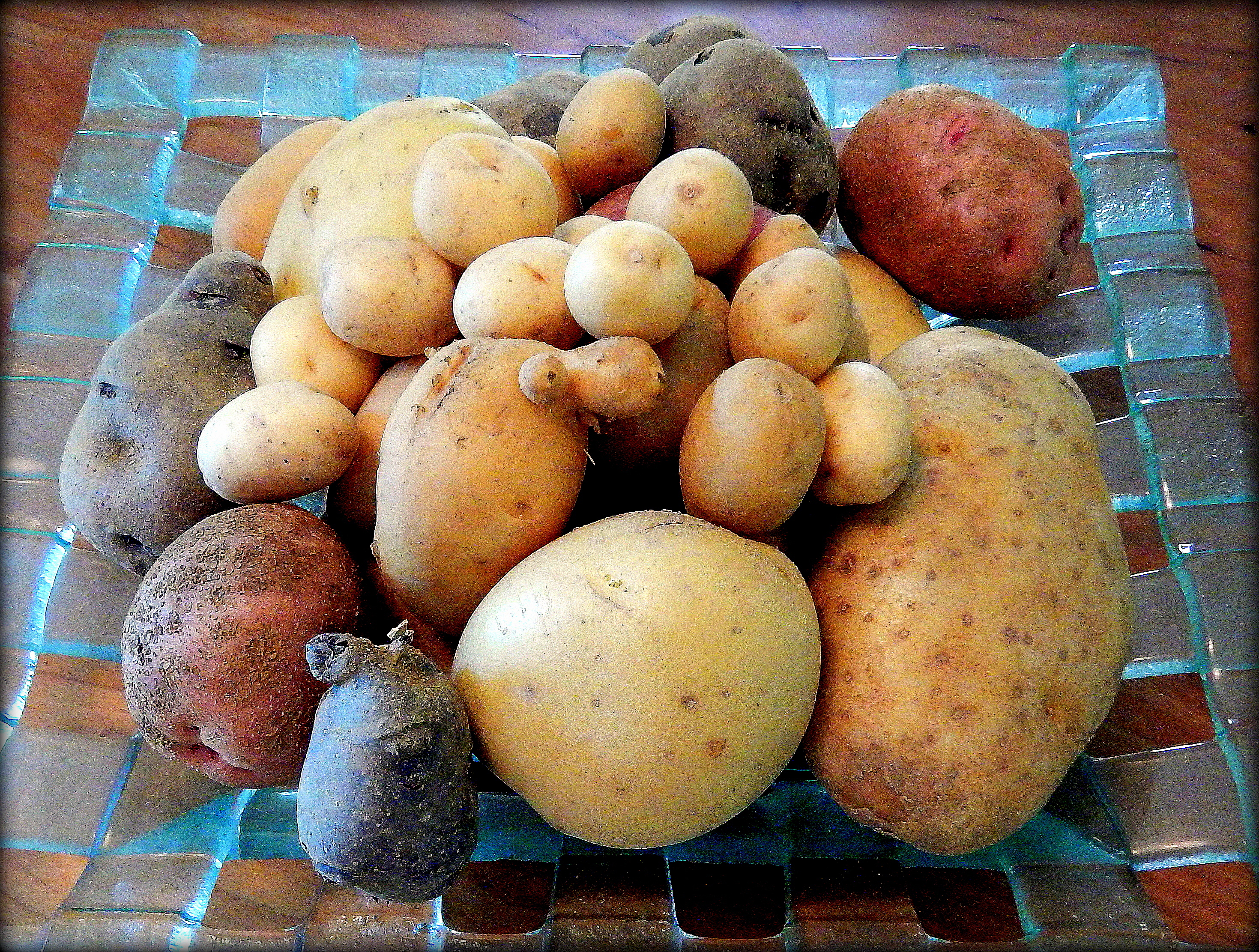
A selection of organic potatoes from both coasts: Idaho and Yukon Gold from California; Honey Gold Nibbles, Gold Marbled Fingerlings, Purple Peruvian, and Adirondack Red potatoes from the Mid-Atlantic area. There are over a hundred varieties available. The petite type are growing in popularity (quick to cook, creamy in texture) as a substitute for pasta (photo by the author)
Not surprisingly, the Smithsonian does not treat the subject as small potatoes. In most, if not all, of the twenty-one separate libraries in the Institution, information on some aspect on the history and culture of the potato can be found. So what better way to celebrate the potato (Solanum tuberosum) and find its relevancy than by digging into some of Smithsonian Libraries’ holdings that tell its rich story? From the Anthropology, American Indian, Natural History, Horticulture and Botany libraries, the trade literature and cookery collections of American History, and, of course, Special Collections, all have original and secondary sources for an (almost) complete picture of this highly significant plant.

Archaeological research finds that the potato was first domesticated from wild plants on the shores of Lake Titicaca in the Andes. With sophisticated agricultural technology, including raised field terraces and irrigation systems, Pre-Inca cultures came to thrive on huge yields of the crop. The Inca Empire relied on potato storehouses, including a freeze-dried product (chuña) that could hold for years, in times of crop failures. Pedro de Cieza de León, explorer and historian, described the cultivation and cooking in his Chronicles of Peru, in 1540. Spanish conquistadors, who largely destroyed the Inca civilization, brought the potato across the Atlantic. Early accounts are a bit murky with the confusion between white (papas) and sweet potatoes (batata), but they were cultivated on the Canary Islands from 1565 and then onto the mainland of Spain.

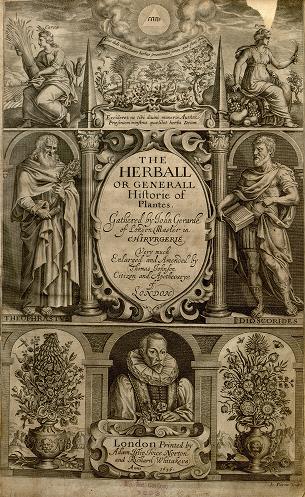
John Gerard, The Herball, or, Generall historie of plantes (Imprinted at London by John Norton, 1597). The Biodiversity Heritage Library has digitized the copy in the Peter H. Raven Library, Missouri Botanical Garden.

John Gerard, The Herball, or, Generall historie of plantes (Imprinted at London by John Norton, 1597). There had been an earlier written description (but with no illustration) of the plant in Gaspard Bauhin’s Phytopinax of 1596. The Dibner Library of the Smithsonian Libraries has this first edition of Gerard. The Biodiversity Heritage Library has digitized the copy in the Peter H. Raven Library, Missouri Botanical Garden (pictured here).
Potatoes were being grown in London not long afterwards. The first printed pictures of the potato plant appear in woodcut illustrations in John Gerard’s great Herball of 1597. Gerard, who grew the plants in his own garden, misidentifies the origin of the potato as Virginia. It was not introduced into North America until the 1620s when the British governor of the Bahamas sent the tuber, along with other vegetables, to the Jamestown colony in Virginia. However, Derry, New Hampshire claims the first potato patch in North America, planted in 1719 when Scot-Irish immigrants settled in the area.
mobot31753000817756_0001
The 1636 edition of Gerard's Herball. The author holds a spray of potato flowers in the illustrated title page of the book, seen in the bottom center, just above the imprint. The Cullman Library of the Smithsonian has two copies; this image is from the scanned copy in the Peter H. Raven Library of the Missouri Botanical Garden (from the catalog of the Biodiversity Heritage Library).
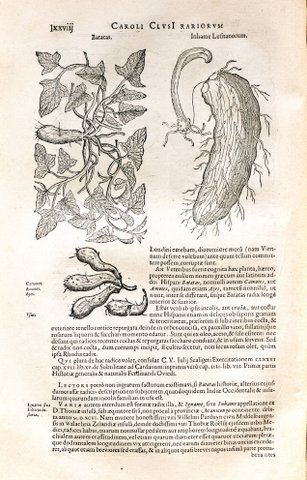
From England, the potato moved to France and then on to the Netherlands. Carolus Clusius (or Charles de l’Ecluse) introduced the potato to the Low Countries. Woodcut illustrations are in his Rariorum plantarum historia (The history of rare plants; Antwerp, 1601). Because potatoes were a good source for preventing scurvy on long voyages, they were distributed via shipboard provisions to the far reaches of the world in the age of exploration. Potatoes also lessened the effects of tuberculosis, measles and dysentery. But the tuber became stigmatized as it moved from the exclusive botanical gardens of the wealthy in the 17th century, when it was thought to be poisonous and fit only for livestock or the truly indigent.

Clusius1601detail
Clusius' Rariorum plantarum historia (Antwerp, 1601). Images of the white and the sweet potatoes (above and below) from the scanned copy in the Peter H. Raven Library of the Missouri Botanical Garden by the Biodiversity Heritage Library (link). The Smithsonian's Cullman Library also has the title.
ClusiusBata.
Clusius also created the first European representation of the potato, a lovely watercolor of 1588 of a plant in his garden. The work of art, with a note written by Clusius, is now in the Plantin-Moretus Museum in Antwerp (link here).
In Europe and Russia during the second half of the 18th century the potato was vigorously promoted to lessen the economic distress of successive disastrous harvests of corn and wheat. Various groups and individuals produced pamphlets and books to educate and extol the crop’s virtues, such as the Society for the Encouragement of Arts, Manufactures and Commerce, and military pharmacist and agronomist Antoine Augustin Parmentier. An example is Memoria sopra I pomi di terra (Memoire on the potatoes) of 1767, an Italian translation of a French publication (Dibner Library) that discusses varieties and cooking methods.

In France, the tuber was particularly regarded as a poor person’s food. Sadly, the Smithsonian Libraries does not own a copy of the important Parmentier work, Examen chimique de la pomme de terre (Chemical examination of the potato, 1778). He was so successful in his efforts that some still believe he invented the potato, and there are many dishes named for him, such as the casserole of veal chops Ă  la Parmentier.

By the 19th century, the potato was common and so prevalent that historians debate its exact role in fueling the population explosion of the period. The food stuff also was being put to other uses, such as in alcoholic spirits. John Ham’s The theory and practice of brewing, from malted corn and from potatos (London, 1829), is one such treatise. There are many gardening manuals in the Smithsonian Libraries that discuss all the types then being developed and best methods of growing and storage. William Cobbett’s The American gardener (London, 1821) has this charming entry:

"Potatoe – Every body knows how to cultivate this plant; and, as to its preservation during winter, if you can ascertain the degree of warmth necessary to keep a baby from perishing, you know precisely the precautions required to preserve a potatoe. – As to sorts they are as numerous as the stones of a pavement in a large city."

But such dependency on a single crop, relied on by a huge population, proved ripe for disaster. This came in the form of late blight disease in the 1840s, which struck hard in Europe and was particularly devastating in Ireland. These catastrophes led to the development of disease-resistant plants, in particular by American horticulturist Luther Burbank who worked to improve the Irish potato; he bred a type in 1872 that established the Idaho potato. These new varieties led to even more potato dominance in food production and plantings around the world. It is a story likely to play out again with climate change, as scientists work to develop cultivars even more resistant to heat, drought and disease. To lessen pollution and water use and help feed its exploding population, China is now by far the largest producer of the staple in the world. Will the potato once again save some parts the world? (see Zuckerman, Larry. The potato: how the humble spud rescued the western world. Boston, 1998 and this Wikipedia entry on the subject).
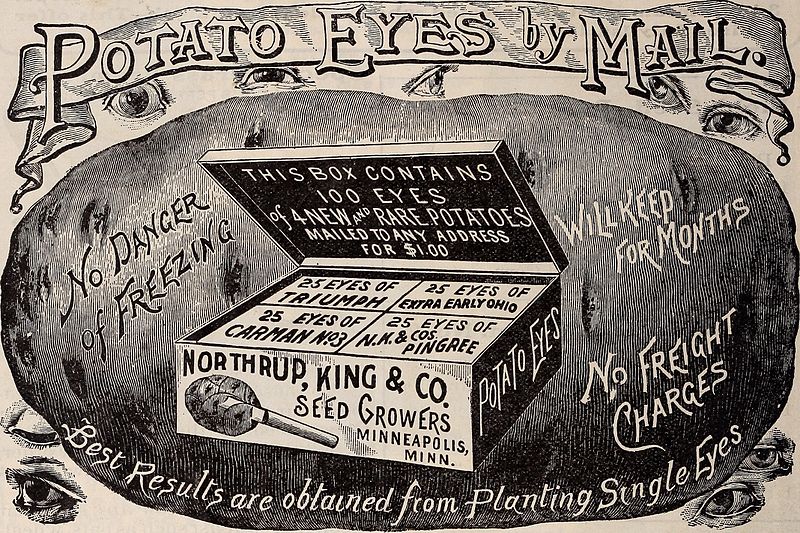
"Good seeds at fair prices": trade literature of 1902 from Minneapolis, Minnesota (image from Wikimedia Commons)
"Good seeds at fair prices": National Museum of American History Trade Catalogs of 1902 from Minneapolis, Minnesota (image from Wikimedia Commons of the copy in the National Agricultural Library)
The extensive agricultural trade literature collections in the Smithsonian illustrate the trends in the potato’s popularity and dominance into the 20th century (one example linked here). The evolution of the vegetable as source of sustenance to a snack food is also traced in the Libraries’ culinary holdings. Thomas Jefferson had "potatoes served in the French manner" at a White House dinner in 1802 (not, strictly speaking, and contrary to the myth, the French fry). A relative of Jefferson’s, Mary Randolph, had seven recipes for potatoes, including one “to fry sliced potatoes” in her book, The Virginia house-wife, or, Methodical cook. The Dibner Library holds the fourth edition of this important cookbook, published in 1830. The Russet Burbank potato, developed in the 1920s, long, regular with a high sugar content, is the hybrid ideal for French fries. Speaking of which, France and Belgium are still arguing over who invented “French fries.”

An artist book in the collections: French fries : a new play, written by Dennis Bernstein, Warren Lehrer ; designed by Warren Lehrer, 1984.
This short history, centered on the Smithsonian Libraries collections, merely skims the surface of the potato. So even if you tend to avoid white potatoes in your diet, pick up one of the many, many accounts of the spud to read or raise a fork to the potato this month and celebrate this small vegetable’s big history in the world. In the words of Winnie-the-Pooh creator A. A. Milne: “What I say is that, if a fellow really likes potatoes, he must be a pretty decent sort of fellow” (“Lunch” in Not that it matters, 1919).

Julia Blakely
Special Collections Cataloger
Smithsonian Libraries 

Potat-19
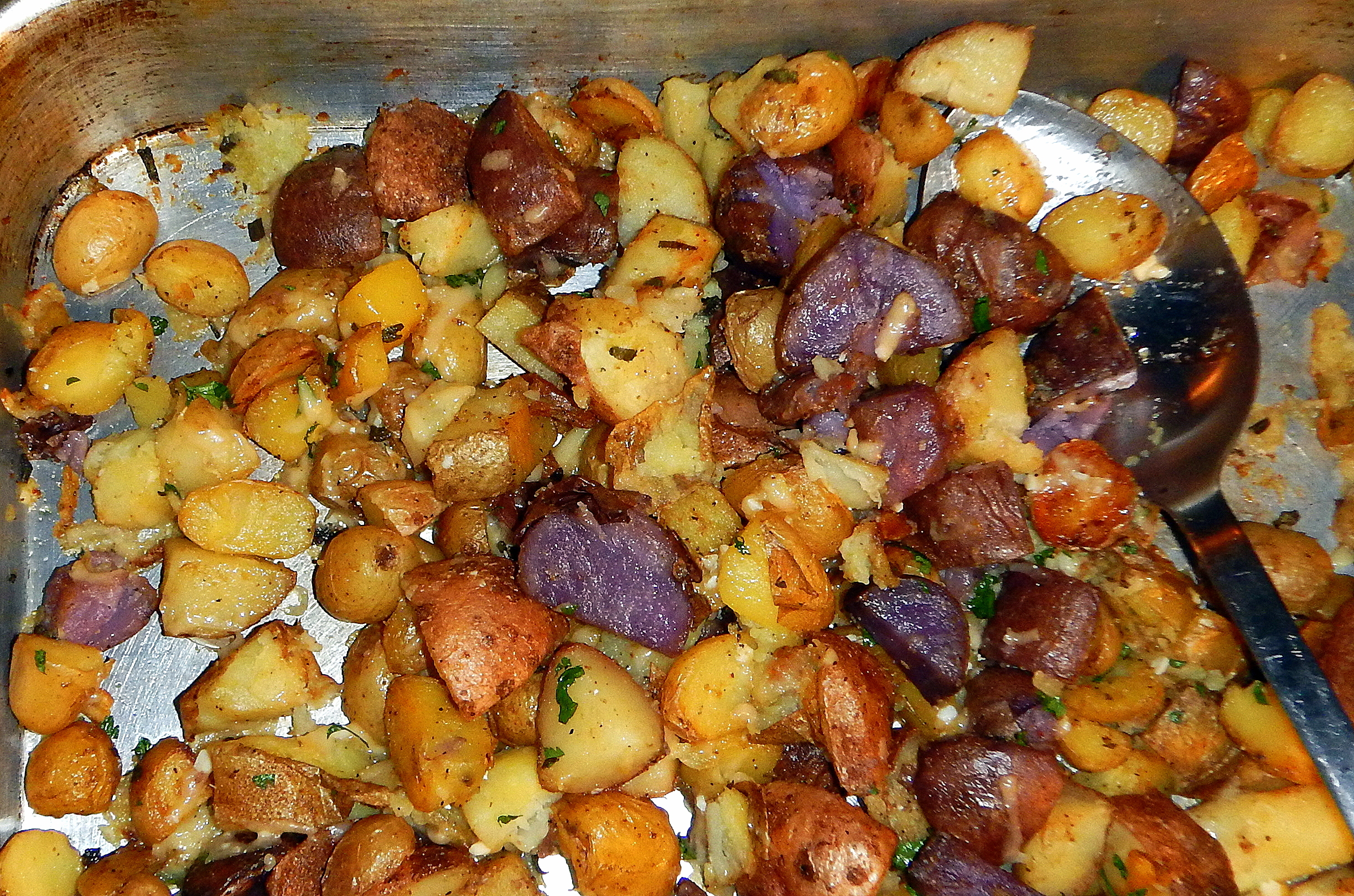
An excellent dish for the month: Rainbow Potato Roast.


For further reading:

Chilies to chocolate: food the Americas gave the world. Tucson, 1992.
Hawkes, J. G. The potatoes of Argentina, Brazil, Paraguay, and Uruguay: a biosystematics study. Oxford, 1969.
Ochoa, Carlos M. Las papas de SudamĂ©rica. Lima, PerĂș, 1999.
Salaman, Redcliffe N. The history and social influence of the potato. Cambridge, 1985.

Potat-13
Well, if you are going to have bacon with your potatoes, might as well have sour cream as well. Photo by the author but the  great recipe and story from the New York Times.