Smithsonian Collections Blog

Highlighting the hidden treasures from over 2 million collections

Collections Search Center
Showing posts with label Ernst Herzfeld Series. Show all posts

Thursday, October 29, 2015

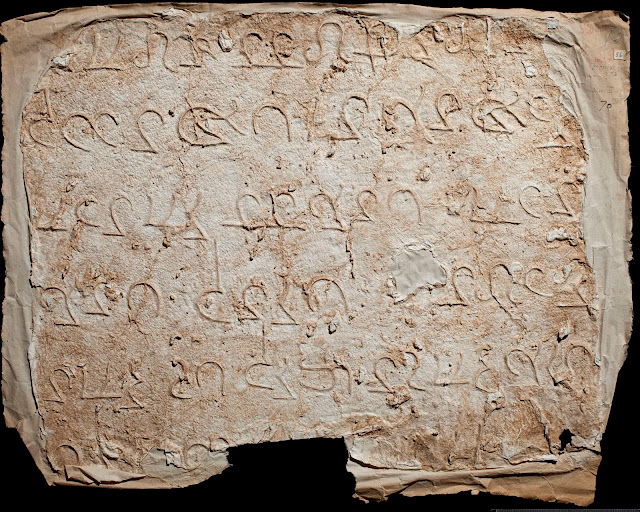
Throwback Thursday: Squeeze Making

Blogs across the Smithsonian will give an inside look at the Institution’s archival collections and practices during a month long blog-a-thon in celebration of October’s American Archives Month. See additional posts from our other participating blogs, as well as related events and resources, on the Smithsonian’s Archives Month website.

With the abundance of technology that surrounds us every day, it’s easy to forget how we ever got along without it. Never fear, archives are here to help answer this and many more questions! For example, how did archaeologists capture and render a three-dimensional image in the early 20th century? We’re glad you asked. Before the invention of 3-D scanners and printers, there were squeezes.


A squeeze is a series of moldable paper, pulp, latex, or plaster that are layered on top of each other and moistened to create a wet pulp. The substance is then pressed, into a low relief inscription. When the material is dry and removed, it becomes a multidimensional mirror-image representation of the original inscription.

The images shown here are from the Ernst Herzfeld Papers housed in the Freer Gallery of Art and Arthur M. Sackler Gallery Archives. The Archives holds 393 squeezes from the ancient Near East, the largest collection outside of Iran and Iraq. To learn more, visit the Squeeze Imaging Project.

Chelsea Fairley
Freer|Sackler Archives

Wednesday, March 4, 2015

Renewed Exposure to the Presence of Africans in Persia: Digitizing the Collections of Antoin Sevruguin Photographs in the Archives of the Freer|Sackler

This second of two blog posts was written by Xavier Courouble, cataloger of the collections of Antoin Sevruguin Photographs and the Ernst Herzfeld Papers at Freer Sackler Archives, Smithsonian Institution.  This post explores the presence of individuals of African descent at religious events in Qajar Iran.


Groups of Attendants at a Religious Gathering.
Antoin Sevruguin (d. 1933). Albumen print taken before 1896. Myron Bement Smith Collection of Sevruguin Photographs. Freer Gallery of Art and Arthur M. Sackler Gallery Archives. Smithsonian Institution, Washington D.C.
(FSA A2011.03 B.09).
Africans in Shiite Rituals during the Qajar Dynasty

The three photographs, taken by Antoin Sevruguin at the beginning of the twentieth century, depict a private performance and a large public procession, annually held during the first ten days of Moharram, the first month of the Islamic calendar. They are part of the mourning ceremonies of Moharram, commemorating the martyrdom of Imam Hosayn at Karbala in 61 AH/680 CE and reaching their climax on the tenth day of the month (Ashura). Expression of grief during public mourning processions are accompanied by assemblies held in buildings erected for the purpose (hosayniyas or takias), as well as in mosques and private houses. At these assemblies, called rowzeh-khani, professional reciters recount the tragedy at Karbala, curse the enemies, and arouse the emotions of the mourners who respond by congregational singing of dirges. The public mourning processions, held on the tenth day, display the traditional customs of the old time, displaying certain pre-Islamic funerary practices, such as the use of dark colored banners and horses.

The formal group portrait, with an individual of African descent at the center and a master storyteller slightly on the left, holding little folded scripts in the palm of his hand, depicts a traditional setting for a private performance of rowzeh-khani. As witnessed in the photograph, Africans, mostly Abyssinians or Swahilis, did participate in Shia rituals in roles that are still understudied. Yet, according to popular belief, participation in rowzeh-khani ensures participants of all classes of society of intercession by Hosayn on the Judgment Day. In the eyes of the Shiites, Hosayn fought and sacrificed his life for the underdog, the unprivileged, the oppressed, and humiliated. During the Qajar period, the rowzeh-khani sermons, while continuing to recount the tragedy at Karbala, to reflect on its meaning, and to recite elegies in memory of the martyred Imam, had also evolved into a discussion on subjects of discontent including social injustice, political oppression, economic disparities, and social upheaval of the day, making this Shiite commemorative ritual a very important political weapon. The Qajar elites were enthusiastic patrons of Shiite rituals, most notably both the rowzeh-khani and the public Moharram processions. These rituals served to strengthen the bonds of loyalty between the state and its subjects, thus ensuring the Qajar elites a certain degree of religious and political legitimacy.

Gathering of a Large Crowd (probably a Muharram Procession) at the Maydan-i Tupkhana, Tehran (Iran).
Antoin Sevruguin (d. 1933). Glass plate negative taken before 1896. Myron Bement Smith Collection of Sevruguin Photographs. Freer Gallery of Art and Arthur M. Sackler Gallery Archives. Smithsonian Institution, Washington D.C.
(FSA A.4 2.12.GN.50.05).

The African Presence in Qajar Iran

In these three Sevruguin photographs, the almost invisible presence of individuals of African descent provides an opportunity to examine the sources, destinations, and existence of Africans in Iran and the Persian Gulf. According to Mirzai Behnaz, for centuries, Africans were drawn in small numbers at one time or another from the interior region of East Africa, forming a small percentage of the country’s multi-ethnic enslaved population. The sea trade route of the Indian Ocean significantly facilitated the transport of a large number of Africans from the Swahili coast to Muscat and Sur from where they were eventually carried into the Ottoman Empire, the Arab States, and Iran. Pilgrims were
also bringing enslaved peoples through western and southwestern Iran from the Arabian cities of Baghdad, Karbala, Mecca and Medina.

The majority of enslaved Africans mostly served as pearl fishers, agricultural laborers or domestics. A small number were conveyed from southern ports to the interior and were absorbed in different urban areas and socioeconomic sectors. They were mainly employed as domestics. Some were engaged in specific tasks in the harems of Shahs and princes. Among them, one group consisted of eunuchs who served at the court of the Shah. Another group of Africans was engaged in the royal army as confidential household troops or guards of princes, called ghulam-1 Shahi.

During the Qajar dynastic period (1795-1925), African men, women and children were brought to Iran in greater numbers than the country had ever witnessed. Aristocratic and wealthy families
incorporated domestic slaves into their household as both investments and symbols of prosperity. Additionally, economic forces driven by the expansion of foreign trade in the south and commercial farming innovations in the south-eastern provinces gave rise to the need for new sources of slave labor. The development of the trade in enslaved Africans was given religious justification by some in Islamic societies on the grounds of the need to convert a large number of Africans in Islam. Enslaved people were considered to be part of the household, and since Islam opened many ways for their emancipation they could gradually be absorbed into the society, therefore leading to the formation of diasporic communities of Afro-Iranians along the shores of the Persian Gulf from the southwest to the southeastern parts of Iran.

Ashura Reenactment Procession.
Antoin Sevruguin (d. 1933). Glass plate negative taken before 1896. Myron Bement Smith Collection of Sevruguin Photographs. Freer Gallery of Art and Arthur M. Sackler Gallery Archives. Smithsonian Institution, Washington D.C.
(FSA A.4 2.12.GN.21.03).

ONLINE RESOURCE
- AFRICANS IN PERSIA, photographs taken by Antoin Sevruguin, from the collections of Sevruguin photographs at National Anthropological Archives and the Archives of the Freer Gallery of Art and Arthur M. Sackler Gallery , Smithsonian Institution, Washington, D.C.
- IRAN IN PHOTOGRAPHS, an online exhibition part of the Archives of the Freer Gallery of Art and Arthur M. Sackler Gallery , Smithsonian Institution, Washington, D.C.
- SEVRUGUIN RESOURCE PAGE, Archives of the Freer Gallery of Art and Arthur M. Sackler Gallery , Smithsonian Institution, Washington, D.C.
- MYRON BEMENT SMITH COLLECTION OF SEVRUGUIN PHOTOGRAPHS, Archives of the Freer Gallery of Art and Arthur M. Sackler Gallery , Smithsonian Institution, Washington, D.C.
- STEPHEN ARPEE COLLECTION OF SEVRUGUIN PHOTOGRAPHS, Archives of the Freer Gallery of Art and Arthur M. Sackler Gallery , Smithsonian Institution, Washington, D.C.
- JAY BISNO COLLECTION OF SEVRUGUIN PHOTOGRAPHS, Archives of the Freer Gallery of Art and Arthur M. Sackler Gallery , Smithsonian Institution, Washington, D.C.
- SAILORS AND DAUGHTERS: EARLY PHOTOGRAPHY AND THE INDIAN OCEAN, an online exhibition part of the Smithsonian National Museum of African Art’s programming for Connecting the Gems of the Indian Ocean: From Oman to East Africa.


BIBLIOGRAPHY
- AYOUB Mahmoud, Ashura.  Encyclopædia Iranica, Vol. II, Fasc. 8, pp. 874-876, an updated version is available online at http://www.iranicaonline.org/articles/asura (Originally published: December 15, 1987).
- BETTERIDGE Anne, Festival III: Shi'ite.  Encyclopædia Iranica, Vol. IX, Fasc. 5, pp. 550-555, an updated version is available online at
http://www.iranicaonline.org/articles/festivals-iii-iv-v (Originally published: December 15, 1999).
- CALMARD Jean, Azadari.  Encyclopædia Iranica, Vol. III, Fasc. 2, pp. 174-177, an updated version is available online at
http://www.iranicaonline.org/articles/azadari (Originally published: December 15, 1987).
- CHELKOWSKI Peter, Ta'zia.  Encyclopædia Iranica, an updated version is available online at
http://www.iranicaonline.org/articles/tazia  (Originally published: July 15, 2009).
- JAFRI Syed Husain Mohammad, The Origins and Early Development of Shi'a Islam, Oxford: Oxford University Press, 1979. See preview here
- KHOSRONEJAD Pedram (Ed.), Women's Rituals and Ceremonies in Shiite Iran and Muslim Communities: Methodological and Theoretical Challenges, Berlin, Germany: Lit Verlag Dr. W.

Hopf, 2015. See preview here
- MOMEN Moojan, An Introduction to Shi'i Islam: The History and Doctrines of Twelver Shi'ism, New Haven, CT: Yale University Press, 1985. See book review here
- PLESSNER Martin, Al-Muharram, Encyclopædia of Islam. Vol. 7, second edition, Leiden, The Netherlands: E. J. Brill, 1993.


Friday, February 20, 2015

Renewed Exposure to the Presence of Africans in Persia: Digitizing the Collections of Antoin Sevruguin Photographs in the Archives of the Freer|Sackler, The Smithsonian’s Museum of Asian Art

This is the first of two blog posts written by Xavier Courouble, cataloger of the collections of Antoin Sevruguin Photographs and the Ernst Herzfeld Papers at Freer Sackler Archives, Smithsonian Institution. This post explores the presence of individuals of African descent at the royal court of Qajar Iran.


Nasir Al-Din Shah and his Eunuchs.
Antoin Sevruguin (d. 1933). Glass plate negative taken before 1896. Myron Bement Smith Collection of Sevruguin Photographs. Freer Gallery of Art and Arthur M. Sackler Gallery Archives. Smithsonian Institution, Washington D.C. (FSA A.4 2.12.GN.51.02).

The group portrait photograph, taken by Antoin Sevruguin at the end of the nineteenth century shows Nasir al-Din Shah Qajar (ruled 1848-1896) among several of his personal attendants, many wearing the eunuch’s uniform, a high fur-skin hat and a long, loose robe over the trousers. Under Nasir al-Din Shah, the royal eunuchs, dominated by eunuchs of African descent, enjoyed power and wealth. Some of them obtained villages and lands belonging to the royal domain. Haji Sarvar Khan I'timad al-Harem, standing to the right of Nasir al-Din Shah, initially included in an imperial gift, held the eunuch most coveted position of chief of the royal harem from 1887 until Nasir al-Din’s Shah’s assassination in 1896. In that position Haji Sarvar Khan held the keys to the royal quarters and the harem doors. He controlled the other eunuchs of the royal harem, a total of 38 in 1887, and was an intermediary between the court officers and high ranking dignitaries, the royal women, and the shah himself. After 1896 he went to Tabriz to become Muhammad Ali Mirza's (the crown prince) head of the harem's eunuchs.

Nasir Al-Din Shah Supervising a Banquet for Ashpazan.
Antoin Sevruguin (d. 1933). Glass plate negative taken before 1896. Myron Bement Smith Collection of Sevruguin Photographs. Freer Gallery of Art and Arthur M. Sackler Gallery Archives. Smithsonian Institution, Washington D.C. (FSA A.4 2.12.GN.17.02).

 Nasir al-Din Shah's Intimate Relationship with the Royal Attendants

Born July 17, 1831 in Tehran, Nasir al-Din Shah, a younger son of Mohammad Shah, was named heir apparent of the Qajar dynasty through the influence of his mother, Malik Jahan. According to Abbas Amanat, in his early years, Nasir al-Din received only a haphazard education, largely isolated from the outside. He was confined to his mother’s residential quarters, where a host of eunuchs, maids, and playmates compensated for the noticeable lack of parent care. An Abyssinian eunuch, Bashir Khan, a purchased slave of Malik Jahan, was in charge of overseeing the prince’s affairs. Bashir, like other black eunuchs in the Qajar harem, was treated with a peculiar mixture of awe and intimacy. He was a capable manager whose severe side was complemented by a sentimental, sometimes childish temperament. Later on, when he became the Shah’s chief eunuch, Bashir took pride in his personal attendance to Nasir al-Din over the years. By contrast, a combination of gratitude, pity, and old grudges best characterized Nasir al-Din’s ambivalent attitude toward his eunuch. Bashir was executed under order from Nasir al-Din in 1859 in an outburst of kingly rage! Intimacy with maids and servants and their children, who often were his playmates, may explain Nasir al-din’s unreserved reliance in later life on the servant class. It was this class that first introduced him to the outside world and taught him values of friendship and loyalty. In a society accustomed to treating children as miniature adults, princes even more than other children were in need of moral support to take them through the difficult passage of early adulthood. The sheer political demands on Nasir al-Din to behave majestically, particularly when his apparency was perpetually under question, required that he adopt a mask of solemnness and gravity that could only be put aside in the private company of his attendants. This self-imposed façade of grandeur, so characteristic of Nasir al-Din Shah’s public life, was a defense mechanism painfully developed in his childhood and rehearsed in the privacy of his inner court to conceal his shyness and vulnerability.

Standing Portrait of Nasir Al-Din Shah.
Antoin Sevruguin (d. 1933). Glass plate negative taken before 1896. Myron Bement Smith Collection of Sevruguin Photographs. Freer Gallery of Art and Arthur M. Sackler Gallery   Archives. Smithsonian Institution, Washington D.C. (FSA A.4 2.12.GN.51.08).

The Collections of Antoin Sevruguin Photographs

 The practice of photography was taken up in Iran soon after its invention in Europe, and Nasir al-Din Shah Qajar was an enthusiastic amateur himself. The glass plate negatives were taken by Antoin Sevruguin who, in the late nineteenth century, had fully established one of the most successful commercial photography studios in Tehran, Iran, with ties to the court of Nasir al-Din Shah Qajar. Despite numerous devastating incidents throughout Sevruguin’s career–the loss of more than half of the glass plates in a 1908 blast and fire, and the confiscation by order of the Shah of the remainder of the negatives in the mid-1920’s--695 glass plates negatives survived and were purchased in 1951-1952 from the American Presbyterian Mission in Tehran (Iran) by Myron Bement Smith. Ultimately the Myron B. Smith Papers and his collection of Sevruguin photographs were donated to the Smithsonian Institution in 1973.They are included in the growing collections of Sevruguin photographs in the Freer Sackler Archives.

In Fall 2012, 1,072 photographs were digitized and cataloged from the collection of glass negatives from the Myron Bement Smith Collection, Subseries 2.12: Antoin Sevruguin Photographs; the collection of silver prints purchased by John Upton in 1928 in the Myron Bement Smith Collection, Subseries 2.12: Antoin Sevruguin Photographs; and the collection of albumen prints in the Stephen Arpee Collection of Sevruguin Photographs.

Nasir Al-Din Shah and Court with Bags of Money Owed to the Treasury.
Antoin Sevruguin (d. 1933). Glass plate negative taken in 1890. Myron Bement Smith Collection of Sevruguin Photographs. Freer Gallery of Art and Arthur M. Sackler Gallery   Archives. Smithsonian Institution, Washington D.C.
(FSA A.4 2.12.GN.19.01).

ONLINE RESOURCE

- AFRICANS IN PERSIA, photographs taken by Antoin Sevruguin, from the collections of Sevruguin photographs at National Anthropological Archives and the Archives of the Freer Gallery of Art and Arthur M. Sackler Gallery, Smithsonian Institution, Washington, D.C.
- IRAN IN PHOTOGRAPHS, an online exhibition part of the Archives of the Freer Gallery of Art and Arthur M. Sackler Gallery , Smithsonian Institution, Washington, D.C.
- SEVRUGUIN RESOURCE PAGE, Archives of the Freer Gallery of Art and Arthur M. Sackler Gallery , Smithsonian Institution, Washington, D.C.
- MYRON BEMENT SMITH COLLECTION OF SEVRUGUIN PHOTOGRAPHS, Archives of the Freer Gallery of Art and Arthur M. Sackler Gallery , Smithsonian Institution, Washington, D.C.
- STEPHEN ARPEE COLLECTION OF SEVRUGUIN PHOTOGRAPHS, Archives of the Freer Gallery of Art and Arthur M. Sackler Gallery , Smithsonian Institution, Washington, D.C.
- JAY BISNO COLLECTION OF SEVRUGUIN PHOTOGRAPHS, Archives of the Freer Gallery of Art and Arthur M. Sackler Gallery , Smithsonian Institution, Washington, D.C.
- SAILORS AND DAUGHTERS: EARLY PHOTOGRAPHY AND THE INDIAN OCEAN, an online exhibition part of the Smithsonian National Museum of African Art’s programming for Connecting the Gems of the Indian Ocean: From Oman to East Africa.

BIBLIOGRAPHY

- AMANAT, Abbas, Pivot of the Universe: Nasir Al-Din Shah Qajar and the Iranian Monarchy, 1831-1896, University of California Press, 1997. Abstract available here
- BEHNAZ A. Mirzai, The Slave Trade and The African Diaspora in Iran, Southern Methodist University, Dallas, 2005. PDF file accessible here
- CACCHIOLI, Niambi, Disputed Freedom; Fugitive Slaves, Asylum and Manumission in Iran, 1851 – 1913, in The Slave Route. United Nations Educational, Scientific and Cultural Organization. PDF file Accessible here
- FLOOR, Willem, Barda and Barda-dãri {Slaves and Slavery}, iv. From the Mongols to the Abolition of the Slavery.  Encyclopædia Iranica, III/7, p. 762; an updated version is available online at
http://www.iranicaonline.org/articles/barda-iv (accessed on 27 May 2012).
- MOGHADDAM, Maria Sabaye, African Diaspora in Iran: Zar Ritual and African Cultural Influence. ASA 2013 Annual Meeting Paper. Abstract accessible here
- RICKS, Thomas, Slaves and Slaves Trading in Shi’I iran, AD 1500-1900, in Conceptualizing / Re-conceptualizing Africa; The Construction of African Historical Identity. Edited by Maghan Keita. Leiden; Boston; Koln: Brill, 2002. PDF file accessible here
- SHERIFF, Abdul, The Twilight of Slavery in the Persian Gulf, in  Monsoon and migration: Dhow Culture Dialogues, Zanzibar: Ziff Journal, 2, 2005. PDF file accessible here


Friday, December 30, 2011

Samarra 1911: The End of a Campaign

As taken from Thomas Leisten's book Excavation of Samarra, Volume 1 Architecture. Final Report of the First Campaign, 1910-1912:

*Image Left: Excavation of Sāmarrā (Iraq): Qaṣr al-Āshiq, View of Barrel-Vaulted Serdab from Above, 1911-1913 [graphic].  The Ernst Herzfeld papers. Freer Gallery of Art and Arthur M. Sackler Gallery Archives. Smithsonian Institution, Washington, D.C.
 
On December 3rd, after a long meeting, both [Friedrich] Sarre and Herzfeld decided to end the current campaign as soon as possible and to return in the following year. This decision changed the original plan, which had included a continuation of the campaign and a series of new excavations after Sarre's arrival.  Various reasons can be suggested to explain why the first campaign was broken off prematurely: for on thing, Herzfeld needed some time off to prepare the excavation of the Dar al-Khilafa, the main project for next year.  Furthermore, he recognized the necessity of reviewing the material recovered so far, to eliminate mistakes and to identify problems that could be dealt with during another visit to the site.  Sarre and Herzfeld also agreed that the attempt the transport the stuccos would fail and thus jeopardize both the continuation of the first campaign and their chance at a second. The fragments temporarily stores in the excavation house were not yet in a condition to be transported, and there were no suitable materials in Iraq to produce sturdy and solid frames.  Bartus had even stopped casting copies from stuccos that could not be removed because he lacked fine gypsum and glue, both of which had to be imported from Germany.  Last but not least was Herzfeld's health, which had been constantly deteriorating under the pressure of exhausting work, quarrels with the authorities, and the full responsibility for the success of the project at Samarra.

According to Herzfeld and Sarre, the transportation of casts and originals to Germany had to wait until after the excavations were completely finished. But while an entirely new schedule of the whole project would undoubtedly have caused some trouble, the new plan was to confront Constantinople, i.e. the Directorate of the Imperial Ottoman Museums, with the fait accompli.  Herzfeld therefore contacted Bedri Bey, whose role in this scheme would be either to convince the Director General, Halil Edhem Bey, to call a temporary halt to the campaign or, even better, to give the official order himself to the Germans to stop the current campaign and inform Constantinople of what had happened only afterward.  Sarre, Herzfeld, and Bedri Bey came to the conclusion that it would be safer to follow the latter plan.

During the first week of December 1911, Herzfeld was still working on the western bank. He finished the leveling of Qasr al-Ashiq and made some test soundings within the palace to clear doors and to determine the extent of the main T-shaped hall.  At the same time he had another clearing made on the riverbank below the palace.  Pottery and debris there indicated  large settlement connected with the palace.  Subsequent to the final investigation at the Qasr al-Ashiq he conducted a reexamination of the central domed chamber of the Qabbat al-Sulaibiyya.  Here, three burials were brought to light that he immediately interpreted as three of the 9th century A.D. caliphs of Samarra.

*Image Right: Excavation of Sāmarrā (Iraq): Unglazed Ceramic Vessel, Found in the Qaṣr al-Āshiq, 1911-1913 [graphic].  The Ernst Herzfeld papers. Freer Gallery of Art and Arthur M. Sackler Gallery Archives. Smithsonian Institution, Washington, D.C.

Only now, during the last two weeks of the first campaign in Samarra, were Viollet's finds examined. On the last day before he left on the "Astarabadi" steamer, Bartus by chance found a building on the wet side of the Shari al-A'zam that had been scavenged by the locals. The walls were covered with a set of frescoes showing human figures and various animals, the most interesting so far discovered in this campaign.  On December 20th an excursion was made to al-Istabulat where Herzfeld sketched out a rough plan of the palace.  [...]

On December 25th, Bedri Bey arrived at Samarra and drew up an official letter ending the campaign according to the proposal of both Sarre and Herzfeld. An inventory of all the finds and tools was made and they were prepared for storage. 

 *Image Above: Excavation of Sāmarrā (Iraq): Fragments of Ceramic Vessels with Decorative Motifs, Found in the Qaṣr al-Āshiq and in al-Quraina, House VI, West Room, 1911-1913 [graphic].  The Ernst Herzfeld papers. Freer Gallery of Art and Arthur M. Sackler Gallery Archives. Smithsonian Institution, Washington, D.C.

From the Samarra-Archiv Pergamon Museum, Berlin; Ernst Herzfeld's incomplete report on the first campaign:

Considering the vast extent of the ruins, an excavation of Samarra would create a task that could not be brought to an end even within decades of work. But each excavation is an individual case. The different interests by which the site is approached and the local conditions determine the dimension and method of investigation. The latter are quite different when it comes to excavation on Islamic soil in comparison to Babylonian ruins. For my part, the issues of the first campaign appear to have been investigated sufficiently: the excavation in the mosque could be abandoned as soon as the problem with its pier system was solved; the same was true for the exavation of residential buildings as soon as it became clear that the classes of decorative patterns could not be augmented by new groups. The excavation of Balkuwara could be stopped as soon [as] the character of the structure became tangible.


As a task for the second campaign we have two other topics: to investigate the Bayt al-Khalifah, the ancient Djausaq al-Khaqani, the main palace of Samarra, founded by Mu'tasim, which remained the residence of the caliphs until the last days of Samarra. This palace is larger, richer, and more beautiful than any other ruin of Samarra. Based on previous soundings in the right places could reveal more wall paintings, ceramics, and small finds. Sketches of other ruins could be produced - some of them have been made already - that render the types of such structures more clearly.


The second, very work intensive but attractive topic is a meticulous topographic plan of the complete ruin. Its surface is of such quality that - perhaps with the exception of the immediate surroundings of today's city - the course of avenues, narrow streets, and even single hourses can be traced clearly. In addition to this we have in the work of Ya'qubi an ancient, veritable Baedeker of Samarra. The old chronicles recorded the dramatic events that happened in Samarra with so many topographical and cultural details that - if we only had an accurate plan of the ruin fields - we would be enabled to recreate the picture o  the history and culture of this distant past with the liveliness that would not be matched anywhere else, and certainly not in the Islamic world.

Ernst Herzfeld (1879-1948)

Samarra 1911: Squeeze Making and Continued Resistance in Herzfeld's Samarra
Samarra 1911: The Life of an Alleged Spy: Guns, Kissing, and the Excavation of Balkuwara 
Samarra 1911: Excavation of Shabbat al-Hawa, Qasr al-Ashiq, and Qubbat al-Sulaibiyya 
Samarra 1911: Clashes with Authority led to Sabotage 
Samarra 1911: Excavation of the Great Mosque Finishes, al-Quraina Begins
100th Anniversary of the Samarra Excavation by Ernst Herzfeld

Samarra Resource page.

Rachael Cristine Woody

Freer|Sackler Archives

Monday, October 10, 2011

Samarra 1911: Squeeze Making and Continued Resistance in Herzfeld's Samarra

Trouble continues to follow Ernst Herzfeld's 1911 excavation of Samarra.  Even after he negotiates the spy allegations from the last Samarra 1911 segment, he continues to run into resistance from the police, administrative offices, and locals of the area. 

On October 5th and for two weeks following in Manqur, the removal of stuccos from the main iwan at Balkuwara and squeeze making took place for the Jubairiyya (House XVII, later House XIV) and Sur Isa (House IX).  Unfortunately his documentation later in Qatun could not go forward as the earth that had been placed to protect the stuccos against weather and sabotage had been removed by the locals for their plantations. This left the stuccos almost complete ruined from the winter rains.

In early November Herzfeld took measurements of Qubbat al Sulaibiyya and continued to document Qasr al-Ashiq.  Unfortunately trouble continued to plague him in the second week of November when Herzfeld traveled to Imam al-Dur to copy the inscriptions and facades. Thomas Leisten describes the scene in his book Excavation of Samarra, Volume 1 Architecture. Final Report of the First Campaign, 1910-1912: "standing on a ladder 4.5 m above the ground in almost complete darkness, he [Herzfeld] continued copying the characters while and angry crowd yelled at him from below and rattled his ladder.  Apparently he had neglected to show the credentials that would have explained and authorized his mission to those in charge."  Herzfeld had been shaken by this encounter and spent only two more days making squeezes with police protection.

However, his troubles did not end there, as Leisten continues to describe: "[e]ach morning there were new little obstacles: one day the keys for the mausoleum vanished and the next a mob assembled at the mausoleum, incited by a person who would call upon the others to kick the "Christian" out of the shrine."  Leisten continues to explain the police men assigned to protect Herzfeld "wrote secret reports to the Qaimmaqam that they then used to fuel the hostility" of the local crowds.  Herzfeld had to cancel gathering more information on al-Mutawakkiliyya and returned to Samarra to await reinforcements. On November 20th, Fredrich Sarre and Dr. M. Hesse assembled with a committee to investigate the schemes of the Qaimmaqam and two saiyids of al-Dur.

Image: Excavation of Samarra (Iraq): Jubairiyya, House XVI (Bartus House), View of Wall Decoration, 1911-1913 [graphic].  The Ernst Herzfeld papers. Freer Gallery of Art and Arthur M. Sackler Gallery Archives. Smithsonian Institution, Washington, D.C.

Related Posts:
Samarra 1911: The Life of an Alleged Spy: Guns, Kissing, and the Excavation of Balkuwara Samarra 1911: Excavation of Shabbat al-Hawa, Qasr al-Ashiq, and Qubbat al-Sulaibiyya
Samarra 1911: Clashes with Authority led to Sabotage
Samarra 1911: Excavation of the Great Mosque Finishes, al-Quraina Begins
100th Anniversary of the Samarra Excavation by Ernst Herzfeld

Samarra Resource

Rachael Cristine Woody

Freer|Sackler Archives

Wednesday, August 31, 2011

My Summer Vacation is Over When the Interns Leave

The summer is almost over. I know that because I am completely alone in the Archives and after the exodus of 3 interns my productivity rate has dramatically decreased. There are some who refuse to take on interns because the time and effort required to set up projects and supervise them can be significant. Especially in a large federal institution where massive quantities of paperwork are required before access can be granted. And it's true. It probably takes me several weeks get an intern badged, introduced to the Archives, and started on their project. It then takes a further periodic investment of time to supervise the work they are producing and to mentor them. But, I feel the initial cost of set up is greatly off-set when projects have been completed and products created that otherwise would have taken me years to get to.

This summer I somewhat unexpectedly, (and in retrospect, ambitiously) took on 3 interns. It took about a month to get their various schedules down and the kinks in their projects worked out, but in the end what they accomplished is truly impressive.

Megan Quint came to us from the Pacific NW, where she attends Lewis and Clark.  Megan is interested in pursuing archives or libraries and did a split summer internship between the Freer|Sackler Archives and the Library.  For the Archives she spent the majority of her time researching the Archives' smaller collections and wrote reflective pieces highlighting them on the blog.  To see the first sample of her work, check out "Russell Hamilton's Postcard Collection: Pragmatic or Romantic?"

Kelsey Jansen van Galen just finished her MLIS at Wayne State University and applied for an internship at the Walters Art Museum of Baltimore.  As the F|S Archives and the emerging Walters' Archives have a friendly relationship, Kelsey was able to do a two week intensive internship here where she used her EAD skills to encode two massive finding aids with box and folder lists that totaled over 300.  You can read more details of her work here: "Two Weeks in the Freer|Sackler Archives: an EAD Adventure."

Lastly, Beatrice Kelly is a return intern who has just graduated High School and is on her way to an art history program through the University College, London.  Beatrice spent seven weeks researching thousands of items in the Ernst Herzfeld papers to determine and catalog geographical plot-points for each item so that they can show up in our map interface.  By using original maps in the collection, articles and books written on the region, and working with Archives and Curatorial staff she established the most accurate site and buildings possible for each item.  She then worked with the Google Maps application to determine the exact latitude and longitude for each ancient building at each archaeological site.  In the end, Beatrice researched and entered plot-points for 85 different ancient cities into over 2500 records.  You can read more about this project here: "New Freer|Sackler Archives Image Galleries."

As you can see, even though having multiple interns took a large investment of my time, as a result I have several blog posts highlighting our collections, two finding aids to major collections, and several ancient cities cataloged down to a building level for 2500 items.  There is no way I would have been able to get to all of these projects, let alone focus on them long enough to complete them in three months.  What's more is that I was able to mentor them, share my knowledge and experience, help them make connections, and share in their joy and sense of accomplishment.  That alone, I find, is worth the investment.

To read more on my thoughts on how to utilize interns, see this post: The Thing About Interns Is...


Rachael Cristine Woody
Freer|Sackler Archives

*Image:
"School Children in Front of NMNH," Negative Number: SIA2009-2125 and SIA-1269
Institutional History Division, Smithsonian Institution Archives, 600 Maryland Avenue, S.W., Washington, D.C. 20024-2520, SIHistory@si.edu

Monday, July 25, 2011

Digitization Project Brings Ancient Near Eastern Inscriptions into 21st Century

*Image:   Detail of a cuneiform squeeze. Ernst Herzfeld papers, Freer Gallery of Art and Arthur M. Sackler Gallery Archives.

"The Freer Gallery of Art and the Arthur M. Sackler Gallery Archives announces a new 3-D digital resource that will enable scholars and the public to learn more about the ancient Near East through a unique group of pressed-paper molds called squeezes. This resource provides unparalleled access to the archives' collection of squeezes from ancient Near Eastern archaeological sites."


What is a Squeeze?
The Freer Gallery of Art and the Arthur M. Sackler Gallery Archives (Freer|Sackler Archives) holds a significant collection of 393 squeezes; the largest outside of Iran and Iraq. A squeeze is a series of sheets of paper that are layered on top of each other and moistened to create a wet pulp. This substance is pressed upon the inscriptions of ancient monuments, creating a paper mold and capturing the impressionistic writing for a 3-dimensional negative effect. (See the Squeeze Making tab for more information). The captured inscriptions were often carved on commissioned temples, civic buildings and statues to record battles won, titles acquired or the lineage of kings.

Squeeze Collection
The squeezes in the F|S Archives' Ernst Herzfeld papers date from 1911-1934. The materials used to create squeezes range from very high-grade, robust paper to low-grade cigarette paper. Over time, the squeezes have been transported around the world, handled and stored in less than ideal conditions, and have suffered from various issues that affect all paper products. The squeezes contain Arabic script, Middle Persian, and Cuneiform impressions from archaeological sites: Bastam, Isfahan, Rayy, Samarra, Shiraz, Sunghur, Taq-i Bustan, Tus, Sarpul, Pasargadae, Persepolis, Naqsh-i Rustam, and Paikuli. The Herzfeld papers have been vital in the research of these sites, and the squeezes he created for temporary reference have helped scholars access information from monuments that for many reasons may no longer be available. (Caption for this image below).

Unreachable Inscriptions and Unreadable Squeezes
Three and a half years ago the F|S Archives hosted a team of international archaeologists to research the ancient Paikuli site of Iraq.  Due to a complicated situation, the team's access to the archaeological site and Sassanian Monument was no longer an option.  Aware of Ernst Herzfeld's research, the archaeologists traveled to DC to spend two intensive weeks pouring over the 170 Paikuli squeezes in the collection.  Unsure of when they could return, they requested reference images for further research. We took snapshots of the squeezes for them, but  couldn't help regretting the illegibility of many of the squeezes from poor materials and weathered inscriptions.  As we switched the squeezes over we stumbled upon an interesting discovery - the readability of the inscriptions increased at certain angles of lighting.  Realizing there must be potential behind this, I endeavored to find a way to make the ancient inscriptions more readable and reachable.

Squeeze Inventory
An inventory was the first major step in preparing to undertake a digital imaging preservation grant project. Over three months an intern conducted an inventory noting the physical conditions of the drawings, maps and squeezes in the collection.  With this initial inventory I was able to roughly discern: how many squeezes we had, from which archaeological sites, in which scripts, and in what dimensions. 

Identifying Technology and an MCI Partnership
The Freer|Sackler Archives performed initial feasibility testing with several multi-dimensional imaging tool and strategies.  Reflective Transformation Imaging (RTI) resulted in the most consistent and highest quality scans for the flat-nature, yet 3-D qualities of the squeezes.  We identified that the Museum Conservation Institute of the Smithsonian as a knowledgeable tester of RTI technology, and found that MCI was interested in partnering with a collection entity to further their efforts in the technology. Together, we sought funding to acquire equipment that would benefit all Smithsonian units, and hire a skilled contractor to image the squeezes and create a web resource.

Funding
In 2010, the Freer|Sackler Archives received a grant from the Smithsonian Institution's Collections Care and Preservation Fund to aid in the preservation of the squeezes and the 3-D information they contain. The project would result in the creation of a digital preservation surrogate for each squeeze available via the Squeeze Imaging Project web resource.

Packing Squeezes
The first part of the project was the practicality of safely packing and transporting the squeezes to MCI in Maryland for imaging. The squeezes varied in levels of physical stability due to the materials used and previous storage conditions.  An added level of difficulty was the varying sizes of the squeezes; many of which measure longer and wider than the table image to the left.  After consulting with the F|S Conservation Department's paper conservator, we settled on packing the squeezes in black museum cases, contained in folders, and secured with foam cushioning.


Squeeze Imaging Project - Web Resource
The final product was compiling all of the squeeze RTI images into an easy to use web resource.  Each site is listed on the right-hand side, and allows further breakdown of the site by script or language type.  Once a script option is selected all squeezes display for that area accompanied by a link to the MARC records containing all the known information for the selected squeeze.  (See Paikuli site example to the right; click on each script option at the top of the picture to see digitized squeezes for that selection).


Squeeze Viewing Tool
In addition to protecting the squeezes from further damage, RTI allows the end user to manipulate the image and enhance the squeeze's readability. Scholars will be able to find intellectual and physical information that was previously not known to exist or had been lost. This will allow researchers to learn more from the digital images than they could from the physical object. These images provide unprecedented access to ancient histories, delivered from the cradle of civilization to the homes of scholars and enthusiasts alike.

Please read the Technical Note for more information on RTI technology and how to view the squeezes, as well as the Archival Note for further details on the project.

Related Post:
3d Imaging to Unlock Ancient Mysteries

*Image above for Squeeze Collection is from the Ernst Herzfeld papers, "Naqshi-Rajab." I selected this image because in the center it shows squeezes laying out on a rock to dry.

Wednesday, July 13, 2011

Excavations in the Freer|Sackler Archives

 Presenting Archival Resources to an International Community


Presenting archival resources to a targeted scholarly community was the ultimate goal the Archives had set out to achieve.  The Ernst Herzfeld project initiative began in early 2009 when the collection was identified as an institutional priority.  With that mandate, the Archives worked with several departments within the Freer|Sackler to secure grants to help with the preservation, digitization, cataloging and creation of web resources.  The project's content, scope, and importance led itself to be a natural collaborative endeavor, allowing for the Archives to work with Conservation (including the Museum Conservation Institute), Curatorial, Design, Development, Director's Office, Scholarly Programs and Publications, and Web.

Now, two years into the project the Freer|Sackler has a lot to show for our collaborative efforts even though we are only halfway through the Herzfeld papers.  On July 1st, 2011 Ancient Near East curator Alexander Nagel and myself co-presented on the archival resources that we built up over the last two years for the Ernst Herzfeld papers.  We were honored to be invited by the Museum fur Islamische Kunst of the Pergamon Museum in Berlin, as they held an Ernst Herzfeld colloquium on "100 Years of Excavations in Samarra."  If you're a regular reader then you are familiar with the Freer|Sackler Archives' efforts to acknowledge and celebrate the 100th Anniversary of the Samarra excavations by highlighting the recently digitized records and online web resources.

Alex gave the first half of the presentation by contextualizing the current predicament facing both art and archival items related to the infamous German archaeologist, Ernst Herzfeld. Essentially any of the Herzfeld object finds and his records were dispersed among the international museum community dependent on his current relationship with them and financial need.  Now, almost 100 years later, the museums and scholarly community are trying to piece together the art with their provenance history; a job that's not easy when many of the Ernst Herzfeld papers are not readily accessible across disparate museums and archives.

My half of the presentation was focused on the work that the Freer|Sackler Archives has been doing that presents a possible solution and opportunity for all the museums who have a relationship with the Ernst Herzfeld papers.  Through diligent cataloging on an item level by our highly regarded cataloger, Xavier Courouble, we discovered a coding mechanism that allowed a search function of the entire collection by an inventory number.  Fortunately for us Herzfeld was very meticulous in his record keeping, and he assigned each item an inventory number.  Every time he drew, photographed or otherwise documented the item we would write it's inventory number next to it.  Mr. Courouble would then mark in the records which inventory numbers were documented so that scholars can now do a search of the catalog by an item inventory number, resulting in all the relevant records across the collection being pulled.  (For a thorough example using a Balkuwara object, see our YouTube tutorial).

________________________________________________________________________

Copy of our slides as presented at the "100 Years of Samarra" conference:


Abstract as printed in the "100 Years of Samarra" program:

Alexander Nagel and Rachael Cristine Woody, Washington DC
Excavations in the Archives – An Update on the Ernst Herzfeld
Online Resources at the Freer|Sackler in Washington, DC

In 1946, Ernst Herzfeld donated the largest share of his papers to the Freer Gallery of the Smithsonian Institution in Washington DC. Despite their crucial importance to the study of the art history, archaeology, and early exploration of the Near East, the Herzfeld materials have only recently been completely explored and catalogued at a detailed level. With help of major grants from the Leon Levy Foundation, and the Smithsonian Institution Collections Care and Preservation Fund, the Freer|Sackler Archives was able to undertake an ambitious project to preserve, digitise, and catalogue the contents of the Ernst Herzfeld papers. As the cataloguing project nears completion, the Archives have started producing web products to package the Herzfeld materials for easy use and promotion. In this presentation we will give a brief overview of the F|S Herzfeld Archives contents, an update on current research on the Herzfeld papers F|S staff members are involved in, present the cataloguing project and introduce the various web products that have been created or are in the planning stages.

________________________________________________________________________

From an archivist's perspective, being able to reach a key audience for a collection is what I classify as the concluding success for a project.  There are many things that as archivists we prioritize for any given collection; such as: preservation, cataloging (providing intellectual control and accessibility), and outreach of that collection to the communities that may benefit from the collection's availability.  The Freer|Sackler Archives is very pleased to be able to provide easy online access to our scholars and friends across the globe, and we were honored to be able to share the news of these resources to our colleagues in person at the Museum fur Islamische Kunst.  The Ernst Herzfeld project is far from over, and we look forward to working with our colleagues closely in the years to come.

Rachael Cristine Woody
Freer|Sackler Archives 


Samarra 1911: The Life of an Alleged Spy: Guns, Kissing, and the Excavation of Balkuwara

Excavation of Sāmarrāʼ (Iraq): Balkuwārā Palace, Isometric Reconstruction of the Western Īwān and the Cruciform Reception-Hall Block, 1911-1936 [drawing]. Freer|Sackler Archives.
Ernst Herzfeld grew frustrated with delays the spring had brought him and in mid-July hired more workmen in an effort to increase productivity.  He hired a total of 70 workmen for Manqur, and in the last week of July they revealed the central audience hall of Balkuwara.  During this time he uncovered the "rooms adjacent to the courtyard in front of the audience block - the 3rd Cour d'honneur, as Herzfeld called it. In late August he reached the pavilions to the west of the audience hall over-looking the Tigris while work inside the main iwan, the 'Great Iwan,' was still continuing." As described by Thomas Leisten, in his book Excavation of Samarra, Volume 1 Architecture. Final Report of the First Campaign, 1910-1912.

Image Above: Excavation of Sāmarrāʼ (Iraq): Balkuwārā Palace, Isometric Reconstruction of the Western Īwān and the Cruciform Reception-Hall Block, 1911-1936 [drawing].

August 7th-8th soon interrupted Herzfeld's hopes for productivity.  On the night of the 7th, Herzfeld heard shouting from the sandbank near the camp.  Herzfeld's guards and servants went to check on the situation but as they reached the area, a Bedouin man emerged and ran away towards the north.  Herzfeld and his group got close enough for them to shout "Don't be afraid!" which prompted the runner to turn and fire his gun.  Herzfeld launched towards him, but was deflected by the runner's stick.  Herzfeld pursued until he reached the tent of the shaykh.  Once there he sent word to all the officials, and a police force of 20 men showed up.  Afterward, in his diary, Herzfeld recounts how they then entered into a lengthy negotiation process.  Herzfeld repeatedly demanded the man, his horse, and his gun; but was only presented with the wrong revolver and the horse.  After several more hours, the captain of police said that he could do little other than arrest the shaykh, which would incite a Bedouin attack on Herzfeld.  After several more hours of a stalemate the captain "brought the affair to a quick resolution by declaring the case would be laid in my hands and if I would accept the supplication for forgiveness he would not prosecute. By this and the preceding disclosures I was nolens volens obliged to say Amen. I got more foot-kisses and other kisses and eventually everybody left (Herzfeld's 1911 diary, now held at the Staatliche Museen zu Berlin)."  A later entry on August 12, Herzfeld confirms that the runner who shot at him was the brother of the shaykh.


Excavation of Sāmarrāʼ (Iraq): Balkuwārā palace, gate II, plan and section of southern wing, 1911-1936 [drawing]. Freer|Sackler Archives.
By mid-August, 200 men were working on Bulkuwara to excavate the gates and access to the courtyards in front of the audience hall.  On August 29th excavators had reached the eastern gate and had discovered a bath to the south of the audience hall.  With the excavation of Balkuwara nearing completion, Herzfeld wanted to begin excavation of al-Sanam and al-Qadisiyya.  However a sandstorm on August 30th gave him cause to review his notes for two days and two nights; giving him the revelation that he still needed to draw and map out the ruins and excavation sites if he wanted to obtain further funding for a second campaign on Samarra.  Herzfeld took a two month break from excavating to rectify his record keeping and to give relief to his strained budget.

Image to the Left: Excavation of Sāmarrāʼ (Iraq): Balkuwārā palace, gate II, plan and section of southern wing, 1911-1936 [drawing].


On September 6th, while mapping out the ground plan of Balkuwara, Herzfeld discovered that there had been two mosques in the open spaces.  In his remaining days there he and his depleted crew explore the space of the mosques, gates, and pavilions on the ridge above the river.  After a one-day exploration of al-Sanam, Herzfeld determined that no further work was warranted.  At this time Herzfeld was ready to retire for a break to Baghdad, but on September 10th he learned of a plot by the notorious Jemil Effendi to accuse Herzfeld of "staying overnight outside the camp and undertaking suspicious excursions at night - in short, of acting like a spy." The only hint of resolution Leisten provides us is one line,"Herzfeld and the Qa'immaqam broke off all communication" (Excavation of Samarra, 17)."

Samarra 1911: Excavation of Shabbat al-Hawa, Qasr al-Ashiq, and Qubbat al-Sulaibiyya
Samarra 1911: Clashes with Authority led to Sabotage 
Samarra 1911: Excavation of the Great Mosque Finishes, al-Quraina Begins
100th Anniversary of the Samarra Excavation by Ernst Herzfeld

Samarra Resource page.

Rachael Cristine Woody

Freer|Sackler Archives