Smithsonian Collections Blog

Highlighting the hidden treasures from over 2 million collections

Collections Search Center
Showing posts with label Preservation. Show all posts

Friday, October 20, 2017

Flashback Friday: A Sacred Trust


Sarah Stauderman, former Collections Care Manager at Smithsonian Institution Archives discussing preservation techniques at the "Lecture" portion of the workshop. ACMA_01-005.20140. Photo courtesy of Anacostia Community Museum Archives, Smithsonian Institution.
For this Flashback Friday, we highlight A Sacred Trust: Religious Archives. This initiative consisted of a series of workshops hosted by the Anacostia Community Museum in September 2004 and 2005. The sessions provided encouragement and hands-on archival training for community members and historians working informally to preserve the records of religious institutions. Smithsonian archivists, historians, librarians, and conservators offered guidance in the techniques and practice of establishing and maintaining archival programs and history projects.

The workshops launched a multi-layered initiative to support archival projects and heritage preservation programs by small institutions and to share museum knowledge and expertise with members of the Washington, D.C., Metropolitan community.

Workshop participants on the steps of Asbury United Methodist Church in Washington, D.C., during the "Tour" portion of the workshop. ACMA_01-005.20172. Photo courtesy of Anacostia Community Museum Archives, Smithsonian Institution. 
Jennifer Morris, Archivist
Anacostia Community Museum

Wednesday, July 19, 2017

Public anthropology and the Millennium film project: Cinema of Advocacy or Contradiction?

During my summer internship at the National Anthropological Film Collection (formerly the Human Studies Film Archive) in the National Anthropological Archives. I worked on rehousing and processing the Millennium trims and outs collection. This collection consists of the film edited into a 1992 television series hosted by Harvard anthropologist David Maybury-Lewis.
Small index cards representing footage removed for inclusion in final cuts of episode.
This is typically one of the final steps in production.
 To process the materials, the film rolls were rehoused in archival film cans, which were placed in the National Anthropological Film Collection (NAFC)’s state-of-the-art environmentally controlled sub-zero vault, located at the Museum Support Center in Suitland, MD. In total, the collection comprises 1336 rolls of double-perf camera original rolls that have been rehoused into 399 cans. In addition to preserving the film rolls, the other major goal when processing the collection was to keep valuable contextual and technical information associated with each film roll. Happily, the Millennium trims and outs collection is now safeguarded for future researchers, preserving high quality ethnographic film that portrays a diverse collection of subjects.
Millennium outs and trims collection in sub-zero storage vault.
In addition to handling the collection, I also had the opportunity to learn something about the Millennium film series. What I discovered is that the film collection is particularly fascinating because it reflects some of the methodological and humanistic transformations that were occurring in anthropology during the end of the 20th century. These transformations, I think, display some of the contradictions between ethnographic film and the burgeoning discipline of public anthropology.

In the last few decades of the 20th century, anthropology underwent a transformation as applied anthropologists and academic researchers began to converge on a form of anthropology today known as engaged, or public anthropology (Lamphere 1053). As a result, the discipline became more self-reflexive about its ethics and the politics of its work (Hart 7). This new branch of anthropology called for an increase in collaboration and partnership with the particular communities in which anthropologists worked, as well as increased engagement by anthropologists in the public and political spheres in an attempt to influence policy (Lamphere 1053).

At the forefront of the changes to the discipline was David Maybury-Lewis (Borofsky; Lamphere 1052). Maybury-Lewis strived to counteract negative feelings and popular disdain for indigenous groups, or the so-called “Other,” and to advocate for the interests of these small-scale societies (Hart 1041). Perhaps the largest contribution to his legacy was his creation of the organization Cultural Survival, an NGO dedicated to collaboration that would strengthen the ability of indigenous people to operate their own organizations and advocate for their own rights, including land rights, health care, education, and political power (Lamphere 1051). The 16mm films from his Emmy award-winning 1992 ethnographic film project, Millennium: Tribal Wisdom and the Modern World, which are now processed and housed in the Millennium trims and outs collection at the NAFC is another key piece of Maybury-Lewis’ legacy.

The Millennium documentary film project aired on television in ten 60-minute episodes before being released on VHS in 1992. Holistically, the project challenged the morality of the state (in their various particulars) and attempted to generate broader appreciation for forms of indigenous knowledge that had been amassed over millennium. In short, the series sought to illuminate “tribal” values and knowledge that could “contribute to the transformation of public ethics” in the coming millennium (Hart 1037). The series examined large universal topics, such as love, marriage, politics, wealth, spirituality, power, identity, and art, while looking at specific ethnographic examples from at least 15 distinct countries. Among the indigenous societies filmed by Maybury-Lewis and his crew were the Xavante of western Brazil (the society where he did his original fieldwork), the Mashco-Piro of Peru, the Wodaabe of Niger, the Nyimba of Nepal, the Gabra of Kenya, the Makuna of Colombia, the Dogon of Mali, the Weyewa of Sumba (Indonesia), the Huichol of Mexico, and the Navajo of the southwestern United States. As a way to drive home the universality of themes that it considered, the series contrasted this footage of “tribal” communities with the challenges faced by individuals in Western societies. Examples included an artist dying of AIDS, a teenage suicide-attempt survivor, and a New York City garbage man. Interwoven among these stories is a reflection on the positive and negative impact anthropological pursuits can bring to indigenous societies, as well as an attempt to advocate on the behalf of such communities.

Maybury-Lewis’ goal for the Millennium project was to shed a light on the importance of cultural diversity and to advocate for the rights of indigenous peoples. The project, however, still received critique from his fellow anthropologists. Although self-reflexive about anthropology, Millennium represented indigenous people similarly to earlier ethnographic cinema and revealed in visuals of the exotic “otherness” of indigenous people (Rony 220). Television’s entertainment model did not allow such a project to fully break free of ethnographic cinema’s traditional conventions because it called for dramatic storylines and mystery, clashing with anthropology’s late 20th century critique of exoticism, essentialism, and objectification (Hart 9). While the Millennium series often focused on important socio-political issues, such as the Canada’s Oka Crisis of 1990, it also employed dramatic English voices-overs imagining deeply personal stories of indigenous individuals from a Western perspective.

Regardless of the contradictions of the series, the project is rich in documentary value because of the exceptional footage captured by Maybury-Lewis and his crew, as well as its demonstration of the philosophical tensions in anthropology during the late 20th century. In the National Anthropological Film Collection in the National Anthropological Archives you can now find the original outtakes and trims from the Millennium project.

Caroline Waller, Intern
National Anthropological Film Collection 
National Museum of Natural History


Works Cited
Borofsky, R. (2000), COMMENTARY: Public Anthropology. Where To? What Next?. Anthropology News, 41: 9–10. doi:10.1111/an.2000.41.5.9

Hart, Laurie Kain. "Popular Anthropology and the State: David Maybury-Lewis and Pluralism." Anthropological Quarterly 82, no. 4 (2009): 1033-042. http://www.jstor.org/stable/20638679.

 Lamphere, Louise. "David Maybury-Lewis and Cultural Survival: Providing a Model for Public Anthropology, Advocacy, and Collaboration." Anthropological Quarterly 82, no. 4 (2009): 1049-054. http://www.jstor.org/stable/20638681.

Rony, Fatimah Tobing. The Third Eye : Race, Cinema, and Ethnographic Spectacle. N.C.: Duke University Press, 1996.

Friday, September 5, 2014

Fascinating Fasteners

Micro spatula and archival bond paper with stainless steel paper clip (photo courtesy Alison Oswald)
One of my favorite archival tools is the stainless steel micro spatula. This durable, light-weight tool is invaluable for quickly and safely removing staples and other fasteners found in archival collections. Fasteners, such as staples, paper clips, brads (small tapered nails), grommets, and straight pins are found throughout archival collections. They were used by the creators of the documents to maintain the order and relationship deemed important at the time. Consequently, these fasteners play an important role in archives. An archivist must respect and retain these relationships when organizing and preparing a collection for research use to ensure historical integrity and context. Unfortunately, these all-important fasteners can cause physical damage to the documents such as tearing, puncturing, and staining from rusted metal. Metal fasteners can also be sharp, cutting archivists and breaking against brittle paper, causing even more damage. To reduce the risk of further damage to the materials, archivists remove these fasteners and keep relevant items together using a stainless steel paperclip secured over a small strip of archival bond paper. In some cases where a paper clip will not work, a small folder made of archival bond paper can maintain the order.  Sometimes, we leave non-rusty staples in place provided that environmental conditions are not conducive to rust. In some cases, fasteners are embedded so deeply that they can’t be removed.

2. Advertisement and price list for Rockwell-Barnes Company, manufacturer of fasteners, undated. (AC0060-0002300)
3. Sample card for McGill’s patent fasteners, Holmes, Booth & Haydens, Warshaw Collection of Business Americana, Office Equipment series, undated.  (AC0060-0002305-01) (front)
 4.  Verso of card above  (AC0060-0002305-02)
Most fasteners I encounter while processing are the standard paper clip, sometimes known as the “Owl” or “Fay.” Although I have yet to encounter one in a collection, I recently found information about some really fabulous fasteners manufactured by Holmes, Booth & Haydens, a Waterbury, Connecticut manufacturer involved in casting, rolling and drawing brass and copper in the Warshaw Collection of Business Americana.  I am especially fond of McGill’s No. 3, S-Ring (a turtle). This sample card which features the “McGill Fastener” was used by salesmen as a point-of purchase ad in a stationery store. I was intrigued by these fasteners and began to wonder if I would remove an example if I found one while processing? Would I hesitate, micro spatula in midair?  Best practice dictates I remove it, but I would save this novelty.

Like many things, these fasteners have a fascinating story. George W. McGill (1843-1917), an inventor and patent attorney (how convenient!), invented the first of many metal fasteners in 1866. McGill held over fifty patents, all relating to fasteners.  An improvement in metallic paper-fasteners (US 56,587) was McGill’s first patent, issued on January 24, 1866.  Several legal cases were based on this 1866 patent and subsequent patents for improvements to fasteners. Holmes, Booth & Haydens, had, under contract, the sole right to manufacture the McGill fasteners. But others in the fastening business were interested too so the trade was fraught with litigation surrounding the McGill patents.

In 1891, McGill sued (McGill Fastener Company vs. Universal Paper Fastener) for infringement upon his patent of 1875 for an improvement in metallic paper-fasteners (US 162,183) and his 1886 patent for the regular flathead “T” paper fastener (US 337,182). These two shank fasteners, with the head covered by a metal cap and bent at right angles, formed a button-like head that was applied in a variety of ways. The courts decided in favor of the Universal Paper Fastener Company, citing the McGill patents void and “want of novelty” and therefore there was no infringement. Despite this legal setback McGill would not be deterred.

In 1893, he went back to court in Lawrence vs. McGill.  McGill accused Benjamin Lawrence of the B. Lawrence Stationery Company of manufacturing fasteners like McGill’s patents of 1866 for a metallic fastener  (US 56,587) and 1883 for a staple fastener (US 285,640) and selling them at half the cost.  Lawrence argued that McGill’s patent was invalid because it was invented in England and that even if the patent was valid, it had expired. McGill sent a circular notice to the trade warning other companies against selling the infringed fastener. That circular caused the courts to consider a companion libel case—did McGill’s have the right to issue the circular claiming that B. Lawrence Stationery was infringing? Did McGill blackmail Lawrence by offering money to cease manufacturing?

McGill stated in his testimony, “I am the pioneer in this fastener line in this country. When I brought out my first device in 1866 I had faith and confidence in the business, and devoted my time, energy and money to its development. I spent $25,000 in making improvements which it took years to make and complete. I studied the needs of the business community, kept in touch with the march of improvement, worked hard to find out precisely what the trade needed, and invented new devices for growing needs and various uses.”


5. Advertisement for McGill’s Patent Fasteners, manufactured by Holmes, Booth & Haydens, Warshaw Collection of Business Americana, Office Equipment series, undated.  (AC0060-0002303)
And, in 1901, Holmes, Booth & Haydens vs. McGill appeared on the docket again. McGill brought four lawsuits (thankfully, they were consolidated into one lawsuit) against Holmes, Booth & Haydens for liability for royalties from 1895 to 1896. The suit was settled in favor of McGill, who recovered $20,315.96 worth of royalties. Metal fasteners were certainly profitable for McGill!
To learn more about our collections, visit the Archives Center.

Sources:
The American Stationer, Volume, 28, 1890, pages 277, 958.
The American Stationer, Volume, 31, 1892, pages 695 and 745.
The American Stationer, Volume, 33, 1893, pages 202-204.
American Stationer and Office Outfitter, October 13, 1917.
Federal Reporter, Cases Argued and Determined in the Circuit Courts of Appeals and Circuit and District Courts of the United States, Volume 48, 1892.
United States Court of Appeals Reports, Volume 47, 1901, pages 296-302.

Alison Oswald

Thursday, January 16, 2014

Early Digital Meets New Digital

Not a day goes by at the Smithsonian that the topic of “digital” does not come up in conversation, news, emails, or staff meetings.  We use the term “digital” as some futuristic concept, ideal or level that that we hope to achieve, to make our collections more accessible to our visitors, researchers and ourselves.  Although we imagine digital as something we are moving towards, we have forgotten that digital is nothing new; it’s been with us much longer than we realize.  The digital age literally hit me in the face this week during one of my best attempts to digitally scan and preserve a punch tape from the Grace Murray Hopper Collection, 1944-1965.  The 42 feet of tape spiraled out of control like a Slinky across my desk.

The Grace Murray Hopper Collection includes not only the punch tape, but operating instructions, notes on projects from Harvard University, photographs, and newspaper clippings.  Hopper, a celebrated pioneer in the history of computing, participated in a variety of early computer development projects that resulted in the creation of some of the earliest computer systems, including the Navy’s Mark I, II and III mechanical calculators as well as the civilian equivalent models, the ENIAC and UNIVAC.  These early computer systems were the forerunners of computers we use today.  But unlike today's computers, these systems used a punch card/tape type of programming system.


The punch tape shown above is one of the earliest forms of digital information in computer processing and data input and storage during the 1950’s and 1960’s.  Punch tape contained commands to control automated machinery and/or data processing through the identification of the presence or absence of punched holes.  The punch tape was phased out in the 1970’s with the development of magnetic tape storage devices.

In my best efforts to scan and unite this legacy digital material with current digital preservation, I quickly realized why the use of punch cards faded into history.  I experienced some of the same handling problems that the original users of punch card faced.  I found that it is not easy to handle tightly coiled heavy paper material without it tearing or coiling up.  I think it would have been easier to scan our family's pet cat.

Through the scanning process, I developed a few methods to control this material in order to convert the original forty-two feet into thirty-three preserved digital image files totaling two gigabytes and three full days of work.  Controlling the constant uncoiling of the tape proved the most difficult challenge.  In order to control the loose tape, I laid the two coils on top of the scanner and unrolled and rolled the tape through the scanner by hand, image by image.  This allowed me to manually move the tape as if it were a reel-to-reel, keeping the tape from uncoiling.

 
The second challenge was “how do you merge all the images into one digital image in Photoshop?”  Several attempts at merging the thirty-three images repeatedly produced extremely distorted results.  Since I could not properly merge all the files into one continuous file, I left them as individual files.  Now that this material has been scanned, it will be available for generations of future researchers, while remaining easier to handle!

By Joe Hursey, Reference Archivist
Archives Center, NMAH     

Monday, December 9, 2013

What's Cookin' in the Rinzler Archives?: Digitization Update

Cook-05-06-v, from Cook Labs records
 The last two years has seen the Ralph Rinzler Folklife Archives and Collections' digitization program grow from an activity mainly based on small requests made by researchers to a core function of our work. Our first major project, funded by a Save America's Treasures grant from the National Park Service, was to digitize the Moses and Frances Asch Collection. We quickly realized that our goal of scanning 196 cubic feet of materials over the course of the project was quite unrealistic. In addition to it being our first project (there was a lot to learn), staffing and equipment constraints limited us considerably. However, in spite of these limitations, I am quite proud of our first few years of digitization (we now have over 19,853 images of Asch Collection materials in the Smithsonian's Digital Asset Management System (DAMS), with many more waiting on our servers for quality control!).

The  Moses and Frances Asch Collection project will continue with the assistance of the talented interns in the archives. After over two years of work, we are happy enough with our workflows (influenced by many lessons learned) to make them suitable for independent intern work. While we will continue ushering the Asch project along the road to completion (whatever we eventually decide that means!), we have turned our attention to other important collections in our stacks, thanks to a grant from the Smithsonian's Collections Care and Preservation Fund.


Cook-15-02b-p001, from from Cook Labs records
We digitized the 1.25 cubic feet of paper materials that are a part of the Paredon Records audiorecordings in October-November, and we are now in the midst of digitizing the papers of the Cook Labs records, about 5 cubic feet in total. All digital images get ingested into the DAMS, which keeps them secure but also makes it possible for them to be easily served to a future website where a selection of the images will be available to researchers--a goal that isn't in the cards for us at the moment, but the images will be ready when we are!

I am especially excited to be working with Emory Cook right now--he is by far the most entertainingly quirky character in our stacks, as evidenced by my past posts covering the more charming elements of the collection. Today, I thought I'd share some of my favorite recently digitized materials.The image at the top of this post features a typical Cook-ism: an information card has a space to write down your favorite sound.


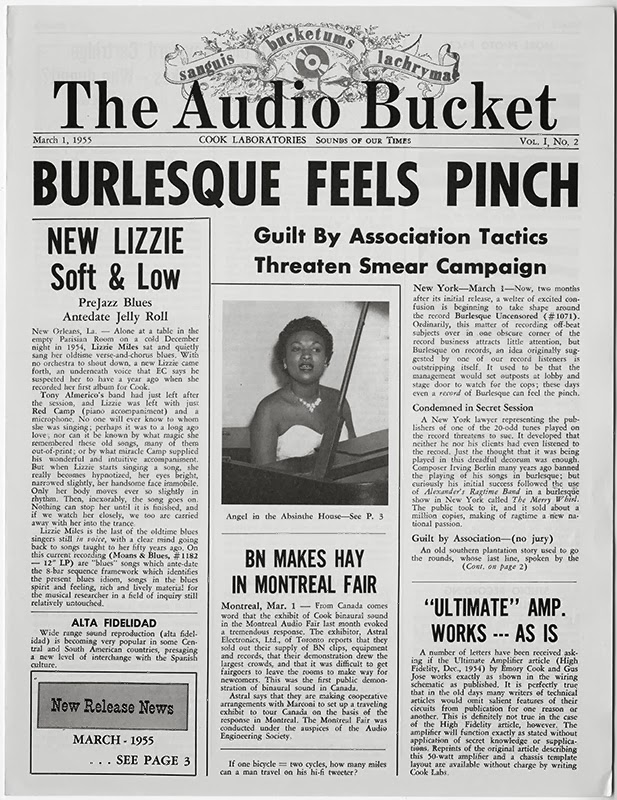
Above, a typical issue of Cook's newsletter, The Audio Bucket. I actually guffawed rather loudly when I read the "BURLESQUE FEELS PINCH" headline.

Cook-13-01-p002-003, from from Cook Labs records
And finally, the interior of a promotional brochure for the Cook Road Recordings series. This paragraph sums up quite nicely Cook's recording philosophy:

"Many of them have been so unusual, so off-the-beat, that it would not be possible to put them into even our bizarre catalog, due to what might turn out to be--shall we say--a limited interest. Not everyone wants a record of a steam calliope. But some of this material stands newly revealed in the light of high fidelity as exciting program. Other subject matter is far from being high fidelity at all, but is just curious in its own right."


Look out for future updates on our progress with this great collection! Until then, what's your favorite sound?

Cecilia Peterson
Ralph Rinzler Folklife Archives and Collections

Friday, May 10, 2013

Invitation to Voyage

Documentary and fiction film alike engage the imagination. And travelogue films with their evocation of imaginary landscapes seem to exist somewhere between the real and the imagined. Popular on film screens from the first days of cinema and with origins extending even earlier to lantern slides and illustrated travel lectures, travelogue filmmaking has proven to be one of cinema’s most versatile and enduring forms.  With its ready-made narrative structure (“the journey”), the travelogue easily lends itself to first person accounts ranging from banal tourist observations to the gently subversive film essays of Jonas Mekas or Chris Marker. The Human Studies Film Archives has a number of fine examples of travelogue films. The century old ON THE WAY FROM KANDY TO COLOMBO (HSFA 89.9.1) is a four minute film documenting a scenic train trip through the countryside of Sri Lanka (Ceylon).

 
The HSFA acquired a 35mm nitrate print with polychrome tinting of this film in 1989 through the efforts of the American Film Institute’s National Center for Film and Video Preservation.  This organization had been alerted by the National Film and Sound Archives Australia of a large store of nitrate films that had been left in their country by numerous film distributors during the silent film era. Travel shorts were common on film programs at that time and were often assembled together for theatrical projection. This film arrived at the HSFA on the same reel as a second travelogue entitled GLIMPSES OF CEYLON.  The only production history we have for the film is provided by its opening credit: ECLAIR COLORIS.  The French company Éclair had opened a studio in Fort Lee, NJ during this period and along with other French producers, they were competing vigorously against American companies for a share of the international film market. 
Novelty in cinema, then as now, remains a big draw and French film producers had pioneered and mastered the craft of stencil coloring for their films.  The HSFA preserved the color of the applied dyes on this B&W film stock by creating a 35mm color intermediate negative as the preservation master.  The video shown above was generated from this preservation master. The subtlety of the coloring may be lost when viewed on a computer screen, but the video master retains a fair record of the soft hues.

The nearly constant motion of the camera in this 1913 film is perhaps even more unusual than the polychrome tinting. The steady gliding motion together with artificial color creates a travel reverie which at times has the feel of enveloping the viewer. In general, early silent films were shot using a stationary camera.  The bulky hand-cranked motion picture cameras required a sturdy and well-stabilized tripod to achieve optimal image quality. Most films made before the 1920s rarely included more than an occasional tilt or panoramic shot from a fixed position as camera movement. There were exceptions of course, and rail travel, whether street cars, trains or even subways, seems to have provided an ideal combination of stability and smooth movement to make truly moving images a possibility for film viewers. The earliest camera “dollies” most likely utilized tracks laid down inside of the film studios. A practice which gave rise to the term “tracking shot” still in use today to indicate virtually any travelling camera movement.

The DC area will have a rare opportunity next month to see a wonderfully comic reversal of travelogue and ethnographic film conventions when the National Gallery of Art screens French filmmaker Jean Rouch’s Petit a petit (1970) as part of its regular weekend film programming.

Mark White
Human Studies Film Archives

Monday, April 22, 2013

Perseverance in Preservation

“…let us save what remains: not by vaults and locks which fence them from the public eye and use in consigning them to the waste of time, but by such a multiplication of copies, as shall place them beyond the reach of accident.” 

This April 21st through the 27th is Preservation Week, a national movement working to increase awareness of the importance and scope of preservation needs of cultural institutions.  

While museums, libraries and other archives are dedicatedly working to protect historical artifacts and documents, the combined conservation needs still greatly exceed available resources.  In 2004 the first comprehensive assessment of the preservation needs of national collections was conducted by Heritage Preservation and the findings were staggering.  Over fourteen thousand organizations were surveyed, including 450 of the 500 largest cultural repositories in the U.S.  Eighty percent had no paid staff for collections care, and 71% indicated that caring for collections would require more training.  One hundred and ninety million artifacts are already in need of conservation treatment. Of the estimated 4.8 billion artifacts held by institutions, 1.3 billion are in danger of being lost.  

When Joni Mitchell sang “Don’t it always seem to go / that you don’t know what you’ve got ‘til it’s gone,” she was sounding a concern shared by people across the globe.  While the need for preservation will never disappear, the options for protecting treasured assets are far greater than they were in the recent past.  With the dawning of the digital age, preservation options for most artifacts now include virtual representations.   As technology continues to improve the process of creating digital copies or surrogates, efforts toward the digitization of cultural artifacts continue to expand.

With the launching of the Digital Public Library of America (DPLA), the electronic records of state and regional digital libraries will be searchable and accessible from a single online point.  In addition to bringing information access to an unheralded level in the U.S., DPLA also aims to encourage community digital preservation efforts.  Planned services include assisting local communities in the digitization of cultural artifacts.  One possibility is a “mobile scan-van” service that would allow local residents to scan their old photographs and other personal paraphernalia (which is especially exciting to someone whose childhood is currently archived in a shoebox). 


Image from the Thomas Warren Sears Collection, Archives of American Gardens, Smithsonian Institution.
At the national level, cultural institutes like the Smithsonian will continue to create and preserve digital representations of unique collections.  One example is the Thomas Warren Sears Collection. Thomas W. Sears was a prolific landscape architect – during nearly 60 years of practice he designed landscapes for playgrounds, parks, and private residences as well as urban housing developments, army camps, and cemeteries.  His zeal for his profession was equally matched by his passion for his hobby – photography.   Operating nearly a century before the ease of the digital camera, he photographed a collection of over 4,600 black and white glass negatives and lantern slides.   His images cross continents and eras with subjects ranging from street scenes to countrysides, private gardens to public parks, and from grinning children to somber adults.

Unidentified woman in Annapolis, Maryland, circa 1900-1901. Thomas Warren Sears, photographer.
Smithsonian Institution, Archives of American Gardens, Thomas Warren Sears Collection

Orchards (designed by Gertrude Jekyll), 1906. Thomas Warren Sears, photographer.
Smithsonian Institution, Archives of American Gardens, Thomas Warren Sears Collection
Some negatives from this fascinating collection had the misfortune of being composed of nitrate, an unstable, toxic and highly flammable material (its use as movie film led to multiple deadly cinema fires in the 1920s).  In the 1990s, these negatives were copied and the nitrate negatives destroyed for safety considerations.  Preservation efforts such as this may be unglamorous, but the reward of protecting the past is priceless.

- Jessica Hemphill, Archives of American Gardens, Intern, Winter 2013


Monday, January 14, 2013

Bringing the Kalahari to Mexico City

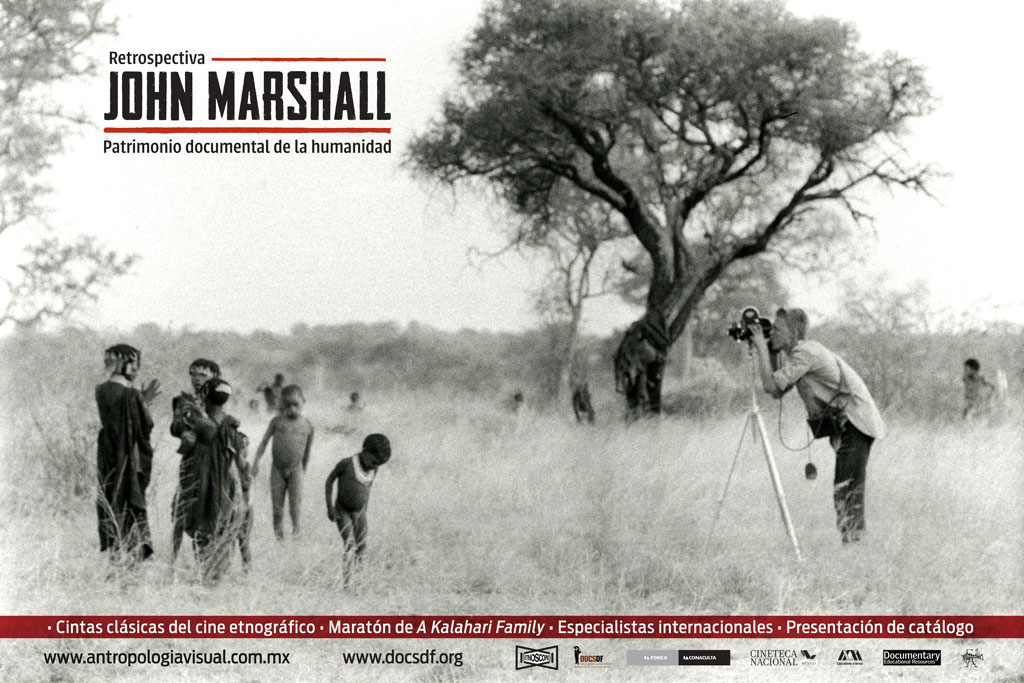
Postcard for Cine en Culturas retrospective of
John Marshall's work, held Nov 10-14, 2012 in Mexico City.
From November 10-14, 2012, audiences in Mexico City were treated to an extensive retrospective of the ethnographic and documentary films of John Marshall. Marshall is best known for his life-long involvement with the Ju/'hoansi, a group of !Kung Bushmen who live in the Kalahari Desert in northeastern Namibia. This retrospective covered both major films and lesser-known works about the Ju/'hoansi, and also explored Marshall's work in the United States, including a documentary series on police work in Pittsburgh, PA.

The retrospective was hosted by Cine en Culturas, an annual program produced by Ethnoscopio as part of the DocsDF documentary film festival. The program was put together with the collaboration of the Human Studies Film Archives (archival home of Marshall's Ju/'hoan Bushman collection) and Documentary Educational Resources (distributor of Marshall's films).


Trailer for the John Marshall retrospective edited by Cine en Culturas.

The incredible team behind Cine en Culturas brought Marshall's work to a Spanish-speaking audience for the first time. Their efforts resulted in Spanish-subtitled versions of all the films shown, including the six-hour series, A Kalahari Family, as well as a fine catalog with a mix of new and previously published essays on Marshall's work, all carefully translated into Spanish. The catalog presents important reflection and scholarship on Marshall's films that was previously only available in English, including an article by our own Jake Homiak, Director of Anthropology Collections and Archives Program at the National Museum of Natural History.

Ticket holders line up at the Cineteca Nacional in Mexico City
for a screening of John Marshall's N!ai, The Story of a !Kung Woman.
© Francisco Palma Lagunas
I was lucky enough to attend the retrospective as an invited guest and speaker. What a gift it was to spend a week immersed in Marshall's films and engaged in discussions about his work and his legacy. Mexico City filmgoers provided the best gift of all - sold-out screenings almost every night of the retrospective, held primarily at the beautiful, newly-renovated Cineteca Nacional. A Kalahari Family (2002) was screened in its entirety throughout one afternoon and evening in a smaller, more intimate theater in the city's energetic downtown. Not only did this six-hour marathon sell out, but many audience members stayed long after for a passionate discussion about the series' implications and lessons for the present.

John Marshall is well-regarded as a major figure in ethnographic film. His work has been the subject of PhD theses and academic articles, and scores of undergraduate students have seen his seminal film, The Hunters (1958), in Anthropology 101 classes. His archival film and video collection is recognized as an important piece of our global documentary heritage and is listed on UNESCO's Memory of the World register. This is all impressive, but it doesn't tell us about the actual impact archival films might have on an individual.

My experience at Cine en Culturas showed me what that impact can be. Each night, anthropologists, filmmakers, students, and cinephiles filled the theater to learn about a time, a culture, a way of life very different from their own. Each night, that audience stayed long after the screening for Q&A sessions and discussions that covered a wide range of topics:  John Marshall's working style and deep commitment to the Ju/'hoansi; the evolution of documentary filmmaking techniques; the ethics of documentary and ethnographic filmmaking; the successes and failures of international development work; the current political and economic standing of the Ju/'hoansi; the struggles of indigenous groups in Mexico and worldwide.

N!ai, The Story of a !Kung Woman screens at the Cineteca Nacional.
© Francisco Palma Lagunas
Having worked for John Marshall on his last project, the reception his films received in Mexico City was deeply gratifying on a personal level. It was equally wonderful from a professional perspective, reinforcing the value of the work that the Human Studies Film Archives has undertaken to preserve Marshall's large audiovisual collection and make it accessible for research and exhibition.

Karma Foley, Smithsonian Channel
(and former contract audiovisual archivist at Human Studies Film Archives)

I am grateful to Francisco Palma Lagunas for his beautiful photographs of the Marshall retrospective, and his permission to use them in this post.


Friday, April 13, 2012

Goin' back to Sumter

Left-right: Bill Poplin, Edna Poplin Elmore,
David Jackson, and "Uncle" China Poplin
Amidst the banjos and ouds drifting out of The Ralph Rinzler Archives and Special Collections, another (decidedly un-folk-y) instrument makes itself known. These days, the distinctive hum of a flatbed scanner accompanies us in our work on the Save America's Treasures grant project. The project's goal is to digitize one of our most important collections--the Moses and Frances Asch Collection, which includes the papers relating to Folkways Records. The collection is rich with stories, many of which are illuminated through the process of digitization.

The latest folder to see the scanner's spotlight was filled with materials relating to Folkways Records FA 2306, The Poplin Family of Sumter, South Carolina. Recorded in 1962 by Jack Tottle, the album contains beautiful renditions of Southern gospel and old-time classics, as well as original pieces (listen to samples). Included in the file are black and white photographs of the family playing around their Sumter home. Some of these photographs were not used for the album and the negatives were poorly stored for some time before they were properly processed, resulting in bent film strips. Others were reproduced on album packaging and liner notes at a low quality. The negatives might have remained unnoticed and tucked away in an envelope, but now they are a perfect example of why our efforts to digitize this material are so important: preserving the Asch collection in digital form sheds light into its darker corners.

Left-right: Edna, China. David and Bill
(the creases in the negative cause the white bands)
These photographs were taken by Jack Tottle in September 1962. China Poplin and Edna Poplin Elmore, brother and sister, grew up in a musical home--both of their parents were accomplished musicians, as were their six siblings (side note: their father, Henry Washington Poplin, settled in Sumter in 1870 after walking from Anson County, North Carolina, approximately 80 miles). Also pictured is China's son, Bill. David Jackson was a friend of the Poplin family. In the photographs, China plays an Epiphone 5-string banjo, Edna and David play Gibson guitars, and Bill plays a Bell Tone mandolin.

Look out for more project highlights as we make our way through the collection!


Left-right: Edna, China, Bill, and David.
-Cecilia Peterson, Ralph Rinzler Folklife Archives and Special Collections

Wednesday, April 4, 2012

Smithsonian Libraries Preservation Week TweetUp

It's an SI Libraries Tweetup!

Do you like old books, even ones with crumbling bindings and damaged paper? Do you want to learn some tips for basic book repair? Have you ever wondered how libraries prepare for dealing with disasters that put their collections at risk? And (most important!) do you like to tweet? If you're an active Twitter user in the DC area who follows @SILibraries, and if you'd like to explore behind the scenes at the Smithsonian Institution Libraries' Book Conservation Lab, you might be in luck. The Smithsonian Libraries is holding a TweetUp for Preservation Week on Thursday, April 26, 2012 from 12:30-3:00 p.m. at its Book Conservation Lab in Landover, Maryland. Ten lucky applicants will be selected to participate. The deadline to register for the TweetUp is April 6, 2012, and details are available on the Smithsonian Libraries website.


However, even if you are not part of the group selected for the TweetUp, you can still learn about the basics of book preservation from these resources on the Association for Library Collections and Technical Services website. You can also follow the TweetUp discussion on Twitter on April 26th using the hashtags #SILTweetUp and #Preswk.

L'Assiette au Beurre, v. 7, before treatment
 
And if you'd like to know more about how libraries, museums, and other cultural organizations prepare for emergencies and respond to disasters, look for information about May Day 2012, sponsored by Heritage Preservation: The National Institute for Conservation.

Plate from Exposition universelle de 1889, being treated with paper washing
 
Various Smithsonian units will be highlighting issues on preservation and disaster preparedness in the months of April and May. You can also ask questions about collections care any time on the Smithsonian Insitution Archives website.

Shown above:

Detail, Blue Jay, plate 15, from Mark Catesby, The Natural History of Carolina, Florida, and the Bahama Islands,  published in London between 1731 and 1743 (call number fQH41.C35 v. 1 SCNHRB Cullman Library)

Volume 7 of the French magazine, L'Assiette au Beurre, published between 1901 and 1912, which recently received preservation treatment in the Smithsonian Libraries' Book Conservation Lab. This copy is from the Cooper-Hewitt National Design Museum Library (call number fAP103.A848 v. 7 CHMRB Cooper-Hewitt National Design Museum Library)

 Plate from Frantz Jourdain's Exposition universelle de 1889 (Paris: Librarie centrale des beaux-arts ; New York : J.W. Bouton, [1892]), undergoing paper washing treatment (call number fNA7105 .J68 1892 CHMRB Cooper-Hewitt National Design Museum Library)

--Diane Shaw, Special Collections Cataloger, Smithsonian Institution Libraries

Thursday, March 29, 2012

Will Digital Data be Around as Long as Fragile Bark Cloth Collected in 1838?


Archives are no longer passive receivers of materials.  In this “born digital” world, archives can be collaborators in creating digital documentation that almost immediately becomes of archival concern because without an intentional effort to maintain the material over the long-term, it will be lost.

Currently, the Collections and Archives Program, Department of Anthropology, is engaged in a Smithsonian Collections Care and Preservation funded project to stabilize and make accessible fragile and damaged bark cloths (tapas) from the South Pacific collected by the 1838 U.S. ExploringExpedition under Charles Wilkes.  As part of this conservation project two Hawaiian community scholars, both contemporary bark cloth makers, have joined the conservation team to share their indigenous knowledge of what the bark cloth designs mean, the techniques by which they were produced and the meaning/value of museum objects to contemporary communities.  This, in addition to the techniques used to conserve these one-of a kind artifacts from Hawaii, Fiji, Tahiti and Samoa, is being documented with digital video.


Moana K.M. Eisele, a Hawaiian community scholar, is using a traditional tool,
i'e kuku, to beat bast fiber from the inner bark of the māmaki, a small Hawaiian tree,
as research into long forgotten techniques to create Hawaiian capa (bark cloth)

Because, really, we do not yet know the full meaning of archiving “born digital” over the long-term (and here I mean just 10 years rather than the 100 years of long-term care for film) we are striving to organize the materials as much as possible through metadata created at the time of recording and, then, metadata that will be associated with the digital moving images when they are ingested into the Smithsonian DAMS (data asset management system).  To this end, we are drafting best practices for moving image and audio data collection, tagging and archiving.  Of course, other museum researchers who are creating digital content are tackling the same issues and may have already established their own protocols—and learned some valuable lessons--for minimal and ideal metadata for digital scientific and museum moving image and audio data.  Certainly, this is the time to share our efforts and engage in a community discussion so that we are not all re-inventing the wheel, as it were.  Please feel free to post a comment or contact us at HSFA@si.edu.

For those of you who are now curious to know more about bark cloth 
and the Wilkes expedition please continue to read:


Bark cloth was traditionally made and used for a variety of purposes in many Pacific cultures,
most notably in ceremonies and rituals.  Both the material available (various plants such as the paper mulberry, breadfruit, and banyan) and the mode of production varied from region to region.  The Smithsonian’s collection of bark cloth is large, with important and unique pieces from the United States Exploring Expedition (1838-1842), the U.S.’s first international scientific survey.  The squadron of ships, under Captain Charles Wilkes, circumnavigated the globe, surveyed and charted nearly 300 islands of the Pacific, mapped 800 miles of the coast of Oregon, and confirmed the existence of Antarctica as a continent. The thousands of ethnological objects and botanical and zoological specimens were brought back to the U.S. by the Expedition’s team of scientists and are among the founding collections of the Smithsonian.

Existing archival records are also data that can support object collections. In the case of bark cloth, the Human Studies Film Archives has a 1985 film, Visiting Samoa, made by ethnomusicologist Laura Boulton that includes a ceremonial presentation of bark cloth and a demonstration of how bark cloth is made and decorated.


Pamela Wintle
Human Studies Film Archives

Tuesday, January 10, 2012

Sydel Silverman: Preserving the Anthropological Record

The National Anthropological Archives recently acquired the papers of Sydel Silverman, an anthropologist known for her work as a researcher, writer, academic administrator, and foundation executive. After receiving her PhD from Columbia University in 1963, she taught at Queens College in New York (1962-75) and became Executive Officer of the CUNY PhD Program in Anthropology (1975-86). She later served as president of the Wenner-Gren Foundation from 1987-1999.

While at the Wenner-Gren Foundation, Silverman’s interest in the history of anthropology led her to become heavily involved in an effort to preserve anthropological records. In 1991, along with Dr. Nancy Parezo, she began planning a conference that would deal with the preservation of anthropology’s historical record. The conference, called "Preserving the Anthropological Record: Issues and Strategies," was held in spring 1992. Anthropologists, archaeologists, archivists, librarians, museum specialists, and potential funders met to identify the issues associated with preserving anthropological records. The conference attendees discussed the issues of records creation and use, ethical concerns, and the necessity of educating stakeholders.

In "Preserving the Anthropological Record," an article written about the conference for the February 1993 issue of Current Anthropology, Silverman described the Resolution on Preserving Anthropological Records that the conference adopted. The Resolution stated that "anthropologists have a professional responsibility to serve as stewards" of their "unpublished anthropological materials" because they are "irreplaceable" and "unique resources" that are "essential for future research and education." Anthropological records contain cultural information that is valuable to many different parties: the anthropologist who gathered the data, the informants who supplied the anthropologist with that data, other members of the informants’ community, or those who wish to study that community.

Silverman Papers, Box 16, folder "Siena Notebooks [4 of 5]"
Silverman unpublished notebook, cover

Notes on Palio of Siena (a festival) Siena, Italy, 1980
Papers from the conference were published in a volume entitled Preserving the Anthropological Record, co-edited by Silverman and Parezo. This publication described why anthropological records should be kept, the roles and responsibilities of various stakeholders, preservation issues, guidelines and strategies. In the book’s Introduction, Silverman expressed the core concern of the conference members: "For anthropology, the unpublished records of the past are of more than historical interest…They constitute the primary data of all research—data that are unique and unrecoverable." Silverman and the rest of the conference participants recognized that much of the anthropological record consisted of grey literature—field notes, interviews, data sets, and more—that could be of great value to future researchers.

In May 1993, a second Wenner-Gren conference, "Preserving the Anthropological Record II: Toward a Disciplinary Center," was held to define an action plan. This conference led to the creation of CoPAR, the Council for the Preservation of Anthropological Records. According to the statement on its homepage, CoPAR "sponsors programs that foster awareness of the importance of preserving anthropological records; provides consulting and technical support to archival repositories; provides information on records location and access; and fosters collaboration between archivists responsible for anthropological collections and tribal archivists." For more information on CoPAR, and Sydel Silverman’s involvement in the movement to preserve anthropological records, visit the National Anthropological Archives website http://www.nmnh.si.edu/naa/.

Sydel Silver Papers, Box 29, folder "April 1995, Reno, NV COPAR"
Silverman is third from right in the front row

Christy Fic, Contract Processing Archivist
National Anthropological Archives


Friday, December 9, 2011

Filming Imagination

Ever since the arrival of motion picture film in the 1890's, the medium has been used not just to document the world around us but to convey the hidden, inner world of the imagination.  Magician-turned-filmmaker Georges Méliès was an early pioneer of portraying fictional worlds through cinema.  His 1902 film, Le voyage dans la Lune (A Trip to the Moon), used elaborate sets, stop-motion animation, hand-coloring, and other special effects to transport audiences to the curious lunar surface.

Méliès and his films are enjoying a revival thanks to Martin Scorsese's Hugo (in which Méliès is a major character) and a recent restoration of the hand-colored version of Le voyage dans la Lune, long believed to be lost, complete with an original score by musical duo Air.  Below is video of the black and white version, with an English narration and a more traditional film score.


At the Human Studies Film Archives, we deal mostly with documentary films.  I was both delighted and intimidated when I wound into the original 16mm film rolls for Jorge Prelorán's experimental short, Claudia.  Here I found extensive splicing due to unusually short shots, multiple soundtracks and credit rolls, and superimposed animation, some of which was scratched into the film's emulsion.  In time I sorted out four versions of the film, each with a different musical score.  Prelorán intended that all four versions be viewed in succession, to experience the different impressions given by the various soundtracks.


All four versions of Claudia have recently been preserved thanks to an Avant-Garde Masters grant from the National Film Preservation Foundation.  The original film was faded and suffering from acetate deterioration.  One set of credits had to be carefully re-created, using a mix of digital tools and film.  The preservation work was done by Bill Brand of BB Optics and Colorlab.  Here is video of Version I in its entirety:


Claudia (Version I) (1972), by Jorge Prelorán


Although he is primarily known as an ethnographic filmmaker, Prelorán made several experimental films and even a feature-length fiction film, Mi Tia Nora (1982).  His very first film, Venganza (1951), is a noir crime story.  The style and plot of Venganza make it easy to imagine that much of Prelorán's youth was spent in his local movie theater.  His last film, Obsesivo (Obsessive) (1996), is an inquiry into the creative process itself.  Claudia is one of several short, playful films Prelorán made during his long career as a filmmaker.  He called these films 'bagatelles', or little songs.  This bagatelle was filmed in Tucumán, Argentina in 1965, during an afternoon spent with the five-year old Claudia, the daughter of a friend.  She was about the same age as Prelorán's own daughter, whom he saw little of and missed. 


Méliès' work was the beginning of a long tradition of experimentation in film. Set design, special effects, and animation have evolved a great deal since his time and yet, there is still something magical and transporting about La voyage dans la Lune.  The same is true of Claudia, with its hand-made animation and deceptively simple approach.  Take a few minutes to watch the film (it is only six minutes long), and see if you don't break out in a smile.  An ode to imagination, childhood, and the joy of play, Claudia was Prelorán's attempt to capture an inner world and portray an experience not visible to the eye, nor to the movie camera. 


Karma Foley, Human Studies Film Archives