Smithsonian Collections Blog

Highlighting the hidden treasures from over 2 million collections

Collections Search Center
Showing posts with label Indigenous Peoples. Show all posts

Tuesday, June 1, 2021

Elizabeth Peratrovich: An Early Civil Rights Activist from Alaska

By Mikaela Hamilton and Nathan Sowry

On February 16th, 1945, nearly 20 years before the Civil Rights Act of 1964, the first anti-discrimination law in the United States was signed into effect. The Anti-Discrimination Act of 1945 was created to address discrimination against Indigenous populations within the Alaskan territory by banning segregationist policies based on race. The successful passing of this act has often been credited to the dedicated work of Elizabeth Wanamaker Peratrovich (Tlingit), a prominent figure in the fight for equality and civil rights in the early twentieth century.

As of this month, the Peratrovich family papers are now available online, and will soon be available for research and reference in the National Museum of the American Indian Archives Center. This collection includes photographs, audio recordings, correspondence, and newspaper clippings documenting the life and important civil rights work of Elizabeth and her husband Roy. 

Elizabeth Wanamaker Peratrovich, 1911-1958.
Peratrovich family papers (NMAI.AC.078), NMAI.AC.078_001_01_021.

Elizabeth (Ḵaax̲gal.aat) was born on July 4, 1911, in Petersburg, Alaska, as a member of the Lukaax̱.ádi clan, in the Raven moiety of the Tlingit nation. Elizabeth spent the first decade of her life in Sitka, a coastal city in southeast Alaska, until her family moved further southeast to the Native village Klawock, where Elizabeth met her future husband, Roy Peratrovich (Tlingit). Although Elizabeth and Roy spent their early years at segregated boarding schools, they were able to graduate from Ketichikan High School, which was integrated following a lawsuit won by attorney William Paul (Tlingit). In 1931, Elizabeth married Roy Peratrovich. They had three children: Roy Jr., Loretta Marie, and Frank Allen. 

In 1941, the Peratroviches moved to Juneau, the capital of the Alaska Territory, in search of more opportunities for themselves and their children. Although they encountered hostile white homeowners who refused to rent to Native Americans, they persevered to become one of the first Indigenous families to live in a non-Native neighborhood. They soon took on leadership roles within the Alaska Native Brotherhood and Sisterhood. Throughout Juneau, discrimination was ubiquitous; local businesses commonly displayed signage reading "No Natives Allowed," "No Dogs, No Natives," and “We cater to white trade only." After encountering a “No Natives Allowed Sign” on a local inn just weeks after the attack on Pearl Harbor, Elizabeth and Roy were driven to write a letter to Governor Ernest Gruening in protest, marking the beginnings of their political activism to establish legal protections for Indigenous people in Juneau and beyond. The letter read, in part:

“The proprietor of ‘Douglas Inn’ does not seem to realize that our Native boys are just as willing as the White boys to lay down their lives to protect the freedom that he enjoys. …We as Indians consider this an outrage because we are the real Natives of Alaska by reason of our ancestors who have guarded these shores and woods for years past."

Letter from the Elizabeth and Roy Peratrovich to Ernest Gruening, Governor of Alaska, December 30, 1941.
Peratrovich family papers (NMAI.AC.078), NMAI.AC.078_001_02_001.

Successfully gaining Governor Gruening’s support, Elizabeth and Roy began a campaign to pass an anti-discrimination bill in 1943. With a vote of 8-8 in the House of Alaska’s two-branch Territorial Legislature, it failed to pass. Undeterred, Elizabeth continued to tirelessly campaign across the Alaskan territory. After garnering public support, Elizabeth and Roy, representing the Alaska Native Brotherhood/Sisterhood, brought a new anti-discrimination bill before the Alaska Senate in 1945. In an eloquent two-hour long testimony, Elizabeth stood before a white male majority and eloquently argued for an end to racial discrimination within Alaska. 

During the hearing, Allen Shattuck, a Juneau territorial senator, asked Elizabeth “Who are these people, barely out of savagery, who want to associate with us whites, with 5,000 years of recorded civilization behind us?” Elizabeth famously responded, “I would not have expected that I, who am ‘barely out of savagery,’ would have to remind gentlemen with five thousand years of recorded civilization behind them, of our Bill of Rights.” A local newspaper printed that she “shamed the opposition into a ‘defensive whisper.’” The Alaska Equal Rights Act of 1945 was signed into law by Governor Gruening on February 16, 1945. The Act provided that all Alaskans be entitled to “full and equal enjoyment” of public areas and businesses and banned signs that discriminated based on race. This marked the end of “Jim Crow” laws within Alaska.
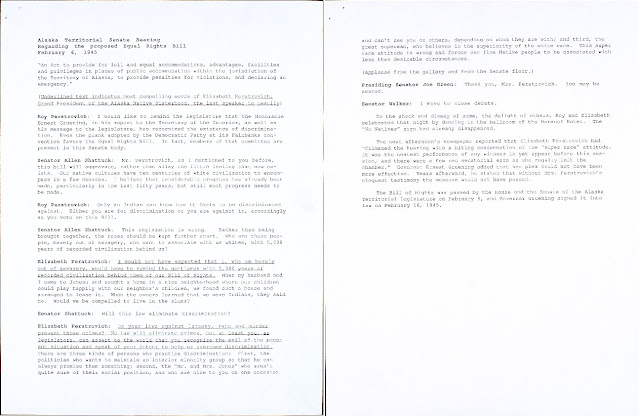
Transcript of Alaska Territorial Senate Hearing regarding proposed Equal Rights Bill, February 6, 1945.
Peratrovich family papers (NMAI.AC.078), NMAI.AC.078_001_02_082 and NMAI.AC.078_001_02_083.

In recognition of her antiracist advocacy to provide equal accommodation privileges to all citizens regardless of race, in 1988 the state of Alaska posthumously established February 16th as Elizabeth Wanamaker Peratrovich Day. More recently, celebrating the 75th anniversary of Alaska’s Anti-Discrimination Law, Elizabeth Peratrovich appeared on the 2020 Native American $1 coin design. That same year, a Google doodle featuring the work of Tlingit and Haida artist Michaela Goade (Sheit.een) commemorated Elizabeth’s life and activism. Elizabeth and Roy’s efforts helped to pave the way for continued Indigenous activism within the United States. 


Mikaela (Mik) Hamilton, Intern, National Museum of the American Indian Archives Center

Nathan Sowry, Reference Archivist, National Museum of the American Indian Archives Center


Friday, May 8, 2020

Cultures in Motion: The Huichol Film Project, 1973-1975 - Part I

 
Young Huichol man sitting on a cliff overlooking the Western Sierra Madre, Summer 1974
Frame grab from HSFA 1989.3.1-8

Before arriving in the Western Sierra Madre of Mexico in April 1973 to produce one of the richest visual ethnographic collections of the Huichol community of San Andres Cohamiata to date, Hungarian-American filmmaker Kalman Antal Müller (1939 – ) had already had a wealth of experiences. By his mid-thirties, Müller had traveled extensively across Africa, Latin America, the Middle East and the South Pacific, making films and writing articles for popular and academic outlets such as Atlas, National Geographic, and the Journal de la Société des Océanistes along the way. Müller had also worked as an administrator for the United Nations in Zaire (now D.R.C.) and as a translator for the Department of State in the U.S.— all while moonlighting as a doctoral student in French Literature at the University of Arizona.[i]

Like most of the places where Müller had spent time through the 1960s and early 1970s, San Andres Cohamiata was not a town one could easily get to. This village or rancho (in Huichol lore) sat (and still sits) in a high plateau, some 6,000 feet above sea level, amid deep, treacherous barrancas—in what is perhaps one of the roughest landscapes in Mexico and the Americas. That the Huichol ancestors settled in this difficult terrain some four hundred years before Müller arrived on the scene was not an accident. Around 1530, following a series of military conflicts known today as the Mixtón Wars, through which the Spanish state and their Nahuatl indigenous allies sought to subjugate northern Mesoamerican peoples, the Huichol ancestors fled west from the lower and drier valleys of what is now the Mexican State of San Luis Potosi to the Sierra Madre highlands.[ii]  One could imagine that the smallpox, measles and other epidemics which decimated Mesoamerican populations to about five percent of its pre-contact numbers would have also provided a strong incentive for the Huichol ancestors to seek geographical isolation.


By the early seventeenth century, the Huichol environment was so uninviting to the eyes of the Spanish government and their indigenous allies that they referred to it as Colotlán--Nahuatl for “the place of scorpions.”

 Carrying a French-made,16-mm Eclair movie camera, a Swiss-made Nagra sound recording system, and a Japanese-made Pentax 120 still camera, along with enough batteries and film rolls to make these gadgets work, what Müller found and recorded upon his arrival in San Andres was one of the most culturally (and geographically) isolated communities in Mexico in the 1970s. At the same time, the residents’ way of life had been increasingly changing over the last few centuries. While Huichols had been relatively successful in evading colonial governments by taking refuge amid the Sierra Madre, they had been less successful escaping other influences such as the Catholic Church and, increasingly, Mexican bureaucrats. Thus, what Müller found on his first visit to San Andres, and what his film footage would most clearly depict, was a Mesoamerican culture in motion: a community with so well preserved a heritage that the traces of its cultural transformation were still fresh.


Huichol man and children, 1975.  Photo by Kalman Müller.


The Hikuri Neixa ceremony is a case in point, as it was the first ceremony Müller documented in the Sierra Madre (HSFA 1989.3.4).   He recorded this ceremony, which formally marks the end of the Huichol year, on his first visit to San Andres in April 1973 and 1974. 

Huichol peyote seeker painting his face during the Hikuri Neixa ceremony, Winter 1974
Frame grab from HSFA 1989.3.2-4
The film of this ceremony shows a group of indigenous people under a midday sun painting bright yellow figures (such as suns, snakes, rain drops, and maize plants) over each other’s faces, while other people drink, dance, and make more yellow paint by grinding up in a molcajete[iii] a root named urra (Mahonia trifofiolata)[iv], Huichol for spark. The painted images represented (and that participants sought to elicit) the blessings and protection of Tatewari, or the god Fire, one of the main deities for the polytheistic Huichol and the most important one for assuring a good harvest for the upcoming year.  Tortillas and beans as well as tepe (a kind of beer made of maize) flow in abundance during the celebration.

Peyote pilgrims on their way to Wirikuta, the sacred land. Summer 1974
Frame grab from HSFA 1989.3.1-4
 Beyond drink and food, during this ceremony Huichols share and consume their sacred peyote plant (Lophophora williamsii).  The Hikuri Neixa (the name of which comes from hikuri, Huichol for peyote, and neixa, Huichol for dance), is as much a celebration marking the end of the Huichol year as a celebration of the end of the peyote pilgrimage to the Huichol sacred land Wirikuta.[v] This is no coincidence, as the peyote pilgrimage is one of the most important rituals for pleasing Tatewari and other Huichol deities. During the pilgrimage to Wirikuta, Huichols gather many of the sacred plants they will use for rituals throughout the year, such as the yellow urra itself. For the Huichol, returning to one’s community with ample quantities of peyote, urra, and other goods to share with the community indicated a successful pilgrimage.  Judging by the liberal amounts of tepe the peyote seekers or kawiteros[vi] drank during the Hikuri Neixa ceremony of 1973, one could assume the peyote hunt for that year was a fruitful one.[vii]

To learn more about the Huichol Film Project check back soon for part 2!


José Carlos Pons Ballesteros
Graduate Fellow
NMNH-Department of Anthropology

Original film footage of the Huichol Film Project, along with sound recordings and associated documentation, form part of the collections of the Human Studies Film Archives.  You can find more information about this film collection here.


[i] Information about Müller for this paragraph drawn from The Huichol Film Project, Kalman Müller’s 1975 C.V.  Human Studies Film Archives, Smithsonian NMNH.. 

[ii] According to Peter Furst’s Rock Crystals and Peyote Dreams (2006) and to Stacey Shaefer’s Huchol Women, Weavers, and Shamans (2015) linguistic proximity suggests the people today identified as Guachichils as the most likely ancestors of the Huichol.

[iii] The stone-made traditional Mesoamerican equivalent to the mortar and pestle. 

[iv] Ethnobotanist James A. Bauml et al. were the first scholars to uncover the scientific classification for the urra plant. Their findings were published in the Journal of Ethnobiology in 1990. Bauml, James, Gilbert Voss, and Peter Collings. 1990. “Uxa Identified.” Journal of Ethnobiology 10: 99–101. 

[v] Indeed, according to Schaefer and Furst (1996), the main purpose of the Hikuri Neixa (The Dance of the Peyote) Ceremony would be to prepare the soil for planting and to call upon the rain. The successful “hunt” of peyote would thus be an activity important as a means to both supply the community with this sacred plant as well as invoke the blessings of the Gods for the growing season. As a ceremony linking hunting and agriculture, the Hikuri Neixa represents the hybrid ecological and productive heritage of the Huichol people.  Schaefer, Stacy B., and Peter T. Furst. 1996. People of the Peyote: Huichol Indian History, Religion & Survival. UNM Press. Other scholars such as french anthropologist Michel Perrin (1994), and Kalman Muller himself referred to this same ceremony as “Hikurineira.”  Perrin, Michel. 1994. “Notes D’Ethnographie Huichol: La Notion de  ‘ma’ive’ et  la  nosologie.” Journal de La Société Des Américanistes 80: 195–206.

[vi] The peyote seekers or kawiteros are identifiable by their large squirrel-adorned sombreros. 

[vii]Information about the Hikuri Neixa for this paragraph drawn from: The Huichol Film Project, Document #3, p. 9.  Human Studies Film Archives, Smithsonian NMNH. August 2019. Schaefer and Furst (1996) also provide important information about this ceremony in their book People of the Peyote.