Smithsonian Collections Blog

Highlighting the hidden treasures from over 2 million collections

Collections Search Center
Showing posts with label The Profession. Show all posts

Friday, April 20, 2018

Processing the Burpee Company Records, Part One

The first time encountering a new collection is exciting for an archivist. This is when we evaluate the physical condition of the collection, the predominant materials (papers, books, memorabilia, etc.), and, if possible, any potential series within the collection (business records, correspondence, newspapers, etc.) that aid in its final arrangement. It can be overwhelming to see a large number of disordered and dusty boxes in front of you, but knowing that within each box rests items that have not been touched for 5, 10, 30, even a hundred years is always exhilarating (in a bookish kind of way). This post will talk about my first week working on a new accretion to the W. Atlee Burpee Company Records.

The first step involves researching what exactly the collection is about. The W. Atlee Burpee Co. was founded by Washington Atlee Burpee in 1878. Burpee’s business grew over the next 15 years, and by 1893, Burpee had reached the top of the American seed scene when he was elected president of the American Seed Trade Association (ASTA). The Burpee Company rose to prominence under W. Atlee Burpee, but, of course, not without its good and bad years. When W. Atlee became ill around 1913, his eldest son David left his studies at Cornell to assist in operating the family business. In 1915, David was made CEO. Under David’s direction, the Burpee Co. continued to expand globally. In 1970, General Foods acquired the company.
David Burpee’s official resignation as president of W. Atlee Burpee Co., and the official “closing” of the deal with General Foods. The Burpee Co. merged with the Ball Seed Company in 1991 and is still an active business today.
The Burpee Co. was a well-run machine by the beginning of the twentieth century. W. Atlee Burpee was an astute businessman, a great organizer, and an innovator in seed marketing and advertising. He kept a close eye on all of his products as well. Constantly in correspondence with employees, contractors, retailers, and consumers, he stayed current with all aspects of his business. But it was marketing that separated Burpee from his competitors. Having the consumer interact with the company not only encouraged interest in Burpee seeds, but also helped the Burpee Co. connect with those who supported its business. Burpee’s approach to marketing ensured a personal and long-lasting relationship with its customers.

Looking at the business records of a company run by such a man is inspiring. Detailed notes scribbled all over scraps of paper capture his marketing skills. David Burpee had large shoes to fill when he took over the company, and he succeeded. In 1926, just a few years into radio broadcasting’s “golden age,” the Burpee Co. promoted a “largest zinnia” contest through a local radio station, WLIT in Philadelphia. Letters poured in to the radio station (which were all forwarded to the Burpee Co.) regarding the contest, with some seeking Burpee publications as well.

1926 letter submitted by Mrs. E. Shepherd of West Philadelphia to WLIT radio station in Philadelphia, Pennsylvania.  Listeners were invited to submit a letter requesting free Burpee seeds and publications. 

Between a company that crossed all oceans, and a business model that was as connected as ever to the customer, W. Atlee would have been proud of what his son accomplished. I am excited to be working on the W. Atlee Burpee Company Records. It is a great story of an American company, and deserves to be preserved. Processing collections requires patience, attention to detail, and great organization. Above all else, the archivist must acknowledge that they are presenting once hidden materials to the public.

Chris DeMairo, Intern

Tuesday, October 17, 2017

Come Join Us at the 2017 Archives Fair!


As an archivist, ethnomusicologist, and musician working at the Smithsonian, I feel inspired when I have opportunities to work with colleagues within and beyond the Institution to provide public-facing platforms for dialogue. I get particularly enthusiastic when these events relate to the power of archival collections to provide context for the customs and traditions that shape the cultures in which we live. On Saturday, October 21, 2017, I will be participating in such an event at the National Museum of American History in the Coulter Performance Plaza and the SC Johnson Conference Center.

From 11 a.m. to 4 p.m., the public is invited to celebrate American Archives Month at the 2017 Archives Fair with the theme Performance and Preservation. As described on the National Archives webpage, participants will explore “the ways in which the preservation of archival collections translates into the preservation of culture through the performance and artistry of individuals and communities across the United States and around the world.”

The Fair has four main features. First, a diverse range of musicians, dancers, singers, and performers will take the stage throughout the day in the Coulter Performance Plaza to illuminate the ways in which the archival record informs their work as artists. Second, a series of panel discussions in the SC Johnson Conference Center will reveal how archival documentation influences artistic expression, dance (bodies in motion), and access. Third, we will have representatives of over 20 archives and organizational repositories exhibiting at tables set up throughout Coulter Performance Plaza, sharing information about their archival work in a wide range of institutional, regional, and community contexts. Last (but definitely not least), visitors will have the rare opportunity to participate in a behind-the-scenes archives tour at the National Museum of American History’s Archives Center, home to some of the country’s most valuable archival collections.

Ultimately, this year’s event would not be happening were it not for the vision and collaboration between members of the National Archives Assembly, the Smithsonian Institution Archives and Special Collections Council, and the Mid-Atlantic Regional Archives Conference DC and Maryland Caucuses. For more information about the schedule-of-events and a full list of the Fair’s participants, please visit the Archives Fair website and plan on arriving at the National Museum of American History when it opens at 10 a.m. The official welcoming and opening remarks will begin at 10:45 with the first performances and panel discussions taking place at 11!

We look forward to seeing you there!

Greg C. Adams, Assistant Archivist
Ralph Rinzler Folklife ArchivesSmithsonian Center for Folklife and Cultural Heritage

Tuesday, June 13, 2017

Cleaning Up Freer’s Attic

Collections change over time. Collections often come from chaos. Archival collections are often a rushed boxing up after someone passes. The collector is no longer there to ask questions of. This inherently leads to questions. What was this ledger for? Who were these letters to? How did they want their art displayed?

Archivists, museum staff, and researchers grapple with these questions every day. It is often where interesting exhibits come from.

Head Archivist, David Hogge, puzzling out how to organize various photographs.
The Freer | Sackler Archives made the decision a year ago to overhaul the Charles Lang Freer Papers. Please click here for a link to his new and improved finding aid! Freer was the founder of our museum. Opened in 1923, it was the first topic-focused museum at the Smithsonian and its first art museum. Freer did not live to see his museum completed, but the museum did receive, on top of all of his art collection, his vast collection of papers.

Freer was a meticulous man when it came to his correspondence, his purchasing, and, well, everything. This has left a rich collection of papers for museum staff and researchers to use when studying a Freer art object or the man himself.

Not all paper is of equal size.

The finding aid (guide to any collection) for Freer’s papers, like so many other “legacy” archival collections, was created before modern archival standards were established. F|S Archives staff made the decision to overhaul the Freer papers after having many problems in recent years, both finding items for researchers and dealing with how to organize their digital surrogates. You must have a firm handle on the physical side of any archival collection before you can even contemplate digitizing it.

Working in an archives means using your hands and handling physical objects from paper to film canisters.
Physical collection? What is that you ask? It must be hard to imagine in this age of digital smorgasbord that there are still items in the world that are only available in the physical format. Well, a large part of what archivists do is make available in a digital environment what was once only sitting on a shelf in a box and only a few passionate researchers even tried to look for. Everything in an archives is unique, one a kind, the only one in the world.

Archivists are working hard around the world to make unique pieces of human history available and accessible to all, please see this great blog post about putting more of human history online. So
digitizing archival materials is crucial to both outreach (anyone in the world can look at the digital surrogates from the various Smithsonian Archives) and to the long term life of the materials. Paper lasts a long time, but it does not exist forever.

How does one organize a physical collection? How does one re-think it? A collection is always organized to preserve any original organization of the creator, in this case Freer. There are times where it becomes obvious there was no organization to begin with. This is often the main mystery that archivists struggle with on a daily basis: did so and so want these papers this way? Were these postcards meant to go together? Was this part of their research patterns? Their collecting patterns?

Organizing ones thoughts the old fashioned way, on paper.


When archivists make decisions about organization, we are not copy-pasting some files to a new folder in a computer drive. We are weeding through boxes and boxes of materials and attempting to form them into a unit of thought or creator's process. Think of it this way, what if you had to organize Bob Dylan’s writing process. There would be tons of paper or scraps of papers and you have to figure out if he had an order to begin with or was it all chaos? Is imposing some sort of order, potentially where none exists, harming the integrity of Dylan’s creative process or are you creating just enough access points so that a researcher writing the next bestselling Dylan biography can find what he/she needs to do their job?

Basically, does taking a mountain of paper and creating an access pathway (e.g. putting the materials in folders and boxes with labels), a way of thinking about them, looking at them, destroy intrinsically what they are?

The slow task of properly identifying and labeling boxes.  Lots of glue gets on your fingers.
There were many sections of Freer’s papers like this; piles of paper all next to one another and yet had nothing in common. F|S Archives Staff had to separate out these papers into neat pathways that would lead researchers to access points of useful information. For example, what now constitutes Series One in the Freer Papers, was once a few boxes that were just near one another. If you look at the finding aid now, you can see clear pathways/access points (e.g. Memberships and Honorary Awards, Freer Residences, Genealogical Materials, etc.). These pathways are called Series and Subseries in the archival world. Neat piles of paper that all have their own theme and purpose. This makes it much easier for researchers to find what they need; whether that is physically handling the materials or doing a Google word search. We have made these important documents that much more accessible to the citizens of the world.

This aspect of creating finding aids is the complex intellectual part. There are other aspects to cleaning up a collection that are much more hands on.

One of the biggest decisions the F|S Archives made was to completely re-number the boxes and materials in the Freer papers. This may seem like a small thing. Well, the Freer papers hold over 300 boxes and this would not just be re-numbering the boxes in a digital document (the Freer finding aid), it would entail physically pasting new labels on all of the over 300 boxes. You are probably thinking, why would you do that?!
A wall of a job of well done.
Well, most of the Freer papers are not digitized. The only way to track and monitor the small physical components of the collection is to have solid and accurate box numbers. In addition, the archives has to have strong control of the physical space our materials reside in. We have a space matrix documenting where the materials of all of our, over 100, collections are shelved.

So, yes, having accurate labels on the physical materials in an archive is essential. The long term goal – archives often have to think in the long term, collections are too large to allow for instantaneous work – is to enable much of Freer's papers to be digitized, so that more scholars around the world can examine his materials and learn more about Charles Lang Freer, his art collecting, and the art pieces themselves.

Lara Amrod, Archivist

Thursday, November 10, 2016

Betsy’s Travels through India

In the Freer | Sackler Archives our best volunteer is a woman named Betsy.  Betsy has been working in the archives since 2001.  Fifteen years of detailed and focused attention that has led to the creation and availability of the Smith and Pope collections.  She is the quintessential no-nonsense woman with a heart of gold.

Sometimes I think that the hard work that goes into making a collection available (doing basic preservation, creating the finding aid, organizing the materials, etc.) is overlooked.  Making a collection accessible to the public is a monumental task.  Collections generally do not arrive ready to be put online, with digital surrogates and finding aids.  Often collections are literally a palette of boxes pulled out of someone’s basement or an unorganized hard drive of materials.  The person who is tasked with organizing a collection for access to the public has to preserve the thought processes of the collection's creator and at the same time ensure that the materials are organized in such a way that they can be combed through by eager researchers.

Betsy hard at work in the Freer | Sackler Archives
This past year Betsy has been working hard on the papers of Dr. Prince Aschwin de Lippe-Biesterfeld, PhD (1914-1988).  Lippe was curator in the Far Eastern Department at the Metropolitan Museum of Art from 1949 until 1973. He specialized in Chinese Classical Paintings.  The subject matter of this collection was a bit out of Betsy’s wheelhouse of knowledge, but she is more than capable of working through a collection regardless of subject matter expertise.

from Left to Right): James Cahill, Aschwin de Lippe, H. Bevil, and John Pope.  Taken at National Gallery of Art, 1961. 
There were, of course, some bumps along the way.  The biggest speed bump came with trying to identify locations in the countless photograph slides that Lippe had taken during his travels and study of India.  Betsy has a lot of experience with photographs and she first approached this problem from the angle of making all the negative and slide numbers match to at least give these photographs a sense of order for researchers. Secondarily, she made note of any writing on slides photographs and added those to the finding aid she was building in tandem with her physical overhaul of the Lippe collection.

Some of these notes had difficult to read hand writing.  One particular slide note was hard to read and Betsy asked me if I could make it out.  I starred at it for a while, afraid to verbalize my answer.  She jumped in and said it looks like the second word looked like Butterball, but I can’t make out the first word.  I felt better that I was not the only one who thought it said Butterball.  After a little time we determined that the first word was Krishna.  Since neither of us are subject matter experts, I did a search online and low and behold we discovered that Krishna’s Butterball is a real rock in India.

Krishna’s Butterball in Mahabalipuram, India. Prince Aschwin de Lippe Papers 1940-1988,FSA A2012.01 Box 11, Folder 33
Krishna’s Butterball is one small example of the amount of research and time that goes into making materials clear and organized. Betsy had to check out several books from the library to cross check and confirm locations in India.  She had to completely read through and then figure out a way to order Lippe’s research notes and notebooks so that they both preserved Lippe’s thought processes and could actually be accessed by scholars.

Working on an archival collection is always a long game.  Sometimes you only organize a few folders due to the complexity of the materials. Other days you have epiphanies about connections between various scattered materials and can go through several boxes. We are lucky to have someone as intelligent, tenacious, and dedicated as Betsy working in the Freer |Sackler Archives.

Collections Betsy has Organized:
Myron Bement Smith Collection
John Pope Papers
Prince Aschwin de Lippe Papers

Lara Amrod
Freer | Sackler Archives

Wednesday, August 3, 2016

SELGEM: Designing IT applications in the 1970s

This is the last of a three-part-series on SELGEM, a pioneering computer systems used to manage museum collections in the United States. Read the first part here; and the second part here

You might think that total confusion would reign if specifying requirements and assigning data Category Numbers was not strictly controlled by “the system.”  However, the end users cared deeply about information accuracy and the quality of final products, such as specimen labels, catalog cards and resulting publications.  The staff were highly motivated to following the data standards and produce high quality products.  Museum staffs were generally acquainted with structured data because of their traditional work cataloging museum specimens and object, and in research data analysis.
A standard data capture form of the Botany Type Register Project. Page 13, from:  Shetler, Stanwyn G., Mary Jane Petrini, Constance Graham Carley, M. J. Harvey, Larry E. Morse, Thomas Kopfler, and collaborators.  1973.  An Introduction to the Botanical Type Specimen Register.  Smithsonian Contributions to Botany 12. Smithsonian Institution Archives. 
The design of a new SELGEM application in the early 70’s was simpler than design of a new information system in 2016.  There were three reasons for this:  Smithsonian operated a single Honeywell mainframe computer; possessed a single general purpose software “database” tool; and there were only two or three data entry procedures available.  In addition some experience acquired in one application, such as cataloging mammal specimens, could be applied directly to another application, say cataloging mollusk specimens.  While every discipline has some unique data elements, there were recurring groups of data elements for taxonomic information, geographic information, collectors, etc. that you could build on.  Best practices learned designing the earliest SELGEM applications were applied to the design of succeeding applications.

Stanley A. Kovy Director of Information Systems Division (ISD)
and early supporter of the SELGEM system.  Standing at the 
computer console of the upgraded Honeywell 2015, Nov. 1971.
Smithsonian Institution Archives. 71-2785-12. 
For a first time application, usually the system owner or sponsor would assemble sample input records, data sheets, current output products and samples of desired outputs.  The staff member would discuss the proposed SELGEM application with an experienced SELGEM person, “the expert.”  Current workflows were reviewed for possible changes and improvements.  Often there was a very specific output desired.  From these discussions they would begin to prepare a data dictionary, define data standards, and rules for data entry; and SELGEM Category Numbers would be assigned.  They would consider immediate objectives and future objectives; as well as possible improvements and changes to the workflow in the future.

While Category Numbers could be assigned sequentially without any gaps (001, 002, 003, 004, etc.) there was no technical reason to do that.  Theoretically, at least, you had 999 Category Numbers to select from.  It was generally believed that a more flexible design was achieved by providing gaps when assigning Category Numbers.

For the scientific name you might have this data structure:
071 genus
073 subgenus
075 species
077 subspecies
This format was frequently adopted even when the systems owner had no intention of entering data for subgenus or subspecies.  So the documented design might look like this:
071 genus
075 species
This design met the immediate requirements, and provided a flexible logical data structure for the future, with subgenus and subspecies not even defined.

For truly new applications without any precedent, such as an archives catalog, a prototype file of a few records could be created within a day or two.  This “prototype file” could be used for what we now call “proof of concept.”  It could be reviewed by other staff members for comment and approval.  The file could be used to create sample reports, or evaluate how to best structure particular data elements for the most flexible data processing.

Or a proposed application, such as an index of reprint publications, might be very similar to previous applications.  Once you have created several bibliographic applications and produced reports for several years, you understand the basic structure and processing requirements of this type of application.
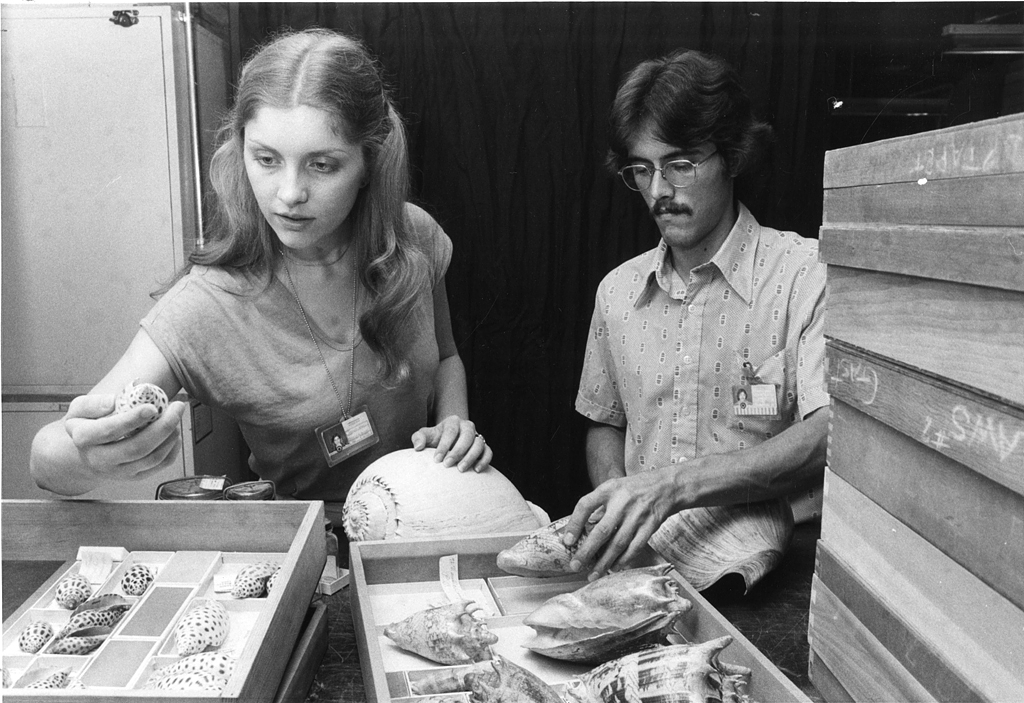
Deborah Bennett and Tim Coffer, museum technicians, sort trays of shells for the mollusk inventory in the National Museum of Natural History's Division of Mollusks.  SELGEM was used to support the inventory and in preparation for the collection move to the Museum Support Center in Suitland, MD. Smithsonian Institution Archives. SIA2009-3232. 
Initially the SELGEM technical knowledge was in the hands of the pioneers, but as the knowledge of the SELGEM system was acquired by an increasing number of museum staff members, new applications could be quickly designed to meet new requests.  SELGEM processed all the information for the “great count,” the Smithsonian collections inventory program (1979-1983). SELGEM was a truly powerful information processing system in its day.


David Bridge, Volunteer
Smithsonian Institution Archives

Wednesday, July 27, 2016

SELGEM: The Logical Structure

This is the second of a three-part-series on SELGEM, a pioneering computer system used to manage museum collections in the United States. Read the first post here.

A SELGEM (an acronym for: SELf GEnerating Master) computer record was what we all define as a typical record, all the information about: one object, one specimen, one work of art, one publication, or, one person, etc. It included all the related fields or data elements. The SELGEM logical record was composed of one or more physical records. A logical record was all the “physical records” with identical Serial Numbers.

Because SELGEM was a general purpose data management system it was used for a wide range of applications at the Smithsonian Institution. Computer applications (using SELGEM) in the 1970s included: museum objects from National Museum of Natural History (NMNH), National Museum of American History (NMAH), National Air and Space Museum (NASM), art museums, the Smithsonian Institution Archives, Volcanoes of the World, bibliographic applications, systematic checklists, type-specimen catalogs, Catalog of American Portraits, National Portrait Gallery (NPG), Inventories of American Painting and Sculpture, and a list of threatened and endangered plants in the United States. Many of these pioneer applications continue today, having evolved into modern databases and web-based applications.

SELGEM master file, directory record
Ayensu, Edward S. and Robert A. DeFilipps. 1978.  Endangered and threatened plants of the United States.  xv, 403 pages.  Smithsonian Institution, Washington, DC. 
Typically a SELGEM logical record was composed of from about 5 to 50 physical records (individual lines); maybe an occasional application included as many as a hundred. The Category Numbers could be any number between “001” and “999”. Each Category Number represented a data element. The first Category Number for a logical record was not required to begin with “001” and application owners generally provided gaps when assigning Category Numbers to create a more flexible design. However a Master List of records displayed Category Numbers, and the associated data, in numerical sequence.

The first line of a category always began with Line Number “01”. If the amount of data exceeded 64 characters, then continuation lines were created, and numbered sequentially “02”, “03”, etc. The theoretical maximum amount of data for one data element (or Category) was 99 lines x 64 characters or a maximum of 6,336 characters.
Sample SELGEM record, page III
Creighton, Reginald A., Penelope Packard, and Holley Linn.  1971.  SELGEM Retrieval:  a general description.  Smithsonian Institution Procedures in Computer Sciences, 1(1):(6 pages) + 1-38.Dated July 1972.
The theoretical maximum amount of data for one logical record was: 999 Category Numbers x 6,336 characters, for a total of 6,329,664 (or 6.3 megabytes). No application reached this size, let alone an individual record. In addition, individual SELGEM computer programs also had memory limits; which also limited the maximum size of a record that could be processed. Remember, even mainframe computers had some limitations.

Some advantages of this design:
  • Easy to add new data elements to any SELGEM record by creating new catalog numbers (Either due to lack of planning or the development of data elements, such as DNA information.)
  • Empty, missing, or blank data elements were not stored in the SELGEM record
  • Flexibility to respond to changing and evolving user requirements
  • The data structure was under the control and responsibility of the end user and less restricted by the application, and
  • With limited technical support staff, a general purpose system supported more applications across the organization than if custom-design systems were developed for each application.
A sample page of a master list showing six logical records
Wilson, Don E., Beth Ann Sabo, and Gregory Blair.  1987.  Automated Data Processing Procedures at the U.S. National Museum of Natural History, pages 111-119.  In:  Genoways, Hugh H., Clyde Jones, and Olga L. Rossolimo (editors).  Mammal Collection Management.  Texas Tech University Press
All the stored data was character data; there was no ability to store binary data, special numerical data types, image data, memo fields, currency or “date formatted” information, as are typically supported in many current database programs. Most application owners in NMNH maintained a detailed data standards document external to SELGEM; defining the data definition, data format, controlled vocabulary lists, and rules for recording the data, etc.

David Bridge, Volunteer

Wednesday, July 20, 2016

SELGEM: The Data Structure

This is the first of a three-part-series on SELGEM, a pioneering computer system used to manage museum collections in the United States

The first publication about the Smithsonian’s
SELGEM system, August 1971. 
SELGEM was an information management computer system invented, developed, and distributed at the Smithsonian Institution and used for more than 30 years.  The exact invention date for SELGEM has been lost to antiquity, perhaps very late 1969; however Reginald A. Creighton and James J. Crockett, two of the men who developed and created SELGEM, state that it “has been in operation … since spring 1970”.*  SELGEM has been called a “records management system”, rather than a true database, at least in the modern senses of the word.  In an era pre-dating relational databases, when commercial software tools were almost nonexistent, SELGEM was used to organize and manage data in a wide variety of applications at the Smithsonian and also many other institutions.  The name is an acronym derived from the system’s full name:  SELf GEnerating Master.  It was “self-generating” because of its general purpose format and because no initial computer programming was required to create a new data file or application.


The SELGEM data structure was simple.
User documentation illustrating the relationship between SELGEM transactions records and SELGEM master records.  Undated, ca. 1971-1972, MNH.
The physical record was a single fixed length record of 77 characters in length. There were only four components to the record:
Serial Number, 8 characters, required, no spaces, an alphanumeric value. Frequently it was a number, however, it could be an arbitrary number, but it could also be a data element**, such as a museum catalog number, a sample number, or a photo image number.
Category Number, three digit numeric, required.  Any three digit number could be used, between “001” and “999”.  The Category Number was a code number for a data element* or data field name.
Line Number, two digits numeric, in the range of “01” to “99”, required.  The first Line Number for a Category Number should begin with “01” and continuation lines should be numbered sequentially.
Data:  the good stuff, up to 64 characters of data could be stored in a single SELGEM line or a physical record.
A single physical record frequently represented a single data element if the data were less than 64 characters in length, or one line of multi-line textual data element, such as:  remarks, description, or an abstract. As an example, suppose that data element “Country” has been assigned to Category Number “100”, the data fits into one line, and the record would look like this:
1234567810001United States


The computer records were created by the SELGEM update program (SELUPD) from a sorted SELGEM transaction record file.  SELGEM transaction records were 80 characters in size (see flowchart at right).  The transaction code controlled the action to be performed by the update program, such as add, change, or delete.


SELGEM transaction records could be prepared using any data entry technology available.

Forms used to create data entry programs on the key-to-disk systems 

The 80-character IBM card format could be produced directly or indirectly.  The following technologies were used for data entry at the Smithsonian at various times:  paper type typewriters, teletype machines, IBM keypunches, key-to-disk data entry systems (such as ENTREX and NIXDORF systems), optical characters recognition (OCR), optical mark sense (OMR) forms, and personal computers.


This was the SELGEM physical record description; in the next blog the story will continue with the Logical Record structure.  A Logical Record was all the “physical records” with identical Serial Numbers (the first eight characters).

David Bridge, Volunteer
Smithsonian Institution Archives

*Creighton, Reginald A. and James J. Crockett.  1971.  SELGEM:  A system for collection management.  Smithsonian Institution Information Systems Innovations 2(3):1.

**The term data element is used as defined in wikipedia.org:  “the term data element is an atomic unit of data that has precise meaning or precise semantics.”  https://en.wikipedia.org/wiki/Data_elementIn SELGEM only the 3-digit code number was stored in the computer file; the definition, data standards, rules, and attributes were defined externally to SELGEM.

Friday, January 31, 2014

Remembering Pete Seeger (1919-2014): A Banjoist’s Archival Connections

Pete Seeger performs at the 1966 Newport Folk Festival. Photograph by Diana Davies.

Pete Seeger’s January 27th passing sparked a groundswell of stories and shared memories about the man, his music, and the many causes he supported and pioneered. Of the millions of people impacted by his works, I am one of the countless banjoists who identify Pete Seeger as the reason I became a banjo player. And like everyone else, I too have a Seeger story that I want to share. It moves beyond having had the chance to meet Pete, share a photo, ask for his autograph, and have a conversation. It is a personal story illustrated through archival connections found in the Ralph Rinzler Folklife Archives and Collections (RRFAC) at the Smithsonian’s Center for Folklife and Cultural Heritage.

While I now self identify as an archivist, ethnomusicologist, and a musician, I was in a very different place in the early months of 1994. I was at a personal crossroads. As a high-energy 19-year old who lacked any inspired direction, I had few places to meaningfully focus my artistic and service-oriented disposition. One day, I serendipitously tuned into my local PBS station and began watching the 1981 documentary The Weavers: Wasn’t That a Time!, which featured Ronnie Gilbert, Lee Hays, Fred Hellerman, and Pete Seeger.

The Weavers - Pete Seeger, Ronnie Gilbert, Lee Hays, and Fred Hellerman - perform at the Old Town School of Folk Music in Chicago, Illinois, January 13, 1958. Photograph by Robert C. Malone.
For me, the most moving parts of the documentary were those segments of The Weavers’ Carnegie Hall performance where the entire audience, not just the ensemble, participated actively in the music making. The projected sense of community I saw on my television screen—one that appeared to be inclusive and nurturing—moved me deeply. For whatever reason, the entire experience was embodied in Pete Seeger’s banjo and I knew I needed to get one. Perhaps it had something to do with the message written around the edge of his banjo head.
Pete Seeger plays his banjo at his home in Beacon, N.Y., November 3, 2005. Photograph by Bruce Mondschain, used by permission.

 After saving up a little money, in the fall of 1994 I bought my first banjo. Since that time, I have been working regularly to find ways of recreating that sense of community in as many contexts as I can muster. As I prepare to turn 40 this summer, I am beginning to see the last 20 years of my life as a chapter. It starts with the work of The Weavers and ends with having achieved one of my dreams of working at the Center for Folklife and Cultural Heritage. Now, after two-and-a-half years in the Rinzler Archives, I consider it a privilege to work with a dedicated group of people who are charged with caring for materials whose content continue to shape my identity.

For example, I am part of a younger generation working to better understand the American experience. As I gain a longer view of my own history, my view of the past continues to evolve as well. I remain astonished by the lengths to which people have gone to selectively oppress individuals or entire groups because of who they are. Learning about Pete’s experiences confronting the House Un-American Activities Committee (HUAC), I admire his personal resolve to stand up for his beliefs and the rights of others, which is something he did for his entire life.

Telegram from Pete Seeger to Sing Out! Magazine, 12 March 1962. From the Moses and Frances Asch Collection

Pete was also one of the many notable voices to sing out during the Civil Rights Movement. Pete and his banjo were part of a larger effort to confront the national traumas that began with slavery, whose violence continued through the institutional racism and segregation of the Jim Crow era, and whose legacy in many ways persists. In the 21st century, efforts that proclaim we are moving on to victory are still relevant to people working to overcome many forms of injustice here in the United States and around the world.


Ultimately, Pete Seeger will always be a cherished, essential figure in my life as I continue working as an archivist and an active member of the banjo community. It is reassuring to know that materials found in places such as the Ralph Rinzler Folklife Archives and Collections provide valued reminders of where we’ve been, where we’re going, and the things we should never forget. That consolation helps me to see how these archival connections can serve as living links to those loved ones who are no longer with us. Thinking about archival materials in this way makes it much easier to welcome the comfort, wit, and sincerity of Arlo Guthrie’s recent Facebook statement about Pete Seeger’s death, “Well, of course he passed away…but that doesn’t mean he’s gone.”

Greg Adams, Processing Archivist
Ralph Rinzler Folklife Archives and Collections

People march in an anti-war rally in New York City, April 27, 1968. Pete Seeger can be seen center right, Seeger's daughter Tinya is at center, and Arlo Guthrie is center left. Photograph by Diana Davies.


Monday, February 25, 2013

But, everything is online...right?


                                                                           Nope!

NMAI Archive Center Stacks
Archives around the world document human history.  They hold materials fundamental for academic and personal research on almost every subject conceivable and have long been collecting immeasurable amounts of material long before the birth of the internet.  The Smithsonian Institution, for example, was founded in 1846 with a dedication to the “increase and diffusion of knowledge”.  The Smithsonian’s first website was inaugurated in 1995.  That leaves 149 years of collected knowledge before we even had an online presence. 

In addition to working at the National Museum of the American Indian Archives Center, I am also in graduate school.  I am often frustrated with the assumption by students that research can be done solely through the use of the internet.  The internet is a useful tool, however, it is inconceivable that over 149 years of material could be fully digitized in the 18 years since we've had the internet, let alone high-quality equipment.  Can you imagine loading a digital archive on Netscape?

A portion of the Museum of the American
 Indian, Heye Foundation Records


Never fear!  Archivists around the Institution are working tirelessly to fulfill the Smithsonian’s mission of “diffusion of knowledge” and bringing you complete and accurate digitized material.  The project that I am involved with is the digitization of the Museum of the American Indian, Heye Foundation records. Over the past two years we have digitized 51 boxes of manuscript material, that is, more than 50,000 pages!  

Digitizing archival material is a bit more complicated than running documents through a scanner as we have unique and original material.  A few examples:


Fragile Materials: Manuscripts like this field notebook from 1896 require special care, handling, and more time when imaging.


Culturally Sensitive Materials: This is defined in different ways by members of individual tribes, ethnic groups, nations, communities,and religious denominations, but usually include materials that relate to traditional knowledge and practices.  Such materials may not be digitized.


Oversize Materials: The physical size of certain items also require additional digitizing techniques.

So, what is available online?  While large collections may not be fully digitized, we have a lot of digital resources available to help the researcher in their quest.  These online finding aids serve as a guide to the collections and provide a detailed description of the contents and arrangement of an archival collection.  After that, once a researcher gets familiar with our collections, they may make an appointment to come see us and conduct their research!

Remember, Archivists and Librarians are here to help you.   If you don’t live in the DC area, ask your local reference librarian for a place to start. As you are considering avenues of research, don’t limit yourself to what is available online, or you may be missing out on a world of knowledge.

Nichole Procopenko
Archives Scanning Technician

Wednesday, January 30, 2013

Cold Cases and Archival Mysteries


"Archivist" is a very broad term describing what we in the profession do on a daily basis. We wear many hats: a master staple-remover hat, a scanning robot hat, and a metadata wordsmith hat are amongst the many ready to be plucked off our racks. My favorite accessory is my deerstalker hat, which has the obvious effect of increasing my powers of reason and deduction.

An archivist must often step into the role of detective: we work with a whole lot of old stuff, and not all of it comes with a convenient label or explanation. Most of the time (though not always) we know where our mystery materials came from, in archives-speak, the acquisition. But sometimes, that's all we know. Who wrote this letter? What's happening in this photograph? What is the strange black powder in this box (that mystery was solved: it was powdered vinyl)? WHY is this HERE?

So we dig. We take what we do know about the mystery object and start following the clues. We compare handwriting samples, photography styles, other materials with similar subjects. Sometimes the trail leads to something, and we follow it (holding a comically large magnifying glass, of course) and give our now not-so-mysterious object a proper home. Sometimes materials remain a mystery for a very long time. Let's call these cold cases.

Cold cases are a frustrating dilemma for an archivist. They are hidden in the collection, making them difficult for researchers to use (or even locate), and we have no way of knowing how these mystery materials could impact scholarship.

Thank goodness for the internet.

As the old saying goes, hundreds of brains are better than one. Let's solve some mysteries!


These mystery photos were found scattered across multiple "miscellaneous" boxes in the Moses and Frances Asch Collection. What's shown here is just a sampling from one of the rolls found. Here's what we know about them:
  • They were developed by Moses Asch.
  • There are hundreds of photographs to parse through, but the majority appear to have been taken in New York City circa 1949. This date is based on a campaign poster for Franklin Delano Roosevelt, Jr. in one of the photographs.
  • The negatives have an aspect ratio of 1.33 (30 mm x 40 mm), though the closest film format to this ratio and time period is 828 film.
As far as we know, Asch was not a photographer, but this could be proof otherwise. If he didn't take them, who did? And why so many New York City street scenes? Do you recognize any of the locations? Was this an artistic endeavor or simply an effort to document the New York of 1949?

What do you think?

-Cecilia Peterson, Ralph Rinzler Folklife Archives and Collections

Thursday, October 25, 2012

The Mystery of the Missing Crossfield Papers


Blogs across the Smithsonian will give an inside look at the Institution’s archival collections and practices during a month long blogathon in celebration of October’s American Archives Month. See additional posts from our other participating blogs, as well as related events and resources, on the Smithsonian’s Archives Month website.
 
Sometimes collections come to the Archives in unusual ways and sometimes extraordinary circumstances shape the content of those collections. When I was processing the A. Scott Crossfield Papers for the National Air and Space Museum Archives, it was clear that there was a good deal more material from the later stages of Crossfield’s career and I would soon find some intriguing correspondence that explained why.


Scott Crossfield standing in front of the North American X-15, October 1958. NASM 9A08280.

Albert Scott "Scotty" Crossfield, Jr. was an aviator, U.S. Navy veteran, and aeronautical engineer best known for his work as a test pilot with the National Advisory Committee for Aeronautics (NACA), where he made history on November 20, 1953 in the Douglas D-558-2 Skyrocket as the first pilot to exceed Mach 2. In 1955, Crossfield left NACA and went to work for North American Aviation, Inc. as both Project Pilot and as a Design Specialist on their X-15 program. Later at North American, Crossfield worked on various projects including the Hounddog Missile (AGM-28, GAM-77), Paragliders for the Gemini program, Apollo Command and Service Module, and the Saturn V launch vehicles, second stage. In 1967, Crossfield joined Eastern Airlines where he served in various executive positions for several years before leaving to serve as Senior Vice President for Hawker Siddeley Aviation's U.S. subsidiary branch (an office he helped establish). After leaving Hawker Siddeley, Crossfield served for many years as an independent technical advisor to the U.S. Congress and, in the later part of his life, Crossfield traveled extensively to give talks, attend events, and make various professional appearances.


Scott Crossfield during his time at Eastern Air Lines. NASM 9A10099.

While going through the collection, I was surprised at the quantity of material from Crossfield’s years with Eastern Airlines onwards and I was also surprised at gaps in the papers from Crossfield’s exciting work at North American. Then I found some correspondence, dated 1973, from Crossfield to both a history professor at the University of Wyoming and to a high-ranking U.S. Navy official in San Francisco alluding to an aircraft crash that destroyed some of his personal papers. A little research revealed that a terrible tragedy had indeed shaped the scope of the collection that the NASM Archives holds today.

On the evening of February 7, 1973, two U.S. Navy Vought A-7E Corsair II aircraft were on a routine training flight from Naval Air Station Lemoore to Sacramento, California when one of the aircraft plummeted into the Tahoe Apartment Building in Alameda, California. Eleven people were killed, including the pilot, Lieutenant Robert Lee Ward. A former secretary of Crossfield’s , Marian L. Brown, was a resident of the Tahoe Apartment building who fortunately survived the crash. She was in possession of Crossfield’s personal records covering the years 1958 to 1967 because she was being paid to organize them for Crossfield’s future writing projects. As Crossfield states in a letter dated April 6, 1973 to J.M. Tobin, Commandant, Twelfth Naval District and Commander, Naval Base, San Francisco:

“The records covered all of my activities associated with the X-15 airplane design and test, the F-100, F-107, Sabreliner, and B-70 programs associated while I was Chief Engineering Test Pilot for North American. Also contained were the documents of the design development, test, and quality assurance of the Apollo, Saturn II booster, the paraglider, and the development history of the full pressure suit started with the Navy in 1951.”
Fortunately for our researchers, the collection does still contain some fascinating material on these programs that Crossfield had either retained in his possession or gathered from other sources over the years. Still, who knows what information was lost to history forever that night along with the most terrible loss of all, the lives of those who were killed. As Crossfield put it in his letter to CDR Tobin:

“It is very regrettable they were lost but like with the pilot, the loss is permanent.”
The A. Scott Crossfield papers are a good reminder that the collections we house today are a product of the often eventful lives they have lived before they come to our institutions, and an even better reminder of the importance of safeguarding these materials for future generations.

Jessamyn N. Lloyd
Archivist
National Air and Space Museum