Smithsonian Collections Blog

Highlighting the hidden treasures from over 2 million collections

Collections Search Center
Showing posts with label Internships. Show all posts

Friday, October 18, 2019

The Traditional, International, American Circus


Walker Big Apple Circus, 1994. Dawn V. Rogala Circus Photographs and Papers, 1992-1999 (NMAH AC 1427). Copyright © Dawn V. Rogala. Reproduced with permission.

As an intern in the Archives Center of NMAH, I spend much of my time familiarizing myself with specific collections. My main project this semester has been looking at the Dawn V. Rogala Circus Photographs and Papers, which does make it easy for me to introduce the collection, since the title makes its contents fairly clear. Originally, I was planning on writing this post about a single item, and when I came across the photograph above, I couldn’t help but find it a bit amusing. There are many beautiful, touching, and unique photos in this collection, and in comparison to many of these, this photo appears at first to be rather unremarkable. It took me a bit of time to understand why I found it so funny, but then I realized that it was the perfect image to represent the American circus. I say this because the entire time that I was perusing the collection, there was one paradox which popped out at me from nearly every page, and I can only describe it as this: the traditional, international, American circus.

Walker Bros. Circus, 1995. Dawn V. Rogala Circus Photographs and Papers,
1992–1999 (NMAH AC 1427).
Copyright © Dawn V. Rogala. Reproduced with permission.

Throughout the ephemera of the collection, the words “American” and “tradition” appear more times than I can count. One Carson & Barnes Circus newsletter states that the goal of its show is to “keep alive the spirit and the traditions that are a part of American History and the American Scene.” An article written about Circus Vargas is titled “Traditions and the American Circus; Elements of Circus Vargas.” One souvenir program from the Clyde Beatty – Cole Bros. Circus proclaims that “the tradition of the tented circus… is indeed an American treasure.” It is clear from the constant repetition of the word “tradition” in these excerpts that these circuses profited from a certain cultural nostalgia. Programs from circuses such as the Big Apple Circus and Circus Vargas even provide brief history lessons to highlight the role of the circus in American history, telling it as though it were the story of an individual, such as an immigrant striving towards that famous “American dream.” Yet despite many of these labels, the animals, the performers, and in some cases even the tent – “…brand new…Big Top freshly imported from Italy!”–were advertised for their exoticism.

Clyde Beatty-Cole Bros. Circus, 1995. Dawn V. Rogala Circus Photographs and Papers, 1992–1999 (NMAH AC 1427). Copyright © Dawn V. Rogala. Reproduced with permission.

According to one Big Apple Circus program, the circus itself started as an arena for equestrian sports. Be that as it may, it is the exotic animals which became the major tools for drawing a crowd. The Rogala collection contains many photographs of these lions, tigers, and bears (oh my!), and it’s clear from the collected papers that each circus wanted to emphasize their “Exotic Animal Menagerie.” Among the ephemera in the collection are the programs from six out of the eleven circuses she traveled with – as well as one from a circus that she didn’t travel with – and a crucial part of many of these programs is a listing of the animals, meant undoubtedly to amaze and overwhelm readers: “…approximately 20 [elephants], both Indian and African… approximately 100 exotic and domestic animals, including giraffe, rhinoceros, hippopotamus, camels, liger, tigers, lions, llamas, and many types of equine.” For this industry, it seems to have been vital to make grand claims about their “rather large variety of animals from various parts of the globe” in order to compete with other shows. Finally, most circuses include exciting images of animals in their programs and on their trailers – not necessarily corresponding to the animals in their actual cast. All this is to advertise the circus as a place to view all types of animals that would never ordinarily be seen in the U.S. – quite  the opposite from our “slice of pure Americana.”

Selection of programs from six circuses (listed clockwise from top-left corner: Culpepper & Merriweather Great Combined Circus Official Program and Souvenir Magazine, Folder 7; Circus Vargas Program of Acts, The 29th Anniversary Edition, Folder 4; Kelly Miller Circus, Folder 9; Clyde Beatty – Cole Bros. Circus Program and Magazine, Folder 6; Carson & Barnes Circus 1993 Official Routebook, Folder 2; Big Apple Circus Carnevale in Venice, 1993-94 Lincoln Center & Tour, Folder 1. All Box 8, Dawn V. Rogala Circus Photographs and Papers, 1992–1999 (NMAH AC 1427).

Carson & Barnes Circus 1993 Official Routebook,
Folder 2, Box 8, Dawn V. Rogala Circus Photographs and Papers, 1992–1999 (NMAH AC 1427).

Just as circus programs include lists of their exotic animals, many also catalogue their foreign performers. Circus Vargas even went so far as to have an entire sheet devoted to their “International Cast,” which includes human performers from Spain, Argentina, Bulgaria, Germany, Kenya, England, and the Philippines, as well as a troupe of dogs from Denmark. Even domestic animals, it seems, needed some international flair. These international casts were also displayed in a way which made them appear even more exotic, through fanciful names, acts, and costumes. Big Apple Circus’s “Carneval in Venice” – from which the top photo is taken – is set in a fanciful version of an entirely different place on the globe. Similarly, photos in programs from Carson & Barnes Circus show performers paying tribute to a different time with their colorful “Aztec” costumes. In order to quench this thirst for variety, some of these circus acts portrayed cultures that were not present in the cast of performers. This certainly appears to be the case in the photo below, where several women are dressed in imaginative Asian-inspired costumes, even donning identical black wigs.

Carson & Barnes Circus, 1995. Dawn V. Rogala Circus Photographs and Papers, 1992–1999 (NMAH AC 1427).
Copyright © Dawn V. Rogala. Reproduced with permission.

The exoticism of the circus seems like a contradiction to its place in American tradition, but I think that nothing explains it better than this excerpt from one Clyde Beatty–Cole Bros. program: “Perhaps no tradition reflects the cultural quiltwork of our nation as does the American circus.” The circuses in this collection take a variety of different nationalities, cultures, and traditions, put them all under one big top – typically in colors of red, white, and blue – and call it American. It makes me think of that old debate as to whether the U.S. is more of a melting pot or more of a salad bowl, with the former arguing that all cultures mix until we can no longer see the differences, and the latter arguing that the cultures may be next to each other but they remain distinct and separate. Since this post is scheduled to go online on National Mulligan Day – yes, I chose the day for a reason–we might also think of the circus as being a reflection of the U.S.– a stew made from various unique odds and ends. This stew retains its individual bites of flavor, but it is the broth which brings together these numerous and varied elements to define it as a stew.

Sterling & Reid Bros. Circus, 1998. Dawn V. Rogala Circus Photographs and Papers, 1992–1999 (NMAH AC 1427). Copyright © Dawn V. Rogala. Reproduced with permission.

For more information on the Dawn V. Rogala Circus Photographs and papers, or – even better – to view the collection yourself, please visit our website. There you will find the contact information to set up an appointment to view items from this or other collections!

All quotes taken from box 8 of the collection (ephemera), various folders, the Dawn V. Rogala Circus Photographs and Papers, 1992-1999, Archives Center, National Museum of American History.

Kira Leinwand
Intern, Fall 2019
Archives Center
National Museum of American History

Friday, August 10, 2018

Behind the Archives: Donation and Acquisition of a 10,000-Piece Collection

Collections frequently take a long journey from acquisition to access. Many of the patrons who visit the Archives Center at the National Museum of American History (NMAH) are there to use this amazing repository for research, but don’t know how the material got there. 

This question of how and who donated or sold the material made me interested in finding a donor or seller who gave a collection to the museum and would be willing to tell me about it. That’s how I was introduced to William (Larry) Bird, Ph.D. and his postcard collection. This blog post will take you through my first-hand experience with the donation and acquisition process.

Larry is a bit of a donor anomaly, as he is a former Curator at NMAH in the political history division and is now a curator emeritus in the same division. I had the pleasure of sitting down with him and discussing his very large collection. His picture postcard collection consists of over 10,000 postcards of a very unusual variety. Larry described how this collection was begun accidentally, stemming from another project he was working on at the time. He first became interested in postcards with holiday themes as depicted in window fronts, stores, and parades, for his book Holidays on Display. Larry became increasingly fascinated with postcards and attended paper and postcard shows. This is how he amassed most of his collection, because “you could get one of them for basically a nickel.” He also clarified that the reason many of them were so cheap was due to their being primarily from the 1950s with a glossy finish. To the “high-brow” collectors these were postcards whose value was low, and therefore they didn’t mind letting go of them.

BIG HAIR: Early American by Hanover Kitchens Limited Hanover Ontario Canada
Early American is the atmosphere created by this attractive kitchen, with its authentic looking hammered iron hardware and rich brown Honey Beige color. Courtesy William L. Bird. Archives Center, National Museum of American History. 
However, to Larry, these postcards captured moments in American history and what we deemed worthy of putting on a postcard. Many of them advertised products and services. “[It was a great window into] people and their stuff.” He donated his collection to the Archives Center in May of 2018. Bird curated the collection in three ways. First, he always had specific objectives while collecting. Second, he physically arranged the postcards into topical categories like “Dams” and “Horses”. Third, he created a Flickr account that links fun and innovative topics across categories. An example of such a category is “Saddle Up,” containing “vintage postcards of horses, ponies, [and] riders riding.” These categories give us a peek into the many stores, motels, hairstyles, clothes, and other entities that have since disappeared. When asked which category of his collection was his favorite, he chuckled and replied, “Big Hair.” Big Hair is also categorized under “Allure and beauty” and “Vintage postcards”. The image featured here was actually an advertisement for kitchen cabinets, but placing it in the “Big Hair” category provides added cultural meaning. Due to the way he organized his collection, the Archives Center now can maintain his insights while processing. 

Bird also digitized ALL of his postcards and made them available via Flickr. The Archives Center will get to take advantage of his work by using his scans to provide access to the collection. With Larry’s role finished, the collection is now ready to continue its journey into the hands of researchers.

Foucault Pendulum, Museum of History and Technology, Smithsonian Institution, Washington DC
The Foucault Pendulum demonstrates the rotation of the earth. The earth (and therefore the floor) rotates daily, while the pendulum always swings in the same straight line and therefore lags behind. Courtesy William L. Bird. Archives Center, National Museum of American History. 
The job of an acquisition archivist is a very exciting and complex endeavor. An archivist is a person who strives to “understand and preserve the past on behalf of the future”. Acquisition is the first step the collection takes on its way to being preserved for the future and taking its place in the repository. When a collection makes its way into a repository it is usually either a donation or a purchase. Here at the Smithsonian Institution, there are policies in place that must be followed in order to acquire a collection for the Museum’s Archives Center. The Archives Center’s primary acquisition archivist is Craig Orr. Craig explained to me that the first step he takes is to make sure a prospective collection fits the mission of the Museum and Archives Center. Once he has determined that a collection will "fit," he must get it approved by the chair of the division. While this sounds easy enough, many questions arise when an acquisition is proposed. The acquisition archivist and the chair of the division might not see eye to eye every time when interpreting the mission of the repository. However, once approved, if the collection is over ten cubic feet in size, it also must be approved by the Collections Management Committee. Larry donated over 10,000 postcards but, but the collection size was less than five cubic feet and therefore not reviewed by the committee. The collection now awaits processing in the Archives Center. It was truly amazing to see a collection from the side of the donor and take a peek into the realm of acquisitions.

Today due to the progress of technology we seldom use postcards as a quick means of communication. Most new postcards are purchased nowadays as souvenir items. While they have fallen out of fashion, Larry’s postcards, now Archives Center collection number 1465, the "Larry Bird Postcard Collection," gives us a glimpse into the American past. Through these snapshots of America, we are able to see what photographs were once deemed worthy of circulating as postcards in our ever-changing society.

Sarah K. Rung, Summer 2018 Intern
Archives Center, National Museum of American History

Thursday, April 26, 2018

Processing the Burpee Company Records, Part Two

My ‘archival expectations’ began once I was informed by the Smithsonian’s Archives of American Gardens that I would be processing a seed company’s collection. I figured I would find business records—office files, formal correspondence, personnel and financial records, and contracts. What I was not expecting, however, was a surprisingly large amount of family papers.

For me, the most exciting part about working with personal papers is reading into the social life these people lived; especially of those similar to my age (25). Reading about good times had with family and friends is an enjoyable aspect of working on personal collections. Rarely, however, do personal collections that span generations not mention death, and this is a reality an archivist must anticipate. My time with the Burpee Company Collection has been nothing short of an intellectual and emotional roller coaster: one day going through tax forms and marketing files, the next a box full of correspondence introducing me to a very personal side of the Burpee family.

On a Wednesday, I came across a box of David Burpee’s papers (most likely compiled shortly before he took over the management of the company), which slowly crept up on the dates surrounding the death of his father, W. Atlee, in 1915. David was 22. That summer he traveled through New England—golfing and swimming with family and friends, while simultaneously seeking potential brides (he kept a close eye on newspapers, noting every debutante that caught his interest.)

Photograph from a summer canoe outing in Camden, Maine, 1915.

Newspaper clipping of image of Miss Margaret Gray of Girard Farms.
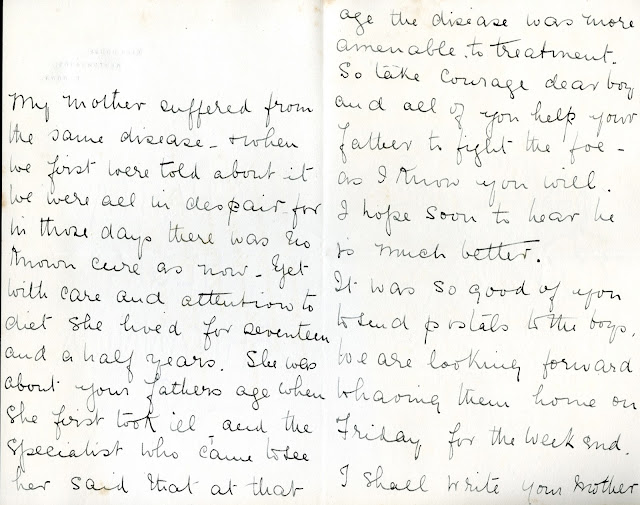
It is amazing how much I can relate to the joy in his adventures with friends and family. But as I read on, the letters took a dark turn, and the content quickly shifted from joyous vacations to his father’s poor health. The humanity and compassion within the correspondence jumped out at me. One can imagine the feeling as David Burpee read letters sent from family and friends who knew he were by the side of his ailing father.

Letter from Aunt Maggie to David Burpee regarding the illness of W. Atlee Burpee, October 25, 1915.
Just two days after working on documents that surrounded W. Atlee’s death, I was working on documents from 1980 approaching David’s death. The box was filled with happy remembrances; composed of documents related to Lois Burpee, David’s wife, and the writing of her garden cookbook, Lois Burpee’s Gardener’s Companion and Cookbook. Newspaper clippings, book reviews, congratulatory letters, and manuscript drafts made up the majority of the material. It appears Lois began working on her book in the early 1970s, but by the time she became more involved with its writing, her husband was ill. David died in June, 1980, at the age of 87. As I went through this box, I came across stacks of newspaper clippings and book reviews, and then another stack of obituaries and memorials. It was a bittersweet juxtaposition.

The fact that this collection includes far more than company records is partly due to who this family was. They were caring, hardworking and intelligent; their company was a vital part of who they were as people. The Burpee Company Collection thus offers insight into not only how a business of this magnitude operated under two generations of one family for nearly a century, but also demonstrates who these people truly were.

Chris DeMairo, Intern
Archives of American Gardens

Friday, April 20, 2018

Processing the Burpee Company Records, Part One

The first time encountering a new collection is exciting for an archivist. This is when we evaluate the physical condition of the collection, the predominant materials (papers, books, memorabilia, etc.), and, if possible, any potential series within the collection (business records, correspondence, newspapers, etc.) that aid in its final arrangement. It can be overwhelming to see a large number of disordered and dusty boxes in front of you, but knowing that within each box rests items that have not been touched for 5, 10, 30, even a hundred years is always exhilarating (in a bookish kind of way). This post will talk about my first week working on a new accretion to the W. Atlee Burpee Company Records.

The first step involves researching what exactly the collection is about. The W. Atlee Burpee Co. was founded by Washington Atlee Burpee in 1878. Burpee’s business grew over the next 15 years, and by 1893, Burpee had reached the top of the American seed scene when he was elected president of the American Seed Trade Association (ASTA). The Burpee Company rose to prominence under W. Atlee Burpee, but, of course, not without its good and bad years. When W. Atlee became ill around 1913, his eldest son David left his studies at Cornell to assist in operating the family business. In 1915, David was made CEO. Under David’s direction, the Burpee Co. continued to expand globally. In 1970, General Foods acquired the company.
David Burpee’s official resignation as president of W. Atlee Burpee Co., and the official “closing” of the deal with General Foods. The Burpee Co. merged with the Ball Seed Company in 1991 and is still an active business today.
The Burpee Co. was a well-run machine by the beginning of the twentieth century. W. Atlee Burpee was an astute businessman, a great organizer, and an innovator in seed marketing and advertising. He kept a close eye on all of his products as well. Constantly in correspondence with employees, contractors, retailers, and consumers, he stayed current with all aspects of his business. But it was marketing that separated Burpee from his competitors. Having the consumer interact with the company not only encouraged interest in Burpee seeds, but also helped the Burpee Co. connect with those who supported its business. Burpee’s approach to marketing ensured a personal and long-lasting relationship with its customers.

Looking at the business records of a company run by such a man is inspiring. Detailed notes scribbled all over scraps of paper capture his marketing skills. David Burpee had large shoes to fill when he took over the company, and he succeeded. In 1926, just a few years into radio broadcasting’s “golden age,” the Burpee Co. promoted a “largest zinnia” contest through a local radio station, WLIT in Philadelphia. Letters poured in to the radio station (which were all forwarded to the Burpee Co.) regarding the contest, with some seeking Burpee publications as well.

1926 letter submitted by Mrs. E. Shepherd of West Philadelphia to WLIT radio station in Philadelphia, Pennsylvania.  Listeners were invited to submit a letter requesting free Burpee seeds and publications. 

Between a company that crossed all oceans, and a business model that was as connected as ever to the customer, W. Atlee would have been proud of what his son accomplished. I am excited to be working on the W. Atlee Burpee Company Records. It is a great story of an American company, and deserves to be preserved. Processing collections requires patience, attention to detail, and great organization. Above all else, the archivist must acknowledge that they are presenting once hidden materials to the public.

Chris DeMairo, Intern

Thursday, December 14, 2017

What Would Frank Espada Do?

As I walk through the streets of the nation’s capital, there is never any shortage of interesting sights. But it is not the monuments nor the plethora of restaurant chains that catch my attention. Instead, I am fascinated by the social ills of society that are so often deemed invisible by our very own conscious effort to look the other way. The homelessness, protests, and social inequality I have witnessed are nothing new, but the way in which I now view these things is.


Man participating in a school boycott in New York, 1964. Frank Espada Photographs, ca. 1970-2000, 
Archives Center, National Museum of American History. AC1395-0000004. 
For over a month now, I have made the trip from downtown Silver Spring to Washington D.C. My destination: the National Museum of American History. As an intern in the Archives Center, my main task has been to process the Frank Espada Photographs Collection. The collection consists of several thousand black-and-white photographs and what seems to me an endless amount of negatives. Apart from processing the collection, it is also my responsibility to understand who Frank Espada was. At first, the answer was simple: a Puerto Rican photographer who documented the Puerto Rican diaspora and later published a book with some of his most famous photographs. But as archival work would soon teach me, the answer is never that easy.

School children in Puerto Rico. Undated. Frank Espada Photographs, ca. 1970-2000,
Archives Center, National Museum of American History. AC1395-0000002.

Walter, a migrant worker and union organizer, in his home located in Glassboro, New Jersey. 1981. Frank Espada Photographs, ca. 1970-2000, Archives Center, National Museum of American History. AC1395-0000003.
As I sift through the countless photographs, I am mesmerized by the stories that each one tells. Espada traveled to various cities in the United States and Puerto Rico and had a talent for capturing scenes and activities. One minute I could find myself in the bustling streets of East Harlem and the next in the San Juan Festival at Cabrillo Beach, California. More importantly, Espada specialized in capturing the raw emotions that are displayed by our countless facial expressions. In the collection, I have encountered photographs of individuals filled with extreme joy and happiness, and by complete contrast, photographs of individuals filled with grief and emotional pain. It’s these photographs that capture the eye of an observer. As I dug deeper into the collection, I realized that Frank Espada was more than just a talented photographer.

Included in the collection are black-and-white photographs taken by Frank Espada during the Civil Rights Era. It’s here that it became clear to me how much his life revolved around community activism. He was driven by a sense of social justice and worked to improve his community and counter the racism and discrimination of the 60s and early 70s. In two photographs, he appears standing next to a sign that reads, “East New York Action”. Espada founded East New York Action, a community organization created for the sole purpose of addressing issues in the community. East New York Action organized rent strikes, educated people on welfare rights, and registered voters. There are photographs of the Puerto Rican Community Development Project, an organization that Espada worked for as a community organizer. Additionally, he had strong ties with the United Bronx Parents and the Young Lords, among others. Frank Espada was a determined leader with an ability to connect with others and a dedication to his community that was hard to match.

I think of Frank Espada and his work, both as a photographer and as a community leader, and comprehend his vision of the world. He saw beauty in every photograph, but understood that the most important thing he could do was help others through their struggles and listen to their stories when the world surrounding them chose to turn a blind eye. It is this part of the collection that impacts me the most. As I continue my walk through D.C., I ask myself, “What would Frank Espada do if he witnessed everything I see on my walks to work?”

I think back to the 30 cassettes in the collection that I spent two weeks digitizing. Each cassette had full-length interviews conducted by Frank Espada of community leaders such as Jack Agüeros, Willy Vasquez, and Juan Gonzalez, among others. Personally, it was my favorite part of the collection, as I was able to place a voice on several of the faces I saw in photographs. It was here that I realized what Espada was doing: he was giving a voice to the community. While his photographs did the work of establishing a national presence of Puerto Rican culture and identity, these interviews showcase the collective work that was being done across the country to improve the lives of Puerto Ricans and other Latinos living in the United States. They were a clear reminder that we must give a voice to the communities that are often silenced by the social barriers of inequality.
Self-portrait of Frank Espada standing in front of East New York Action. Undated.
AC1395-0000001.
So what would Frank Espada do? He would remind us that we must take the time to listen to each other’s stories and to speak up for ourselves and for others. He would remind us that if we do not take the time to do these things, we are incapable of seeing the world through more than one lens, oblivious of the things happening around us. And of course, he would do all of this with a camera in hand, ready to capture us in our most intimate moments. This is what Frank Espada would do.

Edwin Rodriguez, Intern
Archives Center, National Museum of American History

Monday, October 16, 2017

Bryson Jones’ Deep South Travelogue: A Glimpse into Tourism’s Impact on Southern Landscapes and Identities

As a summer intern at the National Anthropological Film Collection (formerly known as the Human Studies Film Archives) in the National Anthropological Archives I digitized clips from the documentary film Bryson Jones Travelogue: Deep South, ca. 1940. This film was used by an amateur travel-lecturer and documented his travels through the American South, focusing on popular tourist destinations. I believe the footage captured in this documentary is particularly valuable for anthropologists and historians alike because of its footage of southern tourism.

Florida oceanarium, likely Marine Studios, St. Augustine, Florida (frame grab sihsfa_1995_11_008_fg_1), National Anthropological Film Collection, National Anthropological Archives, Smithsonian Institution.

But why should we care about southern tourism? Well, because the tourism industry is not only one of the South’s most powerful economic forces, tourism is also an incredibly important actor in the creation of southern imaginaries and landscapes and has played a significant role in shaping a unified and easily identifiable “southern” identity (Starnes; McIntyre). In the half-century after the Civil War, northern tourist writers marketed the South as an exotic, anti-modern, and picturesque escape from modern industrial society to the North’s “affluent urbanites” (Cox; McIntyre). Aiding the growth of southern tourism were rapidly improving and expanding transportation systems and an emerging northern middle class (Cox). Although the South was not the only region of the United States popular for travel during this time period, it was more accessible and less expensive to those Americans living in the North and Midwest who wanted to experience a change in landscape (Cox). The influx of tourists to the region aided in reimagining the South and transforming major cities while southern attractions began promoting a highly romanticized version of a mythic “Old South” and other contrived regional mythologies (McIntyre).

By 1940, tourists were flocking to popular southern tourist areas, many of which are captured in Bryson Jones’ travelogue. This film includes footage of New Orleans, Miami, Jamestown, Appomattox, and the Florida Keys. Each of these locations are examples of tourism’s pronounced impact on southern culture, identity, and landscape. For instance, New Orleans, previously cast as a dangerous “moral escape hatch,” was culturally white-washed and rebranded as a festive city with a romantic, foreign past during the interwar years (Stanonis; Souther). As tourism transformed New Orleans, Miami “burst upon the national consciousness” and its defining values of leisure and luxury appealed to tourists (Schrum). In Bryson Jones’s travelogue you can observe how the tourism industry and the rapid changes in the decades after the Civil War had manifested in both cities by 1940.

Also included in the travelogue are what appear to be two of Florida’s most popular tourist attractions, Marine Studios, popularly known as the “World’s First Oceanarium,” and Silver Springs State Park, a popular tourist destination that offered glass-bottom boat tours and the Ross Allen Reptile Institute. Although a small portion of Bryson Jones Travelogue: Deep South, the footage of Silver Springs State Park is a fascinating window into Florida tourism because of the ways in which this attraction and other similar ones invented a mythic history of Florida’s Everglades and Seminole people. Until the end of the 19th century the Seminoles were cast as “craven mixed-race killers” central to the view of Florida as a “forbidden land” (Knight). Around the turn of the century the Seminoles were recast as “benign specimens of moral and racial purity and saleable symbols of the state’s unique appeal” (Knight). In addition to the recasting of the Seminole Indians, south Florida’s growing popularity and real estate boom in the 1920s caused drainage canals to permeate deeper into the Everglades and erode the resources previously relied upon by the Seminoles (Knight). Thus, Seminoles were more and more likely to work at tourist sites. Tourist sites, such as Silver Springs, capitalized on the draw these newly recast Seminole Indians had on tourists and set up commercial Seminole tourist camps, where the inhabitants would sell crafts as souvenirs and wrestle alligators, as seen in Bryson Jones’ travelogue (Mechling). Alligator wrestling became synonymous with Seminole manhood, yet in reality was inauthentic and violated Seminole taboos about mistreatment of spiritually powerful animals (Frank). Regardless, the image of Seminole Indians constructed by Florida’s tourism industry entered popular culture and the larger southern imaginary.

Possibly Ross Allen or a Seminole Indian employed by Allen at the Reptile Institute, Silver Springs, Florida (frame grab sihsfa_1995_11_008_fg_2), National Anthropological Film Collection, National Anthropological Archives, Smithsonian Institution.
Bryson Jones’ Deep South travelogue is not the only of his travel films housed at the NAFC. The NAFC received eight travelogues documenting his travels to all corners of the world during the late 1930s and early 1940s. These travel films can be found in the NAFC in the National Anthropological Archives, located at the Museum Support Center in Suitland, MD. You can also find clips from Bryson Jones Travelogue: Deep South on the HSFA YouTube channel.

Caroline Waller, Intern
National Anthropological Film Collection,
National Museum of Natural History


References
Cox, Karen L., ed. Destination Dixie: Tourism and Southern History. University Press of Florida, 2012. Florida Scholarship Online, 2013. doi: 10.5744/florida/9780813042374.001.0001.

Frank, Andrew K. "Authenticity for Sale: The Everglades, Seminole Indians, and the Construction of a Pay-Per-View Culture." In Destination Dixie: Tourism and Southern History, edited by Karen L. Cox. University Press of Florida, 2012. Florida Scholarship Online, 2013. doi: 10.5744/florida/9780813042374.003.0014.

Kelly Schrum, Gary R. Mormino; Travel, Tourism, and Urban Growth in Greater Miami: A Digital Archive, http://scholar.library.miami.edu.libproxy.lib.unc.edu/miamidigital/. Created and maintained by the Otto G. Richter Library, University of Miami, Fla. Reviewed Feb.–April 2007. J Am Hist 2007; 94 (3): 1045-1046. doi: 10.2307/25095307

Knight, Henry. "'Savages of Southern Sunshine': Racial Realignment of the Seminoles in the Selling of Jim Crow Florida." Journal of American Studies 48, no. 01 (2014): 251-73. doi:10.1017/s002187581300128x.

McIntyre, Rebecca Cawood. "Introduction." In Souvenirs of the Old South: Northern Tourism and Southern Mythology. University Press of Florida, 2011. Florida Scholarship Online, 2011. doi: 10.5744/florida/9780813036953.003.0001.

Mechling, Jay. Florida Seminoles and the Marketing of the Last Frontier. Westview, 1996.

Starnes, Richard D., ed. Southern Journeys : Tourism, History, and Culture in the Modern South. Tuscaloosa, US: University of Alabama Press, 2014. Accessed July 10, 2017. ProQuest ebrary.

Stanonis, Anthony J.. Creating the Big Easy : New Orleans and the Emergence of Modern Tourism, 1918-1945. Athens, US: University of Georgia Press, 2006. Accessed July 12, 2017. ProQuest ebrary.

Souther, Jonathan Mark. New Orleans on Parade : Tourism and the Transformation of the Crescent City. Baton Rouge: Louisiana State University Press, 2006.

Monday, October 9, 2017

A Summer with Helen

Joseph Garry and Helen Peterson at the NCAI Convention in Spokane, WA, 1955. National Congress of American Indian Records, Photo Folder 158. National Museum of the American Indian, Archive Center. 
As I neared the end of my internship at the National Museum of the American Indian Archive Center this past summer, I was able to take some time to reflect on my work processing the Helen Peterson papers (NMAI.AC.016).  While I was not the first person to process this collection, I do think I got to see a different part of Helen Peterson’s life.  My predecessor, Carla Davis-Castro, dealt mostly with Helen’s materials from her time working at the National Congress of the American Indians (NCAI), the City and County of Denver Commission on Community Relations (CCR), American Indian Development, Inc. (AID), and the White Buffalo Council which deal with Helen’s work between the 1940s to the 1970s.  You can read Carla's blog about here work here. While I did get to process through some materials relating to her time in NCAI, CCR, AID, and the White Buffalo Council, most of what I processed related to her life before and after working at these institutions.  Helen was alive from 1915 to 2000 so there was a large portion of her life that had not yet been explored through the collection.

From 1970 to 1985 Helen was a part of the Bureau of Indian Affairs (BIA).  During her time with the BIA, she went to the United Kingdom to talk about Native Americans.  Around this same time, President Reagan made some uneducated remarks about reservations, catching the attention of the BIA and people that Helen knew, and prompting a response from the Native American community.
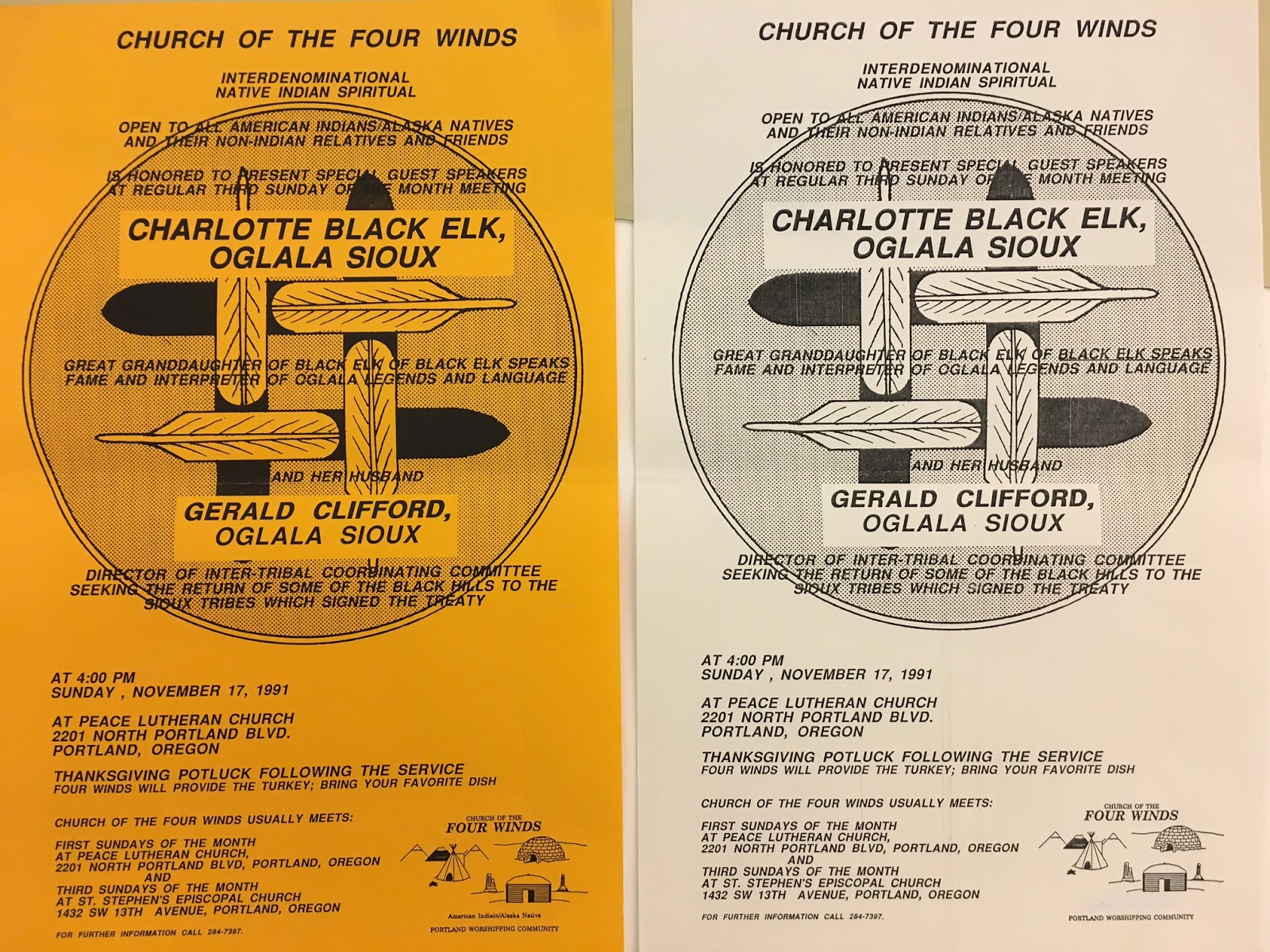
Helen was also a very religious person, who was active in the Episcopal Church.  She started her own church called the Church of the Four Winds.  While she wasn’t a pastor she was the leader of the church.  She maintained an active role in the church during the late 1980s through the 1990s.

Church of the Four Winds Flyers, 1991. Helen Peterson papers. National Museum of the American Indian, Archive Center. 


While it was interesting learning more about the professional side to Helen Peterson, my favorite series to work with was her Personal one.  She had many personal materials including letters from her granddaughter, personal photographs, holiday cards, and cards from her 80th birthday.  This collection really showed how many people loved Helen and highlighted her connection to the people in her life.  Her personal papers also revealed how her life was not always happy.  I found out that following the death of her mother and brother, Helen sought psychiatric help.  As a part of the grieving process,  Helen wrote letters to her mother and brother to help her cope with the many emotions after both of their deaths.  While it was sad to go through these letters, I am glad I was able to read through them, as these letters were more than just materials that needed to be filed away they were the gateway to see Helen Peterson the person.

Letters from Helen Peterson to her mother and brother following their deaths, 1992. Helen Peterson papers. National Museum of the American Indian, Archive Center. 


Sarah Rick, Summer Intern (2017)
National Museum of the American Indian, Archive Center

For more information about NMAI Internship program please visit NMAI’s website here.

Wednesday, July 19, 2017

Public anthropology and the Millennium film project: Cinema of Advocacy or Contradiction?

During my summer internship at the National Anthropological Film Collection (formerly the Human Studies Film Archive) in the National Anthropological Archives. I worked on rehousing and processing the Millennium trims and outs collection. This collection consists of the film edited into a 1992 television series hosted by Harvard anthropologist David Maybury-Lewis.
Small index cards representing footage removed for inclusion in final cuts of episode.
This is typically one of the final steps in production.
 To process the materials, the film rolls were rehoused in archival film cans, which were placed in the National Anthropological Film Collection (NAFC)’s state-of-the-art environmentally controlled sub-zero vault, located at the Museum Support Center in Suitland, MD. In total, the collection comprises 1336 rolls of double-perf camera original rolls that have been rehoused into 399 cans. In addition to preserving the film rolls, the other major goal when processing the collection was to keep valuable contextual and technical information associated with each film roll. Happily, the Millennium trims and outs collection is now safeguarded for future researchers, preserving high quality ethnographic film that portrays a diverse collection of subjects.
Millennium outs and trims collection in sub-zero storage vault.
In addition to handling the collection, I also had the opportunity to learn something about the Millennium film series. What I discovered is that the film collection is particularly fascinating because it reflects some of the methodological and humanistic transformations that were occurring in anthropology during the end of the 20th century. These transformations, I think, display some of the contradictions between ethnographic film and the burgeoning discipline of public anthropology.

In the last few decades of the 20th century, anthropology underwent a transformation as applied anthropologists and academic researchers began to converge on a form of anthropology today known as engaged, or public anthropology (Lamphere 1053). As a result, the discipline became more self-reflexive about its ethics and the politics of its work (Hart 7). This new branch of anthropology called for an increase in collaboration and partnership with the particular communities in which anthropologists worked, as well as increased engagement by anthropologists in the public and political spheres in an attempt to influence policy (Lamphere 1053).

At the forefront of the changes to the discipline was David Maybury-Lewis (Borofsky; Lamphere 1052). Maybury-Lewis strived to counteract negative feelings and popular disdain for indigenous groups, or the so-called “Other,” and to advocate for the interests of these small-scale societies (Hart 1041). Perhaps the largest contribution to his legacy was his creation of the organization Cultural Survival, an NGO dedicated to collaboration that would strengthen the ability of indigenous people to operate their own organizations and advocate for their own rights, including land rights, health care, education, and political power (Lamphere 1051). The 16mm films from his Emmy award-winning 1992 ethnographic film project, Millennium: Tribal Wisdom and the Modern World, which are now processed and housed in the Millennium trims and outs collection at the NAFC is another key piece of Maybury-Lewis’ legacy.

The Millennium documentary film project aired on television in ten 60-minute episodes before being released on VHS in 1992. Holistically, the project challenged the morality of the state (in their various particulars) and attempted to generate broader appreciation for forms of indigenous knowledge that had been amassed over millennium. In short, the series sought to illuminate “tribal” values and knowledge that could “contribute to the transformation of public ethics” in the coming millennium (Hart 1037). The series examined large universal topics, such as love, marriage, politics, wealth, spirituality, power, identity, and art, while looking at specific ethnographic examples from at least 15 distinct countries. Among the indigenous societies filmed by Maybury-Lewis and his crew were the Xavante of western Brazil (the society where he did his original fieldwork), the Mashco-Piro of Peru, the Wodaabe of Niger, the Nyimba of Nepal, the Gabra of Kenya, the Makuna of Colombia, the Dogon of Mali, the Weyewa of Sumba (Indonesia), the Huichol of Mexico, and the Navajo of the southwestern United States. As a way to drive home the universality of themes that it considered, the series contrasted this footage of “tribal” communities with the challenges faced by individuals in Western societies. Examples included an artist dying of AIDS, a teenage suicide-attempt survivor, and a New York City garbage man. Interwoven among these stories is a reflection on the positive and negative impact anthropological pursuits can bring to indigenous societies, as well as an attempt to advocate on the behalf of such communities.

Maybury-Lewis’ goal for the Millennium project was to shed a light on the importance of cultural diversity and to advocate for the rights of indigenous peoples. The project, however, still received critique from his fellow anthropologists. Although self-reflexive about anthropology, Millennium represented indigenous people similarly to earlier ethnographic cinema and revealed in visuals of the exotic “otherness” of indigenous people (Rony 220). Television’s entertainment model did not allow such a project to fully break free of ethnographic cinema’s traditional conventions because it called for dramatic storylines and mystery, clashing with anthropology’s late 20th century critique of exoticism, essentialism, and objectification (Hart 9). While the Millennium series often focused on important socio-political issues, such as the Canada’s Oka Crisis of 1990, it also employed dramatic English voices-overs imagining deeply personal stories of indigenous individuals from a Western perspective.

Regardless of the contradictions of the series, the project is rich in documentary value because of the exceptional footage captured by Maybury-Lewis and his crew, as well as its demonstration of the philosophical tensions in anthropology during the late 20th century. In the National Anthropological Film Collection in the National Anthropological Archives you can now find the original outtakes and trims from the Millennium project.

Caroline Waller, Intern
National Anthropological Film Collection 
National Museum of Natural History


Works Cited
Borofsky, R. (2000), COMMENTARY: Public Anthropology. Where To? What Next?. Anthropology News, 41: 9–10. doi:10.1111/an.2000.41.5.9

Hart, Laurie Kain. "Popular Anthropology and the State: David Maybury-Lewis and Pluralism." Anthropological Quarterly 82, no. 4 (2009): 1033-042. http://www.jstor.org/stable/20638679.

 Lamphere, Louise. "David Maybury-Lewis and Cultural Survival: Providing a Model for Public Anthropology, Advocacy, and Collaboration." Anthropological Quarterly 82, no. 4 (2009): 1049-054. http://www.jstor.org/stable/20638681.

Rony, Fatimah Tobing. The Third Eye : Race, Cinema, and Ethnographic Spectacle. N.C.: Duke University Press, 1996.

Wednesday, December 10, 2014

Baby, It's Cold Outside...

As the winter season approaches, it occurred to me to search SIRIS for “winter” imagery to see what the scope of such holdings in the Archives Center might be.  I found fewer than I expected, and theorize that not all the relevant items have been tagged with “winter” consistently.  The majority of the item-level records returned were for stereoscopic photographs in the Underwood & Underwood Glass Stereograph Collection.  They include such scenery as snow-capped mountains, but also pictures of winter activities, including snow sports.  This entire collection of approximately 28,000 stereo negatives and interpositives is available online, although the linked images are of poor quality, having been digitized at low resolution from a videodisc (thereby creating fifth-generation copies).  We supply new high-resolution scans of pictures in this collection on an ad hoc basis, substituting them for the low-quality images linked to our catalog records—generally one at a time.

I had forgotten that an energetic summer intern, Kathy Kinakin, had already re-scanned some of these photographs several years ago.  She concentrated on anomalies in the Underwood & Underwood collection, specifically searching for cellulose nitrate film.  Most of the film in this collection is non-stereoscopic and a bit later than the 3-D pictures, documenting the company’s ventures into a new field—news photography.  In around 1898-1910, the company began producing stereoscopic pictures of contemporary political figures and “news” events, so eventually it was logical for them to complete their transition to news photography and to end stereograph production.


"Los Angeles, California - Starting on toboggans from the mountain slopes of Los Angeles County Park and terminating with a dip into the semi-tropical pool at Arrowhead Hot Springs, youthful Los Angeles couples staged a unique race..."
Film negative by Underwood & Underwood, ca. 1930.
Underwood & Underwood Glass Stereograph Collection, Archives Center 

Although Underwood & Underwood began documenting political events and even wars, a substantial percentage of their pictures for the daily press illustrated “soft” news and “human interest” stories.  I present herewith some of the winter-related press images that Kathy selected to re-scan for both their technical and topical interest.  The picture above documents a novel winter race, and its newspaper caption follows:

“Los Angeles, California -- Starting on toboggans from the mountain slopes of Los Angeles County Park and terminating with a dip into the semi-tropical pool at Arrowhead Hot Springs, youthful Los Angeles couples staged a unique race. An hour and four minutes after they had left the snowy mountains, the winners were stripping off furry garments underneath which they wore bathing suits, and were plunging into the warm pool in the valley below. The unusual contest was part of the program of winter sports at the annual snow carnival of the L.A. Junior Chamber of Commerce. Photo shows: The start of the race -- left to right-- Miss Joyzelle Joynier and Chris Christensen, the winners; Miss Jean Boring and Dr. Alex Linck, and Manuella Sarsabal with Hudson Drake.  Adolff Dorr, at the right, served as starter.”

"Miss Joyzelle Joynier, of the winning couple, as she stepped in the pool at Arrowhead Hot Springs..."
Film negative by Underwood & Underwood, ca. 1930.
Underwood & Underwood Glass Stereograph Collection, Archives Center 

And here’s a related closeup, captioned: “Los Angeles, Cal.-- Photo shows: Miss Joyzelle Joynier, of the winning couple, as she stepped in the pool at Arrowhead Hot Springs, winning the Winter to Summer Race staged by the Chamber of Commerce. On her head she is carrying her snow shoes and winter outfit which she wore at the start of the race -- on the mountain slopes of Los Angeles County Park. The contestants started on toboggans and raced down the snowy slopes. Snow shoes were also used. When they reached the Hot Springs pool, they stripped off their winter garments to their bathing suits and plunged in. All in an hour and 4 minutes."  Of course, gratuitous “bathing beauty” pictures were a staple of newspapers for many years.   The “news” justifying their publication was usually flimsier than this.

Although that picture provides a glimpse of Ms. Joynier’s somewhat daring (for its time) two-piece swimsuit, newspaper “beauty queen” pictures could be vivacious, yet quite modest.  In the image below, the Snow Queen of Westlake Park, Catherine Curby, models cold-weather clothing.

"...Miss Catherine Curby after being crowned Snow Queen in Westlake Park here. She is to reign over the snow sports in the mountains not far from here, and her furry costume in a semi-tropical setting presents a novel contrast..."
Film negative by Underwood & Underwood, ca. 1930.
Underwood & Underwood Glass Stereograph Collection, Archives Center 

David Haberstich
Curator of Photography, Archives Center

Thursday, August 14, 2014

All the World’s a Stage: Researching the Chicago Columbian Exposition of 1893 at the Archives Center

Between May 1st and October 30th of 1893, Chicago hosted the World’s Columbian Exposition, which celebrated the 400th anniversary of Christopher Columbus’s journey to the New World. The people of Chicago had their work cut out for them.  Just twenty years after the Great Fire of 1871 and in the midst of labor strife, organizers set out to create a magnificent space in Jackson Park, located along Lake Michigan.  Known as the “White City,” the structures that were built were to be temporary and plastered with white stucco. They included the largest building in the world at the time, the Manufacturers and Liberal Arts building, in addition to the Woman’s Building designed by the first woman to receive an architecture degree from MIT, Sophie Hayden (1868-1959). Still standing today is the Palace of Fine Arts building, now known as the Museum of Science and Industry.
 
Silver gelatkin photographic print by unidentified photographer, 1893.  Kenneth M. Swezey Papers,
Archives Center, National Museum of American History.

Many of the collections housed at the National Museum of American History’s Archives Center offer a glimpse into the World’s Columbian Exposition, where the Ferris Wheel and Crackerjack made their debut, and millions of people throughout the world journeyed to Chicago, which was considered by some as “the greatest marvel of rapid and substantial growth of any city in the United States” (Schneyer’s Illustrated Handbook, p. 2).  The Warshaw Collection of Business Americana has an exceptionally comprehensive collection of World’s Fair material. In fact, viewing this collection wouldn’t limit a researcher to just the topic of a World’s Exposition. The collection provides great historical context for anyone researching  Chicago at this time. The scope of the collection includes many guidebooks that provide calendars of events, maps, information on the many buildings of the fair, including their exhibits and layouts. Tourist information, including hotel costs ($2-$3 dollars a day for the Sherman House and the Tremont), places to shop (department stores Marshall Field’s and Carson Pirie Scott), and restaurants (over 700) can be found in these books as well.

New Indexed Standard Guide Map of the World's Columbian Exposition at Chicago, 1893, from Rand McNally's "Week at the Fair" booklet.  From World Expositions series, Warshaw Collection of Business Americana, Archives Center, NMAH 

In addition to the Warshaw collection’s World’s Exposition material, the Archives Center has two diaries written by attendees of the fair in 1893. The Paul R. Strain Columbian Exposition Diary, 1893 was hand written by fourteen-year-old Paul Strain of West Virginia, who kept a daily log of every building he visited and each exhibit he viewed. Inside the West Virginia exhibit, he saw a globe made of grain, and when he visited “the largest building on Earth” he noted the French gowns, pipe organs, and a two-hundred-year-old carpet priced at $15,000 on display.  Plooma Boyd’s Diary of the 1893 Columbian Exposition notes her surroundings in Chicago, including streets and neighborhoods visited throughout the city and exhibits within the Chicago Exposition.

The Larry Zim World’s Fair Collection has an extensive amount of 1893 Columbian Exposition material and contains printed ephemera such as advertisements and admission tickets. The stereographs in the collection detail the breath-taking architecture, interiors of buildings, exhibits, and attractions such as the Ferris Wheel.

Stereograph by B.W. Kilburn, 1893 (copyright 1894), from World's Columbian Exposition series.
Larry Zim World's Fair Collection, Archives Center, National Museum of American History.

Stereograph by B.W. Kilburn, 1893 (copyright 1894), from World's Columbian Exposition series.
Larry Zim World's Fair Collection, Archives Center, National Museum of American History.

In addition to the collections mentioned, there are Chicago Exposition materials interspersed throughout the 1350-plus collections in the Archives Center.  So take a journey back in time and experience the Chicago Columbian Exposition through the diaries, guidebooks, photographs and ephemera at the Archives Center.

Meghan Ryan, Intern
Archives Center, National Museum of American History

Wednesday, August 6, 2014

Root Beer Blast from the Past!

Root beer is a small but powerful example of modern print advertising techniques in 19th century America.  The Warshaw Collection of Business Americana holds hundreds of trade cards, advertisements and ephemera.  The collection is organized into hundreds of categories ranging from agriculture to World’s Fairs, and root beer advertisements are found in the “Beverage” series of the Warshaw Collection.  The root beer companies exemplify new marketing schemes and a new way to make profit in patent medicines and “healthful” beverages.  There is also a large “Patent Medicine” series in the Warshaw Collection.

Hires Rootbeer trade card, ca. 1900.
The late 19th century, often known as the Progressive Era, was a time of shifting social customs.  Large corporations sprang up as smaller companies were absorbed or were run out of business.  New manufacturers such as Hires Rootbeer sent their products around the country to local grocers, druggists, and chemists, creating standardized nation-wide products.   Trade cards advertising Hires Rootbeer often give a local name and address to find the product, such as “S.O. Tarbox, Groceries and Drugs, Farmington, Me.”  Hires Rootbeer demonstrates the new way companies sold goods to a national market instead of merely a local one.

Some companies used games or pseudoscience to market their product.  Knapp’s Root Beer used palmistry on an advertisement for their root beer to attract more customers.  The drawing of a hand marked with letters corresponds to explanations on the back which supposedly indicate personality traits of the viewer.  Using palmistry on an advertisement attracted a new group of consumers to the brand.  People learned about the product while looking at the advertisement to figure out what their hands allegedly said about themselves.  Without the palmistry “hook,” consumers might not have given the advertisement a second look.  It is similar to the sponsorship that companies participate in today.  When Coca-Cola sponsors the World Cup they are getting brand notoriety, comparable to Knapp’s Root Beer palmistry.


Trade card for Knapps Root Beer, ca. 1900.
Verso of trade card at left.

Root beer advertisers also took part in the widely-used marketing scheme of patent medicines. Prevalent in the 19th century in America, patent medicines were non-regulated goods that a druggist or chemist would sell to the public claiming (mostly false) cures for common illnesses.  Dr. Buker’s Root and Herb Beer promised to be “a purifier of the blood” and “a stimulator of the digestive organs.”

Trade card for Allen's Root Beer Extract. 

Dr. Buker's Root and Herb Beer
advertising flyer.
Bryant’s Root Beer was used as “a general stimulant” and “a nerve tonic.”  Allen’s Root Beer Extract claimed not only to act “upon the Kidneys and Liver,” but to furnish “the most valuable elements of nutrition.” The unfounded claims of root beer producers demonstrate an attempt to profit from the budding consumer culture.

Bryant's Root Beer trade card.
Bryant's Root Beer trade card. Verso of card above.
 
Trade card for Raser's Root Beer Extract.

Similarly, Raser’s Root Beer believed in their product enough to warn their buyers to “Beware of worthless imitations.” Ironically, Raser’s root beer itself is an imitation of medicine, despite offering no proof of its promise as a “nerve strengthening beverage.” The advertisements never stated what ingredients of the root beer made it “nerve strengthening,” making the words dubious at best.  Questionable descriptions and claims such as these led to the Pure Food and Drug Act of 1906 passed by President Theodore Roosevelt, partly in an attempt to weed out false claims and misleading information.  The root beer trade cards in the Warshaw Collection of Business Americana are a minuscule part of Warshaw’s collection, but they tell a story of America’s early days of modern advertising.

-- Halle Mares, Intern,
Archives Center,
National Museum of American History


All images shown here are from items in the "Beverages" series, ca. 1880-1920, Warshaw Collection of Business Americana, Archives Center, National Museum of American History.