Smithsonian Collections Blog

Highlighting the hidden treasures from over 2 million collections

Collections Search Center
Showing posts with label Women's History. Show all posts

Monday, March 21, 2022

Women, Cameras, and Images

By David Haberstich

In recent years the Smithsonian Collections Blog has featured numerous posts about women photographers represented in Smithsonian collections. For instance, I’ve blogged about the photographers Katherine Joseph, Dawn Rogala, and Melody Golding, whose work is in the NMAH Archives Center, but now I want to highlight a much earlier Smithsonian effort to celebrate women in photography. The National Museum of American History (then the Museum of History and Technology) featured female photographic artists in a series entitled “Women, Cameras, and Images” in 1969-1970, initiated by Curator of Photography Eugene Ostroff. Although three of these photographers were famous, even legendary, and already included in general histories of photography, two were comparatively unknown at the time. Prints by all five are in the museum’s Photographic History Collection, acquired in conjunction with their exhibitions. This program was an early attempt to emphasize the contributions of women to twentieth-century photography via a series that combined three famous photographers, who utilized standard photographic techniques to achieve their unique personal vision, with two younger, relatively unknown artists who experimented with “obsolete” photographic processes, combined with hand techniques, to interrogate assumptions about the nature of photography. Indeed, Betty Hahn later challenged standard notions about photography (and the nature of her multi-media variations) in the very title of her book, Photography…Or Maybe Not. *
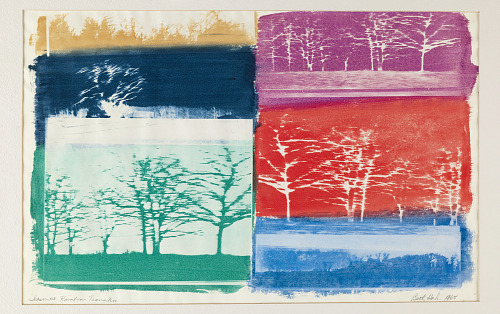
Betty Hahn (b. 1940), "Seasonal Rainbow Transition," gum bichromate with paint on paper, 1968. Photographic History Collection, National Museum of American History.

All four exhibitions were accompanied by poster-checklists and formal, if modest, openings. The first show in the series, “Women, Cameras, and Images I,” was a retrospective of Imogen Cunningham’s classic imagery. I well remember her sly humor and witty sarcasm at her opening: she was delightful, and it was especially gratifying for me after my failed attempt to meet her during a trip to San Francisco.
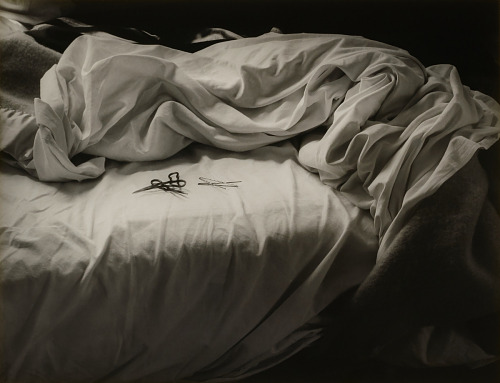
Imogen Cunningham (1882-1976), "Unmade Bed," gelatin silver photographic print, 1957, printed 1957, Smithsonian American Art Museum.

The second exhibition, “Women, Cameras, and Images II,” combined the work of Betty Hahn and Gayle Smalley. I had met Betty in graduate school at Indiana University and vaguely knew Gayle, who had graduated from the Rochester Institute of Technology five years before I had. Their work was very different from that of the other three women, employing radically new approaches to the medium. Hahn was one of the first photographers to experiment with “obsolete” photographic processes, including gum-bichromate, and combined photography with textiles, sometimes adding hand-work, such as paint, needlework and embroidery, which in her words represented a homage to the unsung women who traditionally practiced such stereotypically feminine “crafts.” Independently, Gayle Smalley combined photography with hand printmaking techniques. Hahn’s and Smalley’s prints were colorful, semi-abstract, and often playful and humorous, heavily influenced by contemporary printmaking.        

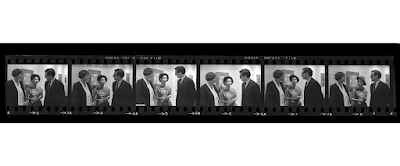
Above: Gayle Smalley (left) and Betty Hahn (center) talking with Eugene Ostroff at the opening of their exhibition, 1969. Smithsonian photographer unidentified.

“Women, Cameras, and Images III” was devoted to the work of Berenice Abbott, whose long and influential career ranged from documentation of New York City to the development of techniques for  scientific photography, in which she was an important pioneer. Unfortunately, we lacked funds to bring her to Washington for the opening, and I think she never quite forgave me.
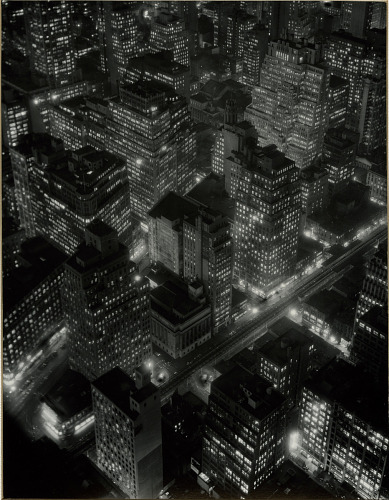

Berenice Abbott (1898-1991), "Night Aerial View, Midtown Manhattan," 1933, gelatin silver print. Photographic History Collection, National  Museum of American History.


Barbara Morgan was the artist of “Women, Cameras, and Images IV.” Noted for her photographs of Martha Graham’s dancers, a major component of the exhibition, she worried about the design of the show, and explained her concern with rhythm and flow in the placement and sequencing of the framed images. I was tempted to let her develop the layout or collaborate with me, but was warned not to permit her participation lest it delay the opening. It was a nail-biter for me as I hung the show, fearing that she didn’t fully trust my curatorial eye, but I needn’t have worried: she was pleased and pronounced it a huge success, telling me “You got it!” She had been honored previously in a similar retrospective solo exhibition at the Museum of Modern Art, curated by my photo-history mentor, Peter Bunnell, and pronounced my design “better.” At social occasions for several years afterward she proudly introduced me as “the man who hung my Smithsonian show, you know,” and we had a lovely and rewarding friendship.
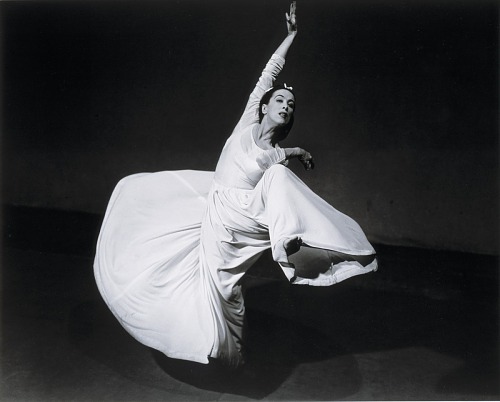
Barbara Morgan's photographs have been collected not only by NMAH, but also by the Smithsonian American Art Museum (SAAM) and the National Portrait Gallery (NPG). This is also true for the work of Imogen Cunningham and Berenice Abbott. However, NMAH was the first Smithsonian museum to collect and mount exhibitions of their work. 

Barbara Morgan (1900-1992), "Martha Graham--Letter to the World--(Swirl)," 1940, gelatin silver print, printed ca.1980. Smithsonian American Art Museum, gift of Virginia Zabriskie. 

However, the series, which originally was intended to continue for another year, foundered and ended when some photographers objected to being “classified” or identified as “women photographers” within a special series, as if each photographer's work couldn't stand on its own merits. Similarly, I recall hearing certain women criticize the creation of Washington’s National Museum of Women in the Arts for what nowadays some might call bad “optics,” appearing to relegate female artists to a separate category rather than striving to integrate them in greater numbers into existing art museum awareness and practice.

Opinions, perspectives, and tactics intended to promote social change often themselves change with the times and the politics of culture, however. In 1970 we found that for some women photographers, the prospect of inclusion in a series of gendered exhibitions (curated by men) entitled “Women, Cameras, and Images” could be interpreted as more demeaning than celebratory, perhaps suggesting mere tokenism. Controversial “optics!” By contrast, the emphasis on equity in the 2020s has regularly employed group solidarity and separation as a logical, effective tactic to highlight marginalized groups and their members’ individual stories--for example, through Black History Month and Women’s History Month. I recently noticed a current exhibition at Lehigh University entitled “Hear Me Roar: Women Photographers II,” reflecting the similar strategy of the Smithsonian’s “Women, Cameras, and Images” exhibitions of the tumultuous late 1960s. I couldn't help smiling.

David Haberstich, Curator of Photography

Archives Center, National Museum of American History 

Tuesday, February 15, 2022

Hidden History, Part 2: Joy McLean Bosfield Sings at Kennedy Center Dedication

 By Jennifer Sieck


Joy McLean Bosfield framed this page from the score for “Gloria in Excelsis” signed for her by MASS composer Leonard Bernstein. She sang in the choir for MASS’s world premiere, conducted by Bernstein for the Kennedy Center’s dedication in 1971. Joy McLean Bosfield papers, Anacostia Community Museum, Smithsonian Institution, gift of Joy McLean Bosfield.

"Gloria in Excelsis" proclaims the title of this autographed musical score in prelude to the story of Joy McLean Bosfield (1924-1999), a musician, educator, and entrepreneur who lived in Washington, DC from 1962 to 1985. Like another accomplished African American musician in the District featured in a prior post on this blog, McLean Bosfield was instrumental in bringing the Kennedy Center into being. Her contribution took the form of singing in Leonard Bernstein’s MASS: A Theatre Piece for Singers, Players and Dancers at the Kennedy Center’s dedication on September 8, 1971. Commissioned by Jacqueline Kennedy Onassis in memory of her husband, President John F. Kennedy, Bernstein riffed on the traditional Latin mass to honor the nation’s first Roman Catholic president in an operatic piece featuring more than 200 performers and choreography by Alvin Ailey. The Kennedy Center’s 50th Anniversary Season concludes with a new interpretation of MASS in September 2022.


Original Production of Leonard Bernstein’s MASS, 1971. Photo by Fletcher Drake. Courtesy of the John F. Kennedy Center Archives, 1971. Joy McLean Bosfield might be among the robed choir members above the dais, possibly the second singer in the first row to the right of the center aisle. The photo ran on the front page of The Washington Post on September 9, 1971.

The framed sheet music might have been especially meaningful for McLean Bosfield, as she had co-founded a business that prepared printed music for publication in 1959. This excerpt from “Gloria in Excelsis” shows the choral and orchestral parts for an exuberant response to the absolution of sin. Across the opening bars, Bernstein inscribed in red ink, “Gloria to Joy McClean!” [sic] along with his signature and the date. Significantly, it is the only framed item among the newspaper clippings (including Washington Post articles about MASS at the Kennedy Center), photographs, and programs in the Joy McLean Bosfield papers at the Anacostia Community Museum.


A photo from Joy McLean Bosfield’s scrapbook shows the cast of 
Porgy and Bess in Hollywood in 1954: left to right, unidentified man, Irene Williams, Leslie Scott, Joy McLean, LeVern Hutcherson. Courtesy of The Joy McLean Bosfield papers, Anacostia Community Museum, Smithsonian Institution, gift of Joy McLean Bosfield.


“Joy McLean” appears among the names in the MASS program along with other renowned artists, such as Alvin Ailey dancers Judith Jamison and Sylvia Waters. The name served as both her real and stage name for much of her career, including when she sang the role of Clara in an international touring production of Porgy and Bess that played a significant role in Cold War cultural diplomacy in the 1950s. 


Norman Scribner wrote a letter to the original MASS cast members on Kennedy Center letterhead, Feb. 16, 1972. Courtesy of The Joy McLean Bosfield papers, Anacostia Community Museum, Smithsonian Institution, gift of Joy McLean Bosfield.

McLean Bosfield’s papers also include a letter from Washington Choral Arts and MASS choir director Norman Scribner. Its salutation reads, “Dear ‘Original Cast’ Member,” and invites her to participate in a 1972 touring revival of MASS. Professional obligations likely prevented her from participating, such as her service as music minister for John Wesley AME Zion Church in the District’s Logan Circle. A church colleague, Rev. John R. Kinard, became the founding director of the Anacostia Neighborhood Museum in 1967. Recognizing the value of her papers, he worked with Senior Curator Portia James to acquire them for the museum’s collection as McLean Bosfield prepared to retire to Mexico in 1985.


Annotated scrapbook photos show Joy McLean Bosfield teaching her choreography to youth in rehearsals for the Community League of West 159th Street’s Cotillion in New York City, 1958. Courtesy of The Joy McLean Bosfield papers, Anacostia Community Museum, Smithsonian Institution, gift of Joy McLean Bosfield.

Born and raised in New Jersey, McLean Bosfield came of age artistically in New York City. Like Bernstein, she performed and conducted at Lincoln Center. Her scrapbooks attest to a wide-ranging repertoire rooted in African American musical traditions, including those of her mother’s birthplace of Demarara, British Guiana (Guyana, in 2022), alongside fluency in mélodie (French art song), classical compositions, and Broadway showtunes.

A verse on a handmade card congratulating McLean Bosfield on her college acceptance concludes with the double entendre, “Let Joy Be Unconfined.” Her archive and students bear witness to a legacy of unconfined Joy.

In harmony with this post and in honor of Black History Month, McLean Bosfield’s scrapbooks are being relaunched on the Smithsonian Transcription Center. Digital volunteers can refine prior transcriptions, which proved challenging due to the scrapbooks’ varied and fragile materials. Check out the scrapbooks: here and here.

Jennifer Sieck, Ph.D., Collections Researcher

Smithsonian Anacostia Community Museum


Monday, January 24, 2022

Butter and Egg Money

By Lily Stowe-Alekman

Elizabeth Bourne Robinson was born on December 3, 1892, and died on July 25, 1976.  On November 20, 1929, she married Frank A. Robinson and moved to the Robinson family farm near Brandywine in Prince George’s County, Maryland. They had three children: Mary Elizabeth, Franklin Alexander, and Robert Lee. After Frank’s father died in 1937, he bought out his siblings’ and mother’s portions of the estate to retain the property as one. In 1937, the farm consisted of "1 corn house & cow stable, 1 stable, and 1 Granary & Stable.” Elizabeth kept a record of life on the farm in her diaries beginning in 1951 through 1960. 

Elizabeth and Frank Robinson, December 25, 1957, Ferndale Farm. Gelatin silver photographic print, Robinson and Via Family Papers, Box 33, AC0475.0000342,  Archives Center, National Museum of American History.

Elizabeth’s farm diaries are housed in the Archives Center’s Robinson and Via Family Papers, AC0475. In her earliest diaries, 1951 to 1953, she writes about the farm workers, her children’s activities, what her husband does, who visits, where she goes, the weather, and anything else that seemed important to her. A large part of her entries consists of logging the work done on the farm. The family grew many things, but tobacco was a very important crop on the farm. In her diaries, Elizabeth also tracked how many eggs were collected from the chickens each day, how much money was made on eggs, and how much money was made on butter. At the end of each month and year, Elizabeth totaled the income from these items made and how many eggs were collected. In 1951, Elizabeth recorded making $151.90 on butter, $85.35 on eggs, $237.25 together, and collected 5062 eggs.  Elizabeth recorded making $161.90 on butter, $49.40 on eggs, $211.30 together and collected 2880 eggs in 1952.  In 1953, Elizabeth wrote, “took in for year from eggs and butter. $255.80.”  From looking at only these three years, one can see that Elizabeth was bringing in significant income from her egg and dairy production. Elizabeth tends not to record amounts of money from other ventures, so clearly tracking the sale of butter and eggs and her egg collection was important to her.

Elizabeth’s totals for income from butter and eggs and number of eggs gathered for 1951 in Elizabeth Robinson’s Farm Diary Volume 1, 1951-1953, page 58, Robinson and Via Family Papers, Box 4, Folder 6, NMAH.AC.0475, https://transcription.si.edu/view/7008/NMAH-AC0475-0000251-31.

Scholars have written about farm women’s egg and butter production and sales. While it is uncertain how much control Elizabeth had over managing farm operations, her recording the eggs and butter shows they were important in her daily notations. In "Women Who Work in the Field": The Changing Role of Farm and Nonfarm Women, Stephanie Carpenter states, “By 1940, female field labor had in many areas become obsolete. Removing women from field work downplayed their importance in field production and placed greater emphasis on their part in dairy, garden, and poultry operations.” Carpenter also notes that this changed during World War II as women went to work in the absence of men fighting in the war, indicating that “during the last years of war, more than three million farm and nonfarm women provided labor to farmers through private employment and as members of the Women’s Land Army.”

Elizabeth Robinson (left) and Adina Mae Via (right) in a field of wheat, June 1956. Gelatin silver photographic print, Robinson and Via Family Papers, Box 17, AC0475-0000341. Archives Center, National Museum of American History.


In 1953, the Women’s Bureau recorded that 730,000 women were “farmers and farm workers” as opposed to 690,000 in 1940. Elizabeth’s first diaries are firmly placed in this period. While I have not researched Elizabeth’s experience during WWII, placing her in the context of other farm women in this period is important. Following WWII, there was a push for women to resume and return to their traditional feminine roles as mothers and wives and out of the workforce. Part of this would mean a return to the jobs women were supposed to embrace instead of field work in 1940: “dairy, garden, and poultry operations.” Carpenter believes that “in their effort to embrace the feminine ideal of the postwar era, farm women described their lives as they hoped they would be.” As such, in popular farm magazines, women weighed in that they should not do field work, but also that this was not all that was realistic for them. Butter and egg production, it seems, were acceptable tasks for women to do on farms while maintaining this image of femininity. I wonder if there were other ways for Elizabeth to earn money for her work on the family farm or if egg and butter production were the only socially acceptable ways? It is difficult to tell what additional work Elizabeth herself completed on the farm, as she often writes without crediting tasks to different people; however, she often notes that her son Franklin did the milking. It seems Elizabeth spent most of her time on the farm and was thoroughly involved in its day-to-day operation. Her daily diary entries provide a very personal and detailed look into life on a mid-Atlantic family farm for a woman in the mid-20th century. 

"Planting tobacco, standing: Norris Grose; sitting: Elizabeth Robinson; and driving: Frank Robinson, July 1955, Ferndale Farm." Gelatin silver photographic print, Robinson and Via Family Papers, Box 17, AC0475.0000340, Archives Center,
National Museum of American History.


Works Cited

Carpenter, Stephanie. “’Women Who Work in the Field’: The Changing Role of Farm and Nonfarm Women on the Farm.” Agricultural History 74, no.2 (Spring, 2000), pp. 465-474. https://www.jstor.org/stable/3744865

Find a Grave. “Elizabeth Bourne Robinson.” Accessed December 1, 2021. https://www.findagrave.com/memorial/23927447/elizabeth-robinson

Robinson, Elizabeth Bourne. “Elizabeth Bourne Robinson Farm Diary Volume 1, 1951-1953.” January-December 1951. Robinson and Via Family Papers, NMAH.AC.0457, Archives Center, National Museum of American History. https://transcription.si.edu/view/7008/NMAH-AC0475-0000251-31

Robinson, Elizabeth Bourne. “Elizabeth Bourne Robinson Farm Diary Volume 1, 1951-1953.” January-December 1952. Robinson and Via Family Papers, NMAH.AC.0457, Archives Center, National Museum of American History. https://transcription.si.edu/view/7008/NMAH-AC0475-0000251-60

Robinson, Elizabeth Bourne. “Elizabeth Bourne Robinson Farm Diary Volume 2, 1953-1955,” January-December 1953. Robinson and Via Family Papers, NMAH.AC.0457, Archives Center, National Museum of American History. https://transcription.si.edu/view/7008/NMAH-AC0475-0000251-31

Robinson, Franklin A., Jr. “Guide to the Robinson and Via Family Papers.” NMAH.AC.0475, Archives Center, National Museum of American History. https://sirismm.si.edu/EADpdfs/NMAH.AC.0475.pdf

U.S. Women's Bureau. Women as Workers: A Statistical Guide. Washington, D.C.: Government Printing Office, 1953. In Carpenter, Stephanie. “’Women Who Work in the Field’: The Changing Role of Farm and Nonfarm Women on the Farm.” Agricultural History 74, no.2 (Spring, 2000).  https://www.jstor.org/stable/3744865

Friday, November 12, 2021

Hidden History: Lillian Evanti's Lobbying Contributes to the Creation of the Kennedy Center

 By Jennifer Sieck

This post is being published on November 12, the eightieth anniversary of the founding of the National Negro Opera Company in 1941.

At the same time, the John F. Kennedy Center for the Performing Arts is celebrating its 50th anniversary in 2021. It opened twelve years after President Dwight D. Eisenhower signed bipartisan legislation creating a national cultural center in 1958. However, the Evans-Tibbs Collection at the Anacostia Community Museum includes even earlier bills. House Resolutions (H.R.) 5397 and 8047 testify to the advocacy of Madam Lillian Evanti (1890-1967) in the early 1950s (see below). The international opera star lobbied for a national performing arts center in her native city of Washington, DC.


A graduate of Armstrong High School, Miner Teacher’s College, and Howard University, Evanti sang the role of Violetta in the National Negro Opera Company’s staging of La Traviata on the Water Gate barge, anchored just downstream from the Kennedy Center’s future location on the Potomac River. An August 28, 1943 performance drew an audience estimated at 12,000, and rave reviews inspired an encore show the following night. The Water Gate provided a rare, racially-integrated venue as segregation barred African Americans from many performance spaces, especially for large-scale productions like operas. This discrimination contributed to Evanti’s desire for a national arts center open to all.


Evanti’s handwriting on H.R. 5397 references H.R. 9111, the “most recent” bill as of May 1954. Stamps on the bills read “From Congressman Charles R. Howell,” who represented New Jersey’s 4th District and introduced H.R. 5397 on the House floor in May 1953. Representative John “Jack” Shelley of California introduced H.R. 8047 in February 1954. Both bills were referred to the Committee on Education and Labor. Groundbreaking for the Kennedy Center took place in 1964, three years before Evanti’s passing. 

Visit the Museum’s Collections page to see Madame Evanti’s custom-built piano, handheld fan, and opera glasses

Above: Reproduction of an article by Grace W. Tompkins and photos of La Traviata staged at the Water Gate in 1943 in A Pictorial History and Listing of Achievements of the National Negro Opera Company and National Negro Opera Company Foundation, 1959, p. 32-33. Co-stars William Coleman as Germont and Lillian Evanti as Violetta are pictured in the top right. All images from Evans-Tibbs collection, Anacostia Community Museum, Smithsonian Institution, gift of the Estate of Thurlow E. Tibbs, Jr.

Jennifer Sieck

Collections Researcher

Anacostia Community Museum


Tuesday, June 1, 2021

Elizabeth Peratrovich: An Early Civil Rights Activist from Alaska

By Mikaela Hamilton and Nathan Sowry

On February 16th, 1945, nearly 20 years before the Civil Rights Act of 1964, the first anti-discrimination law in the United States was signed into effect. The Anti-Discrimination Act of 1945 was created to address discrimination against Indigenous populations within the Alaskan territory by banning segregationist policies based on race. The successful passing of this act has often been credited to the dedicated work of Elizabeth Wanamaker Peratrovich (Tlingit), a prominent figure in the fight for equality and civil rights in the early twentieth century.

As of this month, the Peratrovich family papers are now available online, and will soon be available for research and reference in the National Museum of the American Indian Archives Center. This collection includes photographs, audio recordings, correspondence, and newspaper clippings documenting the life and important civil rights work of Elizabeth and her husband Roy. 

Elizabeth Wanamaker Peratrovich, 1911-1958.
Peratrovich family papers (NMAI.AC.078), NMAI.AC.078_001_01_021.

Elizabeth (Ḵaax̲gal.aat) was born on July 4, 1911, in Petersburg, Alaska, as a member of the Lukaax̱.ádi clan, in the Raven moiety of the Tlingit nation. Elizabeth spent the first decade of her life in Sitka, a coastal city in southeast Alaska, until her family moved further southeast to the Native village Klawock, where Elizabeth met her future husband, Roy Peratrovich (Tlingit). Although Elizabeth and Roy spent their early years at segregated boarding schools, they were able to graduate from Ketichikan High School, which was integrated following a lawsuit won by attorney William Paul (Tlingit). In 1931, Elizabeth married Roy Peratrovich. They had three children: Roy Jr., Loretta Marie, and Frank Allen. 

In 1941, the Peratroviches moved to Juneau, the capital of the Alaska Territory, in search of more opportunities for themselves and their children. Although they encountered hostile white homeowners who refused to rent to Native Americans, they persevered to become one of the first Indigenous families to live in a non-Native neighborhood. They soon took on leadership roles within the Alaska Native Brotherhood and Sisterhood. Throughout Juneau, discrimination was ubiquitous; local businesses commonly displayed signage reading "No Natives Allowed," "No Dogs, No Natives," and “We cater to white trade only." After encountering a “No Natives Allowed Sign” on a local inn just weeks after the attack on Pearl Harbor, Elizabeth and Roy were driven to write a letter to Governor Ernest Gruening in protest, marking the beginnings of their political activism to establish legal protections for Indigenous people in Juneau and beyond. The letter read, in part:

“The proprietor of ‘Douglas Inn’ does not seem to realize that our Native boys are just as willing as the White boys to lay down their lives to protect the freedom that he enjoys. …We as Indians consider this an outrage because we are the real Natives of Alaska by reason of our ancestors who have guarded these shores and woods for years past."

Letter from the Elizabeth and Roy Peratrovich to Ernest Gruening, Governor of Alaska, December 30, 1941.
Peratrovich family papers (NMAI.AC.078), NMAI.AC.078_001_02_001.

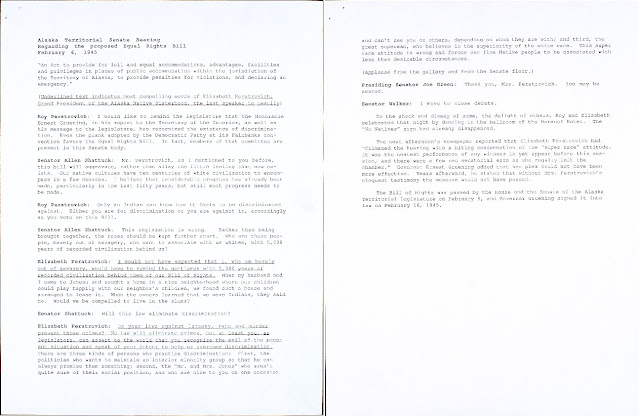
Successfully gaining Governor Gruening’s support, Elizabeth and Roy began a campaign to pass an anti-discrimination bill in 1943. With a vote of 8-8 in the House of Alaska’s two-branch Territorial Legislature, it failed to pass. Undeterred, Elizabeth continued to tirelessly campaign across the Alaskan territory. After garnering public support, Elizabeth and Roy, representing the Alaska Native Brotherhood/Sisterhood, brought a new anti-discrimination bill before the Alaska Senate in 1945. In an eloquent two-hour long testimony, Elizabeth stood before a white male majority and eloquently argued for an end to racial discrimination within Alaska. 

During the hearing, Allen Shattuck, a Juneau territorial senator, asked Elizabeth “Who are these people, barely out of savagery, who want to associate with us whites, with 5,000 years of recorded civilization behind us?” Elizabeth famously responded, “I would not have expected that I, who am ‘barely out of savagery,’ would have to remind gentlemen with five thousand years of recorded civilization behind them, of our Bill of Rights.” A local newspaper printed that she “shamed the opposition into a ‘defensive whisper.’” The Alaska Equal Rights Act of 1945 was signed into law by Governor Gruening on February 16, 1945. The Act provided that all Alaskans be entitled to “full and equal enjoyment” of public areas and businesses and banned signs that discriminated based on race. This marked the end of “Jim Crow” laws within Alaska.

Transcript of Alaska Territorial Senate Hearing regarding proposed Equal Rights Bill, February 6, 1945.
Peratrovich family papers (NMAI.AC.078), NMAI.AC.078_001_02_082 and NMAI.AC.078_001_02_083.

In recognition of her antiracist advocacy to provide equal accommodation privileges to all citizens regardless of race, in 1988 the state of Alaska posthumously established February 16th as Elizabeth Wanamaker Peratrovich Day. More recently, celebrating the 75th anniversary of Alaska’s Anti-Discrimination Law, Elizabeth Peratrovich appeared on the 2020 Native American $1 coin design. That same year, a Google doodle featuring the work of Tlingit and Haida artist Michaela Goade (Sheit.een) commemorated Elizabeth’s life and activism. Elizabeth and Roy’s efforts helped to pave the way for continued Indigenous activism within the United States. 


Mikaela (Mik) Hamilton, Intern, National Museum of the American Indian Archives Center

Nathan Sowry, Reference Archivist, National Museum of the American Indian Archives Center


Monday, March 8, 2021

Celebrating Smithsonian Women in Women's History Month

By Pamela Henson

Smithsonian Institution Archives has a wide array of photographs of women since our early years, but some stand out more than others. I am particularly fond of this image of a group of women celebrating a retirement. Like the flowers Nellie Smith is holding, they are arranged like a bouquet of flowers themselves! But this is a group of very important women at SI in 1930 – they ran a lot of major offices. Louise Pearson moved with Alexander Wetmore to the Secretary’s Office when he became Secretary in 1944 and kept the Institution running. Miss Nellie Smith was replaced by Helena M. Weiss, who was later SI Registrar. When Weiss retired she was replaced by seven separate unit heads. Their titles don’t capture their responsibilities. Moodey was an “Aid” in Geology, but actually curated the gem collection for many years.  As “clerks” to the Institution’s top administrators, this select group of friends kept the Institution humming.

Luncheon for Nellie Smith, 31 July 1930, at the Ye Old Inn. Photograph Probably taken by Narcissus H. Smith, Smithsonian Institution Archives, Record Unit 7177, Box 13, Folder 16, neg. #SIA- 94-4431.
 
Image:  https://ids.si.edu/ids/deliveryService?id=SIA-94-4431  

This image is from a luncheon given by these friends in honor of the retirement of Miss Nellie H. Smith at Ye Old Inn on Thursday, July 31, 1930. She was appointed in March 1890 and spent 40 years at the Smithsonian. Top L to R: Louise A. Rosenbusch, Principal Clerk, Office of Dr. William H. Holmes, Director, National Gallery of Art, now the Smithsonian American Art Museum; Louise Pearson, Secretary to Dr. Alexander Wetmore, Assistant Secretary, SI (later the sixth Secretary of the Smithsonian, 1944-1952); and Narcissus Smith, Clerk to the Editor, Dr. M. Benjamin, United States National Museum (USNM). Bottom L to R: Helen A. Olmsted, Principal Clerk, Office of Mr. W. de C. Ravenel, Administrative Assistant to the Secretary, USNM; Nellie Smith, Clerk, Division of Correspondence and Documents, USNM; and Margaret W. Moodey, Aid, Geology in charge of Gem Collection, working for many years with G.P. Merrill, Head Curator, Department of Geology.

Pamela Henson, Ph.D., Historian, Smithsonian Libraries and Archives


Monday, July 13, 2020

Hattie Meyers Weaver: Life During the Great Influenza Epidemic of 1918


From an early age, Hattie Meyers was fascinated with flight. At first, being a “mere girl,” she contented herself with building models in her Glen Ridge, New Jersey, home with the help of her older brother Charlie, a member of the Aero Club of New York. She recalled her first model, made of cranberry red silk from Scotland, being named the “Red Devil” for the “wicked prohibitive sound and the hope that it would raise the ‘devil’ with the long distance model record held by Percy Pierce.” Hattie’s model shattered the record (and the cellar window)! Hattie’s model success gained her entry into the “boy’s” shop in back of their house, where she was nominally allowed to participate in their endeavor to build a man-carrying glider, often taking the blame for hijinks, all for the promise of a ride in the final product.


Hattie and Charles Meyers, ages five and seven. (Photo is dated 189[9], but is most likely 1903.) NASM 9A16573  
In 1916, Charlie brought home a friend from the Aero Club of Illinois—known only as “Buck.” Hattie immediately noted that he was “a real aviator and not just a model builder” and twenty-one to boot! She also was not a fan of the black and white checkered cap he constantly wore (not knowing that this was the proud symbol of an early aviator). As they courted, Hattie learned his full name was George Weaver. After he turned down an opportunity to fly with Katherine Stinson in Japan, George and Hattie announced their engagement on June 14, 1917, with the specter of the United States’ entrance into World War I looming.

Civilian Flying Instructors, Rich Field, Waco, Texas, January 1918. George E. “Buck” Weaver is the third from the left in the seated row. NASM 9A16576 
George and Charlie registered for the war and went to work at Aeromarine. Already a capable aviator tapped as a civilian flying instructor, George was first sent to the U.S. Naval Reserve School on Long Island then to Dayton and then to Rich Field in Waco, Texas. Hattie left everything she knew in New Jersey to meet his family in Chicago on her way to joining George in Texas. They married on February 12, 1918, with George rushing in from work, washing the castor oil off his face.

George “Buck” Weaver and Hattie Meyers Weaver together in Waco, Texas, March 19, 1918. NASM 9A16575
Hattie settled into life at Rich Field as a wife, impatiently waiting for the war’s end, even as Rich Field was struck by the influenza. George received a doctor’s note for influenza for over a week’s absence in April. Effective as of October 4, all officers and enlisted men were given antiseptic treatment daily as a precaution. Hattie recalled, “The big husky men at Camp MacArthur died faster than burial and when the wind blew from there the odor gave proof.” She noted the other target—pregnant women like herself.

Doctor’s letter, dated April 12, 1918, certifying that George “Buck” Weaver was absent from work due to influenza. NASM NASM.XXXX.0171-M0000127-00300
 On November 11, 1918, Hattie and George joined the Armistice parade in downtown Waco in their Buick convertible: “Flu and babies forgotten.” George obtained a leave of absence so that he could go to Chicago with Hattie to prepare for the baby. By the time they had reached St. Louis, Hattie knew she “had a cold, sneezes and snuffles.” She arrived in Chicago with a fever and full-blown influenza. Although she had “coughs that hurt and would not stop,” Hattie was apologetic that she was a sick nuisance to her mother-in-law.

George E. "Buck" Weaver and wife Hattie Meyers Weaver pose in their Buick Roadster, October 1918. Another version of this photograph was labeled “Mrs. W pregnant, flu epidemic.” NASM 9A16574

George Charles Weaver, nicknamed “Buddie,” was born on December 12, 1918. Hattie noted that the “fever had burned off the weight, the flesh was loose on the 5 lb. 3oz. baby.” She blamed herself and her illness for the premature birth and promised “to do better next time.” George exited the room and only later did Hattie learn he had fainted. He returned to Texas soon after to receive his discharge papers. He had been warned if he was not present, he would not receive the end-of-war separation benefits package.

Hattie convalesced in Chicago under the watchful eye of the Weaver family. Her doctor insisted that she needed to be strong and nurse the baby. Her youngest brother-in-law taught her how to walk again. George wrote often. It was difficult for Hattie to learn that many of the women with whom she had made baby clothes at Rich Field had succumbed to the flu, along with their children. In a January 5 letter, Hattie wrote: “George, that grips me by the heart at nights and when Son is sleeping quietly I have to feel him to be sure he is living. I have tried to write Mrs. Blair but each time I have become deathly sick. I cannot. Oh Georgie how grateful we are.” George returned to Chicago when Buddie was eight weeks old.

After the war, George Weaver took up barnstorming. In 1920, along with Clayton Bruckner and Elwood "Sam" Junkin, he founded the Weaver Aircraft Company. George “Buck” Weaver died on July 31, 1924, from a septic blister. He was eulogized by some of aviation’s greats, including Katherine Stinson: “You [Hattie] have been very dear to and made very happy this boy whom we all loved so dearly.”

Reproduction of July 29, 1924 telegram from Katherine Stinson to Hattie Meyers Weaver regarding the death of George “Buck” Weaver. NASM NASM.XXXX.0171-M0000014-00140

The company was later renamed Advanced Aircraft and, later, Waco (pronounced wah-co, as opposed to way-co). Hattie married Sam Junkin in 1926, but he died shortly afterwards (their daughter Janet was only a few months old). The company slipped out of Hattie’s hands soon after. The Waco Aircraft Company flourished during the interwar period as Waco aircraft were operated by public, private, military and corporate owners in thirty-five countries. During World War II, Waco devoted itself entirely to war production, particularly gliders, but could not adjust to the postwar market.

Hattie and her son Buddie lived long lives. In 1929, Hattie married Ralph Stanton Barnaby, a glider pilot, but the marriage was short-lived. Hattie wrote several versions of the Waco Company history. She was one of the first women to earn a glider class C license. She studied law at the University of Washington (DC), but fell ill before taking the bar.

Hattie Meyers Junkin with son George “Buddie” Weaver, age six, January 1927. Hattie noted on the back that she had trimmed her crepe tunic with beaver from an ageing coat. NASM 9A16577 
In 1976, an episode of the hit television show Upstairs Downstairs prompted Hattie to recall her bout of influenza in a letter to Buddie: “The report again in the final chapter of the ‘Spanish’ flu that caused more deaths than the millions slaughtered in [World] War One, naturally brings me agin [sic] to my carrying you, the Armistice, (pic in my album) of my Kewpie doll body as your father was chosen to lead the parade in our Buick convertible….” She revisited the circumstances of Buddie’s birth, adding, “Since then it is remarkable how we have escaped attempts, literally on our lives.” Hattie Meyers Weaver Junkin died in 1990 and George “Buddie” Weaver followed in 1991.

The National Air and Space Museum Archives holds the Hattie Meyers Junkin Papers, the Waco Aircraft Company Records, and the Ralph Stanley Barnaby Papers. The Waco collection includes almost 25,000 drawings on paper, business records (including purchase orders for individual aircraft), and engineering reports. Ralph Barnaby’s collection holds documents from his gliding career and correspondence received late in his life from other aviation pioneers.

Hattie’s papers are digitized, containing materials from every stage of her life. Her diaries and correspondence are especially rich in the World War I and early Waco periods. She saved everything for years, including photos and cards straight out of George “Buck” Weaver’s wallet and satchel, and donated the collection to the Museum in 1983. In fact, the Smithsonian TranscriptionCenter is looking for volunteers to transcribe materials from the Hattie Meyers Junkin Papers!

Elizabeth C. Borja
Archivist
National Air and Space Museum Archives

Wednesday, October 30, 2019

Soaring through the Archives of Air and Space with Transcription Center

Have you ever wondered what you should pack for a trip to the moon? Or what female aviator clubs were like in the 1930's? How about the history of grape soda and its relationship to America's first transcontinental flight?

                             Inflight Coverall Garment, Jacket, Apollo,                     Items taken aboard Apollo 11, NASM Archives.
                                 D19791187000, National Air and Space Museum.

Well you're in luck! The answers to these questions -- recorded in the pages of diaries, letters, and scrapbooks held in the Archives of the National Air and Space Museum (NASM) -- are now more easily discoverable thanks to volunteer transcription.


Vin Fiz Art Poster, Armour & Co., 1911,  A1935044000, National Air and Space Museum.
Since 2015, staff in the NASM Archives have launched (pun intended) over 200 projects in the Smithsonian Transcription Center--including stowage lists from six different Apollo missions, records from Calbraith (Cal) Perry Rodgers' 1911 transcontinental flight (which was sponsored by the makers of the popular grape soda, the Vin Fiz), and the scrapbook of female pilot, Manila Davis Talley, containing multiple photographs and  news articles on twentieth century women's aviation clubs and flying competitions. 


Page from Scrapbook of Manila Davis Talley, NASM.XXXX.0041, National Air and Space Museum.

The Archives' collections span the history of flight, from ancient times to the present day, and include materials from military officers and personnel, NASA astronauts, Smithsonian staff, civilian pilots and engineers, astrophysicists, nineteenth-century balloonists, flight attendants, and more. Over the past four years 1,062 volunteers (or 'volunpeers' as we say here in TC) have transcribed close to 13,000 pages from the archival collections at NASM. These TC projects only constitute a small portion of NASM's archival collections, yet the work of digital volunteers transcribing and reviewing these materials increases accessibility and awareness of the rich information held within every page. (Want to learn more about how volunteer transcription makes Smithsonian collections accessible and text-searchable? Head to our About page and follow us on Twitter for ongoing updates, discoveries, and behind-the-scenes sneak peeks!)

Here's some highlights from NASM TC Projects:

Apollo 11 Flight, Crew, Training, NASM Archives.
Velma Maul Tanzer, NASM.2005.0036, NASM Archives.
  • World War II diaries and scrapbooks from Harold Raskin (Army Airways Communications System, 7th AACS Wing Ground Control Approach (GCA) unit), William Jones (aerial photographer in the Army Air Corps), and a Japanese man named Yamada (much information on him is still unknown). 
                           General Benjamin O. Davis,                                   William Jones, NASM.2006.0067 NASM Archives.
                          NASM.1992.0023, NASM Archives.                                              

Click here to explore all of the completed and ongoing Transcription Center projects from NASM. And keep an eye out for more projects coming soon, including a letter from astronaut John Glenn, Jr., diaries from WWI Pilot Zenos Miller, and collections documenting the groundbreaking work of female aviators Rubye Berau, Mary Charles, and Helen Richey.

-Caitlin Haynes, Transcription Center Coordinator