Smithsonian Collections Blog

Highlighting the hidden treasures from over 2 million collections

Collections Search Center
Showing posts with label Exhibits. Show all posts

Tuesday, July 19, 2022

The Evolution of Anthropological Research in Documenting Diversity: How Anthropologists Record Human Life


By Muna Ali and Ashley Ray     

Documenting Diversity: How Anthropologists Record Human Life is an exhibit that outlines the ways in which anthropologists have utilized changing technology to record various aspects of human life. The exhibit is organized into four sections: film, photography, paper, and sound. It includes the equipment used for documentation such as rolls of film, video cameras of various ages, wax cylinders, phonographs, and multiple notebooks. The objects shown in the exhibit come from the National Anthropological Archives (NAA) and the Human Studies Film Archive (HSFA), respectively. The NAA is a product of a 1965 merger between the Smithsonian Institution’s Bureau of American Ethnology (1879-1965) and the Department of Anthropology (1883-present). The collection holds anthropological material produced by anthropologists including fieldnotes, journals, manuscripts, correspondence, photographs, maps and more [1]. The NAA contains one of the largest archival collections related to North American archaeology, ethnography, indigenous artwork, and historical photographs in the world. The HSFA, a sister repository to the NAA, was founded in 1975. The HSFA possesses an audiovisual collection that documents the history of filmmaking worldwide, as it relates to anthropology. The documents and equipment included in this exhibit are a key part of tracking the evolution of the study of anthropology through time. One might even say that the documents are a more accurate representation of the attitudes of the researchers rather than the people they are attempting to record. In the following sections, we will explore two examples in which these attitudes are apparent. 

Garson & Read’s Color Swatch 

Underneath the exhibit’s “Documenting on Paper” section, a sample color swatch is displayed prominently across two pages from the 1899 work Notes and Queries on Anthropology by John George Garson (1854-1932) and Charles Hercules Read (1857-1929) [2, 3]. The exhibit designates the color swatch as “a practice borrowed from geology to describe skin, hair, and eye colors” [2]. Similar to the techniques used to classify geological typology, soil compositions, or categorical distinctions based on shared general characteristics, late 19th century anthropologists erroneously figured a scientific typology of humanity could similarly be created, based on variation in color. Both Garson and Read were affiliated with the Royal Anthropological Institute of Great Britain and Ireland, with Read being appointed as the RAI’s President in both 1899 and 1917 [3]. Given anthropology’s complicated history with ascribing meaning to differences in human physical characteristics in the late 19th century (and prior), it’s certainly no surprise that anthropologists who replicated such rhetoric found themselves in positions of intellectual authority.
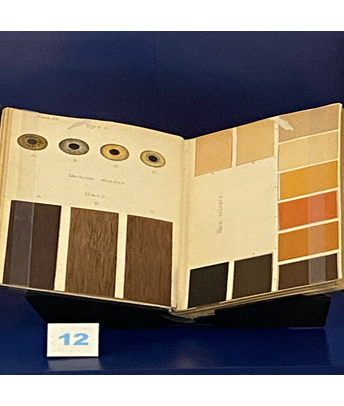
Garson & Read’s color swatch, as depicted in Notes and Queries on Anthropology, Smithsonian Libraries & Archives. 

Critiques of Garson and Read’s color swatch were generally limited to its inability to provide universal descriptors. In the September 1913 edition of a journal titled Folklore, reviewer John H. Weeks even provided suggestions on how to improve the color swatch through “standardise[d]” colors, as “scarcely two men will call an intermediate shade by the same name” [5]. Despite institutionally affiliated anthropologists such as Garson and Read perceiving the color swatch as an intellectual innovation, this exhibit vehemently rejects such attempts to seek meaning in physical differences, declaring “such techniques falsely assumed skin color as a meaningful marker of difference” [7]. The color swatch’s inclusion within the exhibit addresses troubling legacies in anthropology in a compelling manner: the exhibit distances our contemporary understanding of anthropology from harmful conclusions drawn during anthropology of the past, while simultaneously acknowledging that such conclusions are inextricably linked to the field.  

“No. 7 Song with Lacrosse Game” from Menominee Music by Frances Densmore 

In the “Documenting Sound” section, visitors will find a manuscript with marbled edges. The book is opened to a page of sheet music at the top, labeled “No. 7 Song with Lacrosse Game,” followed by an analysis of the notation. The description for this document states that this is a manuscript of “analyses and translations” of songs recorded and translated by ethnomusicologist Frances Densmore (1867-1957). The manuscript, Menominee Music, was published in collaboration with the Bureau of American Ethnology of the Smithsonian Institution in 1932. This book is one of many published by Densmore throughout her career of studying and advocating for the preservation of Native American music [6].  
 

“No. 7 Song with Lacrosse Game” from Menominee Music by Frances Densmore, 1932.
Smithsonian Libraries & Archives

There are many examples of non-Western forms of music that do not have a system for written notation. Instead, these songs are passed down orally, generation by generation, with each adding slight changes to a particular piece [7].  

From a musicological standpoint, there is the question of whether it is even possible to accurately notate Non-Western forms of music using classical Western notation. And perhaps whether one even should. Western musical notation is limited in what it can and cannot represent. It was designed with western instruments in mind and thus lacks the ability to fully accommodate the nuances of other instruments. On top of that, Western music relies largely on major and minor scales while non-Western music utilizes more diatonic and chromatic scales, differs greatly between the two groups [8]. As one composer aptly describes, “The Western system of notation is governed by rigid elementary mathematics inherited from the ancient past,” meaning that the Western system of notation is only ever able to create an imperfect outline, and the nuances of pitch and rhythm must be added in by the performer. Imposing the limiting Western system of notation on other forms of music creates a document that cannot fully capture the intricacies of the original piece [9].  

In summary, though the document has its flaws, that does not mean it is without value. On the contrary, it is more constructive to view this document as a type of translation which is inherently transformative and results in an end-product that cannot be identical to the source material. Documents such as this are valuable in that they offer a glimpse at what music was like at a specific point in time. In addition to that, present-day members of the Menominee Tribe could potentially use this manuscript to recover songs that may have been lost, suppressed, or erased from public consciousness and, more importantly, the community itself. It is the reader’s responsibility to read critically and remember that culture, and music, are dynamic and ever-changing.  

Densmore was able to mitigate weaknesses in her work of the types explored in this section through inclusion of audio recordings in her research. Densmore’s use of both aural and written mediums is an apt example of the ways anthropologists have adapted to emerging technologies so that methodologies are improving as well as the capacity to accurately record human life. 

Anthropology as an Advancing Field 

The thematic structure of the exhibit based on medium—along with its more general focus on technological advancements aiding anthropological fieldwork—presents anthropology to the general public as a constantly transforming field. The selection of objects within the exhibit is particularly effective in conveying this: for instance, in the “Documenting on Film” section, the description for Object 11, a diagram on synchronized sound from 1955, is placed strategically next to object 12, a 1995 Sony camera [4]. Visitors are able to easily envision advancements in recording tools used for fieldwork merely through the two descriptions’ adjacent positions. What’s particularly interesting about the position of these two descriptions is that objects 11 and 12 were used by the same individual, anthropologist John Marshall, exactly forty years apart. This choice allows for the exhibit to portray individual anthropologists and anthropology more broadly as advancing in the wake of major shifts in technology.
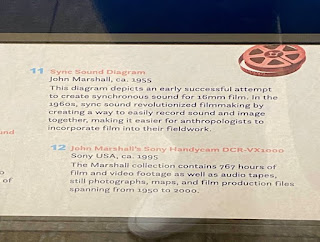
Photo of Exhibit Description, National Museum of Natural History, Smithsonian Institution. 

Overall, the exhibit addresses anthropological discoveries in four mediums: photography, paper, sound, and film. Additionally, on the left side of the hallway, photography, paper, and sound are in one display case, while on the right side, an entire display case is solely dedicated to anthropological film. Given the heightened importance of ethnographic film in anthropological fieldwork, the exhibit’s choice to have film presented separately from the other mediums is certainly advantageous. The choice to separate film from the other anthropological mediums is also indicative of the two repositories mentioned in the exhibit: the National Anthropological Archives and the Human Studies Film Archives. Although the two repositories are closely related to one another, they operate separately. Visitors can envision the physical constraints in having the exhibit spread across two sides of a wide hallway in the context of the separate nature of the two repositories, ultimately complicating the expression of these four mediums as a coherent whole. Regardless of its physical limitations, the exhibit is successful in highlighting changing attitudes and technologies throughout anthropology’s history.

Acknowledgements

Documenting Diversity was co-curated by Diana Marsh, a former NMNH postdoctoral fellow who partook in a three-year long NSF-funded project on NAA collections, and Joshua A. Bell, who serves as NMNH’s Curator of Globalization, Director of the Recovering Voices Program and Acting Director of the National Anthropological Archives. The exhibit was made possible by close collaboration between the NAA, HSFA, Smithsonian Libraries, and Smithsonian Exhibits.


By Muna Ali and Ashley Ray

Natural History Research Experiences (NHRE) Interns
National Anthropological Archives, National Museum of Natural History 


Sources:

[1] “Documenting Diversity,” Smithsonian Libraries and Archives, accessed June 20, 2022, https://library.si.edu/exhibition/documenting-diversity

[2] Erdöl, Das " “Dr. J. G. Garson.” Nature 129 (1932): 931. https://doi.org/10.1038/129931a0 

[3] Balfour, Henry. “Sir Charles Hercules Read, July 6, 1857-February 11, 1929,” Obituaries. Accessed June 2, 2022. https://www.therai.org.uk/archives-and-manuscripts/obituaries/charles-hercules-read 

[4] Bell, Josh and Marsh, Diana. Documenting Diversity: How Anthropologists Record Human Life. Washington: Smithsonian National Museum of Natural History, 2020. https://naturalhistory.si.edu/exhibits/documenting-diversity-how-anthropologists-record-human-life 

[5] Weeks, John H. Folklore 24, no. 3 (1913): 392–97. http://www.jstor.org/stable/1255441

[6] “Frances Densmore (1867-1957).” Smithsonian Institution Archives. 2005. https://siarchives.si.edu/research/sciservwomendensmore.html 

[7] Pasler, Jann. “Sonic Anthropology in 1900: The Challenge of Transcribing Non-Western Music and Language.” Twentieth-Century Music 11, no. 1 (2014): 7–36. doi:10.1017/S1478572213000157. 

[8] Robertson-Wilson, Marian. “The Challenges of Notating Music in General and Coptic Music in Particular: Observations of a Professional Cellist, Composer, and Linguist.” Library of Congress Web. https://www.loc.gov/item/ihas.200156229/

[9] Zon, Bennett. “Music in the Literature of Anthropology from the 1780s to the 1860s.” In Representing Non-Western Music in Nineteenth-Century Britain, NED-New edition., 48–68. Boydell & Brewer, 2007. http://www.jstor.org/stable/10.7722/j.ctt14brrwv.9.


Monday, March 21, 2022

Women, Cameras, and Images

By David Haberstich

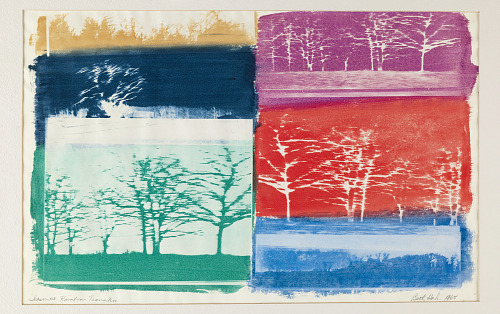
In recent years the Smithsonian Collections Blog has featured numerous posts about women photographers represented in Smithsonian collections. For instance, I’ve blogged about the photographers Katherine Joseph, Dawn Rogala, and Melody Golding, whose work is in the NMAH Archives Center, but now I want to highlight a much earlier Smithsonian effort to celebrate women in photography. The National Museum of American History (then the Museum of History and Technology) featured female photographic artists in a series entitled “Women, Cameras, and Images” in 1969-1970, initiated by Curator of Photography Eugene Ostroff. Although three of these photographers were famous, even legendary, and already included in general histories of photography, two were comparatively unknown at the time. Prints by all five are in the museum’s Photographic History Collection, acquired in conjunction with their exhibitions. This program was an early attempt to emphasize the contributions of women to twentieth-century photography via a series that combined three famous photographers, who utilized standard photographic techniques to achieve their unique personal vision, with two younger, relatively unknown artists who experimented with “obsolete” photographic processes, combined with hand techniques, to interrogate assumptions about the nature of photography. Indeed, Betty Hahn later challenged standard notions about photography (and the nature of her multi-media variations) in the very title of her book, Photography…Or Maybe Not. *

Betty Hahn (b. 1940), "Seasonal Rainbow Transition," gum bichromate with paint on paper, 1968. Photographic History Collection, National Museum of American History.

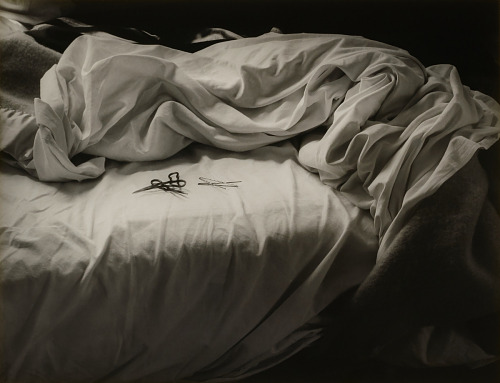
All four exhibitions were accompanied by poster-checklists and formal, if modest, openings. The first show in the series, “Women, Cameras, and Images I,” was a retrospective of Imogen Cunningham’s classic imagery. I well remember her sly humor and witty sarcasm at her opening: she was delightful, and it was especially gratifying for me after my failed attempt to meet her during a trip to San Francisco.

Imogen Cunningham (1882-1976), "Unmade Bed," gelatin silver photographic print, 1957, printed 1957, Smithsonian American Art Museum.

The second exhibition, “Women, Cameras, and Images II,” combined the work of Betty Hahn and Gayle Smalley. I had met Betty in graduate school at Indiana University and vaguely knew Gayle, who had graduated from the Rochester Institute of Technology five years before I had. Their work was very different from that of the other three women, employing radically new approaches to the medium. Hahn was one of the first photographers to experiment with “obsolete” photographic processes, including gum-bichromate, and combined photography with textiles, sometimes adding hand-work, such as paint, needlework and embroidery, which in her words represented a homage to the unsung women who traditionally practiced such stereotypically feminine “crafts.” Independently, Gayle Smalley combined photography with hand printmaking techniques. Hahn’s and Smalley’s prints were colorful, semi-abstract, and often playful and humorous, heavily influenced by contemporary printmaking.        

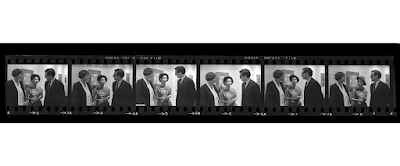
Above: Gayle Smalley (left) and Betty Hahn (center) talking with Eugene Ostroff at the opening of their exhibition, 1969. Smithsonian photographer unidentified.

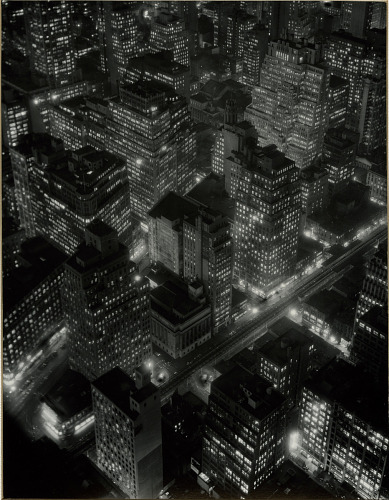
“Women, Cameras, and Images III” was devoted to the work of Berenice Abbott, whose long and influential career ranged from documentation of New York City to the development of techniques for  scientific photography, in which she was an important pioneer. Unfortunately, we lacked funds to bring her to Washington for the opening, and I think she never quite forgave me.


Berenice Abbott (1898-1991), "Night Aerial View, Midtown Manhattan," 1933, gelatin silver print. Photographic History Collection, National  Museum of American History.


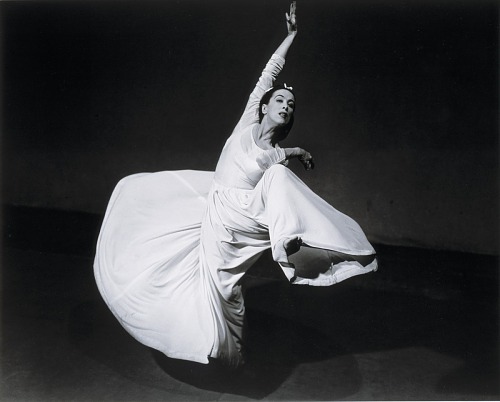
Barbara Morgan was the artist of “Women, Cameras, and Images IV.” Noted for her photographs of Martha Graham’s dancers, a major component of the exhibition, she worried about the design of the show, and explained her concern with rhythm and flow in the placement and sequencing of the framed images. I was tempted to let her develop the layout or collaborate with me, but was warned not to permit her participation lest it delay the opening. It was a nail-biter for me as I hung the show, fearing that she didn’t fully trust my curatorial eye, but I needn’t have worried: she was pleased and pronounced it a huge success, telling me “You got it!” She had been honored previously in a similar retrospective solo exhibition at the Museum of Modern Art, curated by my photo-history mentor, Peter Bunnell, and pronounced my design “better.” At social occasions for several years afterward she proudly introduced me as “the man who hung my Smithsonian show, you know,” and we had a lovely and rewarding friendship.

Barbara Morgan's photographs have been collected not only by NMAH, but also by the Smithsonian American Art Museum (SAAM) and the National Portrait Gallery (NPG). This is also true for the work of Imogen Cunningham and Berenice Abbott. However, NMAH was the first Smithsonian museum to collect and mount exhibitions of their work. 

Barbara Morgan (1900-1992), "Martha Graham--Letter to the World--(Swirl)," 1940, gelatin silver print, printed ca.1980. Smithsonian American Art Museum, gift of Virginia Zabriskie. 

However, the series, which originally was intended to continue for another year, foundered and ended when some photographers objected to being “classified” or identified as “women photographers” within a special series, as if each photographer's work couldn't stand on its own merits. Similarly, I recall hearing certain women criticize the creation of Washington’s National Museum of Women in the Arts for what nowadays some might call bad “optics,” appearing to relegate female artists to a separate category rather than striving to integrate them in greater numbers into existing art museum awareness and practice.

Opinions, perspectives, and tactics intended to promote social change often themselves change with the times and the politics of culture, however. In 1970 we found that for some women photographers, the prospect of inclusion in a series of gendered exhibitions (curated by men) entitled “Women, Cameras, and Images” could be interpreted as more demeaning than celebratory, perhaps suggesting mere tokenism. Controversial “optics!” By contrast, the emphasis on equity in the 2020s has regularly employed group solidarity and separation as a logical, effective tactic to highlight marginalized groups and their members’ individual stories--for example, through Black History Month and Women’s History Month. I recently noticed a current exhibition at Lehigh University entitled “Hear Me Roar: Women Photographers II,” reflecting the similar strategy of the Smithsonian’s “Women, Cameras, and Images” exhibitions of the tumultuous late 1960s. I couldn't help smiling.

David Haberstich, Curator of Photography

Archives Center, National Museum of American History 

Monday, March 1, 2021

Scurlock Photographs, the Corcoran Gallery of Art, and the NMAH Archives Center, Part 2

By David Haberstich 

The previous post described Robert Scurlock's unsuccessful attempts to publish or exhibit photographs by his father, Addison N. Scurlock, and the Scurlock Studio. This happy ending of the story is offered as an extension of  Black History Month into the first few days of March.

Dr. W.E.B. DuBois. Negative by Addison N. Scurlock, 1943.
Later print by Robert S. Scurlock. 14" x 11". Scurlock Studio Records, NMAH Archives Center.

Harry Lunn, the Corcoran Exhibition, and Jackie Onassis

Robert finally found an advocate in Harry H. Lunn, Jr., the charismatic and successful dealer of photographic art based in Washington. Lunn’s gallery, which flourished in several locations, was the premier gallery at a time when there were several other art dealers in Washington who sold photographs exclusively, riding the crest of the first few years of the new photography boom, which I date from 1967. Many historians credit Lunn as the single most important force in establishing photography as a collectible commodity as well as a serious field of academic study. Lunn, Kathleen Ewing, Marie Martin, Jo Tartt, and the Washington Gallery of Photography, operated by Byron and Mary Schumaker, were among the dealers who regularly exhibited and sold “vintage” and contemporary photography, at steadily increasing prices.  It was Lunn’s business acumen which finally helped to make Ansel Adams rich after decades of work as America’s best-known landscape photographer. At some point Robert Scurlock apparently approached Lunn, probably hoping the dealer would help to sell Scurlock photographs. I have found no evidence that Lunn ever sold or exhibited Scurlock photographs, but he encouraged and advised Robert in his quest for recognition. This was especially important for Robert, who was enmeshed in the world of commercial photography and apparently was unaware of the parallel world of contemporary photographic art, which was making gigantic inroads among art collectors and scholars and into museum collections. Despite Robert’s early interest in expanding his horizons beyond the studio-based, insular field of portrait and commercial photography by working as a photojournalist, he was a novice in approaching the new “art” photography and its norms, customs, and cast of influential characters. He wrote two letters on May 13, 1975, in which he noted that Lunn had suggested contacts. He wrote to Douglas Morgan of Morgan & Morgan, a well-known publisher of art photography books and technical texts. Apparently nothing came of this effort, although he met Morgan at a photographic conference and they discussed his proposal, as verified in his letter of September 30, 1975. His letter to Roy Slade, director of the Corcoran Gallery of Art, however, finally bore fruit within a remarkably short period. He noted that Lunn had specifically suggested that an exhibition of Addison Scurlock’s work, especially his portraits of notable African Americans, could supplement an existing Bicentennial theme, already established by the Corcoran.   

Mid-Winter Assembly [of the NAACP], Baltimore, Maryland, 1912.
In the Corcoran exhibition and catalog, Robert Scurlock misidentified this photograph as "Formal Dance at Whitelaw Hotel, ca, 1923." Robert made a new 16" x 20" print for the exhibition from the original 8" x 10" glass plate negative. Scurlock Studio Records, NMAH Archives Center. 

With Slade’s blessing and enthusiastic support from the Corcoran’s chief curator, Jane Livingston (who was already especially interested in Black artists), and photography curator Frances Fralin, Robert arranged for an exhibition of his father’s photographs to begin in June 1976, as part of a series of “American Bicentennial” exhibitions sponsored by the Corcoran Gallery of Art. The Gallery previously had commissioned new work by eight noted (white) photographic artists of diverse styles as a Bicentennial theme. Apparently Lunn convinced the Corcoran curators to host an exhibition of Addison Scurlock’s photographs as an historical counterweight or adjunct to the new commissioned work. The actual arrangements seemed a little unusual, perhaps due to a tight schedule, with Robert himself ordering the printing of the catalog by Colortone Creative Printing on March 17, 1976. Fifteen “vintage” prints by Addison’s hand were the core of the exhibition, while Robert made more than one hundred new prints from his father’s negatives.

Robert now renewed his efforts to get a full-fledged book published in connection with the exhibition, and on March 3, 1976, wrote to Jacqueline Kennedy Onassis at Viking Press in hopes that she would help her mentor from years ago. One of the Scurlock family’s favorite anecdotes concerns Jacqueline Bouvier’s short-term study at the Capitol School of Photography, which Robert and George managed out of the studio from 1948 to 1952. Citing her brief tenure as a student at the school, he wrote:

“Dear Mrs. Onassis,

“[It’s] been a long time but I presume you remember your former teacher of photography. (Jackie Bouvier – Times Herald days) Like many, I’ve followed your career very closely, and [it’s] nice to know that you are back in America and working for Viking Press. I would like to outline a coming event that is very important to me, and if possible, enlist your aid.

“This summer, The Corcoran Gallery will open an exhibit of 125 or so of my father’s photographs. He was a very skillful Camera Artist and probably the most important Black Photographer in the country. This will be a memorial exhibit and will include his portrait studies of people like Booker T. Washington, W.E.B. Dubois [sic], Paul Lawrence Dunbar, Mary Bethune, Samuel Coleridge Taylor, James Weldon Johnson, Countee Cullen and many others.

“Publishing a photographic book of this material is one of my objectives, and in discussing the plans with Jane Livingston, Curator of the Corcoran, the thought occurred that just possibly Viking might be in a position to publish a catalog for us. We realize that time is very short since the exhibition is due for opening in mid-June, however it will be up most of the summer.”

I love the line, “Like many, I’ve followed your career very closely…” We don’t know how Jacqueline Onassis reacted to it—if she saw it. It might have provided a chuckle or two. This request for a major publisher to produce an exhibition catalogue or monograph on only a few months’ notice was unrealistic—even as a personal favor. An assistant at Viking Press wrote Robert to advise that scheduling a book to coincide with the exhibition was impossible. However, there was indeed a modest booklet produced by the Corcoran, basically an illustrated checklist with introductory text (by the reliable Michael Winston), almost identical in format to the publications which accompanied the exhibitions of the eight (white) photographers from whom new work had been commissioned, and identifying the Scurlock exhibition as a component of the Corcoran’s Bicentennial series, “The Nation’s Capital in Photographs, 1976.” Ironically, a copy of this free booklet was recently advertised online at a price of nearly one thousand dollars.

Adopting a more modest goal, on June 21, 1976, Robert wrote to the editor of Studio Light, a Kodak publication, suggesting a story on the exhibition. On July 15 he sent a copy of the 24-page catalog to Cassie Furgurson at Time magazine, requesting a story. On July 26 he wrote to inform African American Congressman Charles Rangel about the exhibition, seeking assistance for publicity. Unfortunately, these efforts did not pay off. 

However, there were gratifying outside contributions toward the exhibition. Robert wrote to the Independence Federal Savings & Loan Association on July 28 to thank “Mr. Fitzgerald” for “financial support given to the Corcoran gallery” in mounting the exhibition. The exhibition included a variety of subjects, but concentrated on portraits of African American leaders of international, national, and local renown. It even included several of his photographs of Black entertainers wearing blackface (represented in the catalog), which apparently were not considered controversial at the time.

Picnic Group, Highland Beach, Md. Original negative by Addison N. Scurlock, ca. 1931-1932.
New print for Corcoran exhibition by Robert S. Scurlock, ca. 1976.
Scurlock Studio Records, NMAH Archives Center.

One of the most influential and well-known American curators of photography saw the exhibition and expressed interest in acquiring Addison’s work for her museum. On September 24, Robert wrote to Anne Tucker at the Houston Museum of Fine Arts, offering to sell her prints at $150.00 each, and suggesting the possibility of showing the exhibition in Houston. Although the show did not travel to Houston, Tucker was among the new wave of eager young photography curators to be hired by major art museums, so the subsequent sale represented a coup for Robert.  

Jane Livingston and Frances Fralin, as well as later dedicated Corcoran photography curators, demonstrated their continuing interest in Black photographers through many other exhibitions and acquisitions. For example, just a year after the Scurlock show, the Corcoran sponsored “Black Photographers in America” from July 30-Aug. 31, 1977. While the Smithsonian Institution was arguably the first American museum to collect and exhibit photographs as works of art, the Corcoran Gallery of Art’s photography exhibitions date from the early twentieth century, and the museum maintained a vigorous, internationally known photography exhibition and acquisitions program until the Corcoran’s sad demise in 2014, its collections eventually dispersed to other museums. After teaching the history of photography in the Corcoran College of Art for two years, with friends among Corcoran teachers and curators, I was deeply disappointed by that unfortunate turn of events. We can’t blame a pandemic for the permanent closing of that illustrious museum. There is some solace in knowing that the Corcoran’s ground-breaking exhibition of Addison Scurlock’s work ultimately became a component of the Archives Center’s Scurlock collection. Kudos to Jane Livingston and the late Frances Fralin and Harry Lunn for their foresight and dedication in helping to bring Addison Scurlock, a major Black photographer and chronicler of Washington’s African American history, to the attention of photographic historians and the general public.

David Haberstich, Curator of Photography, Archives Center

National Museum of American History


Monday, February 22, 2021

Scurlock Photographs, the Corcoran Gallery of Art, and the NMAH Archives Center, Part 1

By David Haberstich

Every February when I think of Black History Month, I naturally think about one of the Archives Center’s premier collections, the Scurlock Studio Records. This collection contains the life’s work of the principals of this Black-owned Washington photography studio, founder Addison N. Scurlock (1883-1964) and his sons Robert (1916-1994) and George (1919-2005). In February 2020 I gave a brief lecture about the collection at a Black History Month social event sponsored by a large Washington law firm, at the invitation of a Scurlock relative on the firm’s staff. Little did I know that it would turn out to be my last in-person lecture (and social event) before COVID-19 closed the Smithsonian and disrupted my social life, along with nearly everyone else’s.

In my talk about Scurlock photographs, I thanked my hosts for the invitation to their lovely party, but mused about another important party that I had missed in 1976, the first year in which Black History Month was observed officially, as recognized by President Gerald Ford. Had I attended that earlier event, an exhibition opening at Washington’s Corcoran Gallery of Art, I could have met Robert Scurlock, as well as the famed African-American New York photographer, James Van Der Zee. (Some call Addison Scurlock Washington’s Van Der Zee, but I like to call Van Der Zee New York’s Scurlock.) I met Mr. Van Der Zee on a later occasion, but unfortunately I never met Robert. I came to know his younger brother George quite well, however, along with other Scurlock relatives.


Typical Scurlock Studio banquet photograph, dinner for Armond W. Scott, 1935.
Scurlock Studio Records, Archives Center, National Museum of American History

The Corcoran exhibition, entitled “The Historic Photographs of Addison N. Scurlock,” ran from June 19 to Aug. 29, 1976. When the National Museum of American History acquired the Scurlock collection almost twenty years later, the entire Corcoran exhibition, having been returned to the studio, was part of the archive. These photographs, conveniently still framed for subsequent displays, were shown in several small exhibitions in the National Museum of American History over the years, as well as in Deborah Willis’s major exhibition in the Arts and Industries Building, “Visual Journal: Harlem and D.C. in the Thirties and Forties,” in 1996. Correspondence in the business records of the Scurlock Studio Records reveal the story behind the historic Corcoran exhibition of 1976.

A Quest for Recognition 

Addison Scurlock sold the business to his sons before his death in 1964. In the early 1970s Robert became concerned about the future of the Scurlock family business and its photographic archive. As he began to confront his own mortality, his brother George’s intention to retire, and the fact that there were no family members to carry on the Scurlock business, it seemed likely that the Scurlock Studio and its later iteration as CustomCraft might die with him. Robert had no children, and brother George’s children had evinced little interest in operating the studio enterprise. Years earlier, Robert had rebuffed the efforts of two young relatives to gain employment at the studio on the grounds that they “hadn’t paid their dues” as photographers. 


Left to right: George, Addison, and Robert Scurlock in their studio, ca. 1948.
Scurlock Studio Records, Archives Center, National Museum of American History

Furthermore, he recognized the classic, enduring quality of his father’s early work, in contrast with his own bread-and-butter portraiture and photojournalism, and was determined to find ways to revive and increase public awareness of Addison’s pioneering photographs. Robert’s eventual success in this quest was preceded by a flurry of activity and disappointing failures. Correspondence in the business papers of the Scurlock Studio Records documents his unsuccessful, frustrating attempts to highlight his father’s work through publications, especially a book reproducing Addison’s finest, most iconic photographs, but ultimately he managed to realize his dream of a major exhibition to honor his father’s work.

Attempting to find a publisher for the book he envisioned, Robert submitted pictures to Holt, Rinehart and Winston, Inc. An acknowledgment from Alison M. Bond (August 4, 1970) indicated that she would consider the project, and agreed to contact famed African American photographer Gordon Parks, whom Robert had asked to write a foreword for the proposed monograph. He also suggested that Michael Winston of the Moorland-Spingarn Research Center could write the text. He telephoned Art Editor Marlayna Franklin in March 1970, as indicated in her letter of April 1. There ensued a bustle of correspondence with Holt, Rinehart and Winston about the project, some of it suggesting that Robert had been erratic in following up on their contacts. Later Paul Anbinder, Executive Editor at Harry N. Abrams, Inc., mentioned Robert’s May 1970 telephone conversation about a book proposal in his letter of May 27, 1970.  On June 9, 1970, however, Anbinder wrote that “the project does not seem suitable” for the Abrams “program.” Alison M. Bond sent Robert a final rejection letter on December 18, 1970, returning the photographs and asserting that the proposed book would be too expensive to produce and that it “could well price itself out of the market.”

While Robert pursued his dream of a coffee-table monograph on his father, he also attempted to interest periodicals in publishing illustrated articles devoted to Addison’s work and/or his own. He contacted an English publication, Telegraph Magazine, on July 13, 1970, suggesting an article on Washington based on his own color transparencies, but editor John Ashby responded that they weren’t quite what he was seeking, while leaving the door open for further submissions (July 24, 1970).  Fred Schmidt, managing editor of The Professional Photographer, indicated that he was interested in doing an article on the CustomCraft business (June 17, 1971), but this did not materialize either.  

Further attempts to interest publishers in a book or articles similarly failed. To be fair, Robert’s letters to publishers were relatively weak inquiries, rather than detailed proposals, and they indicate his naivete about the book publishing business. In these files we can sense his growing frustration over what appeared to be an endangered legacy. Eventually he modified his strategy and included the book concept as a corollary to a more ambitious and potentially risky idea—a gallery in which to display his father’s photographs. The business files contain Robert’s twelve-page typescript entitled “Proposal for Establishment of the Scurlock Gallery of Photography.” In this stronger proposal, complete with a budget, he revealed another element of his aspirations—to honor his father Addison through a permanent exhibition of his work. Although the proposal is undated, it clearly was prepared in the early 1970s, after the establishment of the D.C. Commission on Bicentennial Programs.  Robert wrote: 

“Establishment of the gallery on the site of Mr. Scurlock’s first studio, 900 You [sic] Street, Northwest, would be a positive achievement in the inner city, making a definite contribution to the community, and increasing the opportunity for citizen appreciation of Black progress, past and present.  The gallery would operate on a non-profit basis with free admission to the general public.”

He further proposed that a satellite gallery be established at the same location to show the work of promising Black photographers from around the world; that a “Special Centennial [i.e., Bicentennial] Exhibition” be assembled at the National Portrait Gallery to honor eminent “Black Americans”; that associated traveling exhibitions, educational reproductions, filmstrips, and slide shows be prepared and distributed through educational channels; that a major publisher be sought to produce a “top quality” photography book for the 1976 Bicentennial; and that a special gallery be established for talented Black youths who wish to enter the field of photography, under his direction, with scholastic aid to be solicited from corporate America and major foundations. His proposed first-year budget for $78,400 included salaries for a director (himself), assistant director, and gallery assistant.

Although Robert used the word “Centennial” several times in his proposal, he clearly meant “Bicentennial,” as he was applying for 50% matching funds from the D.C. Commission on Bicentennial Programs. The funding request was denied. No evidence was presented to indicate that the Smithsonian’s National Portrait Gallery was interested in an exhibition hailing the achievements of noted African Americans. Robert had connections with officials at the Gallery through his contract to photograph collection objects, such as paintings, but it isn’t clear if any discussions related to this idea occurred before he approached Marvin Sadik, then director of the National Portrait Gallery, to propose an exhibition of Addison’s portraits of important African American subjects, presumably as a Bicentennial project. In Sadik’s letter of May 12, 1975, the concept was turned down. Sadik wrote that he and his staff decided that “there simply are not enough photographs by your father of nationally noted personalities to make a viable exhibition.” This short-sighted judgment surely disappointed and rankled Robert on several different levels, as he undoubtedly felt that such an exhibition was sorely needed, not only to honor the photographer, but precisely to give recognition to the subjects and help make them “nationally noted.” It must have been a bitter pill to swallow. 

(To Be Continued)

David Haberstich, Curator of Photography, Archives Center

National Museum of American History, Smithsonian Institution