Smithsonian Collections Blog

Highlighting the hidden treasures from over 2 million collections

Collections Search Center
Showing posts with label New in the Catalog. Show all posts

Wednesday, December 26, 2018

Searching for Oldman: Museum Collaboration Across the Globe

Since 2010, a project has been underway at the National Museum of the American Indian to reunite archival records with our collections and reconstruct the provenance, or record of ownership, of objects. You can read more about what we refer to as the Retro-Accession Lot Project here. Our research began by utilizing our own resources in the NMAI Archive Center, the Museum of the American Indian - Heye Foundation Records, but has since grown to include archival resources at other institutions including one halfway around the world.

Early in the project it became evident that the history of the MAI, our predecessor institution, was intertwined with that of other organizations. It was also clear that the world of collecting Native American objects in the 20th century was a relatively small one. Many anthropologists and archaeologists worked for multiple institutions over the course of their lives; the result was that their papers were often spread between several locations. Objects for sale were offered to multiple institutions or collectors and if one potential buyer declined to purchase an item, another might scoop it up. For this reason, documentation about these transactions may exist in multiple archives. We knew that for some objects in our collection, the only way to get the full picture of their provenance was to expand the search to other institutions. This would also give us a better understanding of the interconnected network of dealers in Native American objects.
The George G. Heye Collection of North American Ethnology on display at the University Museum in 1910.
Photo Courtesy of the Penn Museum.
In 2015, we expanded our search for collections documentation to the University of Pennsylvania Museum Archives. In 1908, George Heye struck a deal to place his growing North American ethnology and archaeology collections at the University Museum in Philadelphia. There, the collections were cared for and exhibited in two galleries from 1909 until 1916 when Heye withdrew them to create the MAI, much to the dismay of the University Museum staff, who believed he would donate his collection to their museum. George Hubbard Pepper and Mark Raymond Harrington, who would later join the MAI staff, were employed at the University Museum to care for the Heye collection, conduct research and collect additional objects. Due to these relationships, the Penn Museum archives hold documentation from this early period of Heye’s collecting. 

Surprisingly, correspondence in the Penn archives between Heye and George Byron Gordon, the University Museum’s director, pointed to a new connection. In a letter to Gordon dated July 19, 1909, Heye wrote that he had in his possession “a British Columbia painted skin from Oldman.” This led to the discovery of an incredibly rich archival collection on the other side of the world.

I recognized the name Oldman from Museum of the American Indian catalog records: William Ockleford Oldman (1879–1949) was a British dealer in ethnographic art and European weaponry. He sold to museums and collectors throughout Europe and the United States, including George Heye. The NMAI collections include hundreds of objects recorded as purchased from Oldman, but we had no record of a 1909 purchase. Searching our collections database, I found a painted skin from British Columbia acquired in 1909 but there was no source named: its catalog card simply indicated that it was a purchase.


2/2063 Painted Skin from British Columbia purchased from W.O. Oldman in 1909 and its catalog card. Photo by Ernest Amoroso.
Digging deeper, I learned that Oldman was not only a dealer but also a collector. He sold his personal collection of Oceanic objects to the Government of New Zealand in 1948. This collection, including his business records, is now part of the Museum of New Zealand Te Papa Tongarewa in Wellington.

To learn more about these business records, I contacted Te Papa’s archives and received word that they had several of Oldman’s sale registers as well as his collection ledgers and correspondence. Their archivist, Jennifer Twist, kindly provided a few photographs of the material so I could evaluate the type of information included. One photo from Oldman’s ledger confirmed not only the sale of the painted skin in June 1909 to George Heye but other objects Heye had purchased at the same time. Based on the descriptions in Oldman’s ledgers, I succeeded in identifying several other NMAI objects that were described simply as purchases on their catalog cards. As an added bonus, Oldman had recorded the date he had purchased the items and from whom. The painted skin that began this search was purchased by Oldman from the J.C. Stevens Auction on February 16, 1909. Documentation at Te Papa confirmed the items’ association with Oldman but also provided starting points for research into his sources and the hands objects had traveled through.

W. O. Oldman Sale Register CA000228/001/0001 page 209, New Zealand Museum Te Papa Tongarewa
It became clear that the information in the Oldman ledgers was pertinent not only to NMAI and our provenance research project but also to other museums around the world that also hold collections purchased from Oldman. Gaining a better sense of who Oldman bought from also has the potential to improve our understanding of how Native American objects made their way to Europe in the first place.

To maximize the importance of the Oldman records to NMAI and to other institutions, we initiated a collaborative project with the Museum of New Zealand Te Papa Tongarewa to digitize the Oldman ledgers and make digital images accessible to the public. Te Papa has digitized five Oldman sale registers and two collection ledgers dating from 1902 to 1916. These collaborative research materials are now available for review on the Smithsonian Online Virtual Archive here . Since the ledgers date from the early 20th century and are handwritten, we have also begun a Smithsonian Transcription Center project to have them transcribed. Please take some time to check out this important project and become a volunteer!

Without the connections we have made with other institutions, research about the NMAI collections—including the Oldman objects—would quickly have reached a dead end. By researching relationships between early collectors, dealers, and museums, we can fill in some gaps in our catalog data and restore the connections that have long been broken between our objects and the individuals that made, used, or sold these items.

Many thanks to Alessandro Pezzati and Eric Schnittke for providing access and guidance during research at the Penn Museum Archives and to Jennifer Twist, Mike O’Neill, and Victoria Leachman at the Museum of New Zealand Te Papa Tongarewa for their hard work in collaborating with us on this project.

Maria Galban, Collections Documentation Manager
National Museum of the American Indian

Thursday, August 30, 2018

Introduction to a New World: Processing the Stubblebine Collection

The journey from student to intern in a new city isn’t always the easiest transition. I was fortunate, however, to find a welcome environment that values questions and learning. I just completed an internship at the National Museum of American History Archives Center, where my first assignment was to participate in the processing of the Donald J. Stubblebine Collection of Musical Theater and Motion Picture Sheet Music and Reference Material. It opened my eyes to a different side of archiving, one that involves meticulous attention to detail through technology.

Processing a collection involves the efforts of many dedicated people behind the scenes working tirelessly to organize a collection to make it accessible to researchers. Going through a collection can take a few weeks or a few months, depending on the size of the collection. The Stubblebine Collection is 152 cubic feet; the three archivists and four interns working on it only made a dent in its processing journey. This collection contains music scores, scripts, and miscellaneous ephemera. Each piece in the collection is organized within a series and sub-series. Stage Musicals, for example, is one series under which other sub-series fall, such as “Oh That Melody,” 1918. Each folder is labeled with the collection number, title of the musical, and year or years if that information is available. Stage Musicals are organized in alphabetical order and placed in an acid-free box. The boxes are then labeled with the collection number, collection title, series number, and box number. Once the collection was boxed, I helped it cross the finish line.

"There Seems to be Something About You," sheet music from the Broadway musical, "Oh That Melody," 1918.
 Archives Center, NMAH, AC 1211, Stubblebine Collection, Box 252, Folder 11. File Name: AC1211-0000012.tif.
My main job was to review every box, number each file within the box, and ensure alphabetical order. Once I had gone through each folder, I used a collections management system called ArchivesSpace (or ASpace). ArchivesSpace is an online database application that supports collection management, archival processing, and finding aid creation. In ASpace, I entered every file folder description. A finding aid is “a description of records that gives the repository physical and intellectual control over the materials and that assists users to gain access to and understand the materials.” A finding aid allows researchers to use keyword or phrase searches in the catalog and be able to find what they need down to the folder number. Once this step is complete, we are able to add further description to the finding aids to better serve our patrons. Descriptive content is also added to the system. At the completion of data entry the collection is placed on the shelf. Recording the location is very important, as it allows a repository to track both the permanent and temporary locations of the materials.

Archival processing is a very interesting and lengthy process. I enjoyed getting to know the hurdles a collection goes through in order to get into the researcher’s hands. Processing is an integral part of the archival profession, and this experience is better preparing me for my future as an archivist. I very much appreciate the skills I cultivated at the Archives Center and look forward to many more learning opportunities.

By Sarah K. Rung, Summer 2018 Intern
Archives Center, National Museum of American History

Friday, August 10, 2018

Behind the Archives: Donation and Acquisition of a 10,000-Piece Collection

Collections frequently take a long journey from acquisition to access. Many of the patrons who visit the Archives Center at the National Museum of American History (NMAH) are there to use this amazing repository for research, but don’t know how the material got there. 

This question of how and who donated or sold the material made me interested in finding a donor or seller who gave a collection to the museum and would be willing to tell me about it. That’s how I was introduced to William (Larry) Bird, Ph.D. and his postcard collection. This blog post will take you through my first-hand experience with the donation and acquisition process.

Larry is a bit of a donor anomaly, as he is a former Curator at NMAH in the political history division and is now a curator emeritus in the same division. I had the pleasure of sitting down with him and discussing his very large collection. His picture postcard collection consists of over 10,000 postcards of a very unusual variety. Larry described how this collection was begun accidentally, stemming from another project he was working on at the time. He first became interested in postcards with holiday themes as depicted in window fronts, stores, and parades, for his book Holidays on Display. Larry became increasingly fascinated with postcards and attended paper and postcard shows. This is how he amassed most of his collection, because “you could get one of them for basically a nickel.” He also clarified that the reason many of them were so cheap was due to their being primarily from the 1950s with a glossy finish. To the “high-brow” collectors these were postcards whose value was low, and therefore they didn’t mind letting go of them.

BIG HAIR: Early American by Hanover Kitchens Limited Hanover Ontario Canada
Early American is the atmosphere created by this attractive kitchen, with its authentic looking hammered iron hardware and rich brown Honey Beige color. Courtesy William L. Bird. Archives Center, National Museum of American History. 
However, to Larry, these postcards captured moments in American history and what we deemed worthy of putting on a postcard. Many of them advertised products and services. “[It was a great window into] people and their stuff.” He donated his collection to the Archives Center in May of 2018. Bird curated the collection in three ways. First, he always had specific objectives while collecting. Second, he physically arranged the postcards into topical categories like “Dams” and “Horses”. Third, he created a Flickr account that links fun and innovative topics across categories. An example of such a category is “Saddle Up,” containing “vintage postcards of horses, ponies, [and] riders riding.” These categories give us a peek into the many stores, motels, hairstyles, clothes, and other entities that have since disappeared. When asked which category of his collection was his favorite, he chuckled and replied, “Big Hair.” Big Hair is also categorized under “Allure and beauty” and “Vintage postcards”. The image featured here was actually an advertisement for kitchen cabinets, but placing it in the “Big Hair” category provides added cultural meaning. Due to the way he organized his collection, the Archives Center now can maintain his insights while processing. 

Bird also digitized ALL of his postcards and made them available via Flickr. The Archives Center will get to take advantage of his work by using his scans to provide access to the collection. With Larry’s role finished, the collection is now ready to continue its journey into the hands of researchers.

Foucault Pendulum, Museum of History and Technology, Smithsonian Institution, Washington DC
The Foucault Pendulum demonstrates the rotation of the earth. The earth (and therefore the floor) rotates daily, while the pendulum always swings in the same straight line and therefore lags behind. Courtesy William L. Bird. Archives Center, National Museum of American History. 
The job of an acquisition archivist is a very exciting and complex endeavor. An archivist is a person who strives to “understand and preserve the past on behalf of the future”. Acquisition is the first step the collection takes on its way to being preserved for the future and taking its place in the repository. When a collection makes its way into a repository it is usually either a donation or a purchase. Here at the Smithsonian Institution, there are policies in place that must be followed in order to acquire a collection for the Museum’s Archives Center. The Archives Center’s primary acquisition archivist is Craig Orr. Craig explained to me that the first step he takes is to make sure a prospective collection fits the mission of the Museum and Archives Center. Once he has determined that a collection will "fit," he must get it approved by the chair of the division. While this sounds easy enough, many questions arise when an acquisition is proposed. The acquisition archivist and the chair of the division might not see eye to eye every time when interpreting the mission of the repository. However, once approved, if the collection is over ten cubic feet in size, it also must be approved by the Collections Management Committee. Larry donated over 10,000 postcards but, but the collection size was less than five cubic feet and therefore not reviewed by the committee. The collection now awaits processing in the Archives Center. It was truly amazing to see a collection from the side of the donor and take a peek into the realm of acquisitions.

Today due to the progress of technology we seldom use postcards as a quick means of communication. Most new postcards are purchased nowadays as souvenir items. While they have fallen out of fashion, Larry’s postcards, now Archives Center collection number 1465, the "Larry Bird Postcard Collection," gives us a glimpse into the American past. Through these snapshots of America, we are able to see what photographs were once deemed worthy of circulating as postcards in our ever-changing society.

Sarah K. Rung, Summer 2018 Intern
Archives Center, National Museum of American History

Thursday, April 26, 2018

Processing the Burpee Company Records, Part Two

My ‘archival expectations’ began once I was informed by the Smithsonian’s Archives of American Gardens that I would be processing a seed company’s collection. I figured I would find business records—office files, formal correspondence, personnel and financial records, and contracts. What I was not expecting, however, was a surprisingly large amount of family papers.

For me, the most exciting part about working with personal papers is reading into the social life these people lived; especially of those similar to my age (25). Reading about good times had with family and friends is an enjoyable aspect of working on personal collections. Rarely, however, do personal collections that span generations not mention death, and this is a reality an archivist must anticipate. My time with the Burpee Company Collection has been nothing short of an intellectual and emotional roller coaster: one day going through tax forms and marketing files, the next a box full of correspondence introducing me to a very personal side of the Burpee family.

On a Wednesday, I came across a box of David Burpee’s papers (most likely compiled shortly before he took over the management of the company), which slowly crept up on the dates surrounding the death of his father, W. Atlee, in 1915. David was 22. That summer he traveled through New England—golfing and swimming with family and friends, while simultaneously seeking potential brides (he kept a close eye on newspapers, noting every debutante that caught his interest.)

Photograph from a summer canoe outing in Camden, Maine, 1915.

Newspaper clipping of image of Miss Margaret Gray of Girard Farms.
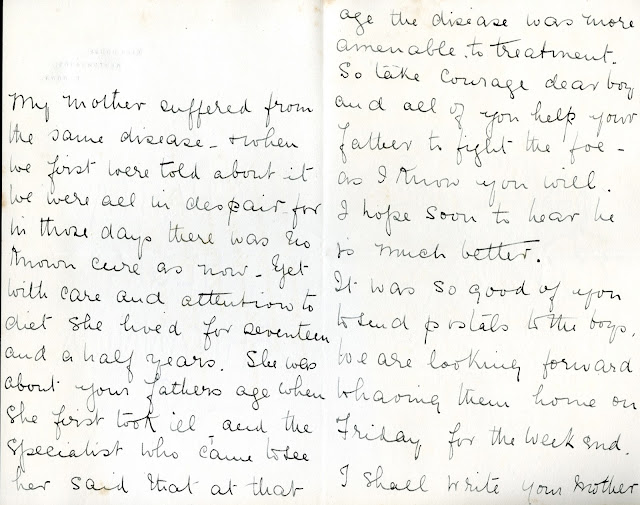
It is amazing how much I can relate to the joy in his adventures with friends and family. But as I read on, the letters took a dark turn, and the content quickly shifted from joyous vacations to his father’s poor health. The humanity and compassion within the correspondence jumped out at me. One can imagine the feeling as David Burpee read letters sent from family and friends who knew he were by the side of his ailing father.

Letter from Aunt Maggie to David Burpee regarding the illness of W. Atlee Burpee, October 25, 1915.
Just two days after working on documents that surrounded W. Atlee’s death, I was working on documents from 1980 approaching David’s death. The box was filled with happy remembrances; composed of documents related to Lois Burpee, David’s wife, and the writing of her garden cookbook, Lois Burpee’s Gardener’s Companion and Cookbook. Newspaper clippings, book reviews, congratulatory letters, and manuscript drafts made up the majority of the material. It appears Lois began working on her book in the early 1970s, but by the time she became more involved with its writing, her husband was ill. David died in June, 1980, at the age of 87. As I went through this box, I came across stacks of newspaper clippings and book reviews, and then another stack of obituaries and memorials. It was a bittersweet juxtaposition.

The fact that this collection includes far more than company records is partly due to who this family was. They were caring, hardworking and intelligent; their company was a vital part of who they were as people. The Burpee Company Collection thus offers insight into not only how a business of this magnitude operated under two generations of one family for nearly a century, but also demonstrates who these people truly were.

Chris DeMairo, Intern
Archives of American Gardens

Friday, April 20, 2018

Processing the Burpee Company Records, Part One

The first time encountering a new collection is exciting for an archivist. This is when we evaluate the physical condition of the collection, the predominant materials (papers, books, memorabilia, etc.), and, if possible, any potential series within the collection (business records, correspondence, newspapers, etc.) that aid in its final arrangement. It can be overwhelming to see a large number of disordered and dusty boxes in front of you, but knowing that within each box rests items that have not been touched for 5, 10, 30, even a hundred years is always exhilarating (in a bookish kind of way). This post will talk about my first week working on a new accretion to the W. Atlee Burpee Company Records.

The first step involves researching what exactly the collection is about. The W. Atlee Burpee Co. was founded by Washington Atlee Burpee in 1878. Burpee’s business grew over the next 15 years, and by 1893, Burpee had reached the top of the American seed scene when he was elected president of the American Seed Trade Association (ASTA). The Burpee Company rose to prominence under W. Atlee Burpee, but, of course, not without its good and bad years. When W. Atlee became ill around 1913, his eldest son David left his studies at Cornell to assist in operating the family business. In 1915, David was made CEO. Under David’s direction, the Burpee Co. continued to expand globally. In 1970, General Foods acquired the company.
David Burpee’s official resignation as president of W. Atlee Burpee Co., and the official “closing” of the deal with General Foods. The Burpee Co. merged with the Ball Seed Company in 1991 and is still an active business today.
The Burpee Co. was a well-run machine by the beginning of the twentieth century. W. Atlee Burpee was an astute businessman, a great organizer, and an innovator in seed marketing and advertising. He kept a close eye on all of his products as well. Constantly in correspondence with employees, contractors, retailers, and consumers, he stayed current with all aspects of his business. But it was marketing that separated Burpee from his competitors. Having the consumer interact with the company not only encouraged interest in Burpee seeds, but also helped the Burpee Co. connect with those who supported its business. Burpee’s approach to marketing ensured a personal and long-lasting relationship with its customers.

Looking at the business records of a company run by such a man is inspiring. Detailed notes scribbled all over scraps of paper capture his marketing skills. David Burpee had large shoes to fill when he took over the company, and he succeeded. In 1926, just a few years into radio broadcasting’s “golden age,” the Burpee Co. promoted a “largest zinnia” contest through a local radio station, WLIT in Philadelphia. Letters poured in to the radio station (which were all forwarded to the Burpee Co.) regarding the contest, with some seeking Burpee publications as well.

1926 letter submitted by Mrs. E. Shepherd of West Philadelphia to WLIT radio station in Philadelphia, Pennsylvania.  Listeners were invited to submit a letter requesting free Burpee seeds and publications. 

Between a company that crossed all oceans, and a business model that was as connected as ever to the customer, W. Atlee would have been proud of what his son accomplished. I am excited to be working on the W. Atlee Burpee Company Records. It is a great story of an American company, and deserves to be preserved. Processing collections requires patience, attention to detail, and great organization. Above all else, the archivist must acknowledge that they are presenting once hidden materials to the public.

Chris DeMairo, Intern

Tuesday, January 23, 2018

A Jazz Life, Interrupted

A recently acquired National Museum of American History Archives Center collection, the Maceo Jefferson Papers, 1898-1974, relates to a little-known but extremely interesting jazz musician and composer named Maceo Jefferson (1898-1974). Though possessing an impressive resume that included associations with such notables as Duke Ellington, W.C. Handy, Louis Armstrong, The Blackbirds, and others, he never attained fame for himself. He was a prolific composer and arranger, and lived an extremely interesting and eventful life. The rich archival collection donated by his great-nephew to the Archives Center gives us glimpses into the very earliest years of jazz and life for jazz musicians in the years between the world wars, and it opens up opportunities for researchers and scholars of this era. Only a few of our jazz collections document this formative era. Jefferson’s correspondence (he saved carbon copies of letters he sent--a luxury for a researcher) documents his efforts to have his music recorded and heard by the public. Reading Jefferson’s letters, one gets the sense of a likable, generous man with an ebullient personality and a wry wit, one who made the best of things when his career and life were derailed by circumstances beyond his control.

Jefferson’s early jazz life was probably typical of many musicians in the 1920s and 1930s, as he went from band to band, nightclub to nightclub. Many of these bands and clubs are documented in photographs in the collection. Born in 1898 in Beaufort, South Carolina, Jefferson, who came from musical parents, showed early aptitude for both banjo and guitar. In a document, he described lying awake nights listening to music from a dance hall down the street. He attended the Avery Institute in Charleston for two years, but the deaths of his parents ended his chance for further education. He served with the Coast Guard on a cutter, and with the Navy in World War I, and in a letter he stated that he “saw death staring me in the face dozens of times.” After his military service, he went back to music. He played in a nightclub in Norfolk, Virginia, for two years. He then spent another two years in a nightclub in Washington, where he met Duke Ellington and was one of the original members of his band, the Washingtonians. According to Jefferson’s nephew, he was the original arranger for this act, but Jefferson and Ellington had a falling out. He moved on to New York and worked in a succession of clubs there. He described the transformative experience of seeing and hearing Fats Waller play the piano in the Gaiety Theater. He joined Lew Leslie’s Blackbirds orchestra in 1926 and went on a European tour with them throughout 1927, and another with Leon Abbey’s band in 1928, eventually relocating to Paris. He lived in France for several years, married a Parisian costume designer, Yvonne Runtz, in 1937, and worked with several jazz bands and musicians including Louis Armstrong’s Plantation Orchestra, and then returned to New York. He played in Willie “The Lion” Smith’s band and later toured with blues composer W.C. Handy.

 Photographer unidentified. Jefferson (front row, wearing arm band) with Louis Armstrong (top row, far left) and his orchestra. Maceo Jefferson Papers, No. 1370-0000005.

Photographer unidentified. Jefferson (at left, seated, having his shoes shined) with the Leon Abbey Band. Maceo Jefferson Papers, No. 1370-0000004.

Photographer unidentified. Jefferson (holding banjo) with the Four Harmony Kings.
Maceo Jefferson Papers, No. 1370-0000006.

The late 1930s found him back in Paris. Soon afterward, Jefferson’s life took a radical detour. The Germans invaded Paris in 1940. After the closing of the Moulin Rouge left Jefferson without work, he worked with the Red Cross delivering U.S.-donated food and medicine to civilians and prison camps. In a 1967 letter, he said that “the Germans considered most of us working with the American Red Cross a bunch of spies.”


Photographer unidentified. Photographs taken of Jefferson while he was working for the Red Cross. Maceo Jefferson Papers. Top, No. 1370-0000008. Bottom, No. 1370-0000010.

The Nazis arrested Jefferson three days after Germany’s declaration of war on the U.S. (December 11, 1941), and he spent the next 27 months in an internment camp in Compiegne, France. Compiegne held political prisoners, French Jews, employees of the French government, and resistance fighters to the Vichy government. While imprisoned, Jefferson led an orchestra in the camp. According to his nephew, this may have saved his life. A concert program, hand-made, survives in the collection. The musical pieces played at this concert are an eclectic mix of fox trots, waltzes, hymns, solos, and just one composition by Jefferson.


 Program from a February, 1942 concert held inside the Frontstalag 122, Compiegne, France, led by Maceo Jefferson. Maceo Jefferson Papers.  Top: Cover, No. 1370-0000001-01.
Bottom: Inside text, No. 1370-0000001-02.

Jefferson’s wife Yvonne came regularly to see him in the camp, and bring him food. In a letter he wrote late in life, at a time when he had to make many sacrifices to take care of his wife, he said “she came 72 times to see me…walking from home to the station and after arriving at Compiegne she had three miles to walk to the camp, and that back… she has shown me her courage now it’s my time.”

In a 1967 letter, Jefferson describes his wife Yvonne’s heroic efforts to sustain him during his imprisonment by the Nazis. Maceo Jefferson Papers, No. 1370-0000002.
He was released in 1944 in a prisoner exchange, and returned to the United States in diminished health. At this point he resumed club work and songwriting, and in fact, in his later years he concentrated on composing, on developing new arrangements for old songs, and on getting his music performed and recorded. Letters in the collection document Jefferson’s contacts with performers such as Liberace, Tennessee Ernie Ford, Peggy Lee, and others, offering his compositions for their use. Guitarist Ray Rivera and blues singer Alberta Hunter did accept his offers.

A letter from Tennessee Ernie Ford declining Jefferson’s offer of musical compositions, 1956.
Maceo Jefferson Papers, No. 1370-0000003.
Maceo Jefferson died in 1974, leaving behind a sizable but largely unknown musical legacy. The above-described archival materials comprise just 1/8 of the collection. The other 7/8 contains a couple of recordings, one of which is a very early wire recording, and hundreds of Jefferson’s compositions.


By Cathy Keen, Archivist
Archives Center, National Museum of American History

Thursday, December 14, 2017

What Would Frank Espada Do?

As I walk through the streets of the nation’s capital, there is never any shortage of interesting sights. But it is not the monuments nor the plethora of restaurant chains that catch my attention. Instead, I am fascinated by the social ills of society that are so often deemed invisible by our very own conscious effort to look the other way. The homelessness, protests, and social inequality I have witnessed are nothing new, but the way in which I now view these things is.


Man participating in a school boycott in New York, 1964. Frank Espada Photographs, ca. 1970-2000, 
Archives Center, National Museum of American History. AC1395-0000004. 
For over a month now, I have made the trip from downtown Silver Spring to Washington D.C. My destination: the National Museum of American History. As an intern in the Archives Center, my main task has been to process the Frank Espada Photographs Collection. The collection consists of several thousand black-and-white photographs and what seems to me an endless amount of negatives. Apart from processing the collection, it is also my responsibility to understand who Frank Espada was. At first, the answer was simple: a Puerto Rican photographer who documented the Puerto Rican diaspora and later published a book with some of his most famous photographs. But as archival work would soon teach me, the answer is never that easy.

School children in Puerto Rico. Undated. Frank Espada Photographs, ca. 1970-2000,
Archives Center, National Museum of American History. AC1395-0000002.

Walter, a migrant worker and union organizer, in his home located in Glassboro, New Jersey. 1981. Frank Espada Photographs, ca. 1970-2000, Archives Center, National Museum of American History. AC1395-0000003.
As I sift through the countless photographs, I am mesmerized by the stories that each one tells. Espada traveled to various cities in the United States and Puerto Rico and had a talent for capturing scenes and activities. One minute I could find myself in the bustling streets of East Harlem and the next in the San Juan Festival at Cabrillo Beach, California. More importantly, Espada specialized in capturing the raw emotions that are displayed by our countless facial expressions. In the collection, I have encountered photographs of individuals filled with extreme joy and happiness, and by complete contrast, photographs of individuals filled with grief and emotional pain. It’s these photographs that capture the eye of an observer. As I dug deeper into the collection, I realized that Frank Espada was more than just a talented photographer.

Included in the collection are black-and-white photographs taken by Frank Espada during the Civil Rights Era. It’s here that it became clear to me how much his life revolved around community activism. He was driven by a sense of social justice and worked to improve his community and counter the racism and discrimination of the 60s and early 70s. In two photographs, he appears standing next to a sign that reads, “East New York Action”. Espada founded East New York Action, a community organization created for the sole purpose of addressing issues in the community. East New York Action organized rent strikes, educated people on welfare rights, and registered voters. There are photographs of the Puerto Rican Community Development Project, an organization that Espada worked for as a community organizer. Additionally, he had strong ties with the United Bronx Parents and the Young Lords, among others. Frank Espada was a determined leader with an ability to connect with others and a dedication to his community that was hard to match.

I think of Frank Espada and his work, both as a photographer and as a community leader, and comprehend his vision of the world. He saw beauty in every photograph, but understood that the most important thing he could do was help others through their struggles and listen to their stories when the world surrounding them chose to turn a blind eye. It is this part of the collection that impacts me the most. As I continue my walk through D.C., I ask myself, “What would Frank Espada do if he witnessed everything I see on my walks to work?”

I think back to the 30 cassettes in the collection that I spent two weeks digitizing. Each cassette had full-length interviews conducted by Frank Espada of community leaders such as Jack Agüeros, Willy Vasquez, and Juan Gonzalez, among others. Personally, it was my favorite part of the collection, as I was able to place a voice on several of the faces I saw in photographs. It was here that I realized what Espada was doing: he was giving a voice to the community. While his photographs did the work of establishing a national presence of Puerto Rican culture and identity, these interviews showcase the collective work that was being done across the country to improve the lives of Puerto Ricans and other Latinos living in the United States. They were a clear reminder that we must give a voice to the communities that are often silenced by the social barriers of inequality.
Self-portrait of Frank Espada standing in front of East New York Action. Undated.
AC1395-0000001.
So what would Frank Espada do? He would remind us that we must take the time to listen to each other’s stories and to speak up for ourselves and for others. He would remind us that if we do not take the time to do these things, we are incapable of seeing the world through more than one lens, oblivious of the things happening around us. And of course, he would do all of this with a camera in hand, ready to capture us in our most intimate moments. This is what Frank Espada would do.

Edwin Rodriguez, Intern
Archives Center, National Museum of American History

Tuesday, June 13, 2017

Cleaning Up Freer’s Attic

Collections change over time. Collections often come from chaos. Archival collections are often a rushed boxing up after someone passes. The collector is no longer there to ask questions of. This inherently leads to questions. What was this ledger for? Who were these letters to? How did they want their art displayed?

Archivists, museum staff, and researchers grapple with these questions every day. It is often where interesting exhibits come from.

Head Archivist, David Hogge, puzzling out how to organize various photographs.
The Freer | Sackler Archives made the decision a year ago to overhaul the Charles Lang Freer Papers. Please click here for a link to his new and improved finding aid! Freer was the founder of our museum. Opened in 1923, it was the first topic-focused museum at the Smithsonian and its first art museum. Freer did not live to see his museum completed, but the museum did receive, on top of all of his art collection, his vast collection of papers.

Freer was a meticulous man when it came to his correspondence, his purchasing, and, well, everything. This has left a rich collection of papers for museum staff and researchers to use when studying a Freer art object or the man himself.

Not all paper is of equal size.

The finding aid (guide to any collection) for Freer’s papers, like so many other “legacy” archival collections, was created before modern archival standards were established. F|S Archives staff made the decision to overhaul the Freer papers after having many problems in recent years, both finding items for researchers and dealing with how to organize their digital surrogates. You must have a firm handle on the physical side of any archival collection before you can even contemplate digitizing it.

Working in an archives means using your hands and handling physical objects from paper to film canisters.
Physical collection? What is that you ask? It must be hard to imagine in this age of digital smorgasbord that there are still items in the world that are only available in the physical format. Well, a large part of what archivists do is make available in a digital environment what was once only sitting on a shelf in a box and only a few passionate researchers even tried to look for. Everything in an archives is unique, one a kind, the only one in the world.

Archivists are working hard around the world to make unique pieces of human history available and accessible to all, please see this great blog post about putting more of human history online. So
digitizing archival materials is crucial to both outreach (anyone in the world can look at the digital surrogates from the various Smithsonian Archives) and to the long term life of the materials. Paper lasts a long time, but it does not exist forever.

How does one organize a physical collection? How does one re-think it? A collection is always organized to preserve any original organization of the creator, in this case Freer. There are times where it becomes obvious there was no organization to begin with. This is often the main mystery that archivists struggle with on a daily basis: did so and so want these papers this way? Were these postcards meant to go together? Was this part of their research patterns? Their collecting patterns?

Organizing ones thoughts the old fashioned way, on paper.


When archivists make decisions about organization, we are not copy-pasting some files to a new folder in a computer drive. We are weeding through boxes and boxes of materials and attempting to form them into a unit of thought or creator's process. Think of it this way, what if you had to organize Bob Dylan’s writing process. There would be tons of paper or scraps of papers and you have to figure out if he had an order to begin with or was it all chaos? Is imposing some sort of order, potentially where none exists, harming the integrity of Dylan’s creative process or are you creating just enough access points so that a researcher writing the next bestselling Dylan biography can find what he/she needs to do their job?

Basically, does taking a mountain of paper and creating an access pathway (e.g. putting the materials in folders and boxes with labels), a way of thinking about them, looking at them, destroy intrinsically what they are?

The slow task of properly identifying and labeling boxes.  Lots of glue gets on your fingers.
There were many sections of Freer’s papers like this; piles of paper all next to one another and yet had nothing in common. F|S Archives Staff had to separate out these papers into neat pathways that would lead researchers to access points of useful information. For example, what now constitutes Series One in the Freer Papers, was once a few boxes that were just near one another. If you look at the finding aid now, you can see clear pathways/access points (e.g. Memberships and Honorary Awards, Freer Residences, Genealogical Materials, etc.). These pathways are called Series and Subseries in the archival world. Neat piles of paper that all have their own theme and purpose. This makes it much easier for researchers to find what they need; whether that is physically handling the materials or doing a Google word search. We have made these important documents that much more accessible to the citizens of the world.

This aspect of creating finding aids is the complex intellectual part. There are other aspects to cleaning up a collection that are much more hands on.

One of the biggest decisions the F|S Archives made was to completely re-number the boxes and materials in the Freer papers. This may seem like a small thing. Well, the Freer papers hold over 300 boxes and this would not just be re-numbering the boxes in a digital document (the Freer finding aid), it would entail physically pasting new labels on all of the over 300 boxes. You are probably thinking, why would you do that?!
A wall of a job of well done.
Well, most of the Freer papers are not digitized. The only way to track and monitor the small physical components of the collection is to have solid and accurate box numbers. In addition, the archives has to have strong control of the physical space our materials reside in. We have a space matrix documenting where the materials of all of our, over 100, collections are shelved.

So, yes, having accurate labels on the physical materials in an archive is essential. The long term goal – archives often have to think in the long term, collections are too large to allow for instantaneous work – is to enable much of Freer's papers to be digitized, so that more scholars around the world can examine his materials and learn more about Charles Lang Freer, his art collecting, and the art pieces themselves.

Lara Amrod, Archivist

Tuesday, December 20, 2016

Donald J. Ortner: Physical Anthropologist, Museum Curator, Paleopathologist

How does tuberculosis leave its mark on a human skeleton? What is the significance of changing ankle stability in an ancient culture? What do skeletons tell us? Donald J. Ortner (1938-2012), a biological anthropologist in the National Museum of Natural History, explored questions such as these. Many of his projects focused on paleopathological studies of human skeletons; essentially Ortner researched the visible effects of ancient diseases on bone.

Donald J. Ortner at the base of a shaft tomb at the Bâb edh-Dhrâ cemetery site in Jordan, circa 1977, Box 64, Donald J. Ortner Papers, National Anthropological Archives, Smithsonian Institution.
The photograph above portrays Ortner in the midst of one of the larger paleopathological projects of his career: Bâb edh-Dhrâ. East of the Dead Sea in Jordan, the site of Bâb edh-Dhrâ includes an Early Bronze Age town and cemetery. From 1975 to 1983, the archaeological team of the Expedition to the Dead Sea Plain (EDSP), co-directed by Walter Rast and R. Thomas Schaub and comprised of people from an array of different disciplines, carried out excavations of the site. While an extraordinary 373 individual skeletons have been uncovered, it is estimated that the cemetery consists of 37,699 bodies buried in over 2,500 shaft tombs. In general, these shafts are about 4 feet across and 6 feet deep; you can see Ortner standing at the base of one of them in this photograph. At the bottom, hemispherical burial chambers were dug out to the side of the shaft, 3 feet high in the center and 6 feet in diameter. Women, men, young, and old were buried together in these chambers with an average of about 5 people per chamber.

During Ortner’s first field season at the Bâb edh-Dhrâ site in 1977, he was given the honor of opening the first excavated burial chamber, A78. The following excerpt from Ortner’s article “Cultural Change in Bronze Age” (Smithsonian Magazine, 1978) describes Ortner’s reaction to opening the chamber:
“I shall never forget the exhilaration. Covered with dust, perspiration rolling off me in the 100-degree-plus heat, I pulled away the stone blocking the north chamber and saw revealed for the first time in 5,000 years the human skeletons and exquisite pottery inside.” 
Ortner and his team used analyses of the specimens and tombs to examine how the transition from a nomadic way of life to an urban one affected burial practices. He also discovered information about the health of these Early Bronze Age people, finding indications of arthritis, brucellosis, and tuberculosis on the bones. Ortner continued his study of specimens over a period 30 years, fascinated by and perhaps even admiring of a group of people so troubled by infectious diseases, yet “surviving and even thriving” (Ortner and Frohlich: 368).

Aside from his work at Bâb edh-Dhrâ, Ortner pursued several other projects related to the history and evolution of human infectious diseases. Throughout his 49 years (1963-2012) in the Department of Anthropology in the NMNH, Ortner was a well-respected colleague and mentor; he filled many positions from Museum Technician to Curator to Acting Director of the Museum.
The Donald J. Ortner Papers are now open for research at the National Anthropological Archives. The National Anthropological Film Collection, formerly the Human Studies Film Archives (HSFA), holds films that document Ortner’s work in Bâb edh-Dhrâ. An appointment is required to view the materials.

Alice Griffin, Contract Processing Archivist
National Anthropological Archives


Sources consulted: 
Ortner, Donald J. “Cultural Change in Bronze Age.” Smithsonian Magazine (1978): 82-87.

Ortner, D. J., and Bruno Frohlich. “The EB IA Tombs and Burials of Bâb edh-Dhrâ, Jordan: A Bioarchaeological Perspective on the People.” International Journal of Osteoarchaeology 17 (2007): 358-368.

Wednesday, December 7, 2016

More on the Photographic Adventures of Katherine Joseph


President Franklin D. Roosevelt and International Ladies Garment Workers Union (ILGWU) president David Dubinsky with cast members of the ILGWU revue "Pins and Needles." Left to right: Ruth Rubenstein, Rose Newmark, Lynn Jaffe, Millie Weitz, Ann Brown, and Nettie Harari at the White House, March 3, 1938. Photograph by Katherine Joseph, © Richard Hertzberg and Suzanne Hertzberg. Katherine Joseph Papers, Archives Center, NMAH.
This is an update to the September blog by Richard Hertzberg and myself, “Every Minute Counts,” about documentary photographer Katherine Joseph. The biographical information in that blog, as well as in the Archives Center’s finding aid and catalog entry, was derived from Katherine Joseph’s daughter Suzanne Hertzberg's 2002 master’s thesis for the University of Southern California, “Photo by Katherine Joseph.”

Ms. Hertzberg then transformed her thesis into a book for publication--a handsome biography of this little-known, talented photographer, entitled Katherine Joseph: Photographing an Era of Social Significance (Bergamot Books, 2016). Illustrated with many of her mother’s photographs, it places Katherine Joseph’s career firmly in the tradition of 1930s-1940s documentary photography, as well as in the context of American women’s history. As such, it is far more than an affectionate memoir. Since Katherine Joseph told her children so little about her photographic career, Suzanne Hertzberg had few specific personal memories to relate, and had to pursue extensive research on her elusive subject.

The collection was donated to the Archives Center in 2007 by Suzanne and Richard Hertzberg.

David Haberstich,
Archives Center, National Museum of American History


Monday, January 19, 2015

On Broadway with the Juley Collection

For fans of the theatre: From our Peter A. Juley & Son Collection, we've recently added 247 images of artworks and related items photographed for the theatrical designer, Jo Mielziner. While many of the artists in our collection are more traditionally represented by their painting and sculpture, the Mielziner images struck me as interesting as they feature not just drawings, but also technical studies, collages, and other seemingly random images taken from the artist’s studio.

A student at the Pennsylvania Academy of Fine Arts, Jo Mielziner was on track to follow in the foot-steps of his father, the painter Leo Mielziner, Sr. It was after a summer spent working as a stage manager however, that Jo instead became interested in scenic and lighting design for the theatre (an interest that was also encouraged by his brother, the actor Kenneth MacKenna).

In the following years, Mielziner went on to study set design in Europe and then apprenticed with Robert Edmond Jones before branching out on his own. A large part of his career was spent working on Broadway productions, most notably A Streetcar Named Desire, Cat on a Hot Tin Roof, and The King and I. His designs for these and other plays would earn him several Tony awards and nominations.

Cat on a Hot Tin Roof

Later on in his career, Mielziner developed an interest in theatre architecture. He designed the theatre at Wake Forest University, and was hired as a consultant for the Vivian Beaumont Theatre at Lincoln Center and the Mark Taper Forum in Los Angeles. He was also commissioned to create a display for the New York’s World Fair, and while we still need to fully research the Mielziner images, I believe we may have a few photos of sketches and inspirations for that project.

Design for Vivian Beaumont Theatre
New York World's Fair Design, Pieta

Among the stage and theatre designs are portraits and photographs of Mielziner’s friends and colleagues. I really like the portrait below of conductor, Arturo Toscanini. You can find the rest of the Mielziner images here. Many are still unidentified, so if you know who or what they are, do let us know!

Robert Edmond Jones
Arturo Toscanini

A big thanks for the help of our wonderful scanning assistant, Bryan. We've been able to upload the Jo Mielziner images, along with over 3,000 images from the Juley Collection, to the Collections Search Center.

--Rachel Brooks, Photograph Archives, Smithsonian American Art Museum

Wednesday, July 30, 2014

Exploring a Renaissance Rarity in the Dibner Library


In the auspicious year of 1543, a book in German, Evangelien vnd Epistlen des Neϋwen Testaments (The Gospels and Letters of the New Testament; qBS239 1543 SCDIRB) was printed in the ancient Alsatian town of Colmar. Compiled by one Ambrosius Kempff, the work contains almost all of the New Testament and some of the Old Testament arranged in the order of the days of the Church calendar. As in a typical Roman Catholic lectionary, each selection was to be read on a certain day of the year. While the Dibner Library is primarily known for its history of science collections, it also contains several Bibles and other religious works, and we were pleased to be given this example on several accounts.


It is indeed a rare volume, with no other recorded copies in the United States and only a handful in European collections. Evangelien vnd Epistlen des NeÏ‹wen Testaments appears in none of the standard reference works. It does get a mention in John M. Frymire’s The Primacy of the Postils (2010) which states it is written “Catholic” in the tradition of Erasmian humanism.

The Bewitched Groom


Interspersed among the 269 leaves of Fraktur letterpress are over a hundred woodcut illustrations by various artists, some of intriguing quality. This work could prove to be a rich source of analysis by an art historian as some of the woodcuts are by that most gifted and strange student of Albrecht Dürer’s, Hans Baldung, called Grien (d. 1545). Known as a painter—one familiar work is Three Ages of Woman and Death (Kunsthistorisches Museum, Vienna, 1510)—he was also a printmaker with a preoccupation with mortality and sorcery. One of Grien’s best known prints is the erotically charged The Bewitched Groom (1544).


The 1540s were a dynamic period for publishing: not only were significant works related to the Protestant Reformation printed but also announcements of new strides in the field of science. The year 1543 in particular is a major milestone in history of science literature, marked with exceptionally significant publications. In the field of astronomy, Nicolaus Copernicus (1473-1543) produced De revolutionibusorbium coelestium (On the Revolutions of the Heavenly Spheres) in Nuremberg, providing arguments, based entirely on mathematical calculations, for the heliocentric universe. In mathematics, the first modern European language edition of Euclid's Elements appeared in Venice, translated into Italian by Niccolò Fontana Tartaglia (d. 1557). And in medicine, Andreas Vesalius's Dehumani corporis fabrica (On the Fabric of the Human Body) was edited and printed in Basel by Johannes Oporinus (1507-1568). The profusely illustrated volume transformed the science of human anatomy by promoting direct observation in addition to (or many times countering) classical medical knowledge. These books of 1543 foreshadowed a new scientific era, the Scientific Revolution in the same year when Evangelien vnd Epistlen manifested the rich new religious literature.


This donation contained a pleasant surprise: it has a 19th-century armorial bookplate although without an accompanying name. However, thanks to online resources, notably the Ex Libris Chronicle of the American Society of Bookplate Collectors (formed in Washington, D.C. in 1922), the previous owner could be quickly identified by the motto and coat-of-arms. Evangelien vnd Epistlen des NeÏ‹wen Testaments once belonged to a great bibliophile, Prince Augustus Frederick, Duke of Sussex (1773-1843). He was the sixth son (of fifteen children) of King George III. His vast library of some 50,000 volumes was housed in Kensington Palace, where some members of the Royal family still live. The Duke’s librarian happened to also be his surgeon, Thomas Joseph Pettigrew, who produced catalogues of the collection as well as books on other topics. Pettigrew’s Medical Portrait Gallery (London, [1838?-1840]; R134 .P52 1838 SCDIRB) is on the Dibner shelves. Alas, the Duke had amassed huge debts (in no small part because of his collecting habits) so soon after his death the books and manuscripts were sold at auction and the library’s contents scattered. This volume is the only one in the Smithsonian Libraries identified with this provenance.

The manuscript inscription and armorial bookplate
But there was more interesting history to uncover in this one book. A handwritten inscription above the Duke’s bookplate seemed matter-of-fact at first glance: Jacob A. Westervelt to his daughter Eliza M. Westervelt / 1864. The names did not appear in either the Smithsonian Libraries online catalog nor in the Library of Congress or the Virtual International Authority File. However, one very good Wikipedia entry pinpointed the identities of these two:  Jacob Westervelt (1800-1879) was a famous shipbuilder whose long career included constructing 247 vessels, and who also served as mayor of New York City, from 1853 to 1855. One of his accomplishments was placing the police force, against great resistance, in uniforms for the first time. An 1885 portrait of Westervelt by Edward Ludlow Mooney is in the Smithsonian American Art Museum. Eliza Mariette (1841-1891) was the youngest of his eight children. 


The donor of the Evangelien vnd Epistlen is Mr. Theron Patrick, Commander United States Coast Guard (Retired) who recently visited the Dibner Library and the Book Conservation Laboratory of the Smithsonian Libraries. We very much appreciate his interest in our collections and we thank him for donating such a fascinating volume.


with the help of Diane Shaw, Special Collections Librarians, Smithsonian Libraries

The illustration of The Bewitched Groom is from Wikimedia Commons, all others are from the Lectionary, Evangelien vnd Epistlen.