Smithsonian Collections Blog

Highlighting the hidden treasures from over 2 million collections

Collections Search Center
Showing posts with label Science and Technology. Show all posts

Monday, August 21, 2017

Solar Eclipse Collections at the Smithsonian

Are you excited about the eclipse today? So are we! Over the centuries, people have long been fascinated by solar and lunar eclipses. The Smithsonian Institution has many eclipse related and inspired collections. Check some of them out on the Smithsonian Collections Search Center.

Here are a few highlights:

This National Portrait Gallery photograph from 1869 depicts John A. Whipple (center, left) and the Harvard Observatory team photographing a rare solar eclipse. An inventor and photographer, Whipple was also the first person to photograph the moon's surface in great detail in 1851.
John A. Whipple and the Harvard Astronomical Expedition to photograph a rare solar eclipse (1869). National Portrait Gallery, Smithsonian Institution; gift of Larry J. West, NPG.2007.127.
Astronomical Photographer and Professor Henry Draper took this photograph of a total solar eclipse on July 29, 1878. You can read more about Draper and his scientific family in the National Museum of American History’s Draper Family Collection finding aid on the Smithsonian Online Virtual Archives (SOVA).

Photograph of the Corona 1878, [photograph reprint], National Museum of American History, Archive Center, AC0121-0000001.
In 1901, future Smithsonian Secretary Charles G. Abbot, then working at Smithsonian Astrophysical Observatory, traveled to Sumatra to study a solar eclipse. Though cloudy weather prevented a perfect viewing for Abbot, but colleagues stationed in other locations were able to gather data. Read more about Abbot's adventures from the Smithsonian Institution Archives: The Best-Laid Plans of Mice and Astronomers

1901 Sumatra Eclipse Expedition, Smithsonian Institution Archives, Image Number 94-12603


If you want to learn more about how to view the solar eclipse safely, check out the National Air and Space Museum’s website for some great videos including this one on fun ways to view the eclipse.


Stay safe everyone and happy eclipse viewing!


Emily Moazami, Assistant Head Archivist

Wednesday, March 29, 2017

Hitler's Electron Microscope

Mama always said life was like a box of chocolates. You never know what you’re gonna get.
                                                                          --Forrest Gump, 1994
Archival material is like a box of chocolates because when you open an archival box you never know exactly what will be inside. Recently it was Adolf Hitler's electron microscope. Well, not the microscope itself, but the paperwork about the 1944 confiscation by Allied Forces of a Siemens electron microscope from the laboratory of Hitler's personal physician, Dr. Theodor Morrell, and its transfer and reassembly at the Army Medical Museum at Walter Reed.

An academic researcher at the Technische Universität Wien (Austria), where they are celebrating the 75th anniversary of electron microscopy, wrote asking for a description of several folders from our Rubin Borasky Electron Microscopy Collection, including Series 5, Box 7, Folder 17: Siemens Electron Microscope (captured in WWII).
The transmittal document describes the Siemens electron microscope as purchased by Adolf Hitler for Dr. Morell. The back story here is that Hitler was a hypochondriac in thrall to Dr. Morell, who supplied him with vitamins, hormones, and steroids. The strength of his hold over Hitler is reflected in the fact that there were perhaps only two or three of these Siemens electron microscopes in existence being used for atomic research. According to a 2009 book by two German historians (The Hitler Book: The Secret Dossier Prepared for Stalin / 2009 Henrik Eberle, Matthias Uhl), Morell hoped to use it to develop an explosive powder. He set up a laboratory in Bad Reichenhall, just at the foot of Berchtesgaden in Bavaria, where Hitler had built his Eagle’s Nest bunker.

The Eagle's Nest, Bavaria
Picked up by Allied Forces, Dr. Morell was taken from prison in Bad Reichenhall, Bavaria; he took them to the laboratory location in a fortified house on the outskirts of the town, where the microscope was found. The Army packed it up but later found parts were missing. Because of the missing parts, a second Siemens electron microscope was located and the parts from the two combined the make a single model for display. The microscope thus created is now part of the Billings Microscope Collection at the National Museum of Health and Medicine.

The National Museum of Health and Medicine website has a complete inventory of the Billings Microscope collection and a Siemens electron microscope appears on p. 151 of the PDF.

Christine Windheuser, Volunteer
Archives Center, National Museum of American History

Monday, October 17, 2016

Journals and Diaries: A Window into the Past

As a member of the Archives Center staff, I have worked with numerous hand-written archival materials over the past four years. Most of my work with hand-written documents has been for the purpose of digitizing them to be uploaded into the Transcription Center for transcription by public volunteers. While the Archives Center staff has digitized a wide array of materials, many of these handwritten documents are diaries or journals.

The majority of these diaries and journals provide a first-hand detailed account of a specific time and place, like the journals in the Leo H. Baekeland Papers, 1863-1968.  Leo Baekeland was a chemist and inventor, credited with the development of an early form of plastic called Bakelite. His journals, which spanned 35 years, 1907-1942, preserve much of his ideas and work in the development and production of plastic and his research. While this may be fascinating to some researchers, what I find most valuable about these journals is not the specifics of his work. I am more interested in his details of day-to-day American life and historic events.


Pages 142-143, Volume 25 of Leo Baekeland’s journals from the Leo H. Baekeland Papers, Archives Center, NMAH
Baekeland’s journals, 65 in all, cover not only his work with plastic, but some of the most important events in American history.  As an example, he wrote on November 7th, 1918, “WAR IS OVER and GERMANY SURRENDERS” and describes the celebration on Broadway in New York City. Later in his diaries, October 29, 1929, Baekeland writes about the fall of Wall Street and how he did not lose his money, but many did due to speculation and inflation of the stock market. In December 1941, he wrote of the bombing of Pearl Harbor.

Journals like this are an invaluable resource for the day-to-day activities of their author, but also the insight they provide on the American experience from that period of time. When researched alongside other journals and diaries from other collections, on the same dates of important events or time periods, these manuscripts can assist the researcher in seeing a snapshot in time.  This can be an important aid to the understanding of a specific time period or experience.  For myself, this is why these types of manuscripts are so important to us and our researchers.

Joe Hursey
Archives Center, National Museum of American History

Wednesday, August 3, 2016

SELGEM: Designing IT applications in the 1970s

This is the last of a three-part-series on SELGEM, a pioneering computer systems used to manage museum collections in the United States. Read the first part here; and the second part here

You might think that total confusion would reign if specifying requirements and assigning data Category Numbers was not strictly controlled by “the system.”  However, the end users cared deeply about information accuracy and the quality of final products, such as specimen labels, catalog cards and resulting publications.  The staff were highly motivated to following the data standards and produce high quality products.  Museum staffs were generally acquainted with structured data because of their traditional work cataloging museum specimens and object, and in research data analysis.
A standard data capture form of the Botany Type Register Project. Page 13, from:  Shetler, Stanwyn G., Mary Jane Petrini, Constance Graham Carley, M. J. Harvey, Larry E. Morse, Thomas Kopfler, and collaborators.  1973.  An Introduction to the Botanical Type Specimen Register.  Smithsonian Contributions to Botany 12. Smithsonian Institution Archives. 
The design of a new SELGEM application in the early 70’s was simpler than design of a new information system in 2016.  There were three reasons for this:  Smithsonian operated a single Honeywell mainframe computer; possessed a single general purpose software “database” tool; and there were only two or three data entry procedures available.  In addition some experience acquired in one application, such as cataloging mammal specimens, could be applied directly to another application, say cataloging mollusk specimens.  While every discipline has some unique data elements, there were recurring groups of data elements for taxonomic information, geographic information, collectors, etc. that you could build on.  Best practices learned designing the earliest SELGEM applications were applied to the design of succeeding applications.

Stanley A. Kovy Director of Information Systems Division (ISD)
and early supporter of the SELGEM system.  Standing at the 
computer console of the upgraded Honeywell 2015, Nov. 1971.
Smithsonian Institution Archives. 71-2785-12. 
For a first time application, usually the system owner or sponsor would assemble sample input records, data sheets, current output products and samples of desired outputs.  The staff member would discuss the proposed SELGEM application with an experienced SELGEM person, “the expert.”  Current workflows were reviewed for possible changes and improvements.  Often there was a very specific output desired.  From these discussions they would begin to prepare a data dictionary, define data standards, and rules for data entry; and SELGEM Category Numbers would be assigned.  They would consider immediate objectives and future objectives; as well as possible improvements and changes to the workflow in the future.

While Category Numbers could be assigned sequentially without any gaps (001, 002, 003, 004, etc.) there was no technical reason to do that.  Theoretically, at least, you had 999 Category Numbers to select from.  It was generally believed that a more flexible design was achieved by providing gaps when assigning Category Numbers.

For the scientific name you might have this data structure:
071 genus
073 subgenus
075 species
077 subspecies
This format was frequently adopted even when the systems owner had no intention of entering data for subgenus or subspecies.  So the documented design might look like this:
071 genus
075 species
This design met the immediate requirements, and provided a flexible logical data structure for the future, with subgenus and subspecies not even defined.

For truly new applications without any precedent, such as an archives catalog, a prototype file of a few records could be created within a day or two.  This “prototype file” could be used for what we now call “proof of concept.”  It could be reviewed by other staff members for comment and approval.  The file could be used to create sample reports, or evaluate how to best structure particular data elements for the most flexible data processing.

Or a proposed application, such as an index of reprint publications, might be very similar to previous applications.  Once you have created several bibliographic applications and produced reports for several years, you understand the basic structure and processing requirements of this type of application.
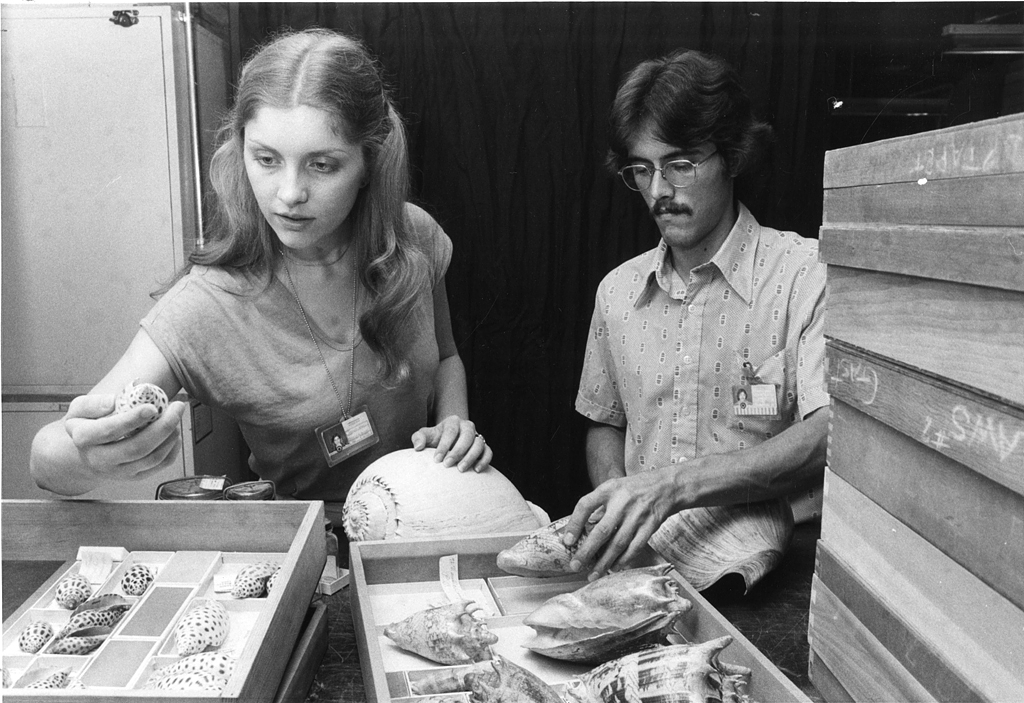
Deborah Bennett and Tim Coffer, museum technicians, sort trays of shells for the mollusk inventory in the National Museum of Natural History's Division of Mollusks.  SELGEM was used to support the inventory and in preparation for the collection move to the Museum Support Center in Suitland, MD. Smithsonian Institution Archives. SIA2009-3232. 
Initially the SELGEM technical knowledge was in the hands of the pioneers, but as the knowledge of the SELGEM system was acquired by an increasing number of museum staff members, new applications could be quickly designed to meet new requests.  SELGEM processed all the information for the “great count,” the Smithsonian collections inventory program (1979-1983). SELGEM was a truly powerful information processing system in its day.


David Bridge, Volunteer
Smithsonian Institution Archives

Wednesday, July 27, 2016

SELGEM: The Logical Structure

This is the second of a three-part-series on SELGEM, a pioneering computer system used to manage museum collections in the United States. Read the first post here.

A SELGEM (an acronym for: SELf GEnerating Master) computer record was what we all define as a typical record, all the information about: one object, one specimen, one work of art, one publication, or, one person, etc. It included all the related fields or data elements. The SELGEM logical record was composed of one or more physical records. A logical record was all the “physical records” with identical Serial Numbers.

Because SELGEM was a general purpose data management system it was used for a wide range of applications at the Smithsonian Institution. Computer applications (using SELGEM) in the 1970s included: museum objects from National Museum of Natural History (NMNH), National Museum of American History (NMAH), National Air and Space Museum (NASM), art museums, the Smithsonian Institution Archives, Volcanoes of the World, bibliographic applications, systematic checklists, type-specimen catalogs, Catalog of American Portraits, National Portrait Gallery (NPG), Inventories of American Painting and Sculpture, and a list of threatened and endangered plants in the United States. Many of these pioneer applications continue today, having evolved into modern databases and web-based applications.

SELGEM master file, directory record
Ayensu, Edward S. and Robert A. DeFilipps. 1978.  Endangered and threatened plants of the United States.  xv, 403 pages.  Smithsonian Institution, Washington, DC. 
Typically a SELGEM logical record was composed of from about 5 to 50 physical records (individual lines); maybe an occasional application included as many as a hundred. The Category Numbers could be any number between “001” and “999”. Each Category Number represented a data element. The first Category Number for a logical record was not required to begin with “001” and application owners generally provided gaps when assigning Category Numbers to create a more flexible design. However a Master List of records displayed Category Numbers, and the associated data, in numerical sequence.

The first line of a category always began with Line Number “01”. If the amount of data exceeded 64 characters, then continuation lines were created, and numbered sequentially “02”, “03”, etc. The theoretical maximum amount of data for one data element (or Category) was 99 lines x 64 characters or a maximum of 6,336 characters.
Sample SELGEM record, page III
Creighton, Reginald A., Penelope Packard, and Holley Linn.  1971.  SELGEM Retrieval:  a general description.  Smithsonian Institution Procedures in Computer Sciences, 1(1):(6 pages) + 1-38.Dated July 1972.
The theoretical maximum amount of data for one logical record was: 999 Category Numbers x 6,336 characters, for a total of 6,329,664 (or 6.3 megabytes). No application reached this size, let alone an individual record. In addition, individual SELGEM computer programs also had memory limits; which also limited the maximum size of a record that could be processed. Remember, even mainframe computers had some limitations.

Some advantages of this design:
  • Easy to add new data elements to any SELGEM record by creating new catalog numbers (Either due to lack of planning or the development of data elements, such as DNA information.)
  • Empty, missing, or blank data elements were not stored in the SELGEM record
  • Flexibility to respond to changing and evolving user requirements
  • The data structure was under the control and responsibility of the end user and less restricted by the application, and
  • With limited technical support staff, a general purpose system supported more applications across the organization than if custom-design systems were developed for each application.
A sample page of a master list showing six logical records
Wilson, Don E., Beth Ann Sabo, and Gregory Blair.  1987.  Automated Data Processing Procedures at the U.S. National Museum of Natural History, pages 111-119.  In:  Genoways, Hugh H., Clyde Jones, and Olga L. Rossolimo (editors).  Mammal Collection Management.  Texas Tech University Press
All the stored data was character data; there was no ability to store binary data, special numerical data types, image data, memo fields, currency or “date formatted” information, as are typically supported in many current database programs. Most application owners in NMNH maintained a detailed data standards document external to SELGEM; defining the data definition, data format, controlled vocabulary lists, and rules for recording the data, etc.

David Bridge, Volunteer

Wednesday, July 20, 2016

SELGEM: The Data Structure

This is the first of a three-part-series on SELGEM, a pioneering computer system used to manage museum collections in the United States

The first publication about the Smithsonian’s
SELGEM system, August 1971. 
SELGEM was an information management computer system invented, developed, and distributed at the Smithsonian Institution and used for more than 30 years.  The exact invention date for SELGEM has been lost to antiquity, perhaps very late 1969; however Reginald A. Creighton and James J. Crockett, two of the men who developed and created SELGEM, state that it “has been in operation … since spring 1970”.*  SELGEM has been called a “records management system”, rather than a true database, at least in the modern senses of the word.  In an era pre-dating relational databases, when commercial software tools were almost nonexistent, SELGEM was used to organize and manage data in a wide variety of applications at the Smithsonian and also many other institutions.  The name is an acronym derived from the system’s full name:  SELf GEnerating Master.  It was “self-generating” because of its general purpose format and because no initial computer programming was required to create a new data file or application.


The SELGEM data structure was simple.
User documentation illustrating the relationship between SELGEM transactions records and SELGEM master records.  Undated, ca. 1971-1972, MNH.
The physical record was a single fixed length record of 77 characters in length. There were only four components to the record:
Serial Number, 8 characters, required, no spaces, an alphanumeric value. Frequently it was a number, however, it could be an arbitrary number, but it could also be a data element**, such as a museum catalog number, a sample number, or a photo image number.
Category Number, three digit numeric, required.  Any three digit number could be used, between “001” and “999”.  The Category Number was a code number for a data element* or data field name.
Line Number, two digits numeric, in the range of “01” to “99”, required.  The first Line Number for a Category Number should begin with “01” and continuation lines should be numbered sequentially.
Data:  the good stuff, up to 64 characters of data could be stored in a single SELGEM line or a physical record.
A single physical record frequently represented a single data element if the data were less than 64 characters in length, or one line of multi-line textual data element, such as:  remarks, description, or an abstract. As an example, suppose that data element “Country” has been assigned to Category Number “100”, the data fits into one line, and the record would look like this:
1234567810001United States


The computer records were created by the SELGEM update program (SELUPD) from a sorted SELGEM transaction record file.  SELGEM transaction records were 80 characters in size (see flowchart at right).  The transaction code controlled the action to be performed by the update program, such as add, change, or delete.


SELGEM transaction records could be prepared using any data entry technology available.

Forms used to create data entry programs on the key-to-disk systems 

The 80-character IBM card format could be produced directly or indirectly.  The following technologies were used for data entry at the Smithsonian at various times:  paper type typewriters, teletype machines, IBM keypunches, key-to-disk data entry systems (such as ENTREX and NIXDORF systems), optical characters recognition (OCR), optical mark sense (OMR) forms, and personal computers.


This was the SELGEM physical record description; in the next blog the story will continue with the Logical Record structure.  A Logical Record was all the “physical records” with identical Serial Numbers (the first eight characters).

David Bridge, Volunteer
Smithsonian Institution Archives

*Creighton, Reginald A. and James J. Crockett.  1971.  SELGEM:  A system for collection management.  Smithsonian Institution Information Systems Innovations 2(3):1.

**The term data element is used as defined in wikipedia.org:  “the term data element is an atomic unit of data that has precise meaning or precise semantics.”  https://en.wikipedia.org/wiki/Data_elementIn SELGEM only the 3-digit code number was stored in the computer file; the definition, data standards, rules, and attributes were defined externally to SELGEM.

Wednesday, July 8, 2015

“For the Increase and Diffusion of Knowledge:” from 18th-Century France to the Libraries' Collections

James Smithson, whose bequest led to the establishment in the mid-19th century of the American institution that now bears his name, famously stated in his will that funds should be used for the “increase and diffusion of knowledge among men.” This seemingly vague request is rooted in Enlightenment philosophy, the desire to create order and understanding in the world. As Heather Ewing wrote in The lost world of James Smithson, he was a member “of this distinct breed of English Enlightenment gentleman: citizens of a new republic of science, dedicated to the cause of ‘improvement.’” The Enlightenment era’s embrace of “the increase and diffusion of knowledge,” an attitude that so inspired Smithson, is exemplified by the monumental twenty-eight-volume publication of Encyclopédie, ou, Dictionnaire raisonné (1751-1772). It is a work which the well-traveled and learned Smithson undoubtedly knew well.

The "System of Human Understanding" or Tree of Knowledge
The first volume of the Encyclopédie contains the famous "Preliminary Discourse" where it is argued that all human knowledge resides in three branches: Memory, Reason, Imagination. The rationalist, secular outlook made its creators subject to censorship, official condemnation and threats of imprisonment.
The Encyclopédie, ou, Dictionnaire raisonné des sciences, des arts et des métiers, par une Société de Gens de Lettres (Encyclopedia, or, Rational Dictionary of the Sciences, Arts and Trades, by a Society of Men of Letters) is a reference work that was conceived with the belief that everything in the world could be explained by rational investigation. Much as the Smithsonian Institution does today, the range of subjects covered was enormous: there were not only abstract disciplines, such as natural philosophy and mathematics, but also practical sciences (mechanics, technology, medicine) and the techniques of the arts, crafts and trades.  

All subjects were presented with the belief of the practical usefulness of knowledge. This plate, "Emailleur, a la lamp perles fausses," details the work of women and children in the porcelain industry, enameling with heat and enamel painting.
The large-format volumes, comprised of folio pages of text printed in double columns and with the famous plates of illustrations, has a long publishing history. It all began simply as a French translation of Ephraim Chambers’ Cyclopaedia, or, Universal dictionary of art and sciences, a two-volume work published in London in 1728. But the concept for the project grew with the prospectus stating that there would be eight volumes of text and two of plates of illustrations. The general editor was the novelist, playwright and literary and art critic, Denis Diderot (1713-1784), with assistance from Jean Le Rond d’Alembert (1717-1783), another philosophe, who was responsible for mathematics and science, with a second mathematician, Abbé Jean Paul de Gua de Malves, helping out.  

The Encyclopédie differed from its seventeenth- and eighteenth-century predecessors by emphasizing the arts and trades and by drawing on a wide variety of prominent contributors to record the sum of human knowledge. Jean-Jacques Rousseau, Montesquieu and Voltaire were some of those prominent writers involved. It was published during a time when there was a great increase in literacy and the attending explosion in the availability of printed materials.

Fan Makers: "Eventailliste, colage et preparation des papiers." Sheets of paper for the fans are shown drying from the rafters before being trimmed and then decorated.
It was also a time when the guilds still closely protected their skills and knowledge, with master craftsmen teaching only by the apprenticeship system. The “métiers” of the title was not incidental: Diderot, son of a cutler, sought to reveal mechanical secrets in the hope that “our descendants, by becoming better instructed, may as consequence by more virtuous and happy.” Although the intricate details in the depictions of machines, tools, and instruments were engraved by a group of highly skilled craftsmen, Diderot himself gathered much of the information from hours of observation.

Details for fancy work, "Boutonnier Passementier," buttons and lace making for clothing trim.
The 3,129 large illustrations are immediately recognizable from countless reproductions. The calm scenes of small workshops of the pre-Industrial-Revolution era show men, women and children employing techniques that had previously been regarded as trade secrets. The clear diagrams and drawings of artisanship and mechanics are absorbing in their detail. Even if the view of industry is rather archaic, the volumes of plates may be the most revolutionary elements of the work, providing visual examples of the philosophe principle that rational knowledge, in the portrayal of human activity, could be the basis for a new world view where happiness is tied to progress and prosperity.

The Book Binder's Workshop: the steps and tools of bookbinding. A bindery for hand-bound books would operate much the same way today.
This radical world view challenged both the church and state, particularly in the earlier volumes addressing religion and politics. Although royal permission for publication had been granted, in 1752 Louis XV’s conseil d’etat threatened the editors with imprisonment. But the Encyclopédie continued to be produced because the project had friends in high places, including the royal mistress, Madame de Pompadour. Printing preceded slowly (volume three appeared in 1753). In 1759, during a difficult and unsettled period in French history, the Encyclopédie was included in an official list of condemned books and censorship forced a temporary suspension of publication. Editors defied the authorities by releasing the next ten volumes simultaneously in 1765 under that convenient and common false imprint of the time--the Swiss city of Neuchâtel.

The renown that the work reached, even as it was being printed, is seen in Quentin de la Tour's portrait of Madame de Pompadour, which places the royal mistress with a volume of the Encyclopédie. (The above is a 1755 pastel portrait on paper now in the Musée du Louvre, Paris)
Then, as now, scandal and controversy were good for business and the print run was expanded from 1,625 to 4,225. Also helping sales was a 1756 portrait of Madame de Pompadour, by Quentin de la Tour, shows her posing with a volume of the encyclopedia. Reprint and pirated editions of the Encyclopédie appeared, as well as foreign language imprints, even as Diderot’s originals were being released. During the American Revolutionary War, Thomas Jefferson ordered a pirated Italian edition from the Virginia Gazette. In Geneva, a folio reprint was issued between 1771 and 1776. Several less expensive versions, in the smaller quarto and octavo formats, added most to the publishing competition before the close of the century.

However radical, the Encyclopédie was not a call for revolution in mid-eighteenth-century France. An encyclopedia of this scale was expensive to produce and purchase. The intended market may have been wider but still its audience was the wealthy, educated gentlemen who would have been conversant in history, philosophy, literature, science, technology, and the arts. Purchasers of the work included the nobility, military officers, clergy, parliamentary officials, and law professionals.  

The title page of volume one of the Dibner Library's copy, now digitized by the Biodiversity Heritage Library for the Smithsonian Libraries.
The Encyclopédie’s value as a source of information on eighteenth-century industry and life is tremendous and continues to feed modern scholarly research. A quick search of the Smithsonian’s online catalog, the Collections Search Center, turns up such titles as Diderot and Goethe: a study in science and humanism, by Gerhard M. Vasco (1978); The spectator and the landscape in the art criticism of Diderot and his contemporaries, by Ian Lochhead (1982); Three early French essays on paper marbling, 1642-1765, with an introduction and thirteen original marbled samples by Richard J. Wolfe (1987); and L'Encyclopédie Diderot & d'Alembert: Les métiers du livre, by P. M. Grinevald et C. Paput (1994); Diderot et le portrait, by Jeannette Geffriaud Rosso (1998); and Robert Darnton’s Censors at work: how states shaped literature (2014).

The art of milling grain: a mill on a stream and mill stones.
"Relieur Doreur" Another step in bookbinding is gilding on the covers for titling and decoration. Note the finished products on the shelves.
The Wonders of the Ancient World were represented in the Encyclopédie well before the work of the savants of the Institut d’Égypte, a scientific organization that accompanied Napoleon's disastrous campaign in Egypt, 1798-1801.
James Smithson very likely would be pleased by recent actions with one of the Institution’s editions of the Encyclopédie. As a further aid to scholarship, with open access to all, the copy in the Dibner Library has recently been digitized and placed online by the Smithsonian Libraries. To safe-guard the actual volumes for future use, this set of the Encyclopédie, ou, Dictionnaire raisonné des sciences, des arts et des métiers is now being conserved by experts in the Smithsonian Libraries lab. 

Julia Blakely
Special Collections Cataloger, Smithsonian Libraries 

Before treatment: a volume of the Dibner Library's copy in the Conservation Lab. The plan is to use Iowa Paper Case paper that is toned to compliment the original mottled calf to re-back the well-used books. Photo by Katie Wagner, Book Conservator.
A subject to appeal to users of the Dibner Library of the History of Science and Technology. This collection has many titles covering the history of astronomy with particular strengths in mathematical astronomy and geodesy.
Inspiration for a New York City fashion designer?: footwear from Antiquity.
The Cooper Hewitt, Smithsonian Design Library also holds a set of the Encyclopédie. Photo by Katie Wagner, Book Conservator.