Smithsonian Collections Blog

Highlighting the hidden treasures from over 2 million collections

Collections Search Center
Showing posts with label Outdoor Sculpture. Show all posts

Monday, March 25, 2013

Sneak Peek from the Stacks: Outdoor Sculpture in DC

You don’t have to wait for the American Art Museum’s visitor hours to see some of the artwork in our permanent collection. Keeping watch outside the Reynolds Center are Roy Lichtenstein’s “Modern Head” and Luis Jimenez’s “Vaquero,” on the South and North sides, respectively. Further afield, near DC’s Embassy Row, you’ll find Jerome Connor’s sculpture of Robert Emmet.

Jerome Connor, "Robert Emmet", 1916
Emmet was an Irish revolutionist and a member of the United Irishmen’s Party. From our Art Inventories:
This sculpture was commissioned by American citizens of Irish ancestry in commemoration of the struggle for independence of Ireland. It was presented to the Smithsonian Institution in 1917 and originally stood in the main rotunda of the National Museum of Natural History until it was replaced with the elephant. The sculpture was then placed in storage until 1966. On April 22, 1966, it was dedicated at its present site on Massachusetts Avenue in commemoration of the fiftieth anniversary of the Easter Rebellion uprising for Irish independence.
There are tons of ‘hidden’ sculptures in and around DC -- just keyword search ‘outdoor sculpture’ in the Art Inventories.

-- Rachel Brooks, Smithsonian American Art Museum, Photograph Archives

Sunday, January 27, 2013

Sneak Peek from the Stacks: Four-legged Heroes

Balto, Frederick G. R. Roth, cast 1925
January 27th marks the anniversary of the start of the 1925 Serum Run, in which over a dozen dogsled teams risked their lives to transport a much needed serum to the town of Nome, Alaska. Cases of misdiagnosed tonsillitis were first brought to the attention of the town doctor in late December 1924; by the end of January, Nome was in the middle of a diphtheria epidemic. Given the winter travel conditions, restocking the town's supply of antitoxin before the entire population was infected appeared hopeless. Airmail within Alaska was in its infancy and flying in below freezing temperatures was deemed too dangerous. Instead it was suggested that the serum be transported using a relay of mushers and their dogs. The first team was to leave Nenana, Alaska on January 27th, in the hopes that the serum would make it to Nome by the beginning of February. The teams exceeded expectations and the antitoxin was delivered to Nome on February 2nd.

The statue above was cast in the likeness of Balto, the lead dog from the final team. The monument was commissioned to recognize all the participating dogs, many of which lost their lives in the relay. The accompanying plaque reads, "Dedicated to the indomitable spirit of the sled dogs that relayed antitoxin six hundred miles over rough ice, across treacherous waters, through Arctic blizzards from Nenana to the relief of stricken Nome in the Winter of 1925."

Commemorated in December 1925, Balto now stands watch in New York's Central Park near the Children's Zoo.


-Rachel Brooks, Smithsonian American Art Museum, Photograph Archives

Wednesday, December 12, 2012

The Moai of Easter Island

How much do you know about the stone figures, called moai, on this tiny Polynesian island? Easter Island, known to residents as Rapa Nui, has long puzzled those who encounter the enormous statues. Although there is no one left to tell us for sure, experts speculate that the moai were constructed around 1200 CE by the original Polynesian settlers as representations of their clans’ revered ancestors.
Man Near Moai (Lava Stone Effigy Figures) at Base of Outer Slope of Volcano 1890, NAA 04960500
Man Near Moai (Lava Stone Effigy Figures)
at Base of Outer Slope of Volcano 1890,
NAA 04960500

This society’s belief system centered on the concept of mana, a magical or spiritual essence. Oral legend says that this is the power that was able to move and erect the moai. The figures, once placed atop their platforms (ahu), were believed to watch over their clan’s territory and protect it with the power of mana. The figures did not have mana until they were given eyes (made of white coral and obsidian or red scoria), however.  There are no remaining moai with their original eyes intact, but several have been restored for demonstration purposes. With or without eyes, these statues still appear majestic and stoic.

The National Anthropological Archives holds a variety of photographs and drawings of these massive stone figures.

The Smithsonian Institution is also in possession of two moai, one of which is on display in the National Museum of Natural History. These two specimens (Head SI-WDC-002 and Moai SI-WDC-001) came from an inland site called Ahu O’Pepe and were brought to the Smithsonian in 1887. William J. Thomson of the U.S. Navy collected the statues on behalf of the Smithsonian Institution in December 1886 and transported them to Washington, D.C. on the U.S.S. Mohican.

George Brown Goode, Samuel D. Langley, and Otis T. Mason with Two Moai (Lava Stone Effigy Figures) Inside Museum Building n.d., NAA 04960200
George Brown Goode, Samuel D. Langley, and
Otis T. Mason with Two Moai (Lava Stone Effigy
Figures) Inside Museum Building n.d.,
NAA 04960200
Until fairly recently, many people were unaware that there are bodies underneath those huge stone heads! Due to the age and shifting landscape of the island, some of the figures have been buried up to their shoulders, making it appear as though they were simply heads. The moai currently displayed in the NMNH (on the left in the above photo) is fully intact, and if you look closely you can see the detail of the hands and fingers laid across the stomach. The moai in the two other photos, taken on Easter Island, are examples of partially buried figures. We can only see the heads and shoulders here, but fully excavated they would appear even taller! The Easter Island Statue Project has been working since 1982 to catalog, excavate, and preserve moai, and they have lots of interesting related information on their website.

You can find other Smithsonian collections related to Easter Island here.

— Jocelyn Baltz, Intern, National Anthropological Archives

Tuesday, April 10, 2012

Sneak Peek from the Stacks

Women's Titanic Memorial, Sculpture Study Collection

Inspired by the upcoming 100th Anniversary of the Titanic disaster, the Research and Scholars Center staff was reminded of an image we have in our Photograph Archives of a memorial that may not be as well known as some of the other historical sculptures around the Nation’s Capital. 


Located a few blocks south on Washington, D.C.’s Southwest waterfront, sits the Woman’s Titanic Memorial. It was designed in 1917 by Gertrude Vanderbilt Whitney and completed in 1918, though it wasn’t unveiled to the public until 1931. Honoring the men who sacrificed their lives to save the women and children aboard the Titanic during its historic sinking, the memorial was erected by the Women’s Titanic Memorial Association and was originally located along Rock Creek Parkway. It was later moved to make room for the soon-to-built Kennedy Center, and re-erected on the Southwest waterfront in 1968. Represented as a figure with his arms outstretched, the memorial looks over the Washington Channel and bears the inscription:
                                                          TO THE BRAVE MEN
                                                              WHO PERISHED
                                                               IN THE WRECK
                                                              OF THE TITANIC
                                                               APRIL 15 1912
                                                           THEY GAVE THEIR
                                                         LIVES THAT WOMEN
                                                              AND CHILDREN
                                                            MIGHT BE SAVED


The above image is part of American Art’s Sculpture Study Collection. You can find more images related to the memorial from our archives collection here.


-Rachel Brooks, Research and Scholars Center, American Art Museum

Thursday, November 17, 2011

Television Art


Next week is Thanksgiving, but on Monday, November 21 we give thanks to the TV! The United Nations declared World Television Day back in 1996. Since I’m at work and I don’t have a TV on hand to celebrate, I thought I’d share some artwork symbolizing this communication technology. 

Sculptor Friedlander standing on the unfinished RCA building marquee under his Television relief sculptures, ca. 1934

In this Peter A. Juley & Son photo, sculptor Leo Friedlander (1890-1966) stands with a boy on the unfinished iconic marquee of the RCA Building (now GE Building) at Rockefeller Center in New York City. Above them at 15 ft. tall and 10 ft. wide are Friedlander’s Television sculpture reliefs. The group on the left, called Production, depict a female figure dancing while another figure films her movement. On the right side of the marquee, Reception receives this transmission of the dancing girl and displays it in her hands for the audience (or viewers) represented by mother and child figures.


Leo Friedlander standing in front of a scale model of Television
Commissioned to design the sculpture relief (and its sister relief Radio) in 1933, Friedlander created these stone carvings when television itself was still in its infancy. This was long before TV was broadcast 24 hours a day and there were thousands of channels and shows to choose from to get information or entertainment. Friedlander’s reliefs remind me of that simple concept of transmitting images in order to bring people and ideas together.

Check out other television related items through the Smithsonian Collections Search.  Have a good World Television Day! 

Emily Moazami, Photograph Archivist, Research & Scholars Center, Smithsonian American Art Museum

Tuesday, May 17, 2011

Manship and the Moods of Time

Part two in our series on the recently cataloged and digitized photographs of Paul Manship sculptures in the Peter A. Juley & Son Collection. Last month we heard from our intern Chris about his favorite Manship sculptures. Now I’ll tell you about mine.

Day

We are well into spring and each day that brings a minute more of sunlight also brings a minute less of darkness.  Because they capture this ebb and flow of time, I’m drawn to Paul Manship’s sculptures The Moods of Time.  The four allegorical figures represent morning, day, evening, and night, and were created for the 1939-40 New York World’s Fair as hour markers in a large sundial.

Night

The sculptures embody the mood associated with each phase of the daily cycle. Manship used fluid, aerodynamic lines to create a sense of motion and to reflect the celestial passage. Morning sleepily yawns and stretches as he is roused by a rooster, trumpeter, and a small figure pulling the cloth of night from his body.  Day carries the hot sun in his outstretched hands. Wind rushes through his hair as he races the two horses at his feet. His energy is juxtaposed with Evening who is lulled into drowsiness by owls as darkness sets in.   Finally, Night soars above a cloud in a deep slumber.  She is accompanied by the moon and two male figures while she takes her flight through dreams.


Morning

Paul Juley’s photos of The Moods of Time make the passage of time almost palpable. His camera’s slow shutter speed turned the World’s Fair visitors into a blur behind the sculptures, serving as a reminder that time is indeed moody and fleeting.

Evening in Manship's garden

“[The sculptures at the fair] summed up [Manship’s] obsession with time,” recalls the artist’s son John Manship. “He believed that a major purpose of art, especially art in the classical tradition, was to reconcile the passage of time with permanence.” Despite this vision, the sculptures were cast in staff (a plaster compound) and were discarded after the fair. Manship loved The Moods of Time so much that he eventually cast smaller bronze versions of the sculptures and even displayed the entire sundial in his personal garden. The originals, however, are gone forever, preserved only in the Juley photographs and in the snapshots taken by fair visitors.

The Moods of Time reminds me both of the permanence of time and the impermanence of the things around us.  Morning flies into day, day into evening, evening into night. Things come and go in a blur.

Emily Moazami, Photograph Archivist, Smithsonian American Art Museum

Monday, January 24, 2011

Kaifeng: Travel Journals (1910-1913) in the Freer|Sackler Archives

Priest at the Iron Pagoda, Kaifeng. Photograph by Yü Tai, 1910. The Charles Lang Freer papers, neg.#34. Freer|Sackler Archives.
Priest at the Iron Pagoda, Kaifeng
Photograph by Yü Tai, 1910
The Charles Lang Freer papers, neg.#34
Many collections in the Archives contain journals, diaries, albums and reports based on individual travels.  When multiple travelers visit the same site over a period of years, they provide scholars a useful range of impressions.   Here are two passages describing the same location, the first by Charles Freer who visited Kaifeng in 1910, and another by the art historian Langdon Warner in 1913.

Freer:
“Saturday P.M. – visited Iron Pagoda.  Priest said built during late Tang and Five Dynasties and repairs made and the prominent yellow tiles with seated Buddhas were placed in the openings by the first Ming Emperor Hung wu, 1368 to 1399.  Name of  priest  (Fan Ming Tun-ger, Buddhist priest family name) now 70 years old – began in this temple when a boy 9 years old and has never since been outside of Kai Feng Fu nor out of sight of the pagoda. This pagoda is very beautiful seen nearby or from a distance.  Its low toned colors are very fine and at a distance resemble ancient iron with exquisite patinas.  Just within its small entrance doors is seen an unimportant seated Buddha – probably Chin, of plaster, but the early decorated tiles covering the walls of the little room are charming.”
Kaifeng,  Iron Pagoda. Photographs by Langdon Warner, 1913. From The Warner Report,Gift of Katherine Graham, 1994. Part I, page 105. Freer|Sackler Archives.
Kaifeng,  Iron Pagoda
Photographs by Langdon Warner, 1913

From The Warner Report,
Gift of Katherine Graham, 1994. Part I, page 105.
“The “iron pagoda” (T’ieh T’a) erected in A.D. 1383 stands among the ruins of a temple of which it was a part.  It is encrusted with glazed tiles moulded in relief and colored rich brown, green, red and yellow.  From a distance the blend of these colors suggests rusty iron.  The tower is thirteen stories high and is octagonal, each face measuring m. 4.15 at a height of about four feet from the ground.  In the faces toward the four cardinal points are small chapels (bricked up), that on the East containing four Ming (?) iron statues, and a glazed tile bearing and incrustation which could not be examined. “
With the kind assistance of volunteers, I am currently transcribing and cataloging Freer’s journals and diaries from his journey to Longmen which, in conjunction with the outstanding images taken by his Chinese photographer Yü Tai, will bring to light a previously unrecognized, but enormously valuable resource. 

-- David Hogge, Freer Gallery of Art and Arthur M. Sackler Gallery Archives

Tuesday, August 17, 2010

The Outdoor Sculpture Garden

In my last blog post on Anna Hyatt Huntington, I mentioned how she and her husband established Brookgreen Gardens in South Carolina.  Sculpture gardens, popular at museum sites, are also destinations of their own.

In the tour guide “A Guide to the Sculpture Parks & Gardens of America” the authors note in the introduction the historical significance of Brookgreen Gardens in the establishment of outdoor sculpture gardens:

“Sculpture gardens as we know them today originated with Brookgreen Gardens in South Carolina in 1931. Brookgreen, the legacy of sculptor Anna Hyatt Huntington, was built by her wealthy husband Archer to display her works and those of artists who were steeped in classical tradition.”


However, a new need for sculpture gardens emerged in the latter half of the century.

“A driving force for creating new sculpture gardens is the need for large, open spaces to display massive contemporary sculpture. These new works cannot be shown to their best advantage within the confines of the museums.  Thus, museums and universities increasingly look to their grounds as ideal locations to present modern, oversized works.”

This brings us to my favorite sculpture park: Storm King in Mountainville, New York, which opened in 1960.

“Storm King is the second oldest large-scale sculpture park in the country, after Brookgreen Gardens in South Carolina. The founders took as a model Sir William Keswick’s sheep farm in Glenkin, Scotland, which is home to many Henry Moore sculptures.”

A few years ago my father and I strolled the grounds (500 acres in total!), which are bordered on one side by Andy Goldsworthy’s 2,278 foot long stone Storm King Wall. The other sculptures we saw were by major artists such as Alexander Calder, Richard Serra, Mark di Suervo, David Smith, and Isamu Noguchi, among others.  For my father and I, it was a truly magnificent experience to experience this art in a natural setting that lent space and respect to the massive contemporary sculptures.

You can search for artworks in both the Brookgreen Gardens and Storm King Art Center collections in the Inventory of American Sculpture.
 

Do you have a favorite sculpture garden? 

Images: Anna Hyatt Huntington, The Young Diana, at Brookgreen Gardens, American Sculpture Photograph Study Collection, American Art Museum (S0001338)


Source:  McCarthy, Jane and Laurily K. Epstein, "A Guide to the Sculpture Parks and Gardens of America," New York: Michael Kesend Pub., 1996. In Smithsonian Libraries 

-Nicole Semenchuk, Research and Scholars Center, American Art Museum

Tuesday, July 27, 2010

Anna Hyatt Huntington and Her Joan of Arc

Model, 1910
In 1910, established sculptor Anna Vaughn Hyatt (who would later marry Archer Milton Huntington) sculpted a model of an equestrian Joan of Arc and exhibited it at the Paris Salon.  She won a medal for the model and at that time she had no idea of the success and recognition that Joan of Arc would bring her.

Living in small apartments in New York City and sometimes abroad, sharing rent and studio space with fellow artists and sometimes relatives, Huntington was recognized by the art world as a sculptor of naturalistic animal sculptures.  Many of these small sculptures can be found in museum collections around the world, including here at the Smithsonian American Art Museum.

While in France, Huntington spent time studying the statues of Joan of Arc erected by the French.  According to Cerinda Evans, Huntington was haunted by the martyrdom of the young Joan and wanted to “immortalize her consecration.” “Accordingly she spent several years near the scenes of the event, gathering an insight in the maid’s decision, which resulted in the famous statue.”

Author Myrna G. Eden writes: “As subject matter for a young woman sculptor imbued with a spirit of independence and a deep creative instinct, Joan had a special appeal to Anna Hyatt. Joan’s spiritual ardor and inner confidence captivated the young Anna...”

Huntington slowly developed the 1910 plaster model.

In an oral history with the Archives of American Art, Huntington states of her version of Joan: “Well, the whole idea was that I remember reading before she went into battle she had acquired a new sword, that is, a sword that she had found somewhere. And when she went into battle, she unconsciously raised it to heaven to ask the blessing of the Lord on it before she went into battle. That was the idea of the statue, that she was asking the Lord to praise the sword, the (sic) bless the sword.”


Riverside Drive, New York City
Because of notice the model received at the Salon, another kind of success found Huntington: she was commissioned to complete a monumental version of her Joan of Arc statue for Riverside Drive in New York City based on the model.Present at the dedication in 1915 was the French Ambassador to the United States.  As the Christian Science Monitor notes of the Dec. 10th event: “When as a climax he drew forth and presented to Miss Hyatt the decoration with which the French government has honored the American woman who made this, the world’s fifteenth, heroic figure of the Maid of Orleans (and the first by one of her sex), cannon booms, the band of the Garde Lafayette struck up the “Marseillaise,” and cheers unrestrained arose from the polite New York crowd assembled on the noble site overlooking the historic Hudson.”

The article continues: “Every one present must have felt, with a thrill of admiration, that Miss Hyatt, as sculptor, had made good with a grand opportunity. She has contributed one of the few—precious few!—satisfactory equestrian monuments to her country and time; and this, so far as present recollection goes, is an absolutely unprecedented achievement for a woman.”


Blois, France
Replicas of Huntington’s Joan of Arc were erected in Blois, France (she was awarded the purple rosette by the French Government and made an honorary citizen of Blois); Gloucester, Massachusetts; San Francisco, California; and Quebec, Canada.  Smaller versions are in museums around the country.

(And an interesting note: Eden writes that Huntington met her husband “sometime between 1915 and 1920...at the Beaux Arts Ball in New York City, where Anna came masquerading as Joan of Arc.”)


Huntington lived a long life and had a very successful career as a sculptor. She and her husband, whom she married in 1923, are still known today for their philanthropy and the establishment of Brookgreen Gardens in South Carolina.

Gloucester, Massachusetts
Her early monumental success with Joan of Arc was followed up with sculptures such as El Cid and Don Quixote, and many more which are listed in the Inventory of American sculpture.

The photographs of Huntington's Joan of Arc sculptures posted above are from the Photograph Archives of the American Art Museum:

1. Model for Joan of Arc, 1910 (American Sculpture Photograph Study Collection)
2. Joan of Arc, 1915, Riverside Drive, New York City (American Sculpture Photograph Study Collection)
3. Joan of Arc, Blois, France (American Sculpture Photograph Study Collection)
4. Joan of Arc, Gloucester, Massachusetts (Peter A. Juley & Son Collection)

Sources:
Eden, Myrna G. Energy and Individuality in the Art of Anna Huntington, Sculptor and Amy Beach, Composer. Metuchen, N.J.: Scarecrow Press, 1987. (In Smithsonian Libraries)

Evans, Cerinda W. Anna Hyatt Huntington. Newport News, VA: Mariners Museum, 1965. (In Smithsonian Libraries)

Read previous posts on women sculptors Bessie Potter Vonnoh and Evelyn Beatrice Longman.

--Nicole Semenchuk, Research and Scholars Center, American Art Museum 

Sunday, July 18, 2010

The Best Of 100 Blog Posts from the Smithsonian Institution Archives, Libraries and Special Collections!


The Reader, (painting). Cassatt, Mary, 1844-1926, painter. Inventories of American Painting and Sculpture, Smithsonian American Art Museum.
Dear Readers,

This is the Collections Search Center - Smithsonian Institution Research and Information System blog; where Archivists, Museum Specialists, and Librarians around the Smithsonian blog to you about their new collections, current works in progress or whatever catches their eye.  Our authors are from 11 different units around the Smithsonian Institution, providing a strong show case of diversity of our work and collections.  It is our goal to bring you (our readers) collection highlights, unveil hidden collections as they become online, and relate to current events with historical artifacts, art work and research materials from the past.

This post is to commemorate our Blog hitting 100 posts!  When we began this endeavor in earnest at the beginning of March 2010, we had no idea what to expect nor how to measure the success of our mission.  Now almost 6 months in, I think we're starting to get know you, and ourselves a little better.

Social media has demonstrated itself as a fluid yet stable means of communication across the world.  Various web platforms have emerged that aid people in easy and frequent communication and sharing of information with each other.  Conversations now have the possibility to engage globally; while the idea that any information worth sharing can be easily found and disseminated by the masses.  The Smithsonian Institution's museums, libraries, archives, and special collections have entered the arena with the goal to allow further unencumbered access to our collections and ourselves as collection care-takers; further unveiling our hidden collections and making them available for user interaction.


This Blog's mission echoes that of the Smithsonian Institution: to increase the diffusion of knowledge.  By highlighting new collections, hidden collections, and collections as they relate to current events, we further reveal our work and our collections for your consumption. 

With that in mind, I have compiled for you a "Best Of" series featuring 1 post from each of this Blog's 11 contributing units.  The posts here are stellar examples of how Smithsonian Institution archivists, librarians and museum specialists have helped this Blog meet its mission by writing about their work and their encounters with the collections.  Please enjoy reading about these posts' behind the scenes facts, author quotes, and comments from you!


This post is spectacular because it challenges the stereotypical view of cowboys.  It blew my cowboy misconceptions out of the water as I read with ferocious appetite Hector Bazy's own account of being a negro cowboy.  Post authoress Jennifer Morris adds,

" I really enjoyed writing "Hector Bazy, the Negro Cowboy" post because it provided me with an opportunity to introduce the public to a rare manuscript that offers an account of a real black cowboy's life.  I hope this document gives new insight and interpretation of the experiences of the American cowboy, often a subject of romance and myth."

These comments for "Hector" affirm that Jennifer achieved her goal of offering new insight on the romantic cowboy image:

Anonymous said... No doubt about it!! This is great information and I think more people should follow their heart - just like Hector Bazy. Keep up the great work! May 21, 2010 9:59 AM

Anonymous said... What a wonderful read, thank you so much for making it possible to view this and other works on-line. Steph,UK. May 26, 2010 3:31 PM


(98) Gazing through sulphurous vapors into the crater's frightful depths Aso-San, Japan. 1904 or earlier. [graphic], is part of the larger Henry and Nancy Rosin Collection of Early Photography of Japan, 1860 - ca. 1900. Freer Gallery of Art and Arthur M. Sackler Archives, Smithsonian Institution.

I (Rachael Cristine Woody) am the blogger for the Freer+Sackler Gallery Archives, and I can tell you this post was inspired by current events.  The eruption of Icelandic volcano Eyjafjallajokull left several of my colleagues stranded in international airports across most of Europe.  The inability to do anything constructive for them, I went to the Collections Search Center to do a pan-Smithsonian collections search on "volcanoes."  I was pleasantly surprised and inspired by the amount of volcano images we had!  The post ended up being wildly successful in part because it was picked up by USA Today blogger Harriet Baskas for her Blog: Stuck at the Airport.com.  Make sure you check out original SIRIS post to read the reverse side of this stereograph, which provides a powerful literary description  of Aso-San.


Our frequent youtube poster Karma Foley expanded our blogging diversity with her frequent and skilled use of providing audio and visual snippets of her collections. 

Karma explains, "The SIRIS Blog is a wonderful outlet for sharing news and information about our collections that don't really "belong" anywhere else.  When we received the video master of the film preservation work for "Hermógenes Cayo", I was blown away at how beautiful it looked and felt very proud to have been able to assist in the preservation of such an important film.  (Just to be clear, HSFA does not do the actual film-to-film preservation in house; the work was done by Film Technology, a lab in California.)  Film preservation is a pretty abstract concept for most people and I wanted to be able to show the results.  A "before-and-after" video clip is not appropriate for a SIRIS catalog record, but the blog was the perfect place to show it off.  Also, as an archivist one has to be factual and objective when describing collections but naturally in the course of our work we come across materials that move, inspire, or amuse us.  It's nice to have a place where we can be subjective and say, "Hey, look at all the amazing things we have!"

Karma's Imaginero post elicited the following comments:

Stone said... I hope to be able to see this exhibit. Should be very interesting. I'm also looking forward to seeing the exhibit on The Gay civil rights. Thank you! April 8, 2010 10:51 PM

Anonymous said... Fantastic post! Thanks so much for adding the video clip--it's amazing to see the difference. Thankfully now, in many years to come, researchers will still be able to appreciate the original intent of the video in the restored version. April 9, 2010 11:50 AM

Anonymous said... Great example of why preservation is so important. May 10, 2010 8:30 PM 


Acee Blue Eagle Papers 1935-1959. Blue Eagle, Acee 1907-1959 Creek Pawnee. National Anthropological Archives, Smithsonian Museum Support Center.

Jennifer Murray's post on native recipes was a huge hit among you and our peers!  This post was a wonderful example of what you can find in the Archives.  Jennifer does a great job at presenting the collection object in a way that resonates with you.  We are all familiar with recipe books, and our traditional family recipes; this post brings a familiar quality to the Oklahoma Indian Cook Book while at the same time educating and amusing our readers. 

Jennifer's post had these thoughtful comments:

Anonymous said... Fantastic! I laughed out loud at the "serves 30". And I love the phrase "IDLE GOSSIP SINKS SHIPS". Not sure I'm brave enough to try any of the recipes! March 30, 2010 10:25 AM

Anonymous said... I loved this post! Funny and informative. But it would be nice to include a wine recommendation for the chicken mousse. April 14, 2010 12:43 PM


Scurlock Studio Records, ca. 1905-1994, Archives Center, National Museum of American History.

The Archives Center houses one of my most favorite photograph collections, the Scurlock Studio Records.  Archives Center blogger David Haberstich treats us regularly to these poignant images, but this post has perhaps the best I've seen yet!  This photograph (as with all Scurlock photographs) has infectious romantic warmth that allows readers to move beyond the skin color and connect to the sincere emotions like a mother and daughter's love for each other, as shown in this post.

Reader Daniel shares with us, "It's interesting to think about how images of motherhood have been communicated in particular contexts and towards particular ends - I think they have been as celebratory as they have been heart-breaking."

"The portrait of Mrs. E. P. Shaw and her daughter - to my surprise - reminded me of another photograph depicting a mother and her children: Dorothea Lange's FSA photograph, 'Migrant Mother.' Both share a sense of intimacy and tenderness which, as you note, has been commandeered by industries interested in encouraging us to express our feelings and appreciation through the celebration of market transaction."

"The imagery and affect associated with motherhood and maternity is interesting to think about, as it has near constant explanation. I'm curious about its associations too - to body form, sentiment, and character, all throughout the twentieth century. It's exciting stuff!" May 17, 2010 10:34 PM


Speaking of diversity, who knew Native American dentistry would be such a popular topic?  From these comments it's clear Leuman M. Waugh has a fan club!

Anonymous said... Great post! I will think of this when I am the dentist on Monday! April 15, 2010 5:16 PM

Anonymous said... Love this guy! April 16, 2010 10:08 AM

Anonymous said... My in-laws lived two doors from Dr. Waugh, after he retired to Betterton, MD. I spent many cocktail times with him from 1961 until his death in 1972. We enjoyed many "martoons" as he called a martini at each residence. He gave my wife I an 1856 harmonium which I have since passed on to my daughter. Dr. Waugh was a fun and spirited person to be around. July 14, 2010 9:43 PM

The Diana Davies Photograph Collection, 1963- [Series XI: Social Justice: Peace Movement, Civil Rights Movement, Poor People's March, ...]Ralph Rinzler Folklife Archives and Collections Center for Folklife and Cultural Heritage: Photographing Social Justice: The Work of Diana Jo Davies

The Folklife Archives is perhaps our most surprisingly diverse archives under the Smithsonian.  I had originally thought their archives was primarly of a music - folkways persuasion, but posts like this one on Diana Jo Davies shows yet another hidden depth of their archives, and therefore the depth of the Smithsonian as a whole.

To see more Social Justice images taken by Diana Jo Davies, click here.
Model for Girl Dancing [sculpture] / (photographer unknown). Vonnoh, Bessie Potter, 1872-1955, artist. American Sculpture Photograph Study Collection, Photograph Archives, Smithsonian American Art Museum.Smithsonian American Art Museum - Inventories of American Painting and Sculpture: Bessie Potter Vonnoh and Lost-Wax Casting

I am always envious of Nicole Semenchuk's posts.  She has such beautiful images to work with in the Inventories of American Painting and Sculpture, and she never fails to alliterate the beauty of both the artist's technique as well as the finished product.  In this post specifically Nicole describes a recent book on Bessie Potter Vonnoh and provides examples and discussion on the artist's technique, elaborating on the process and how it differs from other artistic processes.

Smithsonian Gardens - Archives of American Gardens: Mathematics in the Garden

Gardening has proven to be a popular category of posting, and this one in particular remained popular for weeks after it's initial post.  Authoress Kelly Crawford explains, "I was inspired to write this post after helping a researcher find images of gardens that had connections to science for a flower show exhibit called, ‘Beautiful Science, Beautiful Gardens.’ This research request forced me to think of all the ways that gardens intersected the sciences. When I shared the list (which included geometry) with one of my volunteers and she reminded me of Three Gates, a garden that was inspired by the Fibonacci numbers and golden ratio. After learning April was National Mathematics Awareness Month, I thought that this garden would be a perfect to highlight for a blog post about math and the garden."

Anonymous agrees... Math and Garden? This is really a surprising “odd couple”! I have always associated Gardening with biology and art, but have forgotten the important math component! I now love gardening even more! April 13, 2010 7:25 AM  


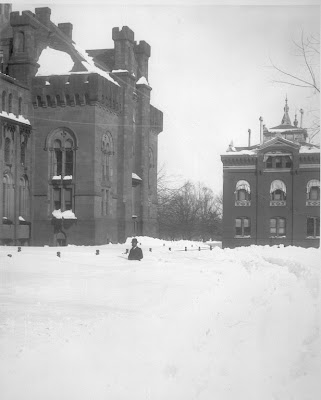
Smithsonian history posts are always popular ones, and it helps that Courtney Esposito has a talent to always pick out historical artifacts and relate them to current events.  This post came in the midst of our blizzard winter, as Courtney explains her inspiration for her posts, "I enjoy writing for the blog because it sheds light on not only the collections but the unique stories about the Smithsonian. It is a great way to show how all of the different parts of the Institution work together. I think showing the public that Smithsonian materials, old and new, can relate to their lives in a variety of ways and creates an understanding their world!"

This post also demonstrated how we and the readers could have a conversation surrounding the collections via this social media:

Anonymous said... Other colleagues of mine were all debating the previous worst blizzard for federal employees, and all had different opinions. Thank you SI Archives for settling this debate with your thorough snow history! February 25, 2010 9:38 AM

Anonymous said... What happened during the blizzard of 1966? March 1, 2010 4:26 PM

Courtney Esposito said... After snowing the over the weekend (January 29 and 30, 1966) A Washington Post article from Monday, January 31, 1966 states: "Except for emergencies, Federal and District Government employees are excused from reporting for work this morning." Later in the day officials excused employees for the entire day. Thus, non-essential Smithsonian staff members, who were federal employees, were excused from work. I haven't found any information thus far on whether the Museums were closed that day or not. However, I did learn that the Zoo was closed until at least February 2, 1966. Several Zookeepers stayed at the Zoo to care for the animals. March 5, 2010 8:58 AM 


[Garden scene with dancers, to be used as the set for a miniature theater] [graphic]. Engelbrecht, Martin, 1684-1756. Cooper-Hewitt, Smithsonian Institution.

Despite being the minority as a librarian, Diane Shaw never fails to amaze with her posts on unique artifacts, whether in between or outside of book covers! 

Diane elaborates, "The SIRIS Blog presents a great opportunity to publicize the opening of new exhibitions featuring library and archival materials at the Smithsonian. "Paper Engineering: Fold, Pull, Pop & Turn" highlights a collecting strength of the SI Libraries that few people previously knew we had.  As one of the catalogers who has worked with these materials, it was particularly delightful for me to see how ingeniously these complicated and artfully designed books are displayed in the exhibition. The Engelbrecht tunnel book with the garden scene depicted in the SIRIS Blog entry consisted of six flat panels inserted in an envelope when it came to me for cataloging. It is absolutely dazzling to be able to see the book on display now in the gallery, assembled by our conservator and exhibition team in the format that its 18th century creator originally intended."

I hope you enjoyed the "Best Of," and thank you for allowing us to share our joys of working on our Nation's collections.

Rachael Cristine Woody
Archivist
Freer Gallery of Art and Arthur M. Sackler Gallery Archives
woodyr@si.edu