Smithsonian Collections Blog

Highlighting the hidden treasures from over 2 million collections

Collections Search Center
Showing posts with label Museums. Show all posts

Tuesday, July 19, 2022

The Evolution of Anthropological Research in Documenting Diversity: How Anthropologists Record Human Life


By Muna Ali and Ashley Ray     

Documenting Diversity: How Anthropologists Record Human Life is an exhibit that outlines the ways in which anthropologists have utilized changing technology to record various aspects of human life. The exhibit is organized into four sections: film, photography, paper, and sound. It includes the equipment used for documentation such as rolls of film, video cameras of various ages, wax cylinders, phonographs, and multiple notebooks. The objects shown in the exhibit come from the National Anthropological Archives (NAA) and the Human Studies Film Archive (HSFA), respectively. The NAA is a product of a 1965 merger between the Smithsonian Institution’s Bureau of American Ethnology (1879-1965) and the Department of Anthropology (1883-present). The collection holds anthropological material produced by anthropologists including fieldnotes, journals, manuscripts, correspondence, photographs, maps and more [1]. The NAA contains one of the largest archival collections related to North American archaeology, ethnography, indigenous artwork, and historical photographs in the world. The HSFA, a sister repository to the NAA, was founded in 1975. The HSFA possesses an audiovisual collection that documents the history of filmmaking worldwide, as it relates to anthropology. The documents and equipment included in this exhibit are a key part of tracking the evolution of the study of anthropology through time. One might even say that the documents are a more accurate representation of the attitudes of the researchers rather than the people they are attempting to record. In the following sections, we will explore two examples in which these attitudes are apparent. 

Garson & Read’s Color Swatch 

Underneath the exhibit’s “Documenting on Paper” section, a sample color swatch is displayed prominently across two pages from the 1899 work Notes and Queries on Anthropology by John George Garson (1854-1932) and Charles Hercules Read (1857-1929) [2, 3]. The exhibit designates the color swatch as “a practice borrowed from geology to describe skin, hair, and eye colors” [2]. Similar to the techniques used to classify geological typology, soil compositions, or categorical distinctions based on shared general characteristics, late 19th century anthropologists erroneously figured a scientific typology of humanity could similarly be created, based on variation in color. Both Garson and Read were affiliated with the Royal Anthropological Institute of Great Britain and Ireland, with Read being appointed as the RAI’s President in both 1899 and 1917 [3]. Given anthropology’s complicated history with ascribing meaning to differences in human physical characteristics in the late 19th century (and prior), it’s certainly no surprise that anthropologists who replicated such rhetoric found themselves in positions of intellectual authority.
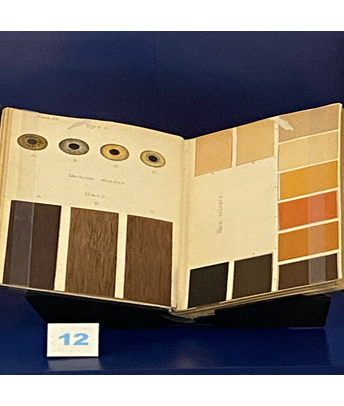
Garson & Read’s color swatch, as depicted in Notes and Queries on Anthropology, Smithsonian Libraries & Archives. 

Critiques of Garson and Read’s color swatch were generally limited to its inability to provide universal descriptors. In the September 1913 edition of a journal titled Folklore, reviewer John H. Weeks even provided suggestions on how to improve the color swatch through “standardise[d]” colors, as “scarcely two men will call an intermediate shade by the same name” [5]. Despite institutionally affiliated anthropologists such as Garson and Read perceiving the color swatch as an intellectual innovation, this exhibit vehemently rejects such attempts to seek meaning in physical differences, declaring “such techniques falsely assumed skin color as a meaningful marker of difference” [7]. The color swatch’s inclusion within the exhibit addresses troubling legacies in anthropology in a compelling manner: the exhibit distances our contemporary understanding of anthropology from harmful conclusions drawn during anthropology of the past, while simultaneously acknowledging that such conclusions are inextricably linked to the field.  

“No. 7 Song with Lacrosse Game” from Menominee Music by Frances Densmore 

In the “Documenting Sound” section, visitors will find a manuscript with marbled edges. The book is opened to a page of sheet music at the top, labeled “No. 7 Song with Lacrosse Game,” followed by an analysis of the notation. The description for this document states that this is a manuscript of “analyses and translations” of songs recorded and translated by ethnomusicologist Frances Densmore (1867-1957). The manuscript, Menominee Music, was published in collaboration with the Bureau of American Ethnology of the Smithsonian Institution in 1932. This book is one of many published by Densmore throughout her career of studying and advocating for the preservation of Native American music [6].  
 

“No. 7 Song with Lacrosse Game” from Menominee Music by Frances Densmore, 1932.
Smithsonian Libraries & Archives

There are many examples of non-Western forms of music that do not have a system for written notation. Instead, these songs are passed down orally, generation by generation, with each adding slight changes to a particular piece [7].  

From a musicological standpoint, there is the question of whether it is even possible to accurately notate Non-Western forms of music using classical Western notation. And perhaps whether one even should. Western musical notation is limited in what it can and cannot represent. It was designed with western instruments in mind and thus lacks the ability to fully accommodate the nuances of other instruments. On top of that, Western music relies largely on major and minor scales while non-Western music utilizes more diatonic and chromatic scales, differs greatly between the two groups [8]. As one composer aptly describes, “The Western system of notation is governed by rigid elementary mathematics inherited from the ancient past,” meaning that the Western system of notation is only ever able to create an imperfect outline, and the nuances of pitch and rhythm must be added in by the performer. Imposing the limiting Western system of notation on other forms of music creates a document that cannot fully capture the intricacies of the original piece [9].  

In summary, though the document has its flaws, that does not mean it is without value. On the contrary, it is more constructive to view this document as a type of translation which is inherently transformative and results in an end-product that cannot be identical to the source material. Documents such as this are valuable in that they offer a glimpse at what music was like at a specific point in time. In addition to that, present-day members of the Menominee Tribe could potentially use this manuscript to recover songs that may have been lost, suppressed, or erased from public consciousness and, more importantly, the community itself. It is the reader’s responsibility to read critically and remember that culture, and music, are dynamic and ever-changing.  

Densmore was able to mitigate weaknesses in her work of the types explored in this section through inclusion of audio recordings in her research. Densmore’s use of both aural and written mediums is an apt example of the ways anthropologists have adapted to emerging technologies so that methodologies are improving as well as the capacity to accurately record human life. 

Anthropology as an Advancing Field 

The thematic structure of the exhibit based on medium—along with its more general focus on technological advancements aiding anthropological fieldwork—presents anthropology to the general public as a constantly transforming field. The selection of objects within the exhibit is particularly effective in conveying this: for instance, in the “Documenting on Film” section, the description for Object 11, a diagram on synchronized sound from 1955, is placed strategically next to object 12, a 1995 Sony camera [4]. Visitors are able to easily envision advancements in recording tools used for fieldwork merely through the two descriptions’ adjacent positions. What’s particularly interesting about the position of these two descriptions is that objects 11 and 12 were used by the same individual, anthropologist John Marshall, exactly forty years apart. This choice allows for the exhibit to portray individual anthropologists and anthropology more broadly as advancing in the wake of major shifts in technology.
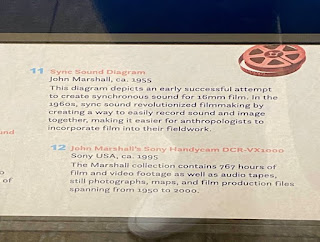
Photo of Exhibit Description, National Museum of Natural History, Smithsonian Institution. 

Overall, the exhibit addresses anthropological discoveries in four mediums: photography, paper, sound, and film. Additionally, on the left side of the hallway, photography, paper, and sound are in one display case, while on the right side, an entire display case is solely dedicated to anthropological film. Given the heightened importance of ethnographic film in anthropological fieldwork, the exhibit’s choice to have film presented separately from the other mediums is certainly advantageous. The choice to separate film from the other anthropological mediums is also indicative of the two repositories mentioned in the exhibit: the National Anthropological Archives and the Human Studies Film Archives. Although the two repositories are closely related to one another, they operate separately. Visitors can envision the physical constraints in having the exhibit spread across two sides of a wide hallway in the context of the separate nature of the two repositories, ultimately complicating the expression of these four mediums as a coherent whole. Regardless of its physical limitations, the exhibit is successful in highlighting changing attitudes and technologies throughout anthropology’s history.

Acknowledgements

Documenting Diversity was co-curated by Diana Marsh, a former NMNH postdoctoral fellow who partook in a three-year long NSF-funded project on NAA collections, and Joshua A. Bell, who serves as NMNH’s Curator of Globalization, Director of the Recovering Voices Program and Acting Director of the National Anthropological Archives. The exhibit was made possible by close collaboration between the NAA, HSFA, Smithsonian Libraries, and Smithsonian Exhibits.


By Muna Ali and Ashley Ray

Natural History Research Experiences (NHRE) Interns
National Anthropological Archives, National Museum of Natural History 


Sources:

[1] “Documenting Diversity,” Smithsonian Libraries and Archives, accessed June 20, 2022, https://library.si.edu/exhibition/documenting-diversity

[2] Erdöl, Das " “Dr. J. G. Garson.” Nature 129 (1932): 931. https://doi.org/10.1038/129931a0 

[3] Balfour, Henry. “Sir Charles Hercules Read, July 6, 1857-February 11, 1929,” Obituaries. Accessed June 2, 2022. https://www.therai.org.uk/archives-and-manuscripts/obituaries/charles-hercules-read 

[4] Bell, Josh and Marsh, Diana. Documenting Diversity: How Anthropologists Record Human Life. Washington: Smithsonian National Museum of Natural History, 2020. https://naturalhistory.si.edu/exhibits/documenting-diversity-how-anthropologists-record-human-life 

[5] Weeks, John H. Folklore 24, no. 3 (1913): 392–97. http://www.jstor.org/stable/1255441

[6] “Frances Densmore (1867-1957).” Smithsonian Institution Archives. 2005. https://siarchives.si.edu/research/sciservwomendensmore.html 

[7] Pasler, Jann. “Sonic Anthropology in 1900: The Challenge of Transcribing Non-Western Music and Language.” Twentieth-Century Music 11, no. 1 (2014): 7–36. doi:10.1017/S1478572213000157. 

[8] Robertson-Wilson, Marian. “The Challenges of Notating Music in General and Coptic Music in Particular: Observations of a Professional Cellist, Composer, and Linguist.” Library of Congress Web. https://www.loc.gov/item/ihas.200156229/

[9] Zon, Bennett. “Music in the Literature of Anthropology from the 1780s to the 1860s.” In Representing Non-Western Music in Nineteenth-Century Britain, NED-New edition., 48–68. Boydell & Brewer, 2007. http://www.jstor.org/stable/10.7722/j.ctt14brrwv.9.


Monday, February 22, 2021

Scurlock Photographs, the Corcoran Gallery of Art, and the NMAH Archives Center, Part 1

By David Haberstich

Every February when I think of Black History Month, I naturally think about one of the Archives Center’s premier collections, the Scurlock Studio Records. This collection contains the life’s work of the principals of this Black-owned Washington photography studio, founder Addison N. Scurlock (1883-1964) and his sons Robert (1916-1994) and George (1919-2005). In February 2020 I gave a brief lecture about the collection at a Black History Month social event sponsored by a large Washington law firm, at the invitation of a Scurlock relative on the firm’s staff. Little did I know that it would turn out to be my last in-person lecture (and social event) before COVID-19 closed the Smithsonian and disrupted my social life, along with nearly everyone else’s.

In my talk about Scurlock photographs, I thanked my hosts for the invitation to their lovely party, but mused about another important party that I had missed in 1976, the first year in which Black History Month was observed officially, as recognized by President Gerald Ford. Had I attended that earlier event, an exhibition opening at Washington’s Corcoran Gallery of Art, I could have met Robert Scurlock, as well as the famed African-American New York photographer, James Van Der Zee. (Some call Addison Scurlock Washington’s Van Der Zee, but I like to call Van Der Zee New York’s Scurlock.) I met Mr. Van Der Zee on a later occasion, but unfortunately I never met Robert. I came to know his younger brother George quite well, however, along with other Scurlock relatives.


Typical Scurlock Studio banquet photograph, dinner for Armond W. Scott, 1935.
Scurlock Studio Records, Archives Center, National Museum of American History

The Corcoran exhibition, entitled “The Historic Photographs of Addison N. Scurlock,” ran from June 19 to Aug. 29, 1976. When the National Museum of American History acquired the Scurlock collection almost twenty years later, the entire Corcoran exhibition, having been returned to the studio, was part of the archive. These photographs, conveniently still framed for subsequent displays, were shown in several small exhibitions in the National Museum of American History over the years, as well as in Deborah Willis’s major exhibition in the Arts and Industries Building, “Visual Journal: Harlem and D.C. in the Thirties and Forties,” in 1996. Correspondence in the business records of the Scurlock Studio Records reveal the story behind the historic Corcoran exhibition of 1976.

A Quest for Recognition 

Addison Scurlock sold the business to his sons before his death in 1964. In the early 1970s Robert became concerned about the future of the Scurlock family business and its photographic archive. As he began to confront his own mortality, his brother George’s intention to retire, and the fact that there were no family members to carry on the Scurlock business, it seemed likely that the Scurlock Studio and its later iteration as CustomCraft might die with him. Robert had no children, and brother George’s children had evinced little interest in operating the studio enterprise. Years earlier, Robert had rebuffed the efforts of two young relatives to gain employment at the studio on the grounds that they “hadn’t paid their dues” as photographers. 


Left to right: George, Addison, and Robert Scurlock in their studio, ca. 1948.
Scurlock Studio Records, Archives Center, National Museum of American History

Furthermore, he recognized the classic, enduring quality of his father’s early work, in contrast with his own bread-and-butter portraiture and photojournalism, and was determined to find ways to revive and increase public awareness of Addison’s pioneering photographs. Robert’s eventual success in this quest was preceded by a flurry of activity and disappointing failures. Correspondence in the business papers of the Scurlock Studio Records documents his unsuccessful, frustrating attempts to highlight his father’s work through publications, especially a book reproducing Addison’s finest, most iconic photographs, but ultimately he managed to realize his dream of a major exhibition to honor his father’s work.

Attempting to find a publisher for the book he envisioned, Robert submitted pictures to Holt, Rinehart and Winston, Inc. An acknowledgment from Alison M. Bond (August 4, 1970) indicated that she would consider the project, and agreed to contact famed African American photographer Gordon Parks, whom Robert had asked to write a foreword for the proposed monograph. He also suggested that Michael Winston of the Moorland-Spingarn Research Center could write the text. He telephoned Art Editor Marlayna Franklin in March 1970, as indicated in her letter of April 1. There ensued a bustle of correspondence with Holt, Rinehart and Winston about the project, some of it suggesting that Robert had been erratic in following up on their contacts. Later Paul Anbinder, Executive Editor at Harry N. Abrams, Inc., mentioned Robert’s May 1970 telephone conversation about a book proposal in his letter of May 27, 1970.  On June 9, 1970, however, Anbinder wrote that “the project does not seem suitable” for the Abrams “program.” Alison M. Bond sent Robert a final rejection letter on December 18, 1970, returning the photographs and asserting that the proposed book would be too expensive to produce and that it “could well price itself out of the market.”

While Robert pursued his dream of a coffee-table monograph on his father, he also attempted to interest periodicals in publishing illustrated articles devoted to Addison’s work and/or his own. He contacted an English publication, Telegraph Magazine, on July 13, 1970, suggesting an article on Washington based on his own color transparencies, but editor John Ashby responded that they weren’t quite what he was seeking, while leaving the door open for further submissions (July 24, 1970).  Fred Schmidt, managing editor of The Professional Photographer, indicated that he was interested in doing an article on the CustomCraft business (June 17, 1971), but this did not materialize either.  

Further attempts to interest publishers in a book or articles similarly failed. To be fair, Robert’s letters to publishers were relatively weak inquiries, rather than detailed proposals, and they indicate his naivete about the book publishing business. In these files we can sense his growing frustration over what appeared to be an endangered legacy. Eventually he modified his strategy and included the book concept as a corollary to a more ambitious and potentially risky idea—a gallery in which to display his father’s photographs. The business files contain Robert’s twelve-page typescript entitled “Proposal for Establishment of the Scurlock Gallery of Photography.” In this stronger proposal, complete with a budget, he revealed another element of his aspirations—to honor his father Addison through a permanent exhibition of his work. Although the proposal is undated, it clearly was prepared in the early 1970s, after the establishment of the D.C. Commission on Bicentennial Programs.  Robert wrote: 

“Establishment of the gallery on the site of Mr. Scurlock’s first studio, 900 You [sic] Street, Northwest, would be a positive achievement in the inner city, making a definite contribution to the community, and increasing the opportunity for citizen appreciation of Black progress, past and present.  The gallery would operate on a non-profit basis with free admission to the general public.”

He further proposed that a satellite gallery be established at the same location to show the work of promising Black photographers from around the world; that a “Special Centennial [i.e., Bicentennial] Exhibition” be assembled at the National Portrait Gallery to honor eminent “Black Americans”; that associated traveling exhibitions, educational reproductions, filmstrips, and slide shows be prepared and distributed through educational channels; that a major publisher be sought to produce a “top quality” photography book for the 1976 Bicentennial; and that a special gallery be established for talented Black youths who wish to enter the field of photography, under his direction, with scholastic aid to be solicited from corporate America and major foundations. His proposed first-year budget for $78,400 included salaries for a director (himself), assistant director, and gallery assistant.

Although Robert used the word “Centennial” several times in his proposal, he clearly meant “Bicentennial,” as he was applying for 50% matching funds from the D.C. Commission on Bicentennial Programs. The funding request was denied. No evidence was presented to indicate that the Smithsonian’s National Portrait Gallery was interested in an exhibition hailing the achievements of noted African Americans. Robert had connections with officials at the Gallery through his contract to photograph collection objects, such as paintings, but it isn’t clear if any discussions related to this idea occurred before he approached Marvin Sadik, then director of the National Portrait Gallery, to propose an exhibition of Addison’s portraits of important African American subjects, presumably as a Bicentennial project. In Sadik’s letter of May 12, 1975, the concept was turned down. Sadik wrote that he and his staff decided that “there simply are not enough photographs by your father of nationally noted personalities to make a viable exhibition.” This short-sighted judgment surely disappointed and rankled Robert on several different levels, as he undoubtedly felt that such an exhibition was sorely needed, not only to honor the photographer, but precisely to give recognition to the subjects and help make them “nationally noted.” It must have been a bitter pill to swallow. 

(To Be Continued)

David Haberstich, Curator of Photography, Archives Center

National Museum of American History, Smithsonian Institution


Tuesday, December 17, 2019

The Smithsonian’s Journey of Computerized Library and Archives (2010-2019)

Read Part I : The First Integrated Library System
Read Part II:  Stepping Outside of the Box 

PART III:   INCREASING ACCESS THROUGH BROADER AND DEEPER REACH


Contributing to the start of Digital Public Library of America (DPLA)

The idea of a national digital library had been circulating among librarians, scholars, educators, and private industry representatives in the United States since the early 1990s.  The DPLA planning process began in October 2010 at a meeting in Cambridge, M.A. During this meeting, 40 leaders from libraries, foundations, academia, and technology projects agreed to work together to create an open and distributed network of comprehensive online resources which are provided by the U.S. libraries, archives, universities and museums.    

The planning team solicited ideas for how this open platform should work and received hundreds of responses from around the country.  Martin Kalfatovic of Smithsonian Libraries approached me for possible ideas. We decided to work with the Library of Congress (LC) and the National Archives Record Administration (NARA) to develop a joint proposal that suggested using the Smithsonian Collections Search Center for DPLA.  We took about 100 MARC records from LC and about 20 MARC records from NARA and, using the Smithsonian Index Metadata model, imported them into the Smithsonian Collection Search Center test system. 

The LC and NARA records worked well among the Smithsonian records in our Collections Search Center without great effort.  This success affirms the importance of developing a system that includes stringent data standards.   We were among the top six submissions selected by the DPLA planning committee for a final open presentation hosted at NARA. 

In December 2010, the Berkman Klein Center for Internet & Society at Harvard University convened leading experts in libraries, technology, law, and education and began work on this ambitious project. I was part of this meeting and worked among those who contributed their knowledge for a brand new DPLA system.  DPLA was launched in April 2013 with contributions from a small number of universities, libraries and museums.  The Smithsonian contributed tens of thousands of library and archives records in the initial launch and supported the Creative Common CC0 for “No Copyright Reserved” on metadata records.  To expand Smithsonian participation, Library Director Nancy Gwinn reached out to many Smithsonian museum directors for support.  Today, the Smithsonian Institution contributes 3.6 million records to DPLA monthly.  This number is expected to increase over time.


Increasing Access and Public Engagement through the Smithsonian Transcription Center

Two examples of Transcription Page
Even though the Smithsonian had millions of collections and historical documents online, accessibility remained a challenge.  Many digitized materials are view-able but not easily searchable; many handwritten materials are difficult to read and understand and many collections were not online.  By creating a transcription center, we could address some of these limitations and support better discovery across disciplines Smithsonian wide.

We began planning and developing the new software platform in 2012.  We worked closely with several archival unit partners to launch the Transcription Center (http://transcription.si.edu) on June 15, 2013.

The Transcription Center was designed to support various object types and material formats, including those held by not just libraries and archives, but museums as well.  Object types included diaries, field books, correspondence, currency bank notes, sound-recordings, photo albums, botanical specimen labels, cataloging sheets, joke index cards, and more. The project crowdsources both the transcribing and reviewing processes by public volunteers, allowing the Smithsonian staff the option to conduct final approval before posting the record online.  We have discovered that because our digital volunteers produce such accurate transcriptions, some staff find no need to review the work!  Transcribed contents are immediately searchable , displayed online in the Collections Search Center and downloadable as PDF files,. Public participation has been phenomenal, with 13,890 digital volunteers and 496,300 pages transcribed as of December 2019, including creating 130,755 catalog records that were previously unavailable to the public. 
Transcribed Text on display automatically with the corresponding image

A full-time project coordinator is on staff to ensure timely communications between the Smithsonian and the public via emails and social media platforms.  Meghan Ferriter, Andres Almeida and Caitlin Haynes served as the coordinators consecutively. It is very important that our volunteers feel connected to the Smithsonian Institution and that their contribution is recognized and greatly appreciated.  We express our appreciation by crediting the volunteers in the transcribed records and the PDF files.


The Transcription Center is more than a website to transcribe historic documents. It is a platform for us to increase our public outreach and engagement.  Being able to interact with our volunteers was one of the most rewarding aspect of this project.   Many of our dedicated volunteers continue to achieve huge progress day after day.  They not only transcribing thousands of pages, but also going above and beyond sharing knowledge and enhancing Smithsonian collections by entering additional information in the note fields on each page.

The Transcription Center has also become a useful tools to Smithsonian social media managers of individual museums. Many Of them have share stories uncovered from the Transcription Center in their outreach campaigns, and they also want to continue the relationship with the Transcription Center in the future. This digital platform demonstrates how transcription work can not only create and diffuse knowledge, but also develop strong community among digital volunteers  and Smithsonian.   


Smithsonian Online Virtual Archives (SOVA) and ArchivesSpace

Archives by their very nature are different from libraries: Most libraries include individual items such as books and journals, while archival collections contain multiple records that are both unique, interrelated and often arranged in a nested hierarchy structure. A library system cannot adequately support archival needs.  Increasingly, archival staff began calling for a system that specifically addressed the unique needs of archives, To remedy this problem, a Melon Foundation grant started software development of The Archivists’ Toolkit™ system in 2006. It was the first open source archival data management system to provide broad, integrated support for the management of archives.

The Smithsonian began to experiment with The Archivists’ Toolkit™ (AT) software system in 2011.  First, we migrated 7,000 MARC records into the new AT system. This allowed for series, box and folder level information to be managed hierarchically within an information management system.  The AT system was superseded in late 2013 by ArchivesSpace.  Both open source software systems allowed archivists to manage archives using a collection-centric approach.

The Internal Smithsonian ArchivesSpace Collections Management System

A difference between an item-centric management approach and a collection-centric approach is that archival materials need finding aids, which increase accessibility to the collection.  At the time, the Smithsonian’s fourteen archival units had different understandings and approaches to description and management.   Barbara Aikens, Head of Collections Processing at the Archives of American Art, took the lead to eliminate these inconsistencies.  She wrote five internal and external grants totaling $499,900 between 2010 and 2016 on behalf of the Smithsonian archival units. The grants allowed the Smithsonian to conduct a pan-institutional Encoded Archival Description (EAD) Gap Analysis Study and hire EAD Metadata Coordinators to focus on content creation and support.  These coordinators, Mark Custer and Nancy Kennedy, proved essential to this project.  Managed by OCIO LASSB, they developed and managed an EAD implementation plan for each Smithsonian archival unit.  This work included assisting units to convert legacy finding aids to EAD standards, answering all questions, and fixing dilemmas as they occurred throughout the system’s implementation.  Meanwhile, we collaborated among all of the archival units and supported their backlog processing projects. The migration from the Horizon MARC system to ArchivesSpace was a very complex process which required folding 400,000 flat records into hierarchical EAD finding aids.  In the end, archives across the institution created 16,800 new EAD finding aids in ArchivesSpace, and the quality of content description at the Smithsonian improved dramatically.
Record Display Supporting Hierarchy levels of Collection, Series, Box and Folder in SOVA
While the quality and quantity of the archival descriptions grew exponentially, public searching and display remained a challenge.  To remedy this, we focused on developing and launching the Smithsonian Online Virtual Archives (http://SOVA.si.edu) in October 2015.    For the first time, the new systems allowed users to search archival materials at all levels (collections, series and items), enabled the  visual display of the hierarchy of the record and dynamically generated EAD online finding aids for nearly 17,000 collections, many of which contain tens of thousands of individual items in multiple series, box and folders.

Screenshots of the search result page with tabs to browse by collections, sub-series or digital items

The ArchivesSpace and SOVA systems enable a digital workflow that is organized, systematic, scalable, and incorporates the digitization process.  In addition, the Smithsonian Digital Access Management System (DAMS) supports seamless metadata synchronization and media file links among all systems.  These systems guide archivists to catalog, digitize, store, link and share digital images, allowing information systems to keep track of mass amounts of media files every step of the way.  Today, there are over 6.7 million images, sound and video recording electronic resources in SOVA.

In 2019, the Smithsonian received accolades for its SOVA and Collections Search Center (CSC).  An online survey, conducted during a NEA-funded workshop on developing in-house collections management systems and online discovery portals, asked professionals to name their favorite online aggregate search center. The Smithsonian’s CSC and SOVA systems were voted the best among all LAM (libraries, archives, and museums) institutions.


Final Thoughts

It has been a long and rewarding journey in the fields of information management and public service.  Knowing the history of the Smithsonian’s transformative information management systems and efforts gives us valuable insight that we can use as we work towards new goals and solving challenges.  The Smithsonian Institution will continue to push forward to support research, education and public service by increasing its mass digitization efforts.  With tens of millions of collections online already, we look forward to making Open Access our next major milestone in 2020.

Read Part I : The First Integrated Library System
Read Part II:  Stepping Outside of the Box 


Ching-hsien Wang,  Branch Manager
Library and Archives Systems Support Branch (LASSB)
Office of the Chief Information Officer

The Smithsonian’s Journey of Computerized Library and Archives (1994-2009)

Read Part I: The First Integrated Library System


PART II: STEPPING OUTSIDE OF THE BOX

Jump starting and Supporting Digitization


In 1994, OIRM SIRIS began a new venture in the field of library and archives automation: the support of online media files.   At the time, the Smithsonian had several Collection Information Systems including the library’s system, but no catalog records were linked to images or video files, which prohibited public access.   

One of the NAA images digitized during early digitization
With a newly implemented internet, we modified a new WebPac application configuration to enable images to display with catalog records online, demonstrating the technical potential to library and archives staff. This new and exciting feature required Smithsonian staff to digitize images and then link the image files to catalog records by referencing the image URL in the MARC 856 field.  It was a challenge to get started because no one knew how this would work, so we had to lead by example.

By 1995, OIT (Office of Information Technology, successor of OIRM) purchased a couple of image scanners.   SIRIS helped the NMAA Art Inventory project digitize about 200 photographs of sculptures and linked them to their catalog records.  The first Smithsonian public online system that could display object records with images was born!   In 1996 at the Smithsonian Institution’s 150th Anniversary Event on the National Mall, we showcased the brand-new functionality to the public.  The online demonstration using the Netscape Navigator web browser even included a few cephalopod video clips from NMNH.   The excitement for the new functionality energized archives staff.  Although more archives professionals accelerated their image digitization efforts, most of them did not have the resources to host images online.  The digitized image files accumulated on hard drives, CD-ROMs, and laser disks.  Many of these storage devices sat on bookshelves or under desks; they were not accessible to the public online.

In 1996, OIT SIRIS created the first Smithsonian central “Multi-Media Server” that hosted online images for SIRIS members. This service included online storage and web server support, image maintenance support, digitization training programs, image linking trainings, and usage statistic reporting.  Until 2014, this multimedia server hosted over 900,000 images, video and sound files for 18 SI units.  Jim Felley, (SIRIS senior system administrator), provided critical support and management of the service until it was retired in 2014, after all images were migrated to a new Digital Asset Management System (DAMS).


Leadership in Data Standard and Vocabulary Control

In 1999, the Smithsonian library system was upgraded to the Ameritech (now SIRSIDYNIX) Horizon system.  This new system came with flexible system-configuration capability and a strong authority (vocabulary) control function.  Most importantly, it allowed the Smithsonian to establish many locally defined fields, supported record relationship linking capability and supported specialized indexes that met the needs of the Smithsonian’s nontraditional challenges.  SIRIS had grown to support eight databases:  Library, Archives, Art Inventories, SAAM Photo Archives, Art Exhibition, Research Bibliography, History of Smithsonian, and Directory of Airplanes. 
Over the years, 14 archives, 20 library branches and several museum research departments depended on SIRIS to do a wide variety of collection management functions.  More and more data sets were added to the eight databases using custom programming and data importing.  By 2006, nearly 50% of the 955,000 non-library records were transferred from local databases such as DBASE, MS Access, Excel, C-Quest, FileMaker Pro, WordPerfect, Text, etc. 
Library of Congress Subject Headings Catalog

Mapping these different datasets into the MARC format was a big challenge, but dealing with data inconsistencies was an even bigger one!  Much of the data from these random databases lacked consistency from record to record and across datasets, and very few datasets followed national data standards.  So, our priority shifted to data cleanup of the records created by the staff at 14 Smithsonian archives .  Our goal was to following national data standards and cataloging guidelines.  This approach proved to be a wise decision on multiple levels.  First, we avoided internal disagreements as to how to standardize the data among several archival units.  Secondly, we were able to hire professionals whose knowledge was applicable to our goal.  Finally, standardizing the data in different databases across the Smithsonian made building the Smithsonian wide Collections Search Center platform much easier. We didn’t know the benefit of this final point at the time. 

We used a few main approaches that were very productive:
  • Conducted extensive data analysis, created reports using thousands of programming scripts, looked for exceptions and patterns in data and listed them out for catalogers to review or make changes. This approach took advantage of both human intelligence and computer speed to handle complex data issues.
  • Conducted several thousand global data modifications based on cataloger’s requests.  This allowed us to make changes to thousands of records at a time, thus speeding up progress and efficiency.
  • Prioritized access points and authority records for Names, Subjects, Form & Genre, Geographical, and Culture terms which greatly improved searchability and discovery.
  • Sent out authority records to professional vendors for authority heading matching, then flipping incorrect terms to Library of Congress standards and reloading the records back into our system. While expensive, it provided high quality data.
  • Conducted regular cataloging and metadata training and encouraged collaboration among cataloging units to maintain high-quality cataloging practices.  The regular face to face meetings reinforced the importance of data quality and improved interactions among staff across the Institution.
For more than ten years, we continued to transform and standardize metadata within the eight Horizon databases.  We established methodologies as to how to handle chaotic situations and developed creative solutions to solve problems.  The result of our persistent efforts became the solid foundation for the next phase: creating a centralized searching system for the Smithsonian Institution and filling the goal and wish from 1980.


Pushing Beyond the Norm and Changing Culture - First Large-Scale Library, Archives and Museum Online Search Center

By 2005, the Smithsonian’s libraries, archives and museum collection records had been growing rapidly across the Institution thanks to the advancement of and wide use of database technology.  Large numbers of computer records were created and maintained in highly specialized commercial and local database systems.  However, collection records were available on over 100 disparate websites, which made them difficult for the public to use. 

In 2006, OCIO LASSB (Library Archives System Support Branch, successor of SIRIS) began to design a one-stop discovery platform that would include all Smithsonian collection data regardless of data format, professional disciplines or data owning organization.  We decided that this Cross Search Center should support simple keyword searching and be able to filter search results by data categories such as Name, Topic, Place, Culture, Date, Media type.  Since no one had done this at a large scale before, we had to innovate and find the best solutions to problems as they arose. 
We started with the eight SIRIS Horizon datasets. Our first challenge was to address the diverse data types and find ways to make the data consistent in the Cross Search Center.  We reviewed technology platforms, data standard options and data mapping possibilities.  We identified common data elements in records from across different disciplines including art, science, culture and history, and defined a new metadata format that supports a wide range of material and object types (i.e. books, journals, bibliographies, photographs, art objects, and archival materials). 

Andrew Gunther(senior software developer), took the lead in selecting an open source technology (Solr) platform that supported easy searching, faceted filtering and fast indexing functions.  The platform also allowed searching with automatic stemming for word matching, configurable relevancy ranking of search results, positive and negative limit options, and scalability for large data sets.

Insisting on consistent metadata standards was the key to our success.  After evaluating several existing metadata standards (MARC, VRE, MEDS, CDWLITE, CCO), we identified the most common data elements and created the Smithsonian Index Metadata Model.  George Bowman (senior system administrator), took the lead in designing this flexible metadata model that accommodated many specific use cases.  The LASSB (Library and Archives System Support Branch, the successor to SIRIS) team consulted OCLC FAST (Faceted Application of Subject Terminology) schema and used it to break up our LCSH subject heading by subfields from our MARC records, thus allowing faceted searching and filtering in the Cross Search Center. 

The system was designed to aggregate data from multiple databases into a central Solr index.  Jim Felley (senior system administrator), led our team in extracting data from the Horizon databases.  All data was mapped to follow the Smithsonian Index Metadata Model and each dataset required custom extraction programs to support the necessary data mapping.  We carefully tracked the highly complex data mapping requirements in a spread sheet, which allowed us to update the data and refresh it daily in the data repository for the Cross Search Center.  Randy Arnold (system administrator) ensured all systems are integrated and monitored multiple servers and system operations.
Data Aggregated from different databases into EDAN for Collections Search Center

In 2007, the Cross Search Center (http://collections.si.edu)  went live with nearly two million records from the Smithsonian libraries, 14 archival units, and several other research offices from two museums.  For the first time, the public was able to search all library and archival collection records in one platform at once.  These search capabilities were the result of Smithsonian staff’s diligence in working on metadata and authority control over the past ten years. The public and the reference staff loved the new user-friendly system.  Anne Spire, Director of the Office of the Chief Information Officer, advised that the Cross Search Center (CSC) be expanded to support all Smithsonian museum collections. The Cross Search Center was renamed the Smithsonian Collections Search Center (http://collections.si.edu), and the back-end data indexing and data repository platform was named the Enterprise Digital Access Network (EDAN). 

Getting more museums to contribute data to EDAN and Collection Search Center required effort to build relationships between OCIO LASSB and the museums.  Even though the technology and system design were fully ready to take on the wide variety of data, changing institutional culture took a lot more time and work.  Smithsonian collection staff had not traditionally worked together across the institution, and letting go of their carefully curated data that was compiled over many years required a new way of thinking. 

LASSB made sure that this collaborative work with the museum staff created mutual benefits. 
  • To make sure the museums can control their own data in the centralized system, we allow the museums to decide on which data elements to contribute and the display labels for their data element.   
  • In the Collection Search Center, museum names were prominently on display and every record had a link to the hosting museum’s website which greatly increased online traffic to the museums’ collection website. 
LASSB first approached smaller museums that were more willing and had more to gain in participating in this project.  Some of the early participating museums included the National Portrait Gallery, the National Postal Museum and the Freer Sackler Gallery.  Mike Trigonoplos (system administrator) extracted most museum data in this phase.  These museums’ holdings were seemingly unrelated, but in the Collection Search Center, search results produced surprising connections.  The positive feedback and testimonies from staff helped to propel the project forward.  The message was clear: collaboration among units produced powerful results.   

Screen shot of Collections Search Center in 2009

By December 2009, the Collection Search Center became the first large scale LAM system in the United States with more than two million catalog records from several SI museums. The system added data from more museums over the next few years.   Today, this system includes 15.5 million records and five million online images, audio and video files from all major Smithsonian libraries, archives, museums, blogs and YouTube websites.  Once again, we had to tackle data consistency issues submitted by the different museums.  Capitalizing on our previous experience in vocabulary control, we quickly developed a systematic method to address these issues.   George Bowman created a sophisticated data mapping database system that defines exception terms and enables replacements by the controlled vocabulary and data categories.  This database contains about 50,000 specific use cases and instructions.  The standardized terms significantly improved the performance of the Collections Search Center and the accuracy of search results.

In 2012, a public tagging functionality was added to the Collections Search Center.  It allowed the public to add keywords to catalog records online, with those tags searchable within ten minutes. During the trial period, 1.6 million records from nine Smithsonian units were released for tagging.  In just six-month, the public entered more than 1,000 tags.  Public users filled in blanks for creator names, classified object types, identified historical events, individuals, ethnic groups, genders, aesthetic characteristics and style, characterized film clips and pointed out mistakes. 
A Tagging Screenshot from the Collections Search Center in 2009
The tags function improved searchability and increased public participation.  However, the Smithsonian staff did not have the resources to shift through all the tags and add them to catalog records, so the project ended after 5 years.


Ching-hsien Wang,  Branch Manager
Library and Archives Systems Support Branch (LASSB)
Office of the Chief Information Officer


Friday, October 25, 2019

The Interplay of Art, Music, and Portraiture


American portraiture captures rich conversations between artists, musicians, and singers. On the occasion of the Smithsonian’s Year of Music, this essay explores the interplay of art, music, and portraiture in the United States, from the Early Republic to today.

During the eighteenth century, artists were often inspired to portray individuals and groups in the act of playing instruments or singing. A popular theme was the informal family concert, which exemplified the harmony and personal values shared by the represented members. An example is the painting Family of Dr. Joseph Montégut (c. 1797-1800), which has been attributed to José Francisco Xavier de Salazar y Mendoza. It depicts a French surgeon who has settled in New Orleans. He is surrounded by his wife, great aunt, and children, who are about to play for their parents. Two hold flutes, while a daughter’s hands are poised on the pianoforte keys. This composition of a French Creole family in Spanish-governed New Orleans presents a vision of musical and domestic harmony, which had precedents in European art tradition.  https://www.crt.state.la.us/louisiana-state-museum/collections/visual-art/artists/jos-francisco-xavier-de-salazar-y-mendoza

From the 1790s through the 1830s, theater and concert performances proliferated and by the mid-nineteenth century, music had become a public commodity. A leading European virtuoso, the Swedish singer Jenny Lind, toured the United States from 1850-1852, in part with the sponsorship of P.T. Barnum. Many American artists portrayed the popular “Swedish Nightingale,” including Francis Bicknell Carpenter, whose 1852 oil painting depicts Jenny Lind in costume, holding a musical score book.


Jenny Lind by Francis Bicknell Carpenter, oil on canvas, 1852. National Portrait Gallery, Smithsonian Institution; gift of Eleanor Morein Foster in Honor of First Lady Hillary Rodham Clinton (NPG.94.123)

From 1892 to 1895, the Czech composer Antonín Dvořák was director of the National Conservatory of Music in America. His famous symphony From the New World (1893) reflected his interest in African American and Native American music. He promoted the idea that American classical music should follow its own models instead of imitating European composers. Dvořák helped inspire our composers to create a distinctly American style of classical music. By the twentieth century, many American composers, such as Leonard Bernstein, Aaron Copland, George Gershwin, and Charles Ives incorporated diverse musical genres into their compositions, including folk, jazz, and blues.

As a composer, pianist, and conductor, Leonard Bernstein made a profound impact on American music by collaborating with the performing arts. His interests ranged from classical music and ballet to jazz and musicals. In an oil portrait of 1960, René Robert Bouché portrayed Bernstein in a moment of reflection, with the papers of the musical score he is writing scattered across the desk in front of him.


Leonard Bernstein by René Robert Bouché, oil on canvas, 1960. National Portrait Gallery, Smithsonian Institution; gift of Springate Corporation. © Denise Bouche Fitch (NPG.92.3)

The composer George Gershwin and his brother, lyricist Ira Gershwin, were also highly versatile, having collaborated on popular musicals and a folk opera. Both brothers also painted interesting self-portraits, which can be viewed in the Gershwin collection in the Music Division of the Library of Congress. In a 1934 oil portrait in the collection of the National Portrait Gallery, George Gershwin represented himself in profile with a musical score and his hand alighting upon the piano keys.


Self-Portrait by George Gershwin, oil on canvas board, 1934. National Portrait Gallery, Smithsonian Institution; gift of Ira Gershwin. © Estate of George Gershwin (NPG.66.48)

The following year, the Gershwin brothers debuted Porgy and Bess, “an American folk opera,” which broke new ground in musical terms. Soprano Leontyne Price appeared in the 1952 revival touring production of Gershwin’s Porgy and Bess, which brought her first major success. Less than a decade later, in 1961, Price became the first leading African-American opera star when she made her debut at the Metropolitan Opera. Bradley Phillips created this formal oil painting of Leontyne Price within a stage setting in 1963. It is one of several portraits he made of the singer. The artist expressed the admiration he felt for her immense talent when seeing her perform onstage.


Leontyne Price by Bradley Phillips, oil on canvas, 1963. National Portrait Gallery, Smithsonian Institution; gift of Ms. Sayre Sheldon (NPG.91.96)

Artists Thomas Eakins and George P.A. Healy also created portraits of singers and musicians. In the medium of painting, these artists were able to convey the intensity and precision of the musicians in their performances. Thomas Eakins asked his model Weda Cook to repeatedly sing a particular phrase from Felix Mendelssohn’s oratorio Elijah, so he could explore the position and movement of her mouth and vocal chords for his portrait Concert Singer (1890-1892). In this manner, he recreated the immediate sense of a formal concert with the contralto singing on the stage and the conductor’s hand and baton raised in the lower corner. https://www.philamuseum.org/collections/permanent/42499.html

George P.A. Healy visited virtuoso Franz Liszt in Rome and created this 1868-1869 oil portrait of him playing the piano in an inspired moment. Healy even convinced the composer to allow Ferdinand Barbedienne to cast his hands in bronze, an artifact Healy later kept in his studio. https://callisto.ggsrv.com/imgsrv/FastFetch/UBER1/ZI-9HFT-2014-JUN00-SPI-142-1 Both artists not only portrayed the physical characteristics of musicians and singers but also the inner passion and mental concentration they brought to their performances. As such, they recreated the emotional spirit of the music for viewers.

James McNeill Whistler thought about his paintings in terms of musical titles and themes. He created not only portraits of musicians but also discussed the subtle tonalities of his more abstract urban scenes and landscapes in musical terms. In 1878, Whistler defended the titles of his paintings: “Why should not I call my works ‘symphonies,’ ‘arrangements,’  ‘harmonies,’ and ‘nocturnes’?...As music is the poetry of sound, so is painting the poetry of sight, and the subject-matter has nothing to do with harmony of sound or of colour.” This analogy between music and painting was Whistler’s primary means for defending his paintings against criticism. Indeed, he published this defense in the journal The World during his libel lawsuit against critic John Ruskin, who referred to Whistler’s 1875 oil painting of fireworks in London, Nocturne in Black and Gold: The Falling Rocket, as “flinging a pot of paint in the public’s face.” https://www.dia.org/art/collection/object/nocturne-black-and-gold-falling-rocket-64931 Whistler’s use of music as a metaphor for painting was intended to build support for the concept that color, form, and painterly technique were the primary elements of an artwork. Whistler brought this correlation of painting and music to public attention with his artworks, which in turn influenced other artists and musicians.  

Regional painter Thomas Hart Benton praised “James McNeill Whistler[’s art]...tone, colors harmoniously arranged…Whether you can distinguish one object from another or not, whether the thing painted looks like a man, woman, or dog, mountain, house or tree, you have harmony and the grandest artistic aim, it is the truly artistic aim.” Benton was a self-taught and performing musician who invented a harmonica tablature notation system used in current music tutorials. He was also a cataloguer, collector, transcriber, and distributor of popular music. He had musical gatherings for family and friends at his home in Kansas City. These sessions were commemorated on a 1942 recording by Decca Records called Saturday Night at Tom Benton’s, which featured chamber and folk music. Benton’s friend, the popular actor and singer Burl Ives, shared his passion for American songs. During the Great Depression, Ives traveled the country gathering and playing folk songs, and Benton made sketches of folk musicians in different regions. In a 1950 lithograph titled the Hymn Singer or the Minstrel, Benton portrayed Ives playing the guitar. 


Burl Ives by Thomas Hart Benton, lithograph on paper, 1950. National Portrait Gallery, Smithsonian Institution. © T.H. Benton and R.P. Benton Testamentary Trusts/Licensed by VAGA, New York, NY (NPG.85.141)

In 1973, Benton was commissioned to paint his last mural, The Sources of Country Music, for the Country Music Hall of Fame and Museum in Nashville, with support from the National Endowment for the Arts. He decided the mural “should show the roots of the music–the sources–before there were records and stars,” and he created a lively, flowing composition of country folk musicians, singers, and dancers.   https://www.arts.gov/about/40th-anniversary-highlights/thomas-hart-bentons-final-gift

Artist LeRoy Neiman featured Duke Ellington, Louis Armstrong, Billie Holiday, Ella Fitzgerald, Charlie Parker, Benny Goodman, and other famous jazz performers in his group portrait Big Band (2005), which is held at the Smithsonian National Museum of American History. It took Neiman ten years to complete this mural-size tribute to eighteen jazz masters, which the LeRoy Neiman Foundation presented to the Smithsonian after the artist’s death in 2012. Neiman frequented jazz clubs, where he befriended and sketched these performers. In 2015, the LeRoy Neiman Foundation donated funds to the Smithsonian towards the expansion of jazz programing during the annual celebration. See the following two part guide to this group portrait of jazz greats:  https://americanhistory.si.edu/blog/neiman-jazz and https://americanhistory.si.edu/blog/neiman-jazz-2

One can discover further portraits and biographies of notable composers, musicians, and singers in the Catalog of American Portraits (CAP). In 1966, the Smithsonian’s National Portrait Gallery founded the CAP, a national portrait archive of historically significant subjects and artists from the colonial period to the present day. The public is welcome to access the online portrait search program of more than 100,000 records from the museum’s website: https://npg.si.edu/portraits/research/search

The Smithsonian is celebrating the Year of Music with a wide variety of collection highlights and programs. To learn more, please visit: https://music.si.edu/smithsonian-year-music

Patricia H. Svoboda, Research Coordinator

Catalog of American Portraits, National Portrait Gallery


Bibliography:
Cheek, Leslie Jr., Director. Souvenir of the Exhibition Entitled Healy’s Sitters. Richmond: Virginia Museum of Fine Arts, 1950.
Coleman, Patrick, ed. The Art of Music. San Diego, CA, and New Haven, CT: San Diego Museum of Art in association with Yale University Press, 2015.
Fargis, Paul, and Sheree Bykofsky, et al. New York Public Library Performing Arts Desk Reference. New York, NY: Stonesong Press, Inc., Macmillan Company, and New York Public Library, 1994.
Fortune, Brandon. Eye to I: Self-Portraits from the National Portrait Gallery. Washington, D.C: National Portrait Gallery, Smithsonian Institution; Munich: Hirmer Verlag, 2019.
Gontar, Cybèle, ed. Salazar: Portraits of Influence in Spanish New Orleans, 1785-1802. New Orleans, LA: Ogden Museum of Southern Art and University of New Orleans Press, 2018.
Henderson, Amy, and Dwight Blocker Bowers. Red, Hot and Blue: A Smithsonian Salute to the American Musical. Washington, D.C.: National Portrait Gallery and National Museum of American History, in association with the Smithsonian Institution Press, 1996.
Kerrigan, Steven J. “Thomas Eakins and the Sound of Painting.” Paper presented at the James F. Jakobsen Graduate Conference, University of Iowa, 2012. https://gss.grad.uiowa.edu/system/files/Thomas%20Eakins%20and%20the%20Sound%20of%20Painting.pdf
Mazow, Leo G. Thomas Hart Benton and the American Sound. University Park, PA: Penn State University Press, 2012: http://www.psupress.org/books/titles/978-0-271-05083-6.html .
Ostendorf, Ann. “Music in the Early American Republic.” The American Historian (February 2019): 1-8.
Phillips, Tom. Music in Art: Through the Ages. Munich and New York, NY: Prestel-Verlag, 1997.
Struble, John Warthen. History of American Classical Music: MacDowell through Minimalism. New York, NY: Facts on File Publishers, 1995.
Walden, Joshua S. Musical Portraits: The Composition of Identity in Contemporary and Experimental Music. New York, NY: Oxford University Press, 2018.
Wilmerding, John, ed. Thomas Eakins. Washington, D.C. and London: National Portrait Gallery and Smithsonian Institution Press, 1993.