Smithsonian Collections Blog

Highlighting the hidden treasures from over 2 million collections

Collections Search Center
Showing posts with label Women's History Month. Show all posts

Monday, March 21, 2022

Women, Cameras, and Images

By David Haberstich

In recent years the Smithsonian Collections Blog has featured numerous posts about women photographers represented in Smithsonian collections. For instance, I’ve blogged about the photographers Katherine Joseph, Dawn Rogala, and Melody Golding, whose work is in the NMAH Archives Center, but now I want to highlight a much earlier Smithsonian effort to celebrate women in photography. The National Museum of American History (then the Museum of History and Technology) featured female photographic artists in a series entitled “Women, Cameras, and Images” in 1969-1970, initiated by Curator of Photography Eugene Ostroff. Although three of these photographers were famous, even legendary, and already included in general histories of photography, two were comparatively unknown at the time. Prints by all five are in the museum’s Photographic History Collection, acquired in conjunction with their exhibitions. This program was an early attempt to emphasize the contributions of women to twentieth-century photography via a series that combined three famous photographers, who utilized standard photographic techniques to achieve their unique personal vision, with two younger, relatively unknown artists who experimented with “obsolete” photographic processes, combined with hand techniques, to interrogate assumptions about the nature of photography. Indeed, Betty Hahn later challenged standard notions about photography (and the nature of her multi-media variations) in the very title of her book, Photography…Or Maybe Not. *
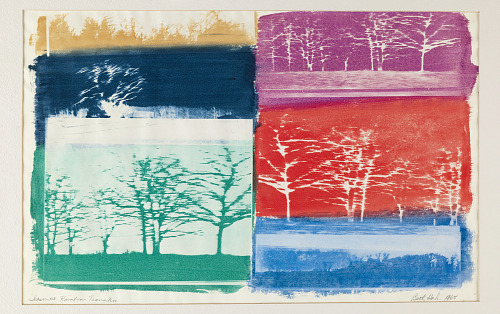
Betty Hahn (b. 1940), "Seasonal Rainbow Transition," gum bichromate with paint on paper, 1968. Photographic History Collection, National Museum of American History.

All four exhibitions were accompanied by poster-checklists and formal, if modest, openings. The first show in the series, “Women, Cameras, and Images I,” was a retrospective of Imogen Cunningham’s classic imagery. I well remember her sly humor and witty sarcasm at her opening: she was delightful, and it was especially gratifying for me after my failed attempt to meet her during a trip to San Francisco.
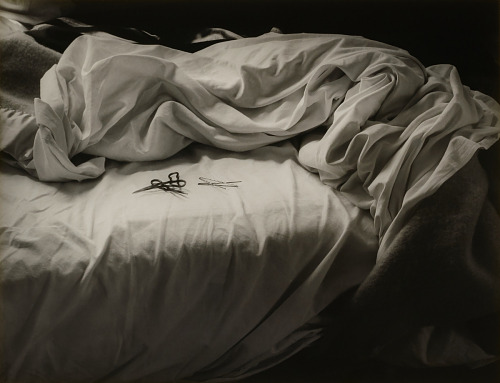
Imogen Cunningham (1882-1976), "Unmade Bed," gelatin silver photographic print, 1957, printed 1957, Smithsonian American Art Museum.

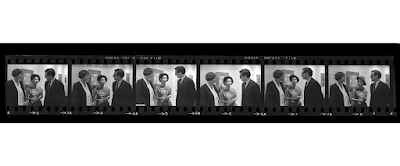
The second exhibition, “Women, Cameras, and Images II,” combined the work of Betty Hahn and Gayle Smalley. I had met Betty in graduate school at Indiana University and vaguely knew Gayle, who had graduated from the Rochester Institute of Technology five years before I had. Their work was very different from that of the other three women, employing radically new approaches to the medium. Hahn was one of the first photographers to experiment with “obsolete” photographic processes, including gum-bichromate, and combined photography with textiles, sometimes adding hand-work, such as paint, needlework and embroidery, which in her words represented a homage to the unsung women who traditionally practiced such stereotypically feminine “crafts.” Independently, Gayle Smalley combined photography with hand printmaking techniques. Hahn’s and Smalley’s prints were colorful, semi-abstract, and often playful and humorous, heavily influenced by contemporary printmaking.        

Above: Gayle Smalley (left) and Betty Hahn (center) talking with Eugene Ostroff at the opening of their exhibition, 1969. Smithsonian photographer unidentified.

“Women, Cameras, and Images III” was devoted to the work of Berenice Abbott, whose long and influential career ranged from documentation of New York City to the development of techniques for  scientific photography, in which she was an important pioneer. Unfortunately, we lacked funds to bring her to Washington for the opening, and I think she never quite forgave me.
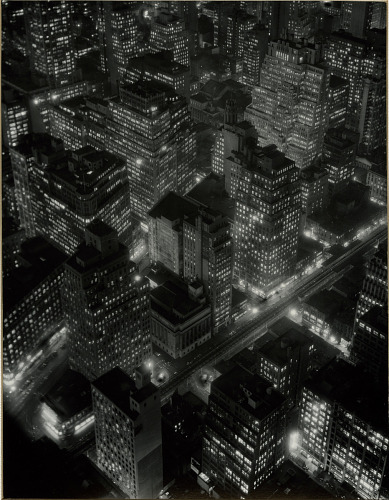

Berenice Abbott (1898-1991), "Night Aerial View, Midtown Manhattan," 1933, gelatin silver print. Photographic History Collection, National  Museum of American History.


Barbara Morgan was the artist of “Women, Cameras, and Images IV.” Noted for her photographs of Martha Graham’s dancers, a major component of the exhibition, she worried about the design of the show, and explained her concern with rhythm and flow in the placement and sequencing of the framed images. I was tempted to let her develop the layout or collaborate with me, but was warned not to permit her participation lest it delay the opening. It was a nail-biter for me as I hung the show, fearing that she didn’t fully trust my curatorial eye, but I needn’t have worried: she was pleased and pronounced it a huge success, telling me “You got it!” She had been honored previously in a similar retrospective solo exhibition at the Museum of Modern Art, curated by my photo-history mentor, Peter Bunnell, and pronounced my design “better.” At social occasions for several years afterward she proudly introduced me as “the man who hung my Smithsonian show, you know,” and we had a lovely and rewarding friendship.
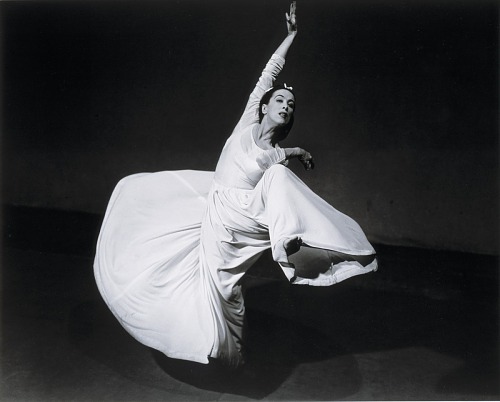
Barbara Morgan's photographs have been collected not only by NMAH, but also by the Smithsonian American Art Museum (SAAM) and the National Portrait Gallery (NPG). This is also true for the work of Imogen Cunningham and Berenice Abbott. However, NMAH was the first Smithsonian museum to collect and mount exhibitions of their work. 

Barbara Morgan (1900-1992), "Martha Graham--Letter to the World--(Swirl)," 1940, gelatin silver print, printed ca.1980. Smithsonian American Art Museum, gift of Virginia Zabriskie. 

However, the series, which originally was intended to continue for another year, foundered and ended when some photographers objected to being “classified” or identified as “women photographers” within a special series, as if each photographer's work couldn't stand on its own merits. Similarly, I recall hearing certain women criticize the creation of Washington’s National Museum of Women in the Arts for what nowadays some might call bad “optics,” appearing to relegate female artists to a separate category rather than striving to integrate them in greater numbers into existing art museum awareness and practice.

Opinions, perspectives, and tactics intended to promote social change often themselves change with the times and the politics of culture, however. In 1970 we found that for some women photographers, the prospect of inclusion in a series of gendered exhibitions (curated by men) entitled “Women, Cameras, and Images” could be interpreted as more demeaning than celebratory, perhaps suggesting mere tokenism. Controversial “optics!” By contrast, the emphasis on equity in the 2020s has regularly employed group solidarity and separation as a logical, effective tactic to highlight marginalized groups and their members’ individual stories--for example, through Black History Month and Women’s History Month. I recently noticed a current exhibition at Lehigh University entitled “Hear Me Roar: Women Photographers II,” reflecting the similar strategy of the Smithsonian’s “Women, Cameras, and Images” exhibitions of the tumultuous late 1960s. I couldn't help smiling.

David Haberstich, Curator of Photography

Archives Center, National Museum of American History 

Tuesday, March 30, 2021

Geneva Townes Turner

 By Jennifer Morris


Geneva Calcier Townes Turner married Lorenzo Dow Turner, a pioneering African American linguist and celebrated father of Gullah studies, who conducted groundbreaking research in the Sea Islands off the coasts of South Carolina and Georgia. Geneva worked as an unofficial research associate and scribe for her husband’s projects in the early years of his research. She participated in creating recordings of the Gullah people’s songs and dialect, and studied the international phonetic system at Brown University in order to better identify and transcribe Gullah speech. While her contributions to the formative years of Dr. Turner’s Gullah research were never fully acknowledged, she took pride in “sharing in his accomplishments.”

The couple separated after nineteen years of marriage, and Geneva went on to enjoy a successful career as an elementary school educator in Washington, DC.  She also collaboratively published and distributed two children’s books.                                  

KatieGrovener [Grovernor] Brown, Gullah Informant, Sapelo Island, Georgia, 1933


Parris and Rosa Capers, Gullah Informants, St. Helena Island, South Carolina, 1932 


SamPolite, Gullah Informant, St. Helena Island, South Carolina, 1932 

Jennifer Morris, Archivist

Wednesday, March 24, 2021

Spotlight on Women Amateur Photographers No. 3

 By Pamela Wintle

"For most of history, Anonymous was a woman.” Virginia Woolf

Mayme Lou Bruce, known as Stevey, was married to James Bruce, a prolific amateur filmmaker and explorer who had a particular interest in Melanesia but also filmed in other areas of the world.  As with other husband-and-wife teams, in the Human Studies Film Archives collections, we know that Stevey accompanied her husband and photographed their adventures. As is so often true, the full extent to which she contributed remains “anonymous.” 

Indonesia, ca. 1975, photograph by Stevey Bruce (James S. and Stevey Bruce Collection, sihsfa_2002_17_op_Indonesia75_026


Ecuador, 1976, photograph by Stevey Bruce (James S. and Stevey Bruce Collection, sihsfa_2002_17_op_Ecuador76_005)


Nepal, ca. 1968, photograph by Stevey Bruce (James S. and Stevey Bruce Collection, sihsfa_2002_17_op_Nepal68)

Pamela Wintle

Human Studies Film Archives

Friday, March 19, 2021

Spotlight on Women Amateur Photographers, No. 2

 By Pamela Wintle

“The rule seemed to be that a great woman must either die unwed ... or find a still greater man to marry her. ... The great man, on the other hand, could marry where he liked, not being restricted to great women; indeed, it was often found sweet and commendable in him to choose a woman of no sort of greatness at all.”

― Dorothy L. Sayers, Gaudy Night (1935)

Anne Hansen married John V. Hansen, a Danish adventurer and accomplished amateur filmmaker, and fully participated in his journeys to various European countries, the American West, Alaska and Central America. We know that Anne Hansen served as the travel photographer, necessitating her own intrepid spirit and sense of adventure. We don’t know for certain if this is Anne Hansen with the rope tied around her waist, but one can imagine that it is she risking a perilous slide in order to witness a geologic feature. Below this image are two of her photographs from their many other travels.


Grinnel Glacier at fissure, Glacier National Park, Montana, ca. 1942, photograph by Anne Hansen
(John and Anne Hansen Collection, sihsfa_1999_10_op_americanwest_007)


Tikal Guatemala, 1968, photograph by Anne Hansen (John and Anne Hansen Collection, sihsfa_1999_10_mexico037)


Mendenhall Glacier, ca. 1945, Anne Hansen (John and Anne Hansen Collection sihsfa_1999_10_americanwest028)

Pamela Wintle


Monday, March 15, 2021

Spotlight on Women Amateur Photographers, No. 1

By Pamela Wintle 

“Not content with making sandwiches and massaging feet, these women were active both in the field and in post-production. They recorded sound, shot film, edited, wrote, narrated, co-hosted, and co-directed.”  Smithsonian Collections Blog: Women in the frame, March 23, 2010

The Human Studies Film Archives has a number of husband-and-wife collaborations in the collections, but rarely do we know the extent to which “these women” contributed.  However, in a few of these collections we do know that the woman in the team was the main still photographer in addition to many other duties!

These women were usually behind the camera, so photos of them in the field are rare. Thus, although we cannot see her face, we believe from images in the Hassoldt Davis collection that the photographer of the image below is Ruth Diawara (nee Staudinger, also formerly Ruth Rozaffi, Ruth Cadoret, Ruth Davis, and Ruth Schaffner, 1914-1996).  After her death, her personal slides and films documenting travels to Mexico, Papua New Guinea, Fiji, and various African countries were discovered in a Los Angeles storage unit and donated to the Human Studies Film Archives.

    Mount Fuji, 1966, photographer unknown (Ruth Diawara Collection, sihsfa_2013_002_op_003)


    Japan, 1966, photograph by Ruth Diawara (Ruth Diawara Collection, sihsfa_2013_002_op_002)

Pamela Wintle


Monday, March 8, 2021

Celebrating Smithsonian Women in Women's History Month

By Pamela Henson

Smithsonian Institution Archives has a wide array of photographs of women since our early years, but some stand out more than others. I am particularly fond of this image of a group of women celebrating a retirement. Like the flowers Nellie Smith is holding, they are arranged like a bouquet of flowers themselves! But this is a group of very important women at SI in 1930 – they ran a lot of major offices. Louise Pearson moved with Alexander Wetmore to the Secretary’s Office when he became Secretary in 1944 and kept the Institution running. Miss Nellie Smith was replaced by Helena M. Weiss, who was later SI Registrar. When Weiss retired she was replaced by seven separate unit heads. Their titles don’t capture their responsibilities. Moodey was an “Aid” in Geology, but actually curated the gem collection for many years.  As “clerks” to the Institution’s top administrators, this select group of friends kept the Institution humming.

Luncheon for Nellie Smith, 31 July 1930, at the Ye Old Inn. Photograph Probably taken by Narcissus H. Smith, Smithsonian Institution Archives, Record Unit 7177, Box 13, Folder 16, neg. #SIA- 94-4431.
 
Image:  https://ids.si.edu/ids/deliveryService?id=SIA-94-4431  

This image is from a luncheon given by these friends in honor of the retirement of Miss Nellie H. Smith at Ye Old Inn on Thursday, July 31, 1930. She was appointed in March 1890 and spent 40 years at the Smithsonian. Top L to R: Louise A. Rosenbusch, Principal Clerk, Office of Dr. William H. Holmes, Director, National Gallery of Art, now the Smithsonian American Art Museum; Louise Pearson, Secretary to Dr. Alexander Wetmore, Assistant Secretary, SI (later the sixth Secretary of the Smithsonian, 1944-1952); and Narcissus Smith, Clerk to the Editor, Dr. M. Benjamin, United States National Museum (USNM). Bottom L to R: Helen A. Olmsted, Principal Clerk, Office of Mr. W. de C. Ravenel, Administrative Assistant to the Secretary, USNM; Nellie Smith, Clerk, Division of Correspondence and Documents, USNM; and Margaret W. Moodey, Aid, Geology in charge of Gem Collection, working for many years with G.P. Merrill, Head Curator, Department of Geology.

Pamela Henson, Ph.D., Historian, Smithsonian Libraries and Archives


Friday, March 29, 2019

Pioneering Women Photographers in Africa: Mary Marvin Breckinridge Patterson


Marvin Breckinridge filming at Great Zimbabwe ruins, Rhodesia (Zimbabwe), 
1932, photograph by Olivia Stokes, EEPA 1985-009-0050

In celebration of Women’s History Month, we’ve searched our archives to find the oldest collection created by a woman photographer.  That honor goes to Mary Marvin Breckinridge Patterson (1905-2002), an American photographer, broadcaster, filmmaker, and philanthropist.  From her journey to Africa in 1932, her work with the Frontier Nursing Service, her broadcasting experience during World War II as the only female member of "The Murrow Boys”, she was, much to her father's chagrin, anything but conventional.  

Boy holding lamb, Natal, South Africa, 1932,
EEPA 1985-009-0009

This amazing woman and her collection are the next highlighted in our Pioneering Women Photographers in Africa project.  The Mary Marvin Breckinridge Patterson Collection at the Eliot Elisofon Photographic Archives (EEPA) is primarily comprised of 78 silver gelatin photographic prints taken by Breckinridge during her trip to Africa in 1932.  Taken during an era of increasing American travel and tourism Africa, these photographs provide significant documentation of a time of great political change in Africa and the professionalization of photography - especially for women.           


Xhosa girl weaving at St. Cuthbert's Mission, Transkei,
South Africa, 1932, EEPA 1985-009-0004

Marvin's prominent family, including her grandfather, Vice President John Cabell Breckinridge, expected her to stay home and marry.  Breckinridge, however, had other plans!  In the first few years following graduation from Vassar College (1928), she worked for the Frontier Nursing Service (a group comprised mainly of women that provided medical services to remote areas in Appalachia), earned a pilot’s license (the first woman in Maine to do so), and assisted in the office of the Democratic National Committee.  In 1932 she set sail to Africa from Southampton, England, accompanying her friend Olivia Stokes and her parents, Rev. Dr. Anson Phelps Stokes and Caroline Mitchell Phelps Stokes.  Dr. Stokes lectured at various locales, working to promote the education and welfare of Africans.  


Kikuyu woman wearing dress made of tree bark,
Kenya, 1932, EEPA 1985-009-0075 


While just 26 years of age, Breckinridge showed a surprisingly sophisticated eye in her documentation of the peoples and landscapes of Tanzania, Rhodesia (Zimbabwe), South Africa, Egypt, Belgian Congo (now the Democratic Republic of Congo), Uganda, Kenya, and Sudan.  Olivia Stokes wrote about the trip in her journal, which was later published as Olivia’s African Diary: Cape Town to Cairo, 1932 (Washington, D.C.: Eastern Press, 1980) and illustrated with Breckinridge’s photographs.


Breckinridge trained the lens of her trusty Graflex camera on a variety of subjects, but seemed most interested in the peoples of the continent.  Pictures of the Baila, San, Shona, Xhosa, Kikiyu and Zulu peoples are prominent in her photographs as are “everyday” scenes, including a bride and groom at Lovedale; workers pouring gold and dancers at the Crown Mine near Johannesburg; flower vendors in Cape Town; two leading elders at Amanzimtoti; a craftsman making spears; miners with their wives in Katanga (now Shaba); schoolboys; women lining-up to receive rations in the Belgian Congo; and a Zulu woman at a market in Durban.  She later shared these photographs with Henry Field, Curator of Anthropology at the Field Museum, to assist in his research.

Wives of miners waiting in line for food rations, Elizabethville, Belgian Congo
(DRC), 1932, EEPA 1985-009-0058


Camel, Sudan, 1932, EEPA 1985-009-0098


She also documented important sites and landscapes, including the Queen Hatshepsut's room at Karnak, Luxor, Egypt; the ruins of Great Zimbabwe; Murchison Falls, Uganda; the Lualaba River; Victoria Falls, Southern Rhodesia (now Zimbabwe); and a mountain at Cape Town.  Additionally, animals feature prominently in her photography, and include egrets, ostriches, camels, lions, and wildebeests.


Breckinridge's experience in Africa further ignited her desire to photograph professionally, and upon return, she enrolled in the Clarence White School of Photography in New York in 1933, taking a month-long training on photographic developing and printing.   She then worked in the office of Democratic congresswoman, and distant relative, Isabella Selmes Greenway, but soon returned to the Clarence White School of Photography for a longer course of study.  Following graduation, she began selling photographs and articles in several magazines, including LifeHarper’s Bazaar, and Town and Country.  Her film credits include The Forgotten Frontier (1930), a documentary about the activities of the Frontier Nursing Service, and She Goes to Vassar (1931), a film that provides an overview of college life at Vassar.        

Mashona woman with baby, Rhodesia (Zimbabwe), 1932, EEPA 1985-009-0044

Traveling to Europe in 1939 on photojournalism assignments, Breckinridge was abroad during the start of World War II and remained only one of four American photographers in England during the first months of the war.  
Edward Murrow hired her as the first female news broadcaster for the CBS World News Roundup to report from Europe.  As the only female member of “The Murrow Boys”, an elite group of only eleven broadcasters handpicked by Edward R Murrow, she covered Great Britain, Scandinavia, and the Low Countries.  In total, Breckinridge broadcasted fifty reports from seven countries.  To learn more about her work during this period, check out  Women Come to the Front, an online exhibition curated by the Library of Congress.

While working in Berlin, she married Foreign Service Officer Jefferson Patterson. She resigned from CBS, hoping to resume her career in photojournalism, but the State Department prohibited it. The couple was posted in Peru, Belgium, Egypt, the Balkans and Uruguay.  After several years, the couple settled in Washington, D.C., where Breckinridge directed her energy on philanthropy.  Breckinridge became an active member of the Society of Woman Geographers and contributed as a trustee of various museums and galleries, including the Smithsonian Women’s Committee.  


Sudanese man, near Kassala, 1932, EEPA 1985-009-0110

We hope that you enjoy Breckinridge's photographs as more are posted online.  You can view the collection's finding aid and explore her photographs here.  We encourage you to read more about the Pioneering Women Photographers in Africa project, and explore other blogs in this series.

To obtain high-resolution images and permission for publication or exhibition, please contact the Eliot Elisofon Photographic Archives, National Museum of African Art.


Eden Orelove, Photo Archivist
Eliot Elisofon Photographic Archives, National Museum of African Art