Smithsonian Collections Blog

Highlighting the hidden treasures from over 2 million collections

Collections Search Center
Showing posts with label South America. Show all posts

Friday, October 6, 2017

Flashback Friday: Revisiting Zorn

Elayne Zorn spent many years and much of her professional career as a museum collector and anthropologist in the Andean regions of Peru and Bolivia. Although it was her interest in textiles and traditional weaving techniques that first brought Zorn to the Island of Taquile in Peru, she was also a musician and took a great interest in festivals (see Fiesta Fiesta in the Elayne Zorn collection). When Elayne passed away in 2010 her son donated her large collection of musical instruments, textiles and archival materials to the National Museum of the American Indian.

Men playing charangos at a festival in Puno, Peru. Elayne Zorn collection. National Museum of the American Indian, Archives. Smithsonian Institution. 


Field notebook from Taquile, Peru, 1975-1976. Box 1, Folder 6 Elayne Zorn collection. National Museum of the American Indian, Archives. Smithsonian Institution. 
Often times as archivists we become attached to certain collections, or more specifically to the people whose papers we can spend months getting intimately acquainted with. For me, the Elayne Zorn collection has always been one I have held close. Processing Elayne’s collection of field notes, tens of thousands of photographs and array of other materials was one of the first projects I was assigned as a professional at the NMAI back in 2011. Soon after finishing the collection I had the pleasure to work with Aymar Ccopacatty an Aymara artist participating in the 2012 NMAI Artist Leadership program. Aymar, who learned traditional weaving techniques from his grandmother in Puno, Peru, was the first researcher to look at the Zorn materials. He immediately recognized individuals in the photographs from Puno, Peru and requested scans to take back to his community.

Festival in Puno, Peru, 1989.  Elayne Zorn collection.
National Museum of the American Indian, Archives.
Smithsonian Institution. 
Festival in Puno, Peru, 1989. Elayne Zorn collection.
National Museum of the American Indian, Archives.
Smithsonian Institution. 

Since 2012 I had little opportunity to engage with the Zorn collection. This past year however a project to survey the object collections and enhance their records, led by Maia Truesdale-Scott, has brought attention back to the archival materials. Because of Maia’s work, departments across the museum, scholarship, collections management, conservation, registration and archives, have come together to examine the collection as a whole. This work has also given me the chance to reconnect with Aymar who was recently brought in by our conservation department as a consultant to review textiles. Due to the advancement of digital projects at NMAI in the last five years it is now much easier for us to digitize and make available the Puno photographs in the Zorn collection using the SOVA (Smithsonian Online Virtual Archive). Moving forward the Archive Center, working collaboratively with Aymar, will be able to ensure these images find their way back to the community where they were taken.

For more information about Maia’s work on the Zorn collection be on the lookout for an upcoming blogpost!

For more information on Aymar’s art visit: http://aymart.org/blog/

Rachel Menyuk, Processing Archivist
National Museum of the American Indian, Archive Center

Thursday, February 16, 2017

Stories from Ethnographic Field Diaries in the Edward C. Green Collection

On October 27, 1971, anthropologist Ted Green was on the way to the airport with his wife and one-year-old son to begin his doctoral field research among the Matawai Maroons in Suriname. “1st day must be worst in anthropological history,” he wrote as the first line of his fresh field notebook. “Attaché case and tape case lost en route to airport containing everything. I’m set back a year, if indeed I can start work at all now. Complete despair.” In the cases were traveler’s checks, letters of introduction, and the family’s medications – essential items for a long foreign stay. More bad news was to follow: “Other things screwed up: house promised not available, museum friend has emigrated, etc. etc.” Fortunately for Green and his family, the cases were found the next day and sent on to meet him in Suriname. “Awoke this morning to learn via phone from Washington that both cases found…Fantastic good fortune. Contents were priceless, irreplaceable,” Green noted.


A page of a field notebook, Suriname, 1971, Box 4, Edward C. Green papers, National Anthropological Archives, Smithsonian Institution.

Green would spend the next two years in Suriname with his family, documenting the Matawai dialect of the Saramaccan language and Matawai kinship structures. (Green’s dissertation, completed in 1974, was entitled “The Matawai Maroons: An Acculturating Afro-American Society.”)


Ted Green in Suriname, 1974, Box 3, Edward C. Green papers, National Anthropological Archives, Smithsonian Institution.

The field notebooks he kept during this time now reside among the Edward C. Green papers, c. 1970-2016 at the National Anthropological Archives (NAA). In addition to standard field note fare – such as interviews, observations, and analysis – Green’s field notebooks capture intimate moments where his professional life as a doctoral student intersected with his personal life as a husband and father. Green’s young son borrowed his father’s notebooks for handwriting practice. Scrawls and loops in earlier notebooks turn into doodles in later ones, with big block-lettered “TIMMY” scratched across pages. The antics of the family dog, Karl, make the cut as well, as do the concerns and ethnographic observations of Green’s first wife, Shannon.

In December 1971, Green wrote, “We flew to Jacobkondre because we were afraid the boat trip would be dangerous for the baby…Gaddan [Jarien Gaddan, a member of Parliament] and the village (missionary) schoolteachers were quite interested in us. We were given a house by the airstrip, the upstairs of which is used for radioing Paramaribo. Then Gaddan and the plane left. A number of children came over to look at Timmy and our big dog, and soon they were all playing.” Perhaps no notebook entry is so dramatic as the opening salvo, but the diaries nevertheless capture the intimate and messy process of ethnographic field work – including the loss of traveler’s checks and their miraculous recovery!


Three field notebooks, Suriname, 1971-1972, Box 4, Edward C. Green papers, National Anthropological Archives, Smithsonian Institution.

The Edward C. Green papers, c. 1970-2016 were processed with funding from the Wenner-Gren Foundation. The collection is open for research at the NAA. A finding aid for the collection is available on the Smithsonian Online Virtual Archives (SOVA). Sound recordings in the collection, including field interviews among the Matawai, are currently being digitized process so they can be made available online within the next year.

Kate Madison, Processing Archivist
National Anthropological Archives

Thursday, September 8, 2016

Celebrate the Potato

September is National Potato Month. Almost all the potatoes grown in the United States are planted in the spring and gathered in the fall. It is the time of year that schools in northern Maine have “harvest break” when students work to dig and sort the season’s spud crop soon after summer vacation.

Maine’s custom is one small part of the very long and interwoven agricultural, economic, social, culinary, medical, and ritual histories of this humble staple. It is a story that stretches from ancient gardens in the Andean Mountains 10,000 to 8,000 years ago … to perhaps Mars in the future? In the recent movie, The Martian, the stranded astronaut-botanist (played by Matt Damon), bases his long-term survival strategy on the Red Planet, not completely unfeasibly, on planting potatoes. But is the potato relevant for us today?

A carbohydrate, the tubers have nutritional detractors who point out that Americans consume far too many calories from white starches, including processed potato products in the forms of French fries and chips (along with the harmful fats and salt that go with them). With dehydrated and other potato products, these foods account for fifty percent of the potato market. Meanwhile, the annual consumption of fresh potatoes in the United States has fallen from eighty-one pounds per person in 1960 to forty-two pounds recently (the official Government report here). Potatoes are a hot political issue: Congress has fought successfully to keep the white potato in food assistance programs, including those of school lunches and breakfasts, against recommendations from the Department of Agriculture.

Following rice, wheat, and corn, potatoes are among the most consumed food crop in the world. The tuber is easy to grow in a variety of climates and soils, and is not as thirsty for water as many other vegetables, producing a high yield from a small area. Able to be stored for long periods, the potato is a good source of vitamin C (surprisingly), potassium, phosphorus, magnesium, vitamin B₆, and some iron. Inexpensive, lacking only calcium and vitamins A and D, it is almost a complete food. Beginning with the ancient civilizations of Huari and Tiahuanacu located in parts of modern-day Peru and Bolivia, the spud has been insurance against famine, providing sustenance when other crops failed.

If there is a food stuff that deserves a commemorative month or day (May 30th in Peru), it is the potato.

Potat-21
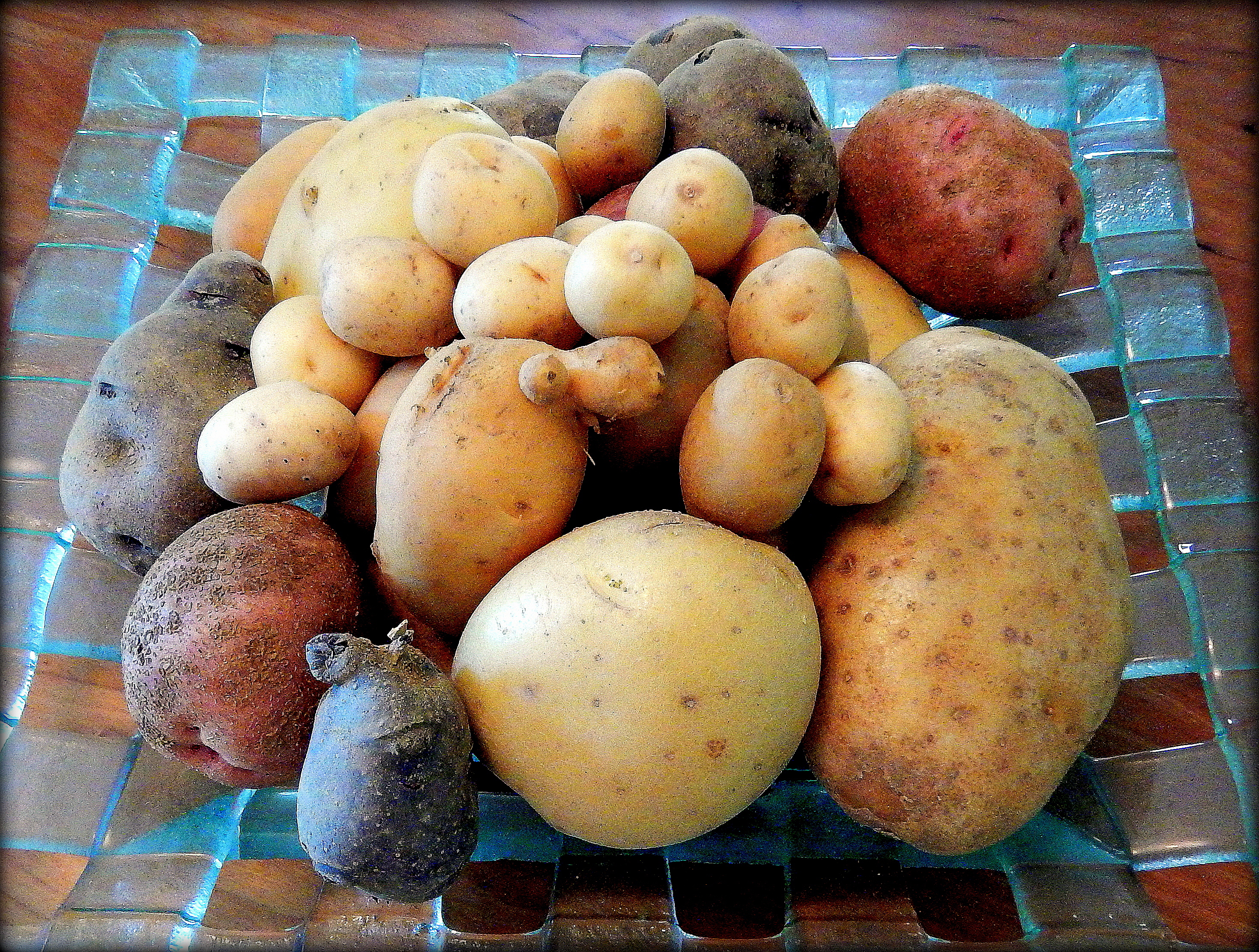
A selection of organic potatoes from both coasts: Idaho and Yukon Gold from California; Honey Gold Nibbles, Gold Marbled Fingerlings, Purple Peruvian, and Adirondack Red potatoes from the Mid-Atlantic area. There are over a hundred varieties available. The petite type are growing in popularity (quick to cook, creamy in texture) as a substitute for pasta (photo by the author)
Not surprisingly, the Smithsonian does not treat the subject as small potatoes. In most, if not all, of the twenty-one separate libraries in the Institution, information on some aspect on the history and culture of the potato can be found. So what better way to celebrate the potato (Solanum tuberosum) and find its relevancy than by digging into some of Smithsonian Libraries’ holdings that tell its rich story? From the Anthropology, American Indian, Natural History, Horticulture and Botany libraries, the trade literature and cookery collections of American History, and, of course, Special Collections, all have original and secondary sources for an (almost) complete picture of this highly significant plant.

Archaeological research finds that the potato was first domesticated from wild plants on the shores of Lake Titicaca in the Andes. With sophisticated agricultural technology, including raised field terraces and irrigation systems, Pre-Inca cultures came to thrive on huge yields of the crop. The Inca Empire relied on potato storehouses, including a freeze-dried product (chuña) that could hold for years, in times of crop failures. Pedro de Cieza de León, explorer and historian, described the cultivation and cooking in his Chronicles of Peru, in 1540. Spanish conquistadors, who largely destroyed the Inca civilization, brought the potato across the Atlantic. Early accounts are a bit murky with the confusion between white (papas) and sweet potatoes (batata), but they were cultivated on the Canary Islands from 1565 and then onto the mainland of Spain.

John Gerard, The Herball, or, Generall historie of plantes (Imprinted at London by John Norton, 1597). The Biodiversity Heritage Library has digitized the copy in the Peter H. Raven Library, Missouri Botanical Garden.

John Gerard, The Herball, or, Generall historie of plantes (Imprinted at London by John Norton, 1597). There had been an earlier written description (but with no illustration) of the plant in Gaspard Bauhin’s Phytopinax of 1596. The Dibner Library of the Smithsonian Libraries has this first edition of Gerard. The Biodiversity Heritage Library has digitized the copy in the Peter H. Raven Library, Missouri Botanical Garden (pictured here).
Potatoes were being grown in London not long afterwards. The first printed pictures of the potato plant appear in woodcut illustrations in John Gerard’s great Herball of 1597. Gerard, who grew the plants in his own garden, misidentifies the origin of the potato as Virginia. It was not introduced into North America until the 1620s when the British governor of the Bahamas sent the tuber, along with other vegetables, to the Jamestown colony in Virginia. However, Derry, New Hampshire claims the first potato patch in North America, planted in 1719 when Scot-Irish immigrants settled in the area.
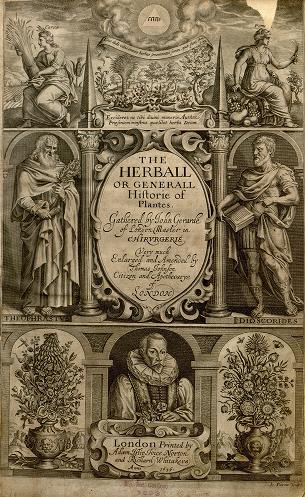
mobot31753000817756_0001
The 1636 edition of Gerard's Herball. The author holds a spray of potato flowers in the illustrated title page of the book, seen in the bottom center, just above the imprint. The Cullman Library of the Smithsonian has two copies; this image is from the scanned copy in the Peter H. Raven Library of the Missouri Botanical Garden (from the catalog of the Biodiversity Heritage Library).
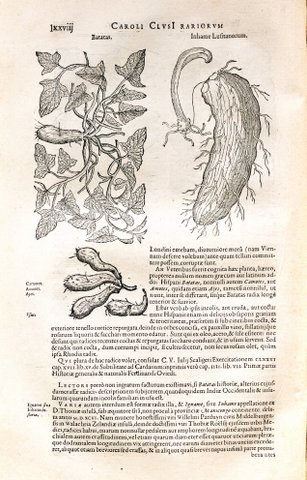
From England, the potato moved to France and then on to the Netherlands. Carolus Clusius (or Charles de l’Ecluse) introduced the potato to the Low Countries. Woodcut illustrations are in his Rariorum plantarum historia (The history of rare plants; Antwerp, 1601). Because potatoes were a good source for preventing scurvy on long voyages, they were distributed via shipboard provisions to the far reaches of the world in the age of exploration. Potatoes also lessened the effects of tuberculosis, measles and dysentery. But the tuber became stigmatized as it moved from the exclusive botanical gardens of the wealthy in the 17th century, when it was thought to be poisonous and fit only for livestock or the truly indigent.

Clusius1601detail
Clusius' Rariorum plantarum historia (Antwerp, 1601). Images of the white and the sweet potatoes (above and below) from the scanned copy in the Peter H. Raven Library of the Missouri Botanical Garden by the Biodiversity Heritage Library (link). The Smithsonian's Cullman Library also has the title.
ClusiusBata.
Clusius also created the first European representation of the potato, a lovely watercolor of 1588 of a plant in his garden. The work of art, with a note written by Clusius, is now in the Plantin-Moretus Museum in Antwerp (link here).
In Europe and Russia during the second half of the 18th century the potato was vigorously promoted to lessen the economic distress of successive disastrous harvests of corn and wheat. Various groups and individuals produced pamphlets and books to educate and extol the crop’s virtues, such as the Society for the Encouragement of Arts, Manufactures and Commerce, and military pharmacist and agronomist Antoine Augustin Parmentier. An example is Memoria sopra I pomi di terra (Memoire on the potatoes) of 1767, an Italian translation of a French publication (Dibner Library) that discusses varieties and cooking methods.

In France, the tuber was particularly regarded as a poor person’s food. Sadly, the Smithsonian Libraries does not own a copy of the important Parmentier work, Examen chimique de la pomme de terre (Chemical examination of the potato, 1778). He was so successful in his efforts that some still believe he invented the potato, and there are many dishes named for him, such as the casserole of veal chops à la Parmentier.

By the 19th century, the potato was common and so prevalent that historians debate its exact role in fueling the population explosion of the period. The food stuff also was being put to other uses, such as in alcoholic spirits. John Ham’s The theory and practice of brewing, from malted corn and from potatos (London, 1829), is one such treatise. There are many gardening manuals in the Smithsonian Libraries that discuss all the types then being developed and best methods of growing and storage. William Cobbett’s The American gardener (London, 1821) has this charming entry:

"Potatoe – Every body knows how to cultivate this plant; and, as to its preservation during winter, if you can ascertain the degree of warmth necessary to keep a baby from perishing, you know precisely the precautions required to preserve a potatoe. – As to sorts they are as numerous as the stones of a pavement in a large city."

But such dependency on a single crop, relied on by a huge population, proved ripe for disaster. This came in the form of late blight disease in the 1840s, which struck hard in Europe and was particularly devastating in Ireland. These catastrophes led to the development of disease-resistant plants, in particular by American horticulturist Luther Burbank who worked to improve the Irish potato; he bred a type in 1872 that established the Idaho potato. These new varieties led to even more potato dominance in food production and plantings around the world. It is a story likely to play out again with climate change, as scientists work to develop cultivars even more resistant to heat, drought and disease. To lessen pollution and water use and help feed its exploding population, China is now by far the largest producer of the staple in the world. Will the potato once again save some parts the world? (see Zuckerman, Larry. The potato: how the humble spud rescued the western world. Boston, 1998 and this Wikipedia entry on the subject).
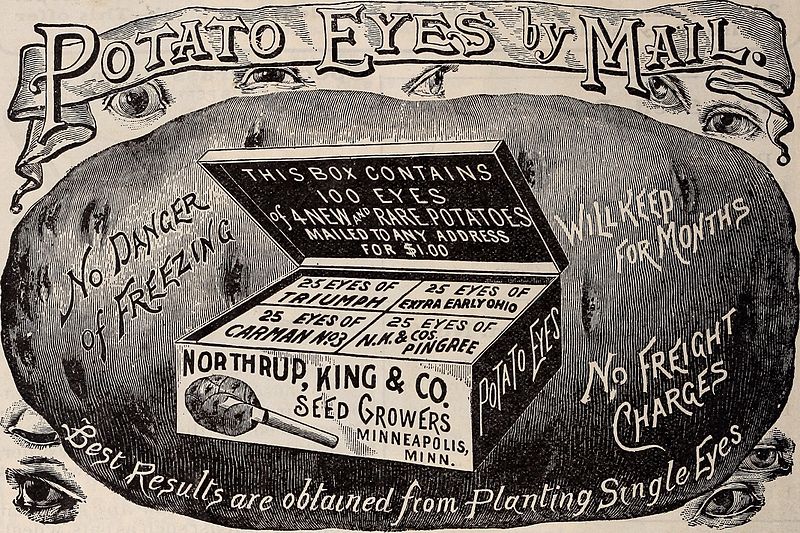
"Good seeds at fair prices": trade literature of 1902 from Minneapolis, Minnesota (image from Wikimedia Commons)
"Good seeds at fair prices": National Museum of American History Trade Catalogs of 1902 from Minneapolis, Minnesota (image from Wikimedia Commons of the copy in the National Agricultural Library)
The extensive agricultural trade literature collections in the Smithsonian illustrate the trends in the potato’s popularity and dominance into the 20th century (one example linked here). The evolution of the vegetable as source of sustenance to a snack food is also traced in the Libraries’ culinary holdings. Thomas Jefferson had "potatoes served in the French manner" at a White House dinner in 1802 (not, strictly speaking, and contrary to the myth, the French fry). A relative of Jefferson’s, Mary Randolph, had seven recipes for potatoes, including one “to fry sliced potatoes” in her book, The Virginia house-wife, or, Methodical cook. The Dibner Library holds the fourth edition of this important cookbook, published in 1830. The Russet Burbank potato, developed in the 1920s, long, regular with a high sugar content, is the hybrid ideal for French fries. Speaking of which, France and Belgium are still arguing over who invented “French fries.”
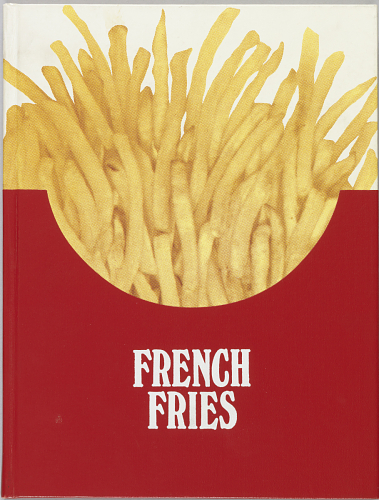
An artist book in the collections: French fries : a new play, written by Dennis Bernstein, Warren Lehrer ; designed by Warren Lehrer, 1984.
This short history, centered on the Smithsonian Libraries collections, merely skims the surface of the potato. So even if you tend to avoid white potatoes in your diet, pick up one of the many, many accounts of the spud to read or raise a fork to the potato this month and celebrate this small vegetable’s big history in the world. In the words of Winnie-the-Pooh creator A. A. Milne: “What I say is that, if a fellow really likes potatoes, he must be a pretty decent sort of fellow” (“Lunch” in Not that it matters, 1919).

Julia Blakely
Special Collections Cataloger
Smithsonian Libraries 

Potat-19
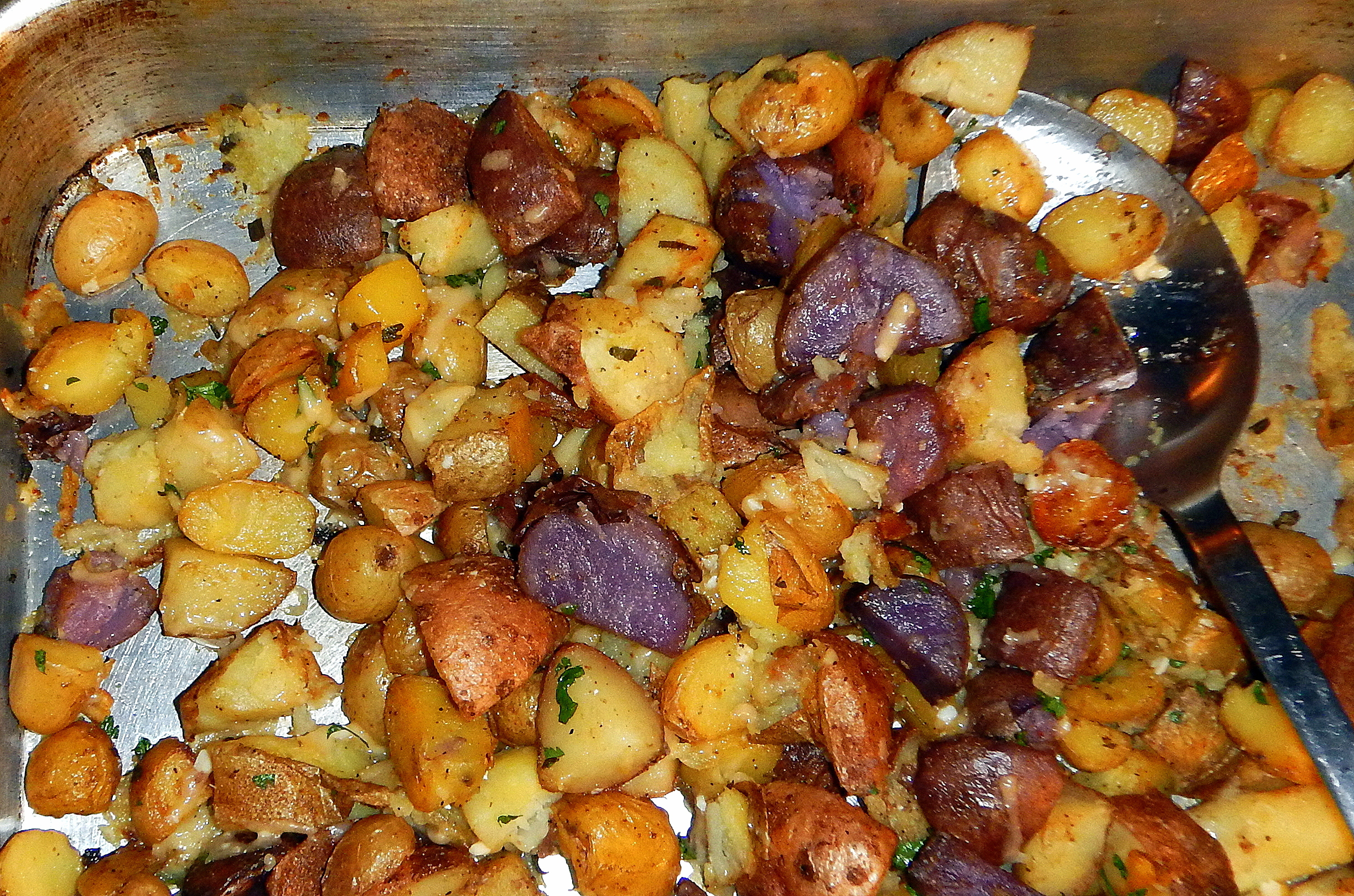
An excellent dish for the month: Rainbow Potato Roast.


For further reading:

Chilies to chocolate: food the Americas gave the world. Tucson, 1992.
Hawkes, J. G. The potatoes of Argentina, Brazil, Paraguay, and Uruguay: a biosystematics study. Oxford, 1969.
Ochoa, Carlos M. Las papas de Sudamérica. Lima, Perú, 1999.
Salaman, Redcliffe N. The history and social influence of the potato. Cambridge, 1985.

Potat-13
Well, if you are going to have bacon with your potatoes, might as well have sour cream as well. Photo by the author but the  great recipe and story from the New York Times.

Friday, October 10, 2014

Flashback Friday: Turner Returns to Brazil

This October, the Smithsonian Collections Blog is celebrating American Archives Month with a month-long blogathon! We will be posting new content almost every weekday with the theme Discover and Connect. See additional posts from our other participating blogs, as well as related events and resources, on the Smithsonian’s Archives Month website.

In 2010 for American Archives Month celebration, I wrote a blog post on the pioneering linguist Lorenzo Dow Turner and the Anacostia Community Museum efforts to preserve and digitize his field recordings created between 1930s and 1950s.  Since that post, the museum has successfully recovered and preserved folktales, songs, and interviews Turner collected in West Africa and Brazil. The museum also presented a groundbreaking exhibition on Dr. Turner titled, Word, Shout, Song: Lorenzo Dow Turner Connecting Communities through Language in 2011.  The exhibit looks at the life, research and scholarship of Professor Turner and is based almost entirely on his archival papers and objects in the museum collection.

A section of the exhibition focuses on Turner’s research on African survivals in Afro-Brazilian culture, especially within the Candomblé religion.  The show along with a museum symposium on Turner helped Brazilian scholars unfamiliar with Turner to discover and connect to his work in their country during the 1940s. As a result, “Word, Shout, Song.  . .” exhibition is scheduled to travel in Brazil starting in July 2015.

This will allow the Candomblé communities to connect with the research and documentation conducted by Turner. As an archivist, it gives me professional pleasure to see the materials one has arranged, described, and cataloged as a source for reconnecting a community to their heritage.  In addition, we plan to ingest some of Dr. Turner’s research and appointment books in the Smithsonian Transcription Center for the benefit of scholars, researchers, and the communities he researched.

In the meanwhile, here are some images from Turner’s research in Brazil:

Woman dressed as Iyansã goddess of the wind and storms and the wife of Sangõ, the god of thunder, in the Candomble pantheon. Lorenzo Dow Turner papers, Anacostia Community Museum Archives, Smithsonian Institution, gift of Lois Turner Williams.
Afro-Brazilian holding a Berimbau, an Angolan musical instrument.Lorenzo Dow Turner papers, Anacostia Community Museum Archives, Smithsonian Institution, gift of Lois Turner Williams.


Mãe Meninha do Gantois and her followers.Lorenzo Dow Turner papers, Anacostia Community Museum Archives, Smithsonian Institution, gift of Lois Turner Williams.
See more images here!
Jennifer Morris
Archivist
          

Friday, February 1, 2013

Fiesta, Fiesta in the Elayne Zorn Collection

On February 2nd 1989, anthropologist Elayne Zorn walked through the city of Puno, Peru equipped with her camera and recording device.  Every February, at an elevation of 12,556 feet, the Andean city is host to the Fiesta de la Virgen de la Candelaria, or Candlemas which is considered one of the largest festivals in South America.  Candelaria draws hundreds of dance groups and tourists every year to Puno, a city and region Zorn was very familiar with. Zorn spent many years and much of her professional career as a museum collector and anthropologist in the Andean regions of Peru and Bolivia. Although it was her interest in textiles and traditional weaving techniques that first brought Zorn to the Island of Taquile in Peru, she was also a musician and took a great interest in festivals.

Personally, I am also interested in festivals. Having studied and participated in street performance in the past I can say there is nothing quite like the thrill of an outdoor crowd. So as I was processing her collection I was immediately drawn to Zorn’s many photographs and audio recordings of the fiestas she attended. Many of the recordings Zorn made feature traditional Andean instruments including the charango, a stringed instrument, sikus, pan pipes and quenas, flute like instruments pictured below. 


Photo by Elayne Zorn. Puno, Peru, 1989. Elayne Zorn collection, Box 47 (S16285)

As a textile enthusiast, Zorn took hundreds of photographs of the traditional outfits worn by both woman and men on festival days.  Zorn writes in her book, Weaving a Future, that audiences at major Puno folklore events would distinguish Taquileans by their clothing, “which tells runa and mestizos the performers’ community of origin.”  (Page 51)


Photo by Elayne Zorn. Puno, Peru, 1989. Elayne Zorn collection, Box 47 (S16277)

Zorn’s collection came to the National Museum of the American Indian as a donation by her son and included both objects and archival materials.  The archival material, measuring about 11 linear feet and containing tens of thousands of photographic objects including negatives, slides and prints as well as audio and video cassettes, documents Zorn’s professional and student activity from 1975 until 2010. In addition to attending festivals, Zorn developed a long association with the community in Taquile,  and spent a significant amount of time conducting field research in Andean communities in Bolivia examining the relationships between tourism and textiles.


Photo by Elayne Zorn. Puno, Peru, 1989. Elayne Zorn collection, Box 47 (S16259)

The Elayne Zorn collection is a wonderful addition to the National Museum of the American Indian archive center. If you would like to learn more about the collection, the finding aid can be accessed here or the NMAI archive center can be reached at NMAIArchives@si.edu

~Rachel Menyuk, Archive Technician NMAI Archive Center