Smithsonian Collections Blog

Highlighting the hidden treasures from over 2 million collections

Collections Search Center
Showing posts with label Artists. Show all posts

Monday, June 29, 2020

Anders Zorn: Swedish Superstar and American Idol

Zorn’s self-portrait appears on the cover of the  brochure for a 
memorial exhibition that traveled the United States in 1925.  

“Special Exhibition of Oil Paintings and Water Colors by Anders Zorn.” 
Grand Central Art Galleries. Carnegie Institute, 
Museum of Art records, 1883-1962, bulk 1885-1940, Series 3: 
Exhibitions, Box 204, Folder 23: Zorn, Anders L., 1924-1925, 
Archives of American Art, Smithsonian Institution.
The year 2020 marks the centennial of the death of Swedish painter Anders Zorn (1860–1920). While he may no longer be a household name, at the time of his death at the age of sixty, Zorn was a world-renowned painter and etcher—highly sought after for portrait commissions not only throughout Europe but also across the United States. His sitters included three U.S. presidents, industrialists Andrew Carnegie and Robert Brookings, and countless other high society figures. Several days after his death was announced in the U.S. press, the New York Times ran a piece on Zorn noting: “Those who noticed the death of the Swedish artist Anders Zorn felt . . . a shock which may be taken as a measure of his significance in art.” [i]


Whereas Zorn’s friends and admirers in the United States were stunned by his death, it was even more deeply felt in Sweden, where he is still known as a “Swedish Superstar.” [ii] Zorn was born and raised in rural Mora, Sweden, about two hundred miles northwest of Stockholm. His mother, who had been working in Stockholm as a bottle washer in a brewery, returned to live with her parents in Mora after becoming pregnant. She gave birth to Zorn in a stable next to their farmhouse. Zorn’s artistic gifts were recognized at an early age. With initial support from his extended family, he made his way to the Royal Swedish Academy of Arts in Stockholm at the age of fifteen. Once there, Zorn managed to finance his living expenses, education, and appetite for travel through portrait commissions, eventually living and working for extended periods in London and Paris and traveling throughout Spain and Italy.


Zorn first traveled to the United States in 1893, when he led a delegation of Swedish artists exhibiting at the World’s Columbian Exposition in Chicago, which is often referred to as the Chicago World’s Fair. His art and his personality alike made quite the impression on fair attendees. Two significant  sales at the event effectively launched Zorn’s career in the United States and brought new commissions: one was the purchase of his painting Omnibus (1892) by Isabella Stewart Gardner, which remains on display at the Isabella Stewart Gardner Museum in Boston, Massachusetts, and the other was the sale of The Waltz (1891) to George Vanderbilt, who installed it at his Biltmore Estate in Asheville, North Carolina, where it can still be viewed.
Mary Hardin by Anders Zorn, date unknown 1977.134.2 
Etching Smithsonian American  Art Museum,  Gift of Laura Dreyfus 
Barney and Natalie Clifford Barney  in memory of their mother, 
Alice Pike Barney 

Zorn was a master etcher whose ability to depict light
and shadow with a few strokes was widely admired.


An article in Art Amateur, which ran at the time of the World’s Fair in 1893, commented, “Zorn’s manner may be said to be that of a careful and scientific Impressionist intent on getting the greatest possible amount of sunlight, quality of color and verity of expression into his work with the least possible display of means.” [iii] While the article was referring to Zorn’s etching, many of his paintings were also characterized by the use of a limited, tonal color palette and the skillful treatment of light. The same Art Amateur article includes the wry observation: “We believe that if a vote were taken, Mr. Zorn would turn out to be the most popular artist with artists at The World’s Fair.” [iv] This popularity was apparently not limited to fellow artists, as his initial trip to the United States led to lifelong friendships with Gardner, Chicago businessman Charles Deering, and others. Their well-documented travels throughout Europe and the United States, lengthy visits to each other’s homes, and extensive correspondence spanning the next twenty-five years, which is now saved in the archives of the Isabella Stewart Gardner Museum and Zornmuseet (Zorn Museum) in Mora, Sweden, attest to the depth of their affection for Zorn.


Oil on canvas
National Portrait Gallery, Smithsonian Institution;
gift of the Reverend Thomas G. Cleveland
NPG.77.229

Zorn painted this portrait in 1899, two years after 
Cleveland had completed his second term. The sittings 
took place at the former president’s estate in Princeton, 
New Jersey, where the artist and subject bantered happily 
for several days. Cleveland expressed satisfaction with t
his portrait, declaring, “As for my ugly mug, I think the 
artist has ‘struck it off’ in great shape.” 
[Excerpted from the National Portrait Gallery’s
museum label]

How did a person of humble origins establish such easy rapport with U.S. high society? Zorn attributed the values instilled in him by his peasant grandparents as a key to his success in developing deep, lasting friendships in the United States. In his memoirs, Zorn wrote:

I got on well in America and with Americans. Their frank, straightforward manner suited my nature. I’ve never really been able to stand our urban Europeans’ ceremonious style and artificial customs . . . . But the simple rules of conduct that were so severely impressed on me by my grandfather from my earliest childhood were not so tricky; faithfulness, being true to one’s word, honesty and punctuality, were virtues I discovered were unnecessary with my fellow countrymen in the cities . . . . Why was I more than other foreigners during [my first visit to America] closest to the elite of American and introduced in all the clubs? Everywhere I went, I ascribed this to my grandfather, the splendid old Mora peasant who raised me until I was twelve… Over there [in America], when they say “he’s all-right,” all doors can open to the foreigner, which Europeans cannot understand. Openness, honesty, straight forwardness, punctuality, and true to friendship -- these things are included in the testimonial "he's all-right." [v] 


Zorn embraced the American entrepreneurial spirit and principles like authenticity, reliability, and trustworthiness that he felt defined his own character. Much like industrialists of the Gilded Age, he was a self-made man.


During Zorn’s third trip to the United States from 1898–1899, he was asked to paint President Grover Cleveland and First Lady Frances Folsom Cleveland, who had recently left the White House. Although President Cleveland informed Zorn that “he would rather go to the dentist than to sit for his portrait,” [vi] he too was eventually won over by Zorn’s personality and engaging repartee. While Zorn gained additional prominence from the opportunity to paint a U.S. president, he was perhaps more inspired by the prospect of painting Frances Cleveland. A fashion icon noted for her beauty and charm, she has been referred to as the country’s “first celebrity first lady.” [vii] Pleased with the resulting portrait of Frances Cleveland, Zorn produced a copy of the painting and presented it to Isabella Stewart Gardner for her birthday in 1899.

Frances Folsom Cleveland by Anders Zorn, 1899 Oil 
on canvas National Portrait Gallery, Smithsonian 
Institution; gift of Frances Payne S/NPG.77.124 


First Lady Frances Folsom Cleveland’s portrait toured 
alongside her husband's as part of the memorial
exhibition organized in the U. S. after Zorn's death.

Although Zorn’s commissions ultimately made him wealthy, he stayed true to his roots, returning every summer to Mora and its surroundings to paint. While he is best known in the U.S. as a portrait painter, he is perhaps better known in Sweden for his depictions of rural folklife. With his earnings, he invested extensively in the community in and around Mora and the preservation of its traditional architecture, music, textiles, wood carving, and other folk arts. Likely inspired by Gardner’s plans to turn her home, Fenway Court, into a museum, Zorn and his wife Emma ensured that their home and studio would eventually be converted into a museum complex.


In 1924, four years after his death, an extensive memorial exhibition showcasing more than five hundred of Zorn’s works was held in Stockholm and highlighted the breadth of his career. Around the same time, a traveling exhibition organized by the Carnegie Institute also toured the United States. While the name Zorn may no longer elicit instant recognition in the United States, his body of work is worth revisiting, as is his unconventional path to superstardom, his entrepreneurial spirit, and his commitment to community, which continues to inspire.


By Beth Gottschling Huber, intern, Smithsonian National Portrait Gallery, Catalog of American Portraits


i “The Art of Anders Zorn,” New York Times, August 29, 1920. 

ii “Zorn–A Swedish Superstar,” Nationalmuseum, Stockholm, accessed May 20, 2020, https://www.nationalmuseum.se/en/utst%C3%A4llningar/kommande-utst%C3%A4llningar/zorn. 

iii “Mr. Zorn’s Exhibition.” The Art Amateur: A Monthly Journal Devoted to Art in the Household (December 1893): 3. 

iv Ibid. 

v Cited after the English translation in William Hagans and Willow Hagens, Zorn in America: A Swedish Impressionist of the Gilded Age (Chicago: Swedish-American Historical Society in cooperation with the American Swedish Institute, 2009), 6. 

vi Ibid, 138. vii S. J. Ackerman, “The First Celebrity First Lady: Frances Cleveland,” Washington Post, July 3, 2013, accessed June 1, 2020, https://www.washingtonpost.com/lifestyle/magazine/the-first-celebrity-first-lady-frances-cleveland/2014/06/27/a4a9bdf4-dd4b-11e3-bda1-9b46b2066796_story.html.

Friday, October 25, 2019

The Interplay of Art, Music, and Portraiture


American portraiture captures rich conversations between artists, musicians, and singers. On the occasion of the Smithsonian’s Year of Music, this essay explores the interplay of art, music, and portraiture in the United States, from the Early Republic to today.

During the eighteenth century, artists were often inspired to portray individuals and groups in the act of playing instruments or singing. A popular theme was the informal family concert, which exemplified the harmony and personal values shared by the represented members. An example is the painting Family of Dr. Joseph Montégut (c. 1797-1800), which has been attributed to José Francisco Xavier de Salazar y Mendoza. It depicts a French surgeon who has settled in New Orleans. He is surrounded by his wife, great aunt, and children, who are about to play for their parents. Two hold flutes, while a daughter’s hands are poised on the pianoforte keys. This composition of a French Creole family in Spanish-governed New Orleans presents a vision of musical and domestic harmony, which had precedents in European art tradition.  https://www.crt.state.la.us/louisiana-state-museum/collections/visual-art/artists/jos-francisco-xavier-de-salazar-y-mendoza

From the 1790s through the 1830s, theater and concert performances proliferated and by the mid-nineteenth century, music had become a public commodity. A leading European virtuoso, the Swedish singer Jenny Lind, toured the United States from 1850-1852, in part with the sponsorship of P.T. Barnum. Many American artists portrayed the popular “Swedish Nightingale,” including Francis Bicknell Carpenter, whose 1852 oil painting depicts Jenny Lind in costume, holding a musical score book.


Jenny Lind by Francis Bicknell Carpenter, oil on canvas, 1852. National Portrait Gallery, Smithsonian Institution; gift of Eleanor Morein Foster in Honor of First Lady Hillary Rodham Clinton (NPG.94.123)

From 1892 to 1895, the Czech composer Antonín Dvořák was director of the National Conservatory of Music in America. His famous symphony From the New World (1893) reflected his interest in African American and Native American music. He promoted the idea that American classical music should follow its own models instead of imitating European composers. Dvořák helped inspire our composers to create a distinctly American style of classical music. By the twentieth century, many American composers, such as Leonard Bernstein, Aaron Copland, George Gershwin, and Charles Ives incorporated diverse musical genres into their compositions, including folk, jazz, and blues.

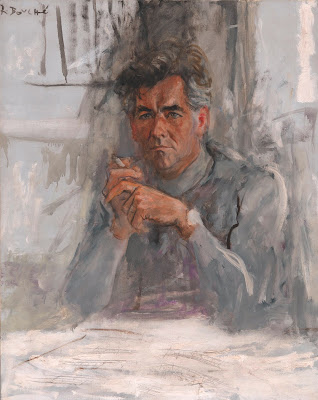
As a composer, pianist, and conductor, Leonard Bernstein made a profound impact on American music by collaborating with the performing arts. His interests ranged from classical music and ballet to jazz and musicals. In an oil portrait of 1960, René Robert Bouché portrayed Bernstein in a moment of reflection, with the papers of the musical score he is writing scattered across the desk in front of him.


Leonard Bernstein by René Robert Bouché, oil on canvas, 1960. National Portrait Gallery, Smithsonian Institution; gift of Springate Corporation. © Denise Bouche Fitch (NPG.92.3)

The composer George Gershwin and his brother, lyricist Ira Gershwin, were also highly versatile, having collaborated on popular musicals and a folk opera. Both brothers also painted interesting self-portraits, which can be viewed in the Gershwin collection in the Music Division of the Library of Congress. In a 1934 oil portrait in the collection of the National Portrait Gallery, George Gershwin represented himself in profile with a musical score and his hand alighting upon the piano keys.


Self-Portrait by George Gershwin, oil on canvas board, 1934. National Portrait Gallery, Smithsonian Institution; gift of Ira Gershwin. © Estate of George Gershwin (NPG.66.48)

The following year, the Gershwin brothers debuted Porgy and Bess, “an American folk opera,” which broke new ground in musical terms. Soprano Leontyne Price appeared in the 1952 revival touring production of Gershwin’s Porgy and Bess, which brought her first major success. Less than a decade later, in 1961, Price became the first leading African-American opera star when she made her debut at the Metropolitan Opera. Bradley Phillips created this formal oil painting of Leontyne Price within a stage setting in 1963. It is one of several portraits he made of the singer. The artist expressed the admiration he felt for her immense talent when seeing her perform onstage.


Leontyne Price by Bradley Phillips, oil on canvas, 1963. National Portrait Gallery, Smithsonian Institution; gift of Ms. Sayre Sheldon (NPG.91.96)

Artists Thomas Eakins and George P.A. Healy also created portraits of singers and musicians. In the medium of painting, these artists were able to convey the intensity and precision of the musicians in their performances. Thomas Eakins asked his model Weda Cook to repeatedly sing a particular phrase from Felix Mendelssohn’s oratorio Elijah, so he could explore the position and movement of her mouth and vocal chords for his portrait Concert Singer (1890-1892). In this manner, he recreated the immediate sense of a formal concert with the contralto singing on the stage and the conductor’s hand and baton raised in the lower corner. https://www.philamuseum.org/collections/permanent/42499.html

George P.A. Healy visited virtuoso Franz Liszt in Rome and created this 1868-1869 oil portrait of him playing the piano in an inspired moment. Healy even convinced the composer to allow Ferdinand Barbedienne to cast his hands in bronze, an artifact Healy later kept in his studio. https://callisto.ggsrv.com/imgsrv/FastFetch/UBER1/ZI-9HFT-2014-JUN00-SPI-142-1 Both artists not only portrayed the physical characteristics of musicians and singers but also the inner passion and mental concentration they brought to their performances. As such, they recreated the emotional spirit of the music for viewers.

James McNeill Whistler thought about his paintings in terms of musical titles and themes. He created not only portraits of musicians but also discussed the subtle tonalities of his more abstract urban scenes and landscapes in musical terms. In 1878, Whistler defended the titles of his paintings: “Why should not I call my works ‘symphonies,’ ‘arrangements,’  ‘harmonies,’ and ‘nocturnes’?...As music is the poetry of sound, so is painting the poetry of sight, and the subject-matter has nothing to do with harmony of sound or of colour.” This analogy between music and painting was Whistler’s primary means for defending his paintings against criticism. Indeed, he published this defense in the journal The World during his libel lawsuit against critic John Ruskin, who referred to Whistler’s 1875 oil painting of fireworks in London, Nocturne in Black and Gold: The Falling Rocket, as “flinging a pot of paint in the public’s face.” https://www.dia.org/art/collection/object/nocturne-black-and-gold-falling-rocket-64931 Whistler’s use of music as a metaphor for painting was intended to build support for the concept that color, form, and painterly technique were the primary elements of an artwork. Whistler brought this correlation of painting and music to public attention with his artworks, which in turn influenced other artists and musicians.  

Regional painter Thomas Hart Benton praised “James McNeill Whistler[’s art]...tone, colors harmoniously arranged…Whether you can distinguish one object from another or not, whether the thing painted looks like a man, woman, or dog, mountain, house or tree, you have harmony and the grandest artistic aim, it is the truly artistic aim.” Benton was a self-taught and performing musician who invented a harmonica tablature notation system used in current music tutorials. He was also a cataloguer, collector, transcriber, and distributor of popular music. He had musical gatherings for family and friends at his home in Kansas City. These sessions were commemorated on a 1942 recording by Decca Records called Saturday Night at Tom Benton’s, which featured chamber and folk music. Benton’s friend, the popular actor and singer Burl Ives, shared his passion for American songs. During the Great Depression, Ives traveled the country gathering and playing folk songs, and Benton made sketches of folk musicians in different regions. In a 1950 lithograph titled the Hymn Singer or the Minstrel, Benton portrayed Ives playing the guitar. 


Burl Ives by Thomas Hart Benton, lithograph on paper, 1950. National Portrait Gallery, Smithsonian Institution. © T.H. Benton and R.P. Benton Testamentary Trusts/Licensed by VAGA, New York, NY (NPG.85.141)

In 1973, Benton was commissioned to paint his last mural, The Sources of Country Music, for the Country Music Hall of Fame and Museum in Nashville, with support from the National Endowment for the Arts. He decided the mural “should show the roots of the music–the sources–before there were records and stars,” and he created a lively, flowing composition of country folk musicians, singers, and dancers.   https://www.arts.gov/about/40th-anniversary-highlights/thomas-hart-bentons-final-gift

Artist LeRoy Neiman featured Duke Ellington, Louis Armstrong, Billie Holiday, Ella Fitzgerald, Charlie Parker, Benny Goodman, and other famous jazz performers in his group portrait Big Band (2005), which is held at the Smithsonian National Museum of American History. It took Neiman ten years to complete this mural-size tribute to eighteen jazz masters, which the LeRoy Neiman Foundation presented to the Smithsonian after the artist’s death in 2012. Neiman frequented jazz clubs, where he befriended and sketched these performers. In 2015, the LeRoy Neiman Foundation donated funds to the Smithsonian towards the expansion of jazz programing during the annual celebration. See the following two part guide to this group portrait of jazz greats:  https://americanhistory.si.edu/blog/neiman-jazz and https://americanhistory.si.edu/blog/neiman-jazz-2

One can discover further portraits and biographies of notable composers, musicians, and singers in the Catalog of American Portraits (CAP). In 1966, the Smithsonian’s National Portrait Gallery founded the CAP, a national portrait archive of historically significant subjects and artists from the colonial period to the present day. The public is welcome to access the online portrait search program of more than 100,000 records from the museum’s website: https://npg.si.edu/portraits/research/search

The Smithsonian is celebrating the Year of Music with a wide variety of collection highlights and programs. To learn more, please visit: https://music.si.edu/smithsonian-year-music

Patricia H. Svoboda, Research Coordinator

Catalog of American Portraits, National Portrait Gallery


Bibliography:
Cheek, Leslie Jr., Director. Souvenir of the Exhibition Entitled Healy’s Sitters. Richmond: Virginia Museum of Fine Arts, 1950.
Coleman, Patrick, ed. The Art of Music. San Diego, CA, and New Haven, CT: San Diego Museum of Art in association with Yale University Press, 2015.
Fargis, Paul, and Sheree Bykofsky, et al. New York Public Library Performing Arts Desk Reference. New York, NY: Stonesong Press, Inc., Macmillan Company, and New York Public Library, 1994.
Fortune, Brandon. Eye to I: Self-Portraits from the National Portrait Gallery. Washington, D.C: National Portrait Gallery, Smithsonian Institution; Munich: Hirmer Verlag, 2019.
Gontar, Cybèle, ed. Salazar: Portraits of Influence in Spanish New Orleans, 1785-1802. New Orleans, LA: Ogden Museum of Southern Art and University of New Orleans Press, 2018.
Henderson, Amy, and Dwight Blocker Bowers. Red, Hot and Blue: A Smithsonian Salute to the American Musical. Washington, D.C.: National Portrait Gallery and National Museum of American History, in association with the Smithsonian Institution Press, 1996.
Kerrigan, Steven J. “Thomas Eakins and the Sound of Painting.” Paper presented at the James F. Jakobsen Graduate Conference, University of Iowa, 2012. https://gss.grad.uiowa.edu/system/files/Thomas%20Eakins%20and%20the%20Sound%20of%20Painting.pdf
Mazow, Leo G. Thomas Hart Benton and the American Sound. University Park, PA: Penn State University Press, 2012: http://www.psupress.org/books/titles/978-0-271-05083-6.html .
Ostendorf, Ann. “Music in the Early American Republic.” The American Historian (February 2019): 1-8.
Phillips, Tom. Music in Art: Through the Ages. Munich and New York, NY: Prestel-Verlag, 1997.
Struble, John Warthen. History of American Classical Music: MacDowell through Minimalism. New York, NY: Facts on File Publishers, 1995.
Walden, Joshua S. Musical Portraits: The Composition of Identity in Contemporary and Experimental Music. New York, NY: Oxford University Press, 2018.
Wilmerding, John, ed. Thomas Eakins. Washington, D.C. and London: National Portrait Gallery and Smithsonian Institution Press, 1993.


Wednesday, October 16, 2019

The Archivist as Marathoner

Paul Juley, Peter A. Juley’s partner and son, in their photography studio. Peter A. Juley & Son Collection, Smithsonian American Art Museum.  

The Juleys ran the most successful fine arts photography firm in New York from 1906 to 1975. Their clients included major artists, galleries, museums and private collectors. The collection provides a unique record of 20th century art; sometimes the Juley photograph is the only visual documentation of altered, damaged or lost works.
In 1996, shortly after the Summer Olympic Games closed in Atlanta, Rachel Allen, the head of the Research and Scholars Center, wrote the following to describe the role of archivists in their organizations.


We are the distance runners. We are the keepers of the catalogues, the archivists, the librarians. We are the marathoners of the museum. Ours is not the race quickly won. Our work is measured by accumulation in thousands of records, numbers of books, linear shelf feet, and sometimes even the size of the backlog. Ours is to collect and catalogue, to compile and classify, to manage and preserve. We measure not in miles but in years, and decades, and generations. The finish line remains on an ever-distant horizon.

This "marathoner's refrain" formed part of an American Art article announcing the completion of printing archival study photographs for all 127,000 negatives in the Peter A. Juley & Son Collection. The effort to print every negative in the Juley Collection was tremendous, but it was just one of several hurdles archives staff had to overcome in the quest to make the collection accessible. Before printing began, museum staff moved the collection from Juley’s New York studio to Washington, D.C. Next, they faced urgent preservation issues such as deteriorating nitrate negatives and fragile glass negatives. Additional challenges included numbering the negatives, documenting the notations on the original negative sleeves and developing a computer system to store the collected data. At times progress seemed slow or paused due to lack of resources, but the knowledge that they were working on a collection of high historical kept the team moving forward. Allen’s metaphor describes this consideration of current and future students and scholars: 


Like the ancient courier Pheidippides, who ran from Athens to Sparta to seek help against the Persians, we to are messengers. We preserve the pieces of history -- the letters, photographs, bits of data, and ephemera -- and pass them on, from one generation to the next. Our work endures over time.
William Zorach in his studio, at work on the full-size clay model for The New State of Texas, photographed by Paul Juley.  Peter A. Juley & Son Collection, Smithsonian American Art Museum.
The Juley Collection holds more than 4,700 portraits of artists. The Juleys’s portraits have been reproduced in many exhibitions and publications, providing insight into the artists lives and artistic practices.

Work in the Juley Collection continues today. Archives staff and interns are researching the Juley photographs to identify the artworks depicted and expand the preliminary records. We are also digitizing the Juley images to make the collection more accessible. Although the finish line for these tasks seems far away, we have the example of the archivists who came before us, who set a goal and kept moving to achieve it.


Rockwell Kent, The Wall Street Runner, photographed by Peter A. Juley & Son. Peter A. Juley & Son Collection, Smithsonian American Art Museum. 
The Juley number assigned and inscribed by archive staff is visible in the upper left-hand corner. 

For more about the Peter A. Juley & Son Collection, visit the Photograph Archives website at https://americanart.si.edu/research/photograph-archives or read the following articles:

"The Marathoner’s Refrain" by Rachel Allen in American Art, Vol. 10, No. 3 (Autumn, 1996), 76-82.

"A Photographic File Covers 80 Years of Our Artistic History," by George Kittle in Smithsonian, Vol. 13, no. 12 (March 1983), 114-124.

Alida Brady
Photograph Archives Coordinator
Smithsonian American Art Museum


Tuesday, December 18, 2018

American Women's Role as Collectors, Patrons, and Museum Founders

As collectors, patrons, and museum founders, American women have played an influential role in national and international art circles from the late nineteenth century until today. With the rise of first-wave feminism, women acquired greater financial independence and access to education and professional careers. They also gained confidence in visiting galleries and museums and participating in cultural organizations. In turn, women commissioned and acquired fine art and decorative objects directly from the artists, or through dealers and commercial galleries. Some even went on to found museums in an effort to share their collections with broader audiences.

From the 1890s to the 1920s, these female patrons were quintessential "New Women." The author Henry James popularized the term, which referred to the growing number of feminists who made their presence felt in cultural, educational, and political groups. Active in the suffragist cause, they exhibited their art collections to raise funds for the movement. In honor of the Smithsonian American Women's History Initiative, which celebrates the centennial of women's suffrage in the United States, this study of female collectors, patrons, and museum founders highlights the women who made a substantial impact on the cultural advancement of their generations.

One of the Smithsonian Institution’s nineteen museums owes its existence to some of the earliest women founders. In 1897, sisters Eleanor Garnier Hewitt and Sarah Cooper Hewitt opened the Museum for the Arts of Decoration (now the Cooper-Hewitt, Smithsonian Design Museum) in New York. Their grandfather Peter Cooper was the industrialist and inventor who had established the Cooper Union for the Advancement of Science and Art, a free school for adults, in 1853. The Hewitt sisters founded their museum as part of Cooper Union and curated its collection of drawings, prints, textiles, furniture, and decorative art objects, which they had acquired in the United States and Europe. They aimed to create a "practical working laboratory," where students and artists could interact with the objects and be inspired by the designs.

A few years later, in 1903, Isabella Stewart Gardner opened her Boston mansion, Fenway Court, to the public. Isabella Stewart was married to the prominent banker and civic leader John Lowell Gardner, who shared her interest in art collecting and traveling. After his death in 1898, she carried out their plans to build a private museum in the style of a Venetian palace with an inner garden courtyard.  In her last will, she instructed that Fenway Court (now the Isabella Stewart Gardner Museum) would be for "the education and enjoyment of the public forever."

Ultimately, Isabella Stewart Gardner amassed a collection of nearly 3,000 objects that includes fine and decorative art from America, Europe, and Asia. Its treasures span classical antiquity and the Renaissance to the modern art of her own day. Not only did she collect art, but she also supported the influential art historian Bernard Berenson, who advised her collecting practice. She was also a patron of the artists James McNeill Whistler, John Singer Sargent, and Anders Zorn, who created remarkable portraits of her. Zorn's first commission from Gardner is an 1894 etching that depicts her seated in an Italian "scabello" armchair, which appears to merge in the shadow of an opulent drapery. She is dressed in a stately, long black dress and fur mantle with a plumed headpiece that echoes the coat of arms in the background.

Isabella Stewart Gardner, by Anders Leonard Zorn, 1894, etching on paper, National Portrait Gallery, Smithsonian Institution, Washington, D.C. (NPG.91.34)

Like Isabella Stewart Gardner, Katherine Sophie Dreier was both a collector and a patron. Together with Marcel Duchamp and Man Ray, Dreier established the Société Anonyme in New York City. She later added the subtitle “Museum of Modern Art: 1920” to commemorate the year it was founded. With Duchamp's assistance, Dreier became the driving force behind this first "experimental museum" of contemporary art in America. Throughout the 1920s and 1930s, she organized and funded an extensive schedule of programs, exhibitions, and publications that featured over seventy American and international artists. In 1941, Dreier and Duchamp promised the Société Anonyme’s collection of more than 1,000 modernist works to the Yale University Art Gallery in New Haven. Although Dreier was not successful in establishing an independent museum, the Société Anonyme served in part as a model for the Museum of Modern Art in New York.

Around the 1930s, women patrons actively launched some of New York's leading museums: the Museum of Modern Art, the Whitney Museum of American Art, and the Solomon R. Guggenheim Museum. In 1929, Abby Aldrich Rockefeller invited her friends Lillie Plummer Bliss and Mary Quinn Sullivan to join her in founding the Museum of Modern Art (MoMA), as a way to support contemporary artists. The three women selected A. Conger Goodyear as president of the board of trustees, and Alfred H. Barr, Jr. as the museum’s director. MoMA established a canonical modern art collection, which it augmented with a program of avant-garde exhibitions from America and abroad. As the museum grew, Abby Aldrich Rockefeller continued to play a pivotal role. In addition to donating over 2,000 works and providing acquisition funds, she acted as treasurer and trustee. Furthermore, she collected nineteenth-century folk art, which she gave to Colonial Williamsburg in 1939 and was transferred to the newly-built Abby Aldrich Rockefeller Folk Art Museum in 1957.

When the Metropolitan Museum of Art turned down sculptor and patron Gertrude Vanderbilt Whitney’s offer to donate her collection of modern American art, she took matters into her own hands. In 1930, she founded the Whitney Museum of American Art, contributing about 700 works to its core collection. Under its first director Juliana Force, the museum became an influential center for American art. Indeed, the founder had wanted her museum to be "devoted both to assembling the best of American art past and present and to fostering the work of living artists, particularly those working in avant-garde styles." Gertrude Vanderbilt Whitney's long-term commitment to living artists is exemplified by this 1968 bronze cast after the 1916 original portrait bust, which she commissioned from the struggling young artist Jo Davidson.

Gertrude Vanderbilt Whitney, by Jo Davidson, 1968 cast after 1916 original, bronze sculpture, National Portrait Gallery, Smithsonian Institution, Washington, D.C. (NPG.68.7)
A portrait commission led to the founding of another major New York City museum. The artist and collector Baroness Hilla Rebay von Ehrenwiesen, who was from an aristocratic family in Alsace, then part of Germany, had immigrated to the United States in 1927. When she painted the businessman Solomon R. Guggenheim in 1928, the two became friends and collaborators. Rebay convinced Guggenheim to begin collecting abstract art. As his advisor, she connected him to artists in Europe and eventually helped him acquire the more than 700 works that would form the basis of his museum. In 1939, he named Rebay the first director of the new Museum of Non-Objective Painting (today the Solomon R. Guggenheim Museum).

Rebay curated the museum's American and European exhibitions, and wrote about and lectured on abstract art. In 1943, Guggenheim and Rebay commissioned architect Frank Lloyd Wright to build the innovative, spiraling museum building that opened in 1959. She established the Hilla von Rebay Foundation in 1967 to "foster, promote, and encourage the interest of the public in non-objective art."  Rebay's art collection and archive became part of the Guggenheim Museum after her death that same year. A 2005 retrospective exhibition of Rebay's artwork highlighted her pivotal role in founding the Guggenheim Museum.

Solomon R. Guggenheim's niece Peggy (Marguerite) Guggenheim shared his passion for abstract art, including Cubism and Surrealism. The gallerist, collector, and patron opened the Art of This Century Gallery in New York in 1942. A combined museum and commercial gallery, Art of This Century exhibited European and American artists, and gave Robert Motherwell, Jackson Pollock, and Mark Rothko their first solo shows. During World War II, Guggenheim went even further in her role as patron, and assisted many artists in their escape from Nazi-controlled areas of Europe to America.

By 1947, Guggenheim decided to close her New York gallery and move back to Europe. She had spent many years on the continent becoming acquainted with the work of avant-garde artists like Man Ray, who photographed her in 1925. This print came from a photo session for an article about influential foreigners residing in Paris in the Swedish weekly Bonniers Vickotidnig. Guggenheim is shown in an elegant cloth-of-gold evening dress by Paul Poiret and a headdress by Vera Stravinsky.

Peggy Guggenheim, by Man Ray, 1925, gelatin silver print, National Portrait Gallery, Smithsonian Institution, Washington, D.C. ©2000 Man Ray Trust/Artists Rights Society, NY/ ADAGP, Paris (NPG.84.120)
In 1948, Peggy Guggenheim was invited to display her modern art collection in its own pavilion at the Venice Biennale. She seized the opportunity to show the American Abstract Expressionists, who had never been publicly exhibited in Europe. In 1949, she moved to Venice, where she purchased an eighteenth-century palace on the Grand Canal called the Palazzo Venier dei Leoni. In forming her collection of avant-garde art, Guggenheim had consulted with the artist Marcel Duchamp and the art historian Herbert Read. In 1951, she opened the Palazzo Venier dei Leoni to the public. For her important cultural contributions, she was nominated as an Honorary Citizen of Venice in 1962. The Peggy Guggenheim Collection opened in 1980 under the management of the Solomon R. Guggenheim Foundation, to which she had bequeathed her art collection and palazzo, stipulating that the artworks remain in the Venetian residence.

Like Peggy Guggenheim, the collectors and patrons Anne Tracey Morgan and Marjorie Merriweather Post founded museums in stately residences. They also shared a common interest in French history and culture. Anne Tracey Morgan was a philanthropist who supported relief efforts for France during and after World War I and World War II. In 1929, Morgan presented a seventeenth-century palace museum to France, which became the Musée National de la Cooperation Franco-Américain du Château de Blérancourt. Its collection focuses on the historical, cultural, and artistic relations of our two nations from the seventeenth century to the present. In 1932, she became the first American woman to be appointed as a commander of the French Legion of Honor.

Marjorie Merriweather Post was a philanthropist who likewise received the French Legion of Honor for funding the construction of field hospitals in France during World War I. Post was an astute businesswoman who expanded her family's Postum Cereal Company to form the General Foods Corporation, which she directed until 1958. She purchased the 1920s Georgian-style Hillwood mansion in Washington, D.C. in 1955, and opened it as a museum in 1977. Post hoped her rare collection of eighteenth-century French and Russian imperial fine and decorative art "would inspire and educate the public." The Hillwood Estate, Museum and Gardens includes exceptional portraits of European and American historical figures, as well as Post's own portrait commissions of herself and her family members. Alfred Cheney Johnston's photograph of young Marjorie Merriweather Post shows her great poise in a formal gown and feather headdress and veil, which she wore when received by King George V and Queen Mary at Buckingham Palace in 1929. Callot Soeurs, a woman-owned fashion design house in Paris, created her presentation at court dress.

Marjorie Merriweather Post, by Alfred Cheney Johnston, 1929, gelatin silver print, National Portrait Gallery, Smithsonian Institution, Washington, D.C., Gift of Francis A. DiMauro (NPG.20011.92)
The National Museum of Women in the Arts (NMWA) in Washington, D.C. also owes its existence to a forward-thinking woman collector and patron. In 1981, Wilhelmina Cole Holladay and her husband Wallace F. Holladay incorporated NMWA. After renovating the historic Masonic Temple, they opened the museum in 1987. The couple had begun collecting women's artworks in the 1960s, when scholars and the public were beginning to recognize that women were underrepresented in major museum collections and exhibitions. Today, the collection includes over 4,500 works of fine and decorative art by American and international women artists that span the sixteenth century to the present. NMWA’s exhibitions, programs, and research library aim to advance women in the visual, literary, and performing arts. In 2006, Wilhelmina Cole Holladay received the National Medal of Arts from the United States and the Legion of Honor from France.

Women did not limit their activities to Europe and cities on the East Coast. They also created museums across the United States, in addition to funding and organizing "museums-without-walls" at fairs and international expositions, and contributing to charitable organizations. Portraits played an important role in reinforcing their status as art collectors and founders of museums. One can discover further portraits and biographies of notable women in the Catalog of American Portraits (CAP). In 1966, the Smithsonian's National Portrait Gallery founded the CAP, a national portrait archive of historically significant subjects and artists from the colonial period to the present day. The public is welcome to access the online portrait search program of more than 100,000 records from the museum's website: Catalog of American Portraits.

Patricia H. Svoboda, Research Coordinator
Catalog of American Portraits, National Portrait Gallery


Portraits of Women Patrons:
Portrait of Sarah Cooper Hewitt in French Costume, by J. Carroll Beckwith, 1899, pastel crayon on paper mounted on linen, Cooper Hewitt, Smithsonian Design Museum, New York, Bequest of Erskine Hewitt (1938-57-890). https://collection.cooperhewitt.org/objects/18351229/

Eleanor Garnier Hewitt, by Antonia de Bañuelos, 1888, oil on canvas, Cooper Hewitt, Smithsonian Design Museum, New York, Bequest of Erskine Hewitt (1938-57-737). https://collection.cooperhewitt.org/objects/18350779/

Isabella Stewart Gardner, by John Singer Sargent, 1888, oil on canvas, Isabella Stewart Gardner Museum, Boston, MA, 1924 Bequest of Isabella Stewart Gardner (P30wI). https://www.gardnermuseum.org/experience/collection/10867

Self-Portrait, by Katherine S. Dreier, 1911, oil on canvas, Yale University Art Gallery, New Haven, CT, Bequest of Katherine S. Dreier (1952.30.6). https://artgallery.yale.edu/collections/objects/48054

Portrait of Mrs. John D. Rockefeller, Jr. (Abby Greene Aldrich), by Robert Brackman, 1941, oil on canvas, Private collection, Colonial Williamsburg Foundation.
http://www.artfixdaily.com/artwire/release/1414-the-abby-aldrich-rockefeller-folk-art-museum-to-hold-60th-anniver

Self-Portrait at 14, by Hilla Rebay, August 1904, drawing, Hilla von Rebay Foundation Archive, Solomon R. Guggenheim Museum Archives, New York, NY (M0007). https://www.guggenheim.org/blogs/findings/discovering-baroness-searching-hilla-rebays-past

Portrait of Miss Anne Morgan, by Walter Dean Goldbeck, c. 1905-1925, oil on canvas, Musée National de la Cooperation Franco-Américain du Château de Blérancourt, FR , Donation of Mrs. Wood, the niece of the sitter (59C 24 or 53C 24).
http://musee.louvre.fr/bases/lafayette/notice.php?lng=1&idOeuvre=490&vignette=oui&nonotice=1&no_page=1&total=1&texte=&titre=anne%20morgan&localisation=&periode=&artiste=goldbeck,%20walter%20dean&date=&domaine=&f=3110&images_sans=sans&nb_par_page=36&tri=Nom&sens=0

Wilhelmina Cole Holladay, by Michele Mattei, color photograph, "You Are Invited: The National Museum of Women in the Arts Celebrates 25 years," National Museum of Women in the Arts and usairwaysmag.com, March 2012, p. 66, ill. https://nmwa.org/sites/default/files/shared/finalusairwayssection_lowres.pdf

Bibliography:
Dreier, Katherine S., Marcel Duchamp, and George H. Hamilton. Collection of the Société Anonyme: Museum of Modern Art 1920. New Haven, CT: Yale University Art Gallery, 1950.

Friedman, B.H., and Flora Miller Irving. Gertrude Vanderbilt Whitney: A Biography. Garden City, NY: Doubleday, 1978.

Guggenheim, Peggy. Out of This Century: Confessions of an Art Addict. Foreword by Gore Vidal; Introduction by Alfred H. Barr, Jr. New York: Universe Books, 1979.

Holladay, Wilhelmina Cole. A Museum of Their Own: National Museum of Women in the Arts. With contributions by Philip Kopper. New York: Abbeville Press, 2008.

King, Catherine and Dianne Sachko Macleod. "Women as Patrons and Collectors." Grove Art Online. Oxford University Press, 2018: http://www.oxfordartonline.com/groveart/view/10.1093/gao/9781884446054.001.0001/oao-9781884446054-e-7002022267

Masinter, Margery F. Sarah and Eleanor: The Hewitt Sisters, Founders of the Nation's Design Museum. New York: Cooper Hewitt Museum, 2016.

Morgan, Anne. The American Girl: Her Education, Her Responsibility, Her Recreation, Her Future. New York and London: Harper & Brothers Publishers, 1915.

Kert, Bernice. Abby Aldrich Rockefeller: The Woman in the Family. New York: Random House Trade Paperback, 2003.

Stuart, Nancy Rubin. American Empress: The Life and Times of Marjorie Merriweather Post. New York: Villard Books, 1995.

Tharp, Louise Hall. Mrs. Jack: A Biography of Isabella Stewart Gardner. Boston: Isabella Stewart Gardner Museum, 1965.

Vail, Karole P.B., ed. The Museum of Non-Objective Painting: Hilla Rebay and the Origins of the Solomon R. Guggenheim Museum. With contributions by Bashkoff, Tracey Bashkoff,  John G. Hanhardt, and Don Quaintance. New York: Solomon R. Guggenheim Museum, 2009. 

Thursday, December 14, 2017

What Would Frank Espada Do?

As I walk through the streets of the nation’s capital, there is never any shortage of interesting sights. But it is not the monuments nor the plethora of restaurant chains that catch my attention. Instead, I am fascinated by the social ills of society that are so often deemed invisible by our very own conscious effort to look the other way. The homelessness, protests, and social inequality I have witnessed are nothing new, but the way in which I now view these things is.


Man participating in a school boycott in New York, 1964. Frank Espada Photographs, ca. 1970-2000, 
Archives Center, National Museum of American History. AC1395-0000004. 
For over a month now, I have made the trip from downtown Silver Spring to Washington D.C. My destination: the National Museum of American History. As an intern in the Archives Center, my main task has been to process the Frank Espada Photographs Collection. The collection consists of several thousand black-and-white photographs and what seems to me an endless amount of negatives. Apart from processing the collection, it is also my responsibility to understand who Frank Espada was. At first, the answer was simple: a Puerto Rican photographer who documented the Puerto Rican diaspora and later published a book with some of his most famous photographs. But as archival work would soon teach me, the answer is never that easy.

School children in Puerto Rico. Undated. Frank Espada Photographs, ca. 1970-2000,
Archives Center, National Museum of American History. AC1395-0000002.

Walter, a migrant worker and union organizer, in his home located in Glassboro, New Jersey. 1981. Frank Espada Photographs, ca. 1970-2000, Archives Center, National Museum of American History. AC1395-0000003.
As I sift through the countless photographs, I am mesmerized by the stories that each one tells. Espada traveled to various cities in the United States and Puerto Rico and had a talent for capturing scenes and activities. One minute I could find myself in the bustling streets of East Harlem and the next in the San Juan Festival at Cabrillo Beach, California. More importantly, Espada specialized in capturing the raw emotions that are displayed by our countless facial expressions. In the collection, I have encountered photographs of individuals filled with extreme joy and happiness, and by complete contrast, photographs of individuals filled with grief and emotional pain. It’s these photographs that capture the eye of an observer. As I dug deeper into the collection, I realized that Frank Espada was more than just a talented photographer.

Included in the collection are black-and-white photographs taken by Frank Espada during the Civil Rights Era. It’s here that it became clear to me how much his life revolved around community activism. He was driven by a sense of social justice and worked to improve his community and counter the racism and discrimination of the 60s and early 70s. In two photographs, he appears standing next to a sign that reads, “East New York Action”. Espada founded East New York Action, a community organization created for the sole purpose of addressing issues in the community. East New York Action organized rent strikes, educated people on welfare rights, and registered voters. There are photographs of the Puerto Rican Community Development Project, an organization that Espada worked for as a community organizer. Additionally, he had strong ties with the United Bronx Parents and the Young Lords, among others. Frank Espada was a determined leader with an ability to connect with others and a dedication to his community that was hard to match.

I think of Frank Espada and his work, both as a photographer and as a community leader, and comprehend his vision of the world. He saw beauty in every photograph, but understood that the most important thing he could do was help others through their struggles and listen to their stories when the world surrounding them chose to turn a blind eye. It is this part of the collection that impacts me the most. As I continue my walk through D.C., I ask myself, “What would Frank Espada do if he witnessed everything I see on my walks to work?”

I think back to the 30 cassettes in the collection that I spent two weeks digitizing. Each cassette had full-length interviews conducted by Frank Espada of community leaders such as Jack Agüeros, Willy Vasquez, and Juan Gonzalez, among others. Personally, it was my favorite part of the collection, as I was able to place a voice on several of the faces I saw in photographs. It was here that I realized what Espada was doing: he was giving a voice to the community. While his photographs did the work of establishing a national presence of Puerto Rican culture and identity, these interviews showcase the collective work that was being done across the country to improve the lives of Puerto Ricans and other Latinos living in the United States. They were a clear reminder that we must give a voice to the communities that are often silenced by the social barriers of inequality.
Self-portrait of Frank Espada standing in front of East New York Action. Undated.
AC1395-0000001.
So what would Frank Espada do? He would remind us that we must take the time to listen to each other’s stories and to speak up for ourselves and for others. He would remind us that if we do not take the time to do these things, we are incapable of seeing the world through more than one lens, oblivious of the things happening around us. And of course, he would do all of this with a camera in hand, ready to capture us in our most intimate moments. This is what Frank Espada would do.

Edwin Rodriguez, Intern
Archives Center, National Museum of American History

Monday, October 30, 2017

The Role of Portraiture in the Alliance of the United States and France

After the signing of the Declaration of Independence on July 4, 1776, and after the American Continental Congress had chosen the “United States” as the name for the new nation, the Congress adopted a model commercial treaty for France on September 17, 1776. One month later, Benjamin Franklin, one of the seven Founding Fathers, traveled to France with this model treaty, aiming to secure assistance in the war against Britain. After negotiations, in March 1778, King Louis XVI presented Franklin with the trade and defense alliance treaties, which had been signed in Paris on February 6 of that year. Through these treaties, the French extended their support to the Americans in the Revolutionary War.  Portraiture celebrated and strengthened the relationship between our two countries.

Benjamin Franklin, by Joseph Siffred Duplessis, c. 1785, oil on canvas,
National Portrait Gallery, Smithsonian Institution, Washington, D.C. (NPG.87.43)
Franklin’s fame as a philosopher, scientist, and statesman brought attention to the American cause, and he drew admirers among the French court at Versailles and in various intellectual circles. He served as minister to France from 1778 until 1785, and his likeness was captured in formal portraits as well as pieces made for popular culture by French artists. Joseph Siffred Duplessis, court painter to King Louis XVI, depicted Franklin’s strength of character in a series of paintings and pastels, with the earliest version garnering public attention at the 1779 Salon du Louvre exhibition. Leading artist Jean-Antoine Houdon, who created sculpture busts of several Founding Fathers, including Franklin, Alexander Hamilton, Thomas Jefferson, and George Washington, portrayed these subjects in neo-classical robes or historical costumes relating to democratic ideals.

In 1784, Houdon was commissioned to create a full-length marble statue of Washington for the Virginia State Capitol in Richmond, which led him to accompany Franklin on a trip to America. He visited George Washington at Mount Vernon in October 1785 and cast a life mask of him, which he used for his sculpture bust series, and in turn influenced other artists’ depictions. Although Washington never visited France, his image was celebrated in numerous portraits as president and military leader.

Thomas Jefferson, by Mather Brown, 1786, oil on canvas,
National Portrait Gallery, Smithsonian Institution, Washington, D.C. (NPG.99.66)
Statesman and philosopher Thomas Jefferson was portrayed in 1786, during his tenure as an American Minister in Paris, in a refined and formal manner by artist Mather Brown. This oil painting went to his friend John Adams and descended in the Adams family. Adams and Jefferson were brought together as trade negotiators in France, and they exchanged portraits as tokens of their friendship. In the portrait’s background, there is an allegorical sculpture of the figure of Liberty, holding a pole with a Phrygian cap at the top. Jefferson admired French culture and supported the country’s political ideals. From 1840 to 1848, King Louis-Philippe commissioned artist George Peter Alexander Healy to create a portrait series of American presidents and statesmen for the historical collection at the Château de Versailles, which included John Adams, John Quincy Adams, Benjamin Franklin, Alexander Hamilton, Andrew Jackson, John Jay, Thomas Jefferson, John Paul Jones, George Washington, and Daniel Webster.

Several important group portraits documented the battles of the Revolutionary War and the following American treaty meetings with France and Britain. Around 1825, John Vanderlyn painted an oil portrait of George Washington and the Marquis de Lafayette that places them at the Battle of Brandywine on September 11, 1777.  Washington was impressed by the valor of young Lafayette who was wounded at this battle and recommended him for the command of a division in a letter to Congress. Lafayette was a heroic figure, who provided his own support and influenced state officials to send more French aid and forces to fight alongside the American military. King Louis-Philippe commissioned artist Auguste Couder to create the 1836 oil portrait of the Siege of Yorktown for the Château de Versailles (Galerie des Batailles). Generals George Washington, Comte de (Jean Baptiste Donatien de Vimeur) Rochambeau, and Marquis (Marie Joseph Paul Yves Roch Gilbert) de Lafayette and other military officers are depicted with the Siege of Yorktown on October 17, 1781, in the background. This battle was a critical victory when the British General Earl Charles Cornwallis surrendered to Generals Washington and Rochambeau and the combined American and French military forces. Benjamin West portrayed the principal American Peace Commissioners John Jay, John Adams, Benjamin Franklin, Henry Laurens, and William Temple Franklin in two unfinished oil studies from 1783 for a larger painting, which was never executed of the Signing of the Treaty of Paris. The Treaty of Paris was signed by representatives of the King George III government of Great Britain and the United States of America on September 3, 1783, in Paris, thereby ending the American Revolutionary War. This treaty and the separate peace treaties between Great Britain and the nations that supported the American cause—France, Spain, and the Dutch Republic—were known collectively as the Peace of Paris.

George Washington, by Jean-Antoine Houdon, c. 1786, plaster,
National Portrait Gallery, Smithsonian Institution, Washington, D.C. (NPG. 78.1)
Historic American portrait collections are at the Musée Carnavalet, Musée du Louvre, Musée National du Château de Versailles, Musée National de la Légion d’Honneur, and the Musée du Château de Blérancourt in France. Musée National de la Légion d’Honneur in Paris has created a special exhibition area to feature the portraits of honored American recipients of the order. On August 8, 1929, Anne Morgan presented a museum to France, which became the Musée National de la Cooperation Franco-Américain du Château de Blérancourt. This museum’s collection showcases the historical, cultural, and artistic relations of our two nations from the seventeenth century to the present. In America, the Society of the Cincinnati was founded in May 1783, and a French branch of the Society was established in January 1784. The two associations honor the military officers of our two nations who fought in the American War for Independence and seek to maintain the friendship between the United States and France. The Society of the Cincinnati Museum in Washington, DC, has a notable portrait collection of leading American and French officers who participated in the American Revolutionary War.

In 1966, the Smithsonian’s National Portrait Gallery founded the Catalog of American Portraits (CAP), a national portrait archive of historically significant subjects and artists from the colonial period to the present day. The public is welcome to access the online portrait search program of more than 100,000 records from the museum’s website: http://npg.si.edu/portraits/research.

Patricia H. Svoboda, Research Coordinator
Catalog of American Portraits, National Portrait Gallery


Websites:
Figure of Louis XVI and Benjamin Franklin, by Charles-Gabriel Sauvage, called Lemire Pere, c. 1780–85, porcelain,  Metropolitan Museum of Art, New York, NY (83.2.260)
https://www.metmuseum.org/art/collection/search/4894?sortBy=Relevance&ft=benjamin+franklin+and+louis+xvi&offset=0&rpp=20&pos=2

John Adams, by Mather Brown, 1788, oil on canvas, Boston Athenaeum, MA, (B.A.UR.72)
 https://www.bostonathenaeum.org/about/publications/selections-acquired-tastes/john-adams-1788

George Peter Alexander Healy portrait collection, Musée National du Château de Versailles, FR
http://musee.louvre.fr/bases/lafayette/3110.php?lng=1&texte=&artiste=%22george+healy+peter+alexander%22&titre=&localisation=&date=&periode=&domaine=&images_sans=sans&submit=Start+the+search&nb_par_page=36&tri=Nom&sens=0

Washington and Lafayette at the Battle of Brandywine, by John Vanderlyn, c. 1825, oil on canvas, Gilcrease Museum, Tulsa, OK, (0126.1018)
https://collections.gilcrease.org/object/01261018

Siege of Yorktown, 17 October 1781, by Auguste Couder, 1836, oil on canvas, Musée National du Château de Versailles, FR, (MV 2747)
http://collections.chateauversailles.fr/#6863d5d4-9e6b-4058-a3f1-0f3a739459d1

American Commissioners of the Preliminary Peace Negotiations with Great Britain, by Benjamin West, c. 1783–1819, oil on canvas, Winterthur Museum, DE, (1957.0856)
http://museumcollection.winterthur.org/single-record.php?resultsperpage=20&view=catalog&srchtype=advanced&hasImage=&ObjObjectName=&CreOrigin=&Earliest=&Latest=&CreCreatorLocal_tab=&materialsearch=&ObjObjectID=&ObjCategory=Paintings&DesMaterial_tab=&DesTechnique_tab=&AccCreditLineLocal=&CreMarkSignature=&recid=1957.0856&srchfld=&srchtxt=benjamin+west&id=2de3&rownum=1&version=100&src=results-imagelink-only#.WfFQN02Ww5Q 

Bibliography:
General Editor Valérie Bajou et al. Versailles and the American Revolution. Versailles: Palace of Versailles and Montreuil: Gourcuff Gradenigo Publisher, 2016.

Ferreiro, Larrie D. Brothers at Arms: American Independence and the Men of France and Spain Who Saved It. New York: Vintage Books, A Division of Penguin Random House LLC, 2017.

Taylor, Alan. American Revolutions: A Continental History, 1750-1804. New York and London: W. W. Norton & Company, 2016.