Smithsonian Collections Blog

Highlighting the hidden treasures from over 2 million collections

Collections Search Center
Showing posts with label Women photographers. Show all posts

Tuesday, August 30, 2022

Women Photographers in Africa: Lynn McLaren

The Eliot Elisofon Photographic Archives (EEPA) is pleased to share the Lynn McClaren collection as part of the Women Photographers in Africa initiative. Eluned M. Demarest – better known professionally as Lynn McLaren (1922-2008) – was an American photojournalist whose work was published in National Geographic, Time-Life, Newsweek, and the New York Times and helped global audiences visualize foreign cultures and landscapes. Her collection (EEPA 2007-009) of 648 color slides (35mm), 38 color transparencies, and 10 black-and-white prints has been digitized and will be available online later this year.

Born in Brooklyn, New York in 1922, McLaren graduated from Vassar College and the Missouri School of Photojournalism. In stark contrast with the experiences of even other working women at the time, she enjoyed a long career that permitted her to travel around the globe. Also photographing parts of Asia and Europe, her collection at the EEPA depicts Kenya and Tanzania in 1966. While the collection represents only a fraction of McLaren’s more than 50-year career, it samples several genres, compositions, and subjects that define both her artistic eye and professional portfolio. 


[Lugongo] sisal estate near Tanga, Tanzania

Photograph by Lynn McLaren, ca. 1966, EEPA 2007-009-0336. Lynn McLaren Collection, Eliot Elisofon Photographic Archives, National Museum of African Art, Smithsonian Institution


Trade and agriculture of major crops and exports along the Swahili coast, including cotton, sisal, and mangrove poles, are represented extensively in the collection. Wide views of cotton and sisal plantations capture their vastness and suggest economic significance of the crops to the region, while expressive portraits of plantation workers locate the humanity within those vast landscapes and economies. Also included in the collection are numerous images of landscapes and animals seen in several East African "game parks," now known as conservation areas or national parks.


Carrying sisal stalks before processing, Tanzania

Photograph by Lynn McLaren, August 1966, EEPA 2007-009-0601. Lynn McLaren Collection, Eliot Elisofon Photographic Archives, National Museum of African Art, Smithsonian Institution


An environmental portraitist, McLaren enjoyed photographing people in their natural surroundings. She was particularly drawn to compositions of people in doorways, and she often turned her lens toward domestic and women’s lives. McLaren’s point of view may noticeably depart from that of her male counterparts in subject matter, composition, and gaze. It also may depart from the points of view of African photographers, photographers of color, and non-journalistic photographers. Inherent to photographic mediums, the collection represents the photographer’s way of seeing her subjects.


[Arab man wearing kofia seated in front of carved door], Lamu Island, Kenya

Photograph by Lynn McLaren, February 1966, EEPA 2007-009-0061. Lynn McLaren Collection, Eliot Elisofon Photographic Archives, National Museum of African Art, Smithsonian Institution


As an extension of the photographer’s eye, the camera lens necessarily captures the photographer’s point of view from their own cultural standpoint. The EEPA’s collections are unique among those of the larger National Museum of African Art because they primarily represent documentary and tourist photography by non-Africans, whereas the museum’s permanent collection items are generally created by Africans. This nature is important to understanding these photographic collections since critics describe photography as inherently voyeuristic and the camera as a tool of colonialism. A collective imagination of Africa and Africans as culturally homogenous at best and uncivilized at worst has been shaped by outsider photography published for the consumption of curious (if voyeuristic) outsiders, like much of McLaren’s work that reached global audiences through publications like National Geographic.  

As an American woman photojournalist, her images represent a gendered, racialized, and inquiring way of viewing two African nations during an important political period. While other collections in the Women Photographers series depict the peak of colonization as far back as the 1920s, McLaren’s images capture Tanzania and Kenya’s immediate postcolonial years (1961 and 1963, respectively). Several shots of Senator Robert F. Kennedy’s 1966 visit to Tanzania (EEPA_2007-009-0692) depict this transitional period. Although the Women Photographers arguably symbolize colonization in embodiment and medium, they also underscore how gender modifies gaze.

Leah Minadeo

Wayne State University, School of Information Sciences

Leah Minadeo is a graduate student of the MLS program at Wayne State University. During Summer 2022, Minadeo volunteered with the Eliot Elisofon Photographic Archives as part of their practicum, cataloging Lynn McLaren’s collection (EEPA 2007-009) and Marilyn Heldman’s collection (EEPA 2016-005) as part of the Women Photographers in Africa initiative. 


Monday, March 21, 2022

Women, Cameras, and Images

By David Haberstich

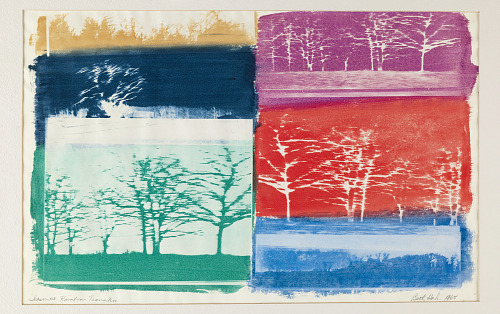
In recent years the Smithsonian Collections Blog has featured numerous posts about women photographers represented in Smithsonian collections. For instance, I’ve blogged about the photographers Katherine Joseph, Dawn Rogala, and Melody Golding, whose work is in the NMAH Archives Center, but now I want to highlight a much earlier Smithsonian effort to celebrate women in photography. The National Museum of American History (then the Museum of History and Technology) featured female photographic artists in a series entitled “Women, Cameras, and Images” in 1969-1970, initiated by Curator of Photography Eugene Ostroff. Although three of these photographers were famous, even legendary, and already included in general histories of photography, two were comparatively unknown at the time. Prints by all five are in the museum’s Photographic History Collection, acquired in conjunction with their exhibitions. This program was an early attempt to emphasize the contributions of women to twentieth-century photography via a series that combined three famous photographers, who utilized standard photographic techniques to achieve their unique personal vision, with two younger, relatively unknown artists who experimented with “obsolete” photographic processes, combined with hand techniques, to interrogate assumptions about the nature of photography. Indeed, Betty Hahn later challenged standard notions about photography (and the nature of her multi-media variations) in the very title of her book, Photography…Or Maybe Not. *

Betty Hahn (b. 1940), "Seasonal Rainbow Transition," gum bichromate with paint on paper, 1968. Photographic History Collection, National Museum of American History.

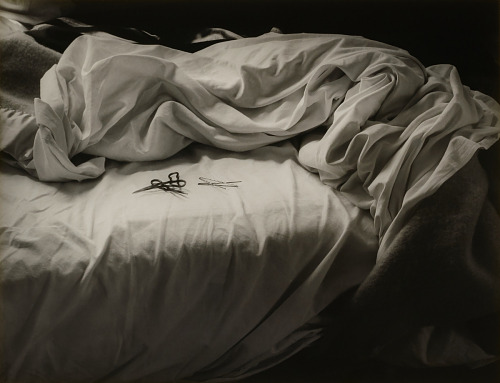
All four exhibitions were accompanied by poster-checklists and formal, if modest, openings. The first show in the series, “Women, Cameras, and Images I,” was a retrospective of Imogen Cunningham’s classic imagery. I well remember her sly humor and witty sarcasm at her opening: she was delightful, and it was especially gratifying for me after my failed attempt to meet her during a trip to San Francisco.

Imogen Cunningham (1882-1976), "Unmade Bed," gelatin silver photographic print, 1957, printed 1957, Smithsonian American Art Museum.

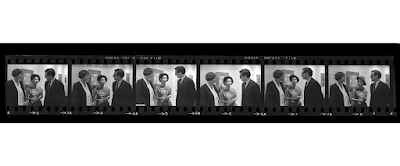
The second exhibition, “Women, Cameras, and Images II,” combined the work of Betty Hahn and Gayle Smalley. I had met Betty in graduate school at Indiana University and vaguely knew Gayle, who had graduated from the Rochester Institute of Technology five years before I had. Their work was very different from that of the other three women, employing radically new approaches to the medium. Hahn was one of the first photographers to experiment with “obsolete” photographic processes, including gum-bichromate, and combined photography with textiles, sometimes adding hand-work, such as paint, needlework and embroidery, which in her words represented a homage to the unsung women who traditionally practiced such stereotypically feminine “crafts.” Independently, Gayle Smalley combined photography with hand printmaking techniques. Hahn’s and Smalley’s prints were colorful, semi-abstract, and often playful and humorous, heavily influenced by contemporary printmaking.        

Above: Gayle Smalley (left) and Betty Hahn (center) talking with Eugene Ostroff at the opening of their exhibition, 1969. Smithsonian photographer unidentified.

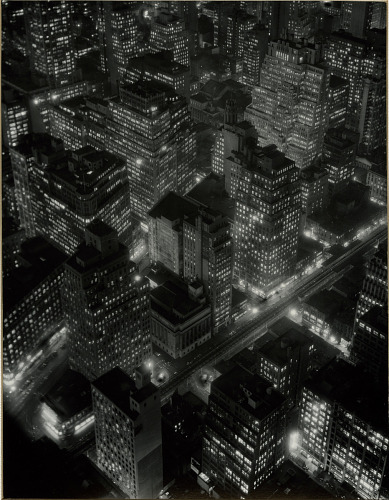
“Women, Cameras, and Images III” was devoted to the work of Berenice Abbott, whose long and influential career ranged from documentation of New York City to the development of techniques for  scientific photography, in which she was an important pioneer. Unfortunately, we lacked funds to bring her to Washington for the opening, and I think she never quite forgave me.


Berenice Abbott (1898-1991), "Night Aerial View, Midtown Manhattan," 1933, gelatin silver print. Photographic History Collection, National  Museum of American History.


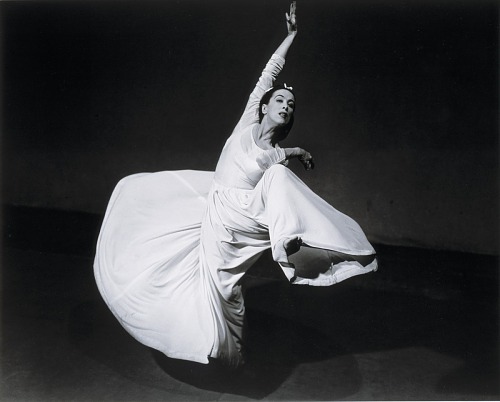
Barbara Morgan was the artist of “Women, Cameras, and Images IV.” Noted for her photographs of Martha Graham’s dancers, a major component of the exhibition, she worried about the design of the show, and explained her concern with rhythm and flow in the placement and sequencing of the framed images. I was tempted to let her develop the layout or collaborate with me, but was warned not to permit her participation lest it delay the opening. It was a nail-biter for me as I hung the show, fearing that she didn’t fully trust my curatorial eye, but I needn’t have worried: she was pleased and pronounced it a huge success, telling me “You got it!” She had been honored previously in a similar retrospective solo exhibition at the Museum of Modern Art, curated by my photo-history mentor, Peter Bunnell, and pronounced my design “better.” At social occasions for several years afterward she proudly introduced me as “the man who hung my Smithsonian show, you know,” and we had a lovely and rewarding friendship.

Barbara Morgan's photographs have been collected not only by NMAH, but also by the Smithsonian American Art Museum (SAAM) and the National Portrait Gallery (NPG). This is also true for the work of Imogen Cunningham and Berenice Abbott. However, NMAH was the first Smithsonian museum to collect and mount exhibitions of their work. 

Barbara Morgan (1900-1992), "Martha Graham--Letter to the World--(Swirl)," 1940, gelatin silver print, printed ca.1980. Smithsonian American Art Museum, gift of Virginia Zabriskie. 

However, the series, which originally was intended to continue for another year, foundered and ended when some photographers objected to being “classified” or identified as “women photographers” within a special series, as if each photographer's work couldn't stand on its own merits. Similarly, I recall hearing certain women criticize the creation of Washington’s National Museum of Women in the Arts for what nowadays some might call bad “optics,” appearing to relegate female artists to a separate category rather than striving to integrate them in greater numbers into existing art museum awareness and practice.

Opinions, perspectives, and tactics intended to promote social change often themselves change with the times and the politics of culture, however. In 1970 we found that for some women photographers, the prospect of inclusion in a series of gendered exhibitions (curated by men) entitled “Women, Cameras, and Images” could be interpreted as more demeaning than celebratory, perhaps suggesting mere tokenism. Controversial “optics!” By contrast, the emphasis on equity in the 2020s has regularly employed group solidarity and separation as a logical, effective tactic to highlight marginalized groups and their members’ individual stories--for example, through Black History Month and Women’s History Month. I recently noticed a current exhibition at Lehigh University entitled “Hear Me Roar: Women Photographers II,” reflecting the similar strategy of the Smithsonian’s “Women, Cameras, and Images” exhibitions of the tumultuous late 1960s. I couldn't help smiling.

David Haberstich, Curator of Photography

Archives Center, National Museum of American History 

Monday, October 18, 2021

DAWN V. ROGALA'S CIRCUS PHOTOGRAPHS: A SMITHSONIAN COLLABORATION

By David Haberstich

October is American Archives Month! I’m celebrating it with this backstory and update to an SI Collections Blog post by former Smith College intern Kira Leinwand, published in late 2019. Kira’s insightful post, emphasizing the cultural dimensions of circus traditions, enthusiastically described some of the fascinating photographs in the NMAH Archives Center’s Dawn V. Rogala Circus Photographs and Papers, also the subject of a book entitled When the Circus Came to Town! An American Tradition in Photographs (Photographs by Dawn V. Rogala; Essays by Dawn V. Rogala,  David E. Haberstich, and Shannon T. Perich). Dr. Rogala, now a paintings conservator at the Smithsonian’s Museum Conservation Institute (MCI), was an amateur photojournalist during the years of her self-assigned circus project. See Kira’s article, "The Traditional, International American Circus."

On October 24 this book was awarded the 2021 Stuart Thayer Prize by the Circus Historical Society, so this is a fitting stimulus to update the story of the collection and the book. Don Covington, president of the society, wrote in an email announcing the award, “The award is presented annually by the Circus Historical Society in recognition of superior documentation of circus history. Your book, ‘When the Circus Came to Town,’ was deemed by the selection committee to be the top entry in a crowded field of competitors.”

Early on, Ginger Minkiewicz of the Smithsonian Institution Scholarly Press expressed interest in publishing a book on Dr. Rogala’s circus photographs. At the same time Dawn was concerned about preserving her photographs from this multi-year project in a suitable repository, and engaged in discussions with Shannon Perich of the NMAH Photographic History in the Division of Work and Industry and myself in the NMAH Archives Center. We both wanted Dawn’s photographs! We easily reached an appropriate compromise. Dawn donated her original negatives, work prints, and related papers from her circus project to the Archives Center, but also prepared a new portfolio of 16” x 20” exhibition-quality prints as a gift to the Photographic History Collection, giving new life to the documentary photographs she had created decades earlier.

Dawn was available to consult on the arrangement of her archive, although it was already in a logical, meaningful order when she delivered it to the Archives Center. I emphasize her role as a congenial consultant, as I know archivists and curators with cautionary tales about allowing donors to “curate” their own collections! Dawn worked with me and Kira Leinwand, answering questions, offering suggestions, and explaining how her working methods as a photographer had informed her decisions about arrangement. Processing was completed by Alison Oswald.

Dawn, Shannon, and I simultaneously embarked on a related collaboration, the creation of the lavishly illustrated scholarly book mentioned above, for which we all wrote essays. Dawn recounted her fascinating experiences in photographing a dozen small traveling circuses over a seven-year period, “embedded” with her subjects in much the same sense that war photographers are said to be embedded with the troops they follow and photograph. Shannon wrote about Dawn’s photographs within the historical context of circus, carnival, and entertainment photographs. As Dawn’s images concentrated on circus people and their behind-the-scenes work and relationships, rather than the spectacle of circus performances as entertainment, I chose to write about her images within the context of “work” photography and its history. Her pictures vividly depict the muscle work of practice and rehearsals, of erecting and dismantling tents, training animals, and the myriad efforts of performers and other workers to create a spectacle for audiences. I also contributed a preliminary finding for the archival collection and other reference material to an appendix in the book. All three of us reviewed each other’s texts, trying to meld them into a cohesive, informative, and entertaining volume. To me, our most rewarding collaboration was the selection, sequencing, and layout of the photographs to be reproduced in the book, conducted by all three of us in several long sessions in conference rooms with large tables. We seemed to be of a single mind, with no significant disagreements.

"Kiss, Carson & Barnes Circus, 1995," by Dawn V. Rogala. Copyright © Dawn V. Rogala. Reproduced with permission. Gelatin silver print, Photographic History Collection, National Museum of American History. 


Ephemera from the Archives Center's Rogala Collection: Route Cards for Kelly Miller Circus and Clyde Beatty-Cole Bros. Circus, 1995.

This archival collection contains a rich trove of information beyond the pictorial documentation, including interviews with circus performers and personnel, memorabilia and colorful ephemera, rare publications, travel itineraries, and related documents. One senses the end of an era, as most of the circuses which Dawn lovingly photographed no longer exist, literally having folded up their tents for the last time.

Our book serves as an extension of Dawn’s circus archive, as it contains her biographical commentary, observations, and fond reminiscences of her travels with the circuses. As a paintings conservator at the Smithsonian’s MCI, she employs the keen analytical eyes she developed as a documentary photographer. She also has to her credit a number of scholarly and scientific books and other publications in her field.

Now here’s the shameless plug: our book, When the Circus Came to Town! An American Tradition in Photographs / Photographs by Dawn V. Rogala, Essays by Dawn V. Rogala, David E. Haberstich, and Shannon T. Perich, is available from the usual sources, and would make a great Christmas/holiday gift!   

David Haberstich, Curator of Photography, Archives Center, National Museum of American History

Friday, March 19, 2021

Spotlight on Women Amateur Photographers, No. 2

 By Pamela Wintle

“The rule seemed to be that a great woman must either die unwed ... or find a still greater man to marry her. ... The great man, on the other hand, could marry where he liked, not being restricted to great women; indeed, it was often found sweet and commendable in him to choose a woman of no sort of greatness at all.”

― Dorothy L. Sayers, Gaudy Night (1935)

Anne Hansen married John V. Hansen, a Danish adventurer and accomplished amateur filmmaker, and fully participated in his journeys to various European countries, the American West, Alaska and Central America. We know that Anne Hansen served as the travel photographer, necessitating her own intrepid spirit and sense of adventure. We don’t know for certain if this is Anne Hansen with the rope tied around her waist, but one can imagine that it is she risking a perilous slide in order to witness a geologic feature. Below this image are two of her photographs from their many other travels.


Grinnel Glacier at fissure, Glacier National Park, Montana, ca. 1942, photograph by Anne Hansen
(John and Anne Hansen Collection, sihsfa_1999_10_op_americanwest_007)


Tikal Guatemala, 1968, photograph by Anne Hansen (John and Anne Hansen Collection, sihsfa_1999_10_mexico037)


Mendenhall Glacier, ca. 1945, Anne Hansen (John and Anne Hansen Collection sihsfa_1999_10_americanwest028)

Pamela Wintle


Monday, March 15, 2021

Spotlight on Women Amateur Photographers, No. 1

By Pamela Wintle 

“Not content with making sandwiches and massaging feet, these women were active both in the field and in post-production. They recorded sound, shot film, edited, wrote, narrated, co-hosted, and co-directed.”  Smithsonian Collections Blog: Women in the frame, March 23, 2010

The Human Studies Film Archives has a number of husband-and-wife collaborations in the collections, but rarely do we know the extent to which “these women” contributed.  However, in a few of these collections we do know that the woman in the team was the main still photographer in addition to many other duties!

These women were usually behind the camera, so photos of them in the field are rare. Thus, although we cannot see her face, we believe from images in the Hassoldt Davis collection that the photographer of the image below is Ruth Diawara (nee Staudinger, also formerly Ruth Rozaffi, Ruth Cadoret, Ruth Davis, and Ruth Schaffner, 1914-1996).  After her death, her personal slides and films documenting travels to Mexico, Papua New Guinea, Fiji, and various African countries were discovered in a Los Angeles storage unit and donated to the Human Studies Film Archives.

    Mount Fuji, 1966, photographer unknown (Ruth Diawara Collection, sihsfa_2013_002_op_003)


    Japan, 1966, photograph by Ruth Diawara (Ruth Diawara Collection, sihsfa_2013_002_op_002)

Pamela Wintle