Smithsonian Collections Blog

Highlighting the hidden treasures from over 2 million collections

Collections Search Center
Showing posts with label National Anthropological Archives. Show all posts

Tuesday, July 19, 2022

The Evolution of Anthropological Research in Documenting Diversity: How Anthropologists Record Human Life


By Muna Ali and Ashley Ray     

Documenting Diversity: How Anthropologists Record Human Life is an exhibit that outlines the ways in which anthropologists have utilized changing technology to record various aspects of human life. The exhibit is organized into four sections: film, photography, paper, and sound. It includes the equipment used for documentation such as rolls of film, video cameras of various ages, wax cylinders, phonographs, and multiple notebooks. The objects shown in the exhibit come from the National Anthropological Archives (NAA) and the Human Studies Film Archive (HSFA), respectively. The NAA is a product of a 1965 merger between the Smithsonian Institution’s Bureau of American Ethnology (1879-1965) and the Department of Anthropology (1883-present). The collection holds anthropological material produced by anthropologists including fieldnotes, journals, manuscripts, correspondence, photographs, maps and more [1]. The NAA contains one of the largest archival collections related to North American archaeology, ethnography, indigenous artwork, and historical photographs in the world. The HSFA, a sister repository to the NAA, was founded in 1975. The HSFA possesses an audiovisual collection that documents the history of filmmaking worldwide, as it relates to anthropology. The documents and equipment included in this exhibit are a key part of tracking the evolution of the study of anthropology through time. One might even say that the documents are a more accurate representation of the attitudes of the researchers rather than the people they are attempting to record. In the following sections, we will explore two examples in which these attitudes are apparent. 

Garson & Read’s Color Swatch 

Underneath the exhibit’s “Documenting on Paper” section, a sample color swatch is displayed prominently across two pages from the 1899 work Notes and Queries on Anthropology by John George Garson (1854-1932) and Charles Hercules Read (1857-1929) [2, 3]. The exhibit designates the color swatch as “a practice borrowed from geology to describe skin, hair, and eye colors” [2]. Similar to the techniques used to classify geological typology, soil compositions, or categorical distinctions based on shared general characteristics, late 19th century anthropologists erroneously figured a scientific typology of humanity could similarly be created, based on variation in color. Both Garson and Read were affiliated with the Royal Anthropological Institute of Great Britain and Ireland, with Read being appointed as the RAI’s President in both 1899 and 1917 [3]. Given anthropology’s complicated history with ascribing meaning to differences in human physical characteristics in the late 19th century (and prior), it’s certainly no surprise that anthropologists who replicated such rhetoric found themselves in positions of intellectual authority.
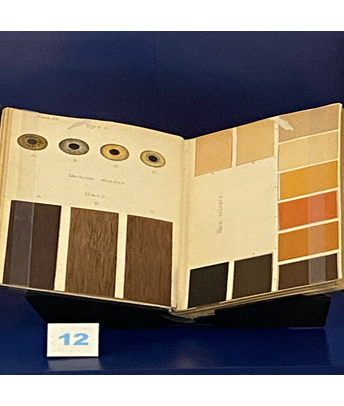
Garson & Read’s color swatch, as depicted in Notes and Queries on Anthropology, Smithsonian Libraries & Archives. 

Critiques of Garson and Read’s color swatch were generally limited to its inability to provide universal descriptors. In the September 1913 edition of a journal titled Folklore, reviewer John H. Weeks even provided suggestions on how to improve the color swatch through “standardise[d]” colors, as “scarcely two men will call an intermediate shade by the same name” [5]. Despite institutionally affiliated anthropologists such as Garson and Read perceiving the color swatch as an intellectual innovation, this exhibit vehemently rejects such attempts to seek meaning in physical differences, declaring “such techniques falsely assumed skin color as a meaningful marker of difference” [7]. The color swatch’s inclusion within the exhibit addresses troubling legacies in anthropology in a compelling manner: the exhibit distances our contemporary understanding of anthropology from harmful conclusions drawn during anthropology of the past, while simultaneously acknowledging that such conclusions are inextricably linked to the field.  

“No. 7 Song with Lacrosse Game” from Menominee Music by Frances Densmore 

In the “Documenting Sound” section, visitors will find a manuscript with marbled edges. The book is opened to a page of sheet music at the top, labeled “No. 7 Song with Lacrosse Game,” followed by an analysis of the notation. The description for this document states that this is a manuscript of “analyses and translations” of songs recorded and translated by ethnomusicologist Frances Densmore (1867-1957). The manuscript, Menominee Music, was published in collaboration with the Bureau of American Ethnology of the Smithsonian Institution in 1932. This book is one of many published by Densmore throughout her career of studying and advocating for the preservation of Native American music [6].  
 

“No. 7 Song with Lacrosse Game” from Menominee Music by Frances Densmore, 1932.
Smithsonian Libraries & Archives

There are many examples of non-Western forms of music that do not have a system for written notation. Instead, these songs are passed down orally, generation by generation, with each adding slight changes to a particular piece [7].  

From a musicological standpoint, there is the question of whether it is even possible to accurately notate Non-Western forms of music using classical Western notation. And perhaps whether one even should. Western musical notation is limited in what it can and cannot represent. It was designed with western instruments in mind and thus lacks the ability to fully accommodate the nuances of other instruments. On top of that, Western music relies largely on major and minor scales while non-Western music utilizes more diatonic and chromatic scales, differs greatly between the two groups [8]. As one composer aptly describes, “The Western system of notation is governed by rigid elementary mathematics inherited from the ancient past,” meaning that the Western system of notation is only ever able to create an imperfect outline, and the nuances of pitch and rhythm must be added in by the performer. Imposing the limiting Western system of notation on other forms of music creates a document that cannot fully capture the intricacies of the original piece [9].  

In summary, though the document has its flaws, that does not mean it is without value. On the contrary, it is more constructive to view this document as a type of translation which is inherently transformative and results in an end-product that cannot be identical to the source material. Documents such as this are valuable in that they offer a glimpse at what music was like at a specific point in time. In addition to that, present-day members of the Menominee Tribe could potentially use this manuscript to recover songs that may have been lost, suppressed, or erased from public consciousness and, more importantly, the community itself. It is the reader’s responsibility to read critically and remember that culture, and music, are dynamic and ever-changing.  

Densmore was able to mitigate weaknesses in her work of the types explored in this section through inclusion of audio recordings in her research. Densmore’s use of both aural and written mediums is an apt example of the ways anthropologists have adapted to emerging technologies so that methodologies are improving as well as the capacity to accurately record human life. 

Anthropology as an Advancing Field 

The thematic structure of the exhibit based on medium—along with its more general focus on technological advancements aiding anthropological fieldwork—presents anthropology to the general public as a constantly transforming field. The selection of objects within the exhibit is particularly effective in conveying this: for instance, in the “Documenting on Film” section, the description for Object 11, a diagram on synchronized sound from 1955, is placed strategically next to object 12, a 1995 Sony camera [4]. Visitors are able to easily envision advancements in recording tools used for fieldwork merely through the two descriptions’ adjacent positions. What’s particularly interesting about the position of these two descriptions is that objects 11 and 12 were used by the same individual, anthropologist John Marshall, exactly forty years apart. This choice allows for the exhibit to portray individual anthropologists and anthropology more broadly as advancing in the wake of major shifts in technology.
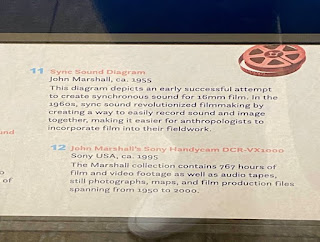
Photo of Exhibit Description, National Museum of Natural History, Smithsonian Institution. 

Overall, the exhibit addresses anthropological discoveries in four mediums: photography, paper, sound, and film. Additionally, on the left side of the hallway, photography, paper, and sound are in one display case, while on the right side, an entire display case is solely dedicated to anthropological film. Given the heightened importance of ethnographic film in anthropological fieldwork, the exhibit’s choice to have film presented separately from the other mediums is certainly advantageous. The choice to separate film from the other anthropological mediums is also indicative of the two repositories mentioned in the exhibit: the National Anthropological Archives and the Human Studies Film Archives. Although the two repositories are closely related to one another, they operate separately. Visitors can envision the physical constraints in having the exhibit spread across two sides of a wide hallway in the context of the separate nature of the two repositories, ultimately complicating the expression of these four mediums as a coherent whole. Regardless of its physical limitations, the exhibit is successful in highlighting changing attitudes and technologies throughout anthropology’s history.

Acknowledgements

Documenting Diversity was co-curated by Diana Marsh, a former NMNH postdoctoral fellow who partook in a three-year long NSF-funded project on NAA collections, and Joshua A. Bell, who serves as NMNH’s Curator of Globalization, Director of the Recovering Voices Program and Acting Director of the National Anthropological Archives. The exhibit was made possible by close collaboration between the NAA, HSFA, Smithsonian Libraries, and Smithsonian Exhibits.


By Muna Ali and Ashley Ray

Natural History Research Experiences (NHRE) Interns
National Anthropological Archives, National Museum of Natural History 


Sources:

[1] “Documenting Diversity,” Smithsonian Libraries and Archives, accessed June 20, 2022, https://library.si.edu/exhibition/documenting-diversity

[2] Erdöl, Das " “Dr. J. G. Garson.” Nature 129 (1932): 931. https://doi.org/10.1038/129931a0 

[3] Balfour, Henry. “Sir Charles Hercules Read, July 6, 1857-February 11, 1929,” Obituaries. Accessed June 2, 2022. https://www.therai.org.uk/archives-and-manuscripts/obituaries/charles-hercules-read 

[4] Bell, Josh and Marsh, Diana. Documenting Diversity: How Anthropologists Record Human Life. Washington: Smithsonian National Museum of Natural History, 2020. https://naturalhistory.si.edu/exhibits/documenting-diversity-how-anthropologists-record-human-life 

[5] Weeks, John H. Folklore 24, no. 3 (1913): 392–97. http://www.jstor.org/stable/1255441

[6] “Frances Densmore (1867-1957).” Smithsonian Institution Archives. 2005. https://siarchives.si.edu/research/sciservwomendensmore.html 

[7] Pasler, Jann. “Sonic Anthropology in 1900: The Challenge of Transcribing Non-Western Music and Language.” Twentieth-Century Music 11, no. 1 (2014): 7–36. doi:10.1017/S1478572213000157. 

[8] Robertson-Wilson, Marian. “The Challenges of Notating Music in General and Coptic Music in Particular: Observations of a Professional Cellist, Composer, and Linguist.” Library of Congress Web. https://www.loc.gov/item/ihas.200156229/

[9] Zon, Bennett. “Music in the Literature of Anthropology from the 1780s to the 1860s.” In Representing Non-Western Music in Nineteenth-Century Britain, NED-New edition., 48–68. Boydell & Brewer, 2007. http://www.jstor.org/stable/10.7722/j.ctt14brrwv.9.


Saturday, May 21, 2022

One Picture is Worth A Thousand Stories

By Adam Gray, May 2022


Rehearsal of the toka dance in Yoohnanan on the island of Tanna, September 1974. Kal Muller films and photographs of Vanuatu (New Hebrides), Tanna Island slides, Slide roll #56.

In the 1960s and 1970s, Vanuatu (then known as the New Hebrides) was on the brink of independence from French and British colonial governance. The culturally and linguistically diverse archipelago in the southwestern Pacific Ocean, with over 100 languages spoken across multiple islands, had been governed as the New Hebrides under a joint French and British “Condominium” administration since 1906. Ni-Vanuatu political resistance, which incorporated expressions of traditional culture into the movement for independence, would go on to achieve independence for the nation in 1980, establishing the Republic of Vanuatu.

The Human Studies Film Archives, part of the National Anthropological Archives (NAA) at the National Museum of Natural History, recently digitized a group of 29,000 photographs taken by photographer and author Kal Muller in the midst of these transformations in Vanuatu society. (1)

The making of the photographs also took place against the backdrop of changes in the tools and methods of anthropology. In the mid-twentieth century, a new generation of relatively portable and inexpensive film and audio equipment, such as the Nagra III tape recorder and Arriflex film cameras, offered anthropologists new opportunities to incorporate photography and film into their research. The establishment of institutions such as the Film Study Center at Harvard University (1957) and the National Anthropological Film Center (1975) at the Smithsonian contributed to the development of “visual anthropology,” an academic discipline that incorporates the production and analysis of images, as well as the study of how people use and produce images, into studies of cultural phenomena.

Muller’s photographs are part of the Kal Muller films and photographs of Vanuatu (New Hebrides), which also contains 15 hours of uncut film footage, over 50 sound recordings, and a small amount of correspondence. (These portions of the collection are not digitized.) The collection will be of interest to Ni-Vanuatu communities interested in their history, traditions, and local knowledge, and will prompt discussions about the history and theory of visual anthropology.

A group of women and girls, possibly in Lendombwey village, island of Malekula, in December 1968. The photograph appears to show the production of one of the sound recordings in the collection. Kal Muller films and photographs of Vanuatu (New Hebrides), Vanuatu slides, Slide roll #147.

Kalman “Kal” Muller, a photographer and author with an interest in anthropology, spent several years during the late 1960s and early 1970s living with and photographing communities on several islands of what is now the Republic of Vanuatu. Though he did not have the formal training of an academic anthropologist, Muller’s skill as a photographer, along with ties he developed with local communities, brought him into contact with some of the people and institutions that played key roles in promoting the use of film in ethnographic research: Muller collaborated with American anthropologist and filmmaker Robert Gardner (1925 – 2014) and the Harvard Film Study Center to film the naghol (in Bislama; land dive, in English) carried out by the Bunlap community on Pentecost Island, resulting in the film Land-Divers of Melanesia (1972). He also received support from the National Anthropological Film Center. The Film Center, which in 1981 was relocated within the National Museum of Natural History and renamed the Human Studies Film Archives, acquired Muller’s photographs and films shortly after they were made. (2)  In 2019, the Archives acquired an additional group of Muller’s photographs from the Harvard Peabody Museum, now incorporated with the previous acquisition.

Cinematographer (possibly Muller) films a group of men, possibly in Lendombwey village, island of Malekula, in January 1969. In correspondence from December 1968, Muller states that he was in Lendombwey village, island of Malekula, filming men in a grade-taking ceremony, and this image may relate to those events. Kal Muller films and photographs of Vanuatu (New Hebrides), Vanuatu slides, Slide roll #180.

In the years since Muller made these photographs, anthropologists--as well as archives and museums that hold knowledge created by and about indigenous communities--have re-examined the assumptions, concepts, and power dynamics intertwined with the production of anthropological images. Photographs don’t just provide evidence of cultural phenomena; they provide a means of exploring questions of memory, history, and interpretation. Like other materials found in archives, they can be valuable resources for cultural sustainability and community-based research activities. One photograph can be used to tell a thousand stories. 

The photographs Muller created during his time in Vanuatu, alongside the films, sound recordings, correspondence, and other documents in this collection, form a complex and voluminous group of images that hold complex layers of information and value. As in other archival collections, the different components speak to each other: correspondence between Muller and E. Richard Sorenson, the inaugural director of the National Anthropological Film Center, points to the interplay between individuals, institutions, and local communities which resulted in the production of the films and photographs; the films contain footage that would be edited into Land-Divers of Melanesia; the photographs show expressions of Ni-Vanuatu heritage, images of western filmmakers and anthropologists shooting film and recording sound, as well as urban and festival scenes in Vanuatu shortly before independence, making them records of the diversity of Ni-Vanuatu culture and of anthropologists’ attempts to represent that diversity.

Men construct a tower for the naghol (land dive), likely in Bunlap, South Pentecost, Pentecost Island, October 1968. Kal Muller films and photographs of Vanuatu (New Hebrides), Vanuatu slides, Slide roll #15.

Before putting the digitized photographs online, the NAA reviewed them to identify culturally sensitive content in order to prevent such images from being made public. As it does with all of its collections, the NAA extends an open-invitation to individuals and communities represented in the NAA to engage in collaborative efforts to improve how it describes and stewards those materials. The NAA looks forward to the conversations that the digitization of these images will enable.

The finding aid for the Kal Muller films and photographs of Vanuatu (New Hebrides), along with the digitized photographs can be found here. To learn how you can access parts of the collection that have not been digitized, get in touch with an archivist at hsfa@si.edu.

Notes:

(1) As Muller himself can be seen in some of the images, apparently at least one other person took some of the photographs; unfortunately, the NAA has not been able to identify the additional photographer(s).

(2) Muller also worked with the Film Center in an effort to produce films and photographs of religious ceremonies practiced by the Huichol of San Andres Coamiata, Jalisco, Mexico. The resulting materials are also held by the Human Studies Film Archives. Former Smithsonian Department of Anthropology Graduate Fellow José Carlos Pons Ballesteros has written an informative series of blog posts about his research with that collection here.

Sources Consulted:

“About.” The Film Study Center at Harvard University, Accessed April 26, 2022. https://filmstudycenter.fas.harvard.edu/about/.

Chio, Jenny. “Visual anthropology.” Cambridge Encyclopedia of Anthropology (2021). DOI: http://doi.org/10.29164/21visual

Foster, S. and Adams, Ron. "Vanuatu." Encyclopedia Britannica, March 10, 2021. https://www.britannica.com/place/Vanuatu.

“The History of ARRI in a Century of Cinema.” ARRI, Accessed May 12, 2022. https://www.arri.com/news-en/the-history-of-arri-in-a-century-of-cinema

“History of the Film Archives.” National Anthropological Archives, Accessed April 20, 2022. https://web.archive.org/web/20001022013618/http://www.nmnh.si.edu/naa/guide/film_history.htm

Jolly, Margaret. “Custom and the Way of the Land: Past and Present in Vanuatu and Fiji.” Oceania 62, no.4 (June 1992): 330-354. https://www.jstor.org/stable/40332509

“Nagra III.” Nagra Audio, Accessed May 12, 2022. https://www.nagraaudio.com/product/nagra-iii/

Ruby, Jay. "The Professionalization of Visual Anthropology in the United States: The 1960s and 1970s." Visual Anthropology Review 17, no. 2 (2001): 5-12. DOI: https://doi.org/10.1525/var.2001.17.2.5

Schäuble, Michaela. "Visual anthropology." The International Encyclopedia of Anthropology (2018): 1-21. DOI: 10.1002/9781118924396.wbiea1969


By Adam Gray, Contractor, Human Studies Film Archives

Submitted by Daisy Njoku, Anthropology Archives, National Museum of Natural History


Thursday, April 1, 2021

New Virtual Finding Aids for Three Smithsonian Institution Anthropology Collections

By Katherine Christensen

In addition to collections which were maintained and donated by individual scientists, the National Anthropological Archives (NAA) holds collections created and maintained by anthropology departments and divisions within the Smithsonian Institution and for projects conducted by those departments. This post covers three of those collections, whose finding aids have recently been made available through the Smithsonian Online Virtual Archives (SOVA).


The Department of Anthropology records

Staff of the Department of Anthropology, United States National Museum, 1904, standing in front of the Arts and Industries Building. Standing from left to right: Edwin H. Hawley, G. C. Maynard, Alěs Hrdlička, Thomas W. Sweeney, Walter Hough, H. W. Hendley, Richard A. Allen, E. P. Upham, Paul Beckwith, Immanuel M. Casanowicz, and J. Palmer. Seated from left to right: Miss Malone and Miss Louisa A. Rosenbusch. SIA-NAA-42012-000002 Smithsonian Institution Archives.

There have been a number of incarnations of the Department of Anthropology through the years as the Smithsonian Institution and its component museums restructured. These include the Section of Ethnology of the Smithsonian Institution, the Division of Anthropology of the United States National Museum, the Office of Anthropology of the National Museum of Natural History, and the Department of Anthropology of the National Museum of Natural History. This collection holds papers and photographs generated by the department and its members in each of these forms.


Staff of the Department of Anthropology, National Museum of Natural History (NMNH), 1931. Seated (L. to R.): T. Dale Stewart, Frank M. Setzler, Neil M. Judd, Walter Hough, Aleš Hrdlička, Herbert W. Krieger, Henry B. Collins. Standing (L. to R.): Charles Terry, William H. Short, Richard A. Allen, George D. McCoy, William H. Egberts, Richard G. Paine, W. H. Bray, Leta B. Loos, and Helen E. Heckler. SIA-MNH-18107A, Smithsonian Institution Archives.

The department was originally focused primarily on collections care and fieldwork as a means of growing the collections, while research was conducted by the Bureau of American Ethnology (BAE). In the 1950s the department shifted to a greater emphasis on research, leading to a merge with the BAE in 1965 in order to eliminate redundancy.1 The Department of Anthropology collection holds some archival materials related to the BAE, such as documents from the River Basin Surveys, but the majority of the BAE’s materials are housed within the Bureau of American Ethnology records.


Staff of the Department of Anthropology, National Museum of Natural History (NMNH), October 29, 1959. Top row (left to right): Saul Reisenberg, Cliff Evans, Robert A. Elder, George Metcalf(?), Joseph Andrews, and unidentified man; second row (left to right): Neil Judd, Eugene Knez, Robert G. Jenkins, G. Robert Lewis, George Phebus (?), and Gus Van Beek (?) ; third row (left to right): Gordon Gibson, T. Dale Stewart, unidentified man, unidentified man, and Waldo Wedel; and bottom row (left to right): Willie Mae Pelham, Jeraldine M. Whitmore, unidentified woman, unidentified woman, Mildred Wedel (?), and Betty Meggers. Smithsonian Institution Archives.

The collection primarily contains institutional records, rather than records of the research conducted by the department’s members. The papers of many members of the department through its long history have been transferred to the NAA, so there are numerous other collections2 which contain materials relating to the activities of the department. There are additional departmental materials in the Smithsonian Institution Archives.


Staff of the Department of Anthropology, National Museum of Natural History (NMNH), 2007. Top row (left to right): Chris Dudar, Bill Billeck, Doug Ubelaker, Mike Frank, Randal Scott, Eric Hollinger, Christopher Parker, Bruno Froilich, Sarah Zabriskie, and Dave Hunt; second row (left to right):  Kim Neutzling, Gail Solomon, Carrie Beauchamp, Bob Laughlin, Mary Jo Arnoldi, Lynn Snyder, Paulina Ledergerber-Crespo, Ron Bishop, Jim Krakker, Rob Leopold, and Dave Rosenthal; third row (left to right): Bruce Bernstein, Cheri Botic, Bill Crocker, Nancy Shorey, Pam Wintle, Stephanie Christensen, Jai Alterman, Jim Blackman, and Don Ortner; fourth row (left to right): Georgia O’Reilly, Bill Fitzhugh, Cindy Wilczak, Noel Broadbent, Paul Michael Taylor, Vyrtis Thomas, unidentified woman, Lorain Wang, Daisy Njoku, Christie Leece, Roy (Chip) Clark, and Mark White; fifth row (left to right): Don Tenoso, Ruth Selig, unidentified woman, Cesare Marino, P. Ann Kaupp, Carmen Eyzaguirre, unidentified man, and Jim Haug; sixth row (left to right):  Kari Bruwelhide, Paula Cardwell, Betty Meggers, Bill Merrill, and Stephen Loring; seventh row (left to right): Jane Walsh, Barbara Watanabe, Laurie Burgess, Ruth Saunders, Candace Greene, and Risa Arbolino; eighth row (left to right): Doug Owsley, Jake Homiak, Dennis Stanford, Letitia Rorie, Rick Potts, Jennifer Clark, and Carole Lee Kin; and ninth row (left to right): Erica Jones, Dan Rogers, Deloris Walker, Peggy Jodry, Zee Payne, JoAllyn Archambault, Joanna Scherer, and Felicia Pickering.


The Center for the Study of Man records

The Center for the Study of Man (CSM) was created in 1968 to apply anthropological knowledge to problems facing all mankind. In pursuit of this goal, the CSM organized meetings of established anthropologists with specific programs and brought researchers together into special task forces. The center additionally headed a number of programs, including an Urgent Anthropology Program (which granted funds to facilitate field work in and accumulate data on cultures that were rapidly changing under the pressure of modernization), an American Indian Program (which sought both to create the Handbook of North American Indians and to undertake action anthropology projects in conjunction with various Native American groups), the Research Institute on Immigration and Ethnic Studies (RIIES), and the National Anthropological Film Center (now the Human Studies Film Archive). The center also sought to create a Museum of Man, which would host exhibits devoted to anthropology and ecology. However, due to internal disagreements over the aims of this museum, the project was never approved. Beginning in 1976, the CSM was slowly phased out due to difficulties with funding and with melding the research goals of individual staff members with those of the center as a whole.


Center for the Study of Man meeting, May 19, 1970. From left to right: William C. Sturtevant, Robert M. Laughlin, Sol Tax, Sam Stanley, Mysore N. Srinivas, Douglas W. Schwartz, T. Dale Stewart, Fredrik Barth, Wilcomb E. Washburn, Laila Shukry El Hamamsy, George W. Stocking Jr., Surajit C. Sinha, Gordon D. Gibson, and Henry B. Collins. Center for the Study of Man records, Sam Stanley papers, Box 141.

The records of the CSM document several international CSM-sponsored conferences, including a planning meeting in Cairo in 1972, several pre-session conferences (on cannabis, alcohol, population, and the transmission of culture) at the Ninth International Congress of Anthropological and Ethnological Sciences in 1973, and a 1974 meeting at Bucharest on the cultural implications of population change. They also include records concerning an attempt to issue a series of monographs and the organization of special task forces concerned with questions of human fertility and the environment. Additionally, there is material pertaining to the action anthropology projects with Native Americans, focusing on economic development and including material relating to the coordination of studies of specific tribes carried out with funds from the Economic Development Administration and economic development consulting for the American Indian Policy Review Commission.


The Tulamniu CWA Project records


Beginning first cross trench north village midden mound. Tulamniu C.W.A. Project records, National Anthropological Archives, Smithsonian Institution.

As part of his recovery plan for the Great Depression, Franklin D. Roosevelt created a variety of agencies whose goal was to provide work to the unemployed. Under the auspices of one of these, the Civil Works Administration (CWA), the Smithsonian Institution sponsored a number of archaeological excavations around the United States. One of these, during the winter of 1933-1934, excavated four sites searching for the historic Tulamni Yokuts village of Tulamniu in Kern County, California.


Beginning survey baseline first trench. Tulamniu C.W.A. Project records, National Anthropological Archives, Smithsonian Institution.

The project was headed by William Duncan Strong (whose papers were previously profiled on this blog) and recovered thousands of artifacts and, in keeping with the practices of the time period, many Native American burials. These artifacts and remains were shipped to the United States National Museum for study after the excavations were complete. The Smithsonian Institution began repatriations to U.S. tribes in 1982 and, in 2013, collections from the project were repatriated jointly to the Tule River Indian Tribe and the Santa Rosa Rancheria of Tachi Yokuts Indians; they were reburied at the Tule River Indian Reservation.3


Closeup of first trench in north village midden mound. Tulamniu C.W.A. Project records, National Anthropological Archives, Smithsonian Institution.

The collection primarily contains correspondence, the field notes of the archaeologists, catalogs, maps, and charts.


Katherine Christensen
Contract Archivist
National Anthropological Archives
____________________________

1 For more information, see https://naturalhistory.si.edu/sites/default/files/media/file/history-anthropology-si_0.pdf

2 Some notable collections include the Betty J. Meggers and Clifford Evans papers, the Aleš Hrdlička papers, the Priscilla Reining papers, the Ralph S. and Rose L. Solecki papers, the Thomas Dale Stewart papers, the Matthew Williams Stirling and Marion Stirling Pugh papers, and the William C. Sturtevant papers.

3 See Repatriation Office Case Report Summaries California Region for more information. Accessed November 2, 2020. https://naturalhistory.si.edu/sites/default/files/media/file/case-reports-california-region-rev2-2020.pdf


Monday, December 7, 2020

Anthropology’s Neighboring Fields: New Virtual Finding Aids for Three NAA Collections

The National Anthropological Archives (NAA) primarily contains the papers of anthropologists, archaeologists, and anthropological societies and institutions. However, there are other disciplines that are connected to anthropology and its work, and these disciplines are also reflected in the NAA’s collections. Today I want to highlight the collections of a geologist (Richard LeRoy Hay), a paleobotanist (C. Earle Smith Jr.), and an animal behaviorist (Richard Lynch Garner).


Richard LeRoy Hay (1926-2006)

Richard LeRoy Hay was a geologist who was best known for his contributions to the fields of sedimentary petrography and archaeological geology. Hay worked with Mary Leakey, a celebrated paleontologist, and her husband, Louis Leakey, on their excavations at Olduvai Gorge and Laetoli in Tanzania. The geological framework that he provided for their excavations helped to place their discoveries into a chronological context.

Annotated photographs of Olduvai. The Richard L. Hay papers, National Anthropological Archives, Smithsonian Institution.

Hay earned his B.S. and M.S. in geology from Northwestern University and his Ph.D. from Princeton University. He served in the US Army Corps of Engineers (1952-1954) and worked for the US Geological Survey (1954-1955) prior to moving into academia. He then taught at Louisiana State University, Baton Rouge (1955-1957); the University of California, Berkeley (1957-1983); the University of Illinois, Urbana (1983-1997), where he was the Ralph E. Grim Professor of Geology; and the University of Arizona, Tucson (1998-2006). He made his first trip to Olduvai Gorge in 1962, when he was at the University of California, Berkeley.

Though he performed geological fieldwork in many other locations, he is best known for his work at Olduvai Gorge and Laetoli because of the paleontological importance of the finds at these locations. Olduvai Gorge has provided the longest continuous known record of human evolution and the development of stone-tool industries.1 In Laetoli, Hay performed a geological analysis of the tuff where a trail of roughly 70 footprints were found. The footprints are believed to have been made by Australopithecus afarensis and provide evidence of the evolution of humans by providing information about the shape of the foot and the development of bipedal movement.2

Annotated photographs of Olduvai. The Richard L. Hay papers, National Anthropological Archives, Smithsonian Institution.

Hay published frequently on Olduvai Gorge, and his detailed study of the geologic history of Olduvai, Geology of the Olduvai Gorge (1976), was his most significant publication. He also published on his work at Laetoli, coauthoring “Pliocene Footprints in the Laetoli Beds at Laetoli, Northern Tanzania” (1979) and “The Fossil Footprints of Laetoli” (1982) with Mary Leakey.

Hay was a fellow of the Geological Society of America, the American Association for the Advancement of Science, and the California Academy of Sciences. His work was celebrated in his lifetime, earning him the Geological Society of America’s Kirk Bryan Award in 1978, the Rip Rapp Archeological Geology Award in 2000, and the Leakey Foundation’s Leakey Prize, for intellectual achievement in the field of human evolution, in 2001. His collection is of moderate size, comprised of 25 boxes, and contains correspondence, field notebooks, maps, photographs, data, and documentation of geological specimens.


C. Earle Smith Jr. (1922-1987)

C. Earle Smith Jr. trained in economic botany, which is the study of the relationship between plants and people, at Harvard University, earning his B.A. in 1949, his M.A. in 1951, and his Ph.D. in 1953. He went on to study this relationship between people and plants in an archaeological context, becoming one of the founders of the modern field of archaeobotany.

His research focused on archaeologically recovered plant remains and their usage by humans, studying the early domestication and distribution of corn, cotton, avocado, and beans. His first discovery in this field occurred while he was still an undergraduate, when he discovered the earliest remains of corn found to that point with fellow student Herbert Dick at Bat Cave, New Mexico, in 1948. He continued to pursue his archaeobotanical studies by serving as the botanist at archaeological excavations in Latin America, working primarily in Mexico and Peru.

Photograph of botanical samples from Tehuacan. The C. Earle Smith Jr. papers, National Anthropological Archives, Smithsonian Institution.

In addition to his ethnobotanical fieldwork in the Yucatán, Panama, the United States, Europe, Southeast Asia, Africa, the Pacific, and Australia, Smith worked at a variety of institutions throughout the United States. He was an assistant curator of botany at the Academy of Natural Sciences of Philadelphia and acting director of the Taylor Memorial Arboretum (1953-1958); a curator of botany at the Field Museum of Natural History (1959-1961); the Senior Research Botanist for the Agricultural Research Service at the U.S. Department of Agriculture (1962-1969); on the faculty in anthropology and biology departments at the University of Alabama (1970-1987), serving as the acting chair of anthropology department (1981-1986); and the President of the Society for Economic Botany (1979). His collection is comprised of 21 boxes and contains correspondence, research notes, data, manuscripts, publications, and photographs.


Richard Lynch Garner (1848-1920)

Richard Lynch Garner was a self-taught zoologist from southwest Virginia. He studied primate behavior, analyzing the vocal communication of apes. He made sound recordings in zoos starting in 1884, moving on to study apes in their natural habitat in the Ogawai River region in 1892. He asserted that he was able to understand the languages of apes and that he could teach them to speak human languages.3 He brought apes back to America to exhibit them in a travelling show, claiming that he was able to communicate with a chimpanzee named Susie.

Richard Lynch Garner performing studies with a child and a chimpanzee. Richard Lynch Garner papers, National Anthropological Archives, Smithsonian Institution.

Garner expanded his studies to observe general primate behavior, spending time in an elevated cage within an area inhabited by chimpanzees and gorillas. His collection also contains his observations about the local people and their customs which he made during his trips to Africa. Garner “saw himself as a defender of paternal southern views of race from northerners and from Christian missionaries”4 and the observations he made in Gabon reflect this perspective.

Garner is a slightly different kettle of fish than Hay and Smith, as his studies did not meet modern standards or methods and many of his conclusions have proven false. Even during his lifetime, he was denigrated by the professional scientific community.5 However, his papers provide a glimpse into early evolutionary study and the colonialist and racially biased outlook which influenced scientific thinkers of his time. Garner’s influence on the academic community is evidenced by the route through which his papers reached the NAA. They were originally in the possession of J. P. Harrington, a noted linguist, whose interest in Garner’s work prompted him to write a biography of the scientist. The collection is quite small, consisting of only five boxes, and contains a diary, correspondence, manuscripts, poetry, data, financial and legal records, maps, biographical material, artwork, and photographs.


Katherine Christensen

Contract Archivist, National Anthropological Archives

_____________________________

1 “Olduvai Gorge,” Encyclopedia Britannica, accessed November 5, 2020, https://www.britannica.com/place/Olduvai-Gorge

2 “Laetoli Footprint Trails,” Smithsonian National Museum of Natural History, accessed November 5, 2020, https://humanorigins.si.edu/evidence/behavior/footprints/laetoli-footprint-trails

3 “Missing Links,” University of Georgia Press, accessed November 18, 2020, https://ugapress.org/book/9780820340609/missing-links/

4 Rich, Jeremy. “Heresy Is the Only True Religion: Richard Lynch Garner (1848–1920), A Southern Freethinker in Africa and America.” The Journal of the Gilded Age and Progressive Era, 12, No. 1 (January 2013): 65-94.

5 “Missing Links,” University of Georgia Press, accessed November 18, 2020, https://ugapress.org/book/9780820340609/missing-links/

Monday, November 16, 2020

New Virtual Finding Aids for Two Linguistic Anthropology Collections

Linguistic Anthropology is the study of the effects of communication—in all its diversity and forms—on society and whether differences in language and its usage relate to differences in the way the world is perceived and understood.1 The two anthropologists discussed in this blogpost whose materials are at the National Anthropological Archive studied different aspects of communication. Garrick Mallery focused on sign language and pictorial representations, while William A. Smalley focused on the written language.

Garrick Mallery (1831-1894)

Pen & ink drawings of Native American sign language prepared for use in the BAE 1st Annual Report (1879-1880), MS 2372 Garrick Mallery Collection on Sign Language and Pictography, National Anthropological Archives, Smithsonian Institution.

Garrick Mallery pioneered the study of sign language and pictographs. He developed an interest in Native American sign language and pictography while serving in the Union Army during the Civil War and was one of the first ethnologists to join the Bureau of American Ethnology in 1879. Under the BAE’s auspices, he collected and examined sign language vocabulary from Native American groups throughout the U.S. and Canada. He additionally related the Native American sign language he documented to examples from the wider world, both of hearing individuals and the deaf.

Plate of Neapolitan gestures prepared for use in the BAE 1st Annual Report (1879-1880), MS 2372 Garrick Mallery Collection on Sign Language and Pictography, National Anthropological Archives, Smithsonian Institution.

Mallery completed several publications on the topic of Native American sign language throughout the 1880s, notably Introduction to the Study of Sign language Among the North American Indians (1880), A Collection of Gesture- Signs and Signals of the North American Indians (1880), and "Sign-language among North American Indians Compared with that Among other People and Deaf-mutes," which appeared in the BAE 1st Annual Report (1881). Many of these publications (some annotated by collaborators) are included in MS 2372 Garrick Mallery Collection on Sign Language and Pictography.

Although he is most widely known for his work with sign language, he also performed extensive research into Native American pictography, with a particular interest in Dakota and Lakota winter counts and petroglyphs (examples of winter counts and copies of petroglyphs are included within the collection).

Battiste Good’s Winter Count (page 19), MS 2372 Garrick Mallery Collection on Sign Language and Pictography, National Anthropological Archives, Smithsonian Institution.

William Smalley (1923-1997)

Like Chris Gjording, whom I discussed in my last blog entry, Smalley coupled anthropology with Christian ministry. The child of missionaries, he was born in Jerusalem in 1923. He developed an interest in anthropology while an undergraduate at Houghton College because he felt that was relevant to missionary work. He attended the Missionary Training Institute (1945-1946), the Summer Institute of Linguistics (SIL) at the University of Oklahoma (1946-1947) for training in linguistics for Bible translation, and Columbia University’s graduate program in anthropology with a concentration in linguistics. Smalley worked on language analysis problems in the southern region of Vietnam when he was sent there by the Christian and Missionary Alliance in 1950. After Vietnam, he was sent to Luang Prabang, Laos, in 1951. While in Laos, Smalley developed the Hmong Romanized Popular Alphabet (RPA) with Reverend G. Linwood Barney and Father Yves Bertrais. He and his wife returned to the United States when civil war broke out in Laos in 1954. His dissertation focused on his work on the Khmu’ language and he received his doctorate from Columbia in 1956. His dissertation was later published, in abbreviated form, in 1961 as Outline of Khmu' Structure.

Sayaboury Script. The William A. Smalley papers, National Anthropological Archives, Smithsonian Institution.

His work with the Hmong language continued after he became a professor of linguistics at Bethel University in 1978 and found the large Hmong community in the Twin Cities. He studied the adaptation of the Hmong to life in America with the University of Minnesota Southeast Asia Refugee Studies Program, publishing "Adaptive Language Strategies of the Hmong: From Asian Mountains to American Ghettos" (1985) and "Stages of Hmong Cultural Adaptation" (1986). Smalley also continued his study of the Hmong written language, as new scripts had been developed since his participation in the creation of RPA (such as Sayaboury Script, pictured above). He was particularly interested in the Pahwah script, which had been created by Shong Lue Yang in Laos. In addition to studying the script, he studied its creator, and published two books on the subject: Mother of Writing: The Origin and Development of a Hmong Messianic Script (1990) and The Life of Shong Lue Yang: Hmong "Mother of Writing" (1990), both of which he co-authored with Chia Koua Vang and Gnia Yee Yang.

Smalley also studied the languages and dialects of Thailand. He lived in Thailand from 1962 to 1967 and from 1969 to 1972 while working as a translation consultant for the American Bible Society and as a translations coordinator and consultant for the United Bible Societies. He later returned to Thailand as a Fulbright research fellow in 1985 and 1986. He published Linguistic Diversity and National Unity: Language Ecology in Thailand (1994); "Thailand's Hierarchy of Multilingualism" (1988); and "Language and Power: Evolution of Thailand's Multilingualism" (1996) as a result of his work there.

________________________

1 “Linguistic anthropology,” Encyclopedia Britannica, accessed September 2, 2020, https://www.britannica.com/science/anthropology/Linguistic-anthropology.


Katherine Christensen

Contract Archivist, National Anthropological Archives


Friday, October 16, 2020

New Virtual Finding Aids for Three 20th Century Cultural Anthropology Collections


In my last post, I told you about two biological anthropologists whose papers are in the National Anthropological Archives whose finding aids have recently become available on SOVA. This time around, I will tell you about three cultural anthropologists. All funding for the legacy finding aids project was provided by the Smithsonian Collections Information (CIS) pool.

Chris Gjording (1943-1993)

Chris Gjording. The Chris Gjording papers, National Anthropological Archives, Smithsonian Institution.

Chris Gjording was an anthropologist and Jesuit priest who worked in Central America in the last two decades of the 20th century. Prior to gaining his M.A. (1978) and Ph.D. (1985) in social and cultural anthropology from the New School for Social Research, he taught philosophy and liberation theory at Gonzaga University (1973-1975). Gjording was strongly influenced by liberation theology, which was a movement that arose in the Roman Catholic church in Latin America and stressed aiding the poor by improving the socioeconomic structures that oppressed them.1 As a result, his work was focused on the poor in Central America and the social and political climate which surrounded them. For his dissertation, he studied the Guaymí people and the transnational Cerro Colorado mining project on their lands in Chiriquí, Panama. A revised version of his dissertation was published under the title Conditions Not of Their Choosing: The Guaymí Indians and Mining Multinationals in Panama by the Smithsonian Institution Press in 1991. He also visited and documented the conditions in Guatemalan Indian refugee camps in Los Lirios and Maya Balam in Quintana Roo, Mexico, and wrote articles for a Spanish language bimonthly newsletter focused on the social, economic, and political situation in Honduras called Informaciones. His papers document his research and activities in Central America.

Marvin Harris (1927-2001)


Marvin Harris lecturing. The Marvin Harris papers, National Anthropological Archives, Smithsonian Institution.

Marvin Harris was one of the major anthropologists of the 20th century who is best known for developing the concept of cultural materialism. Harris described this paradigm as a scientific research strategy “based on the simple premise that human social life is a response to the practical problems of earthly existence”2 in his 1979 book Cultural Materialism. He applied this research method to taboos, food preferences, and family and social structures, arguing that the Aztecs practiced cannibalism due to a protein deficiency and that Yanomami warfare was caused by the pursuit of animal protein. Some of his arguments were controversial, such as his belief that the Hindu religion’s prohibition against the consumption of beef was based on the economic usefulness of cows as draft animals. He also focused on the difference between emic and etic refers to analysis of a culture by perspectives. In social sciences, emic someone participating in that culture3, while etic refers to analysis by someone outside the culture4. He used video as a method of etic analysis, studying families in their home environment during the late 1960s and early 1970s. 
 
Harris authored several important books in the field of anthropology (The Rise of Anthropological Theory and Cultural Materialism: The Struggle for a Science of Culture), as well as several books which reached a wider, non-academic audience (Cows, Pigs, Wars and Witches and Cannibals and Kings). While he was on the faculty of Columbia University (where he had studied, earning his B.A. in 1948 and his Ph.D. in 1953, and taught from 1953 to 1980), he was active in the anti-war movement, serving as vice-chairman of Vietnam Facts, helping to organize the Ad Hoc Teaching Committee on Vietnam, organizing a symposium with Morton Fried and Robert Murphy at the American Anthropological Association’s annual meeting in 1967 which led to the publication of War: The Anthropology of Armed Conflict and Aggression (1968), and openly siding with the students during the 1968 Columbia student uprising. After his time at Columbia, he served as a Graduate Research Professor at the University of Florida (1980-2000).

Anthony Leeds (1925-1989)


Page from Anthony Leeds’ scrapbook with photographs from Salvador. Anthony Leeds papers, National Anthropological Archives, Smithsonian Institution.

Anthony Leeds studied at Columbia at the same time as Marvin Harris, receiving his B.A. in 1949 and his Ph.D. in 1957. His main focus as an anthropologist was urban development, although his papers at the NAA include research in rural areas as well. Like Gjording, Leeds was interested in the social, economic, and political situation in Latin America and he analyzed these factors in cacao production in the Bahia region of Brazil for his dissertation: “Economic Cycles in Brazil: The Persistence of a Total-Cultural Pattern: Cacao and Other Cases.” He studied the social and political cultures of squatter settlements in Rio de Janeiro, São Paulo, Bogotá, Lima, and Santiago de Chile. With funding from the Social Science Research Council and the Ford Foundation, he studied twelve favelas (Brazilian slums5) in Rio de Janeiro from 1965 to 1966, organizing Peace Corps volunteers, academics, and favela residents to collect data. 

Leeds also taught at a number of colleges and universities: Hofstra University and City College in New York City from 1956 to 1961, the University of Texas-Austin from 1963 to 1972, and Boston University from 1973 to 1989. While at Boston University, he served as an active mentor to many of his students.

____________________________________

1“Liberation Theology,” Encyclopedia Britannica, accessed May 1, 2020, https://www.britannica.com/topic/liberation-theology.

2 Harris, Marvin. Cultural Materialism: The Struggle for a Science of Culture. (New York: Random House, 1979), xv.

3“Emic,” Merriam Webster Dictionary, accessed May 1, 2020, https://www.merriam-webster.com/dictionary/emic.

4“Etic,” Merriam Webster Dictionary, accessed May 1, 2020, https://www.merriam-webster.com/dictionary/etic.

5“Favela,” Merriam Webster Dictionary, accessed September 28, 2020, https://www.britannica.com/topic/favela.


Katherine Christensen
Contract Archivist, National Anthropological Archives