Smithsonian Collections Blog

Highlighting the hidden treasures from over 2 million collections

Collections Search Center
Showing posts with label National Portrait Gallery. Show all posts

Monday, June 29, 2020

Anders Zorn: Swedish Superstar and American Idol

Zorn’s self-portrait appears on the cover of the  brochure for a 
memorial exhibition that traveled the United States in 1925.  

“Special Exhibition of Oil Paintings and Water Colors by Anders Zorn.” 
Grand Central Art Galleries. Carnegie Institute, 
Museum of Art records, 1883-1962, bulk 1885-1940, Series 3: 
Exhibitions, Box 204, Folder 23: Zorn, Anders L., 1924-1925, 
Archives of American Art, Smithsonian Institution.
The year 2020 marks the centennial of the death of Swedish painter Anders Zorn (1860–1920). While he may no longer be a household name, at the time of his death at the age of sixty, Zorn was a world-renowned painter and etcher—highly sought after for portrait commissions not only throughout Europe but also across the United States. His sitters included three U.S. presidents, industrialists Andrew Carnegie and Robert Brookings, and countless other high society figures. Several days after his death was announced in the U.S. press, the New York Times ran a piece on Zorn noting: “Those who noticed the death of the Swedish artist Anders Zorn felt . . . a shock which may be taken as a measure of his significance in art.” [i]


Whereas Zorn’s friends and admirers in the United States were stunned by his death, it was even more deeply felt in Sweden, where he is still known as a “Swedish Superstar.” [ii] Zorn was born and raised in rural Mora, Sweden, about two hundred miles northwest of Stockholm. His mother, who had been working in Stockholm as a bottle washer in a brewery, returned to live with her parents in Mora after becoming pregnant. She gave birth to Zorn in a stable next to their farmhouse. Zorn’s artistic gifts were recognized at an early age. With initial support from his extended family, he made his way to the Royal Swedish Academy of Arts in Stockholm at the age of fifteen. Once there, Zorn managed to finance his living expenses, education, and appetite for travel through portrait commissions, eventually living and working for extended periods in London and Paris and traveling throughout Spain and Italy.


Zorn first traveled to the United States in 1893, when he led a delegation of Swedish artists exhibiting at the World’s Columbian Exposition in Chicago, which is often referred to as the Chicago World’s Fair. His art and his personality alike made quite the impression on fair attendees. Two significant  sales at the event effectively launched Zorn’s career in the United States and brought new commissions: one was the purchase of his painting Omnibus (1892) by Isabella Stewart Gardner, which remains on display at the Isabella Stewart Gardner Museum in Boston, Massachusetts, and the other was the sale of The Waltz (1891) to George Vanderbilt, who installed it at his Biltmore Estate in Asheville, North Carolina, where it can still be viewed.
Mary Hardin by Anders Zorn, date unknown 1977.134.2 
Etching Smithsonian American  Art Museum,  Gift of Laura Dreyfus 
Barney and Natalie Clifford Barney  in memory of their mother, 
Alice Pike Barney 

Zorn was a master etcher whose ability to depict light
and shadow with a few strokes was widely admired.


An article in Art Amateur, which ran at the time of the World’s Fair in 1893, commented, “Zorn’s manner may be said to be that of a careful and scientific Impressionist intent on getting the greatest possible amount of sunlight, quality of color and verity of expression into his work with the least possible display of means.” [iii] While the article was referring to Zorn’s etching, many of his paintings were also characterized by the use of a limited, tonal color palette and the skillful treatment of light. The same Art Amateur article includes the wry observation: “We believe that if a vote were taken, Mr. Zorn would turn out to be the most popular artist with artists at The World’s Fair.” [iv] This popularity was apparently not limited to fellow artists, as his initial trip to the United States led to lifelong friendships with Gardner, Chicago businessman Charles Deering, and others. Their well-documented travels throughout Europe and the United States, lengthy visits to each other’s homes, and extensive correspondence spanning the next twenty-five years, which is now saved in the archives of the Isabella Stewart Gardner Museum and Zornmuseet (Zorn Museum) in Mora, Sweden, attest to the depth of their affection for Zorn.


Oil on canvas
National Portrait Gallery, Smithsonian Institution;
gift of the Reverend Thomas G. Cleveland
NPG.77.229

Zorn painted this portrait in 1899, two years after 
Cleveland had completed his second term. The sittings 
took place at the former president’s estate in Princeton, 
New Jersey, where the artist and subject bantered happily 
for several days. Cleveland expressed satisfaction with t
his portrait, declaring, “As for my ugly mug, I think the 
artist has ‘struck it off’ in great shape.” 
[Excerpted from the National Portrait Gallery’s
museum label]

How did a person of humble origins establish such easy rapport with U.S. high society? Zorn attributed the values instilled in him by his peasant grandparents as a key to his success in developing deep, lasting friendships in the United States. In his memoirs, Zorn wrote:

I got on well in America and with Americans. Their frank, straightforward manner suited my nature. I’ve never really been able to stand our urban Europeans’ ceremonious style and artificial customs . . . . But the simple rules of conduct that were so severely impressed on me by my grandfather from my earliest childhood were not so tricky; faithfulness, being true to one’s word, honesty and punctuality, were virtues I discovered were unnecessary with my fellow countrymen in the cities . . . . Why was I more than other foreigners during [my first visit to America] closest to the elite of American and introduced in all the clubs? Everywhere I went, I ascribed this to my grandfather, the splendid old Mora peasant who raised me until I was twelve… Over there [in America], when they say “he’s all-right,” all doors can open to the foreigner, which Europeans cannot understand. Openness, honesty, straight forwardness, punctuality, and true to friendship -- these things are included in the testimonial "he's all-right." [v] 


Zorn embraced the American entrepreneurial spirit and principles like authenticity, reliability, and trustworthiness that he felt defined his own character. Much like industrialists of the Gilded Age, he was a self-made man.


During Zorn’s third trip to the United States from 1898–1899, he was asked to paint President Grover Cleveland and First Lady Frances Folsom Cleveland, who had recently left the White House. Although President Cleveland informed Zorn that “he would rather go to the dentist than to sit for his portrait,” [vi] he too was eventually won over by Zorn’s personality and engaging repartee. While Zorn gained additional prominence from the opportunity to paint a U.S. president, he was perhaps more inspired by the prospect of painting Frances Cleveland. A fashion icon noted for her beauty and charm, she has been referred to as the country’s “first celebrity first lady.” [vii] Pleased with the resulting portrait of Frances Cleveland, Zorn produced a copy of the painting and presented it to Isabella Stewart Gardner for her birthday in 1899.

Frances Folsom Cleveland by Anders Zorn, 1899 Oil 
on canvas National Portrait Gallery, Smithsonian 
Institution; gift of Frances Payne S/NPG.77.124 


First Lady Frances Folsom Cleveland’s portrait toured 
alongside her husband's as part of the memorial
exhibition organized in the U. S. after Zorn's death.

Although Zorn’s commissions ultimately made him wealthy, he stayed true to his roots, returning every summer to Mora and its surroundings to paint. While he is best known in the U.S. as a portrait painter, he is perhaps better known in Sweden for his depictions of rural folklife. With his earnings, he invested extensively in the community in and around Mora and the preservation of its traditional architecture, music, textiles, wood carving, and other folk arts. Likely inspired by Gardner’s plans to turn her home, Fenway Court, into a museum, Zorn and his wife Emma ensured that their home and studio would eventually be converted into a museum complex.


In 1924, four years after his death, an extensive memorial exhibition showcasing more than five hundred of Zorn’s works was held in Stockholm and highlighted the breadth of his career. Around the same time, a traveling exhibition organized by the Carnegie Institute also toured the United States. While the name Zorn may no longer elicit instant recognition in the United States, his body of work is worth revisiting, as is his unconventional path to superstardom, his entrepreneurial spirit, and his commitment to community, which continues to inspire.


By Beth Gottschling Huber, intern, Smithsonian National Portrait Gallery, Catalog of American Portraits


i “The Art of Anders Zorn,” New York Times, August 29, 1920. 

ii “Zorn–A Swedish Superstar,” Nationalmuseum, Stockholm, accessed May 20, 2020, https://www.nationalmuseum.se/en/utst%C3%A4llningar/kommande-utst%C3%A4llningar/zorn. 

iii “Mr. Zorn’s Exhibition.” The Art Amateur: A Monthly Journal Devoted to Art in the Household (December 1893): 3. 

iv Ibid. 

v Cited after the English translation in William Hagans and Willow Hagens, Zorn in America: A Swedish Impressionist of the Gilded Age (Chicago: Swedish-American Historical Society in cooperation with the American Swedish Institute, 2009), 6. 

vi Ibid, 138. vii S. J. Ackerman, “The First Celebrity First Lady: Frances Cleveland,” Washington Post, July 3, 2013, accessed June 1, 2020, https://www.washingtonpost.com/lifestyle/magazine/the-first-celebrity-first-lady-frances-cleveland/2014/06/27/a4a9bdf4-dd4b-11e3-bda1-9b46b2066796_story.html.

Friday, October 25, 2019

The Interplay of Art, Music, and Portraiture


American portraiture captures rich conversations between artists, musicians, and singers. On the occasion of the Smithsonian’s Year of Music, this essay explores the interplay of art, music, and portraiture in the United States, from the Early Republic to today.

During the eighteenth century, artists were often inspired to portray individuals and groups in the act of playing instruments or singing. A popular theme was the informal family concert, which exemplified the harmony and personal values shared by the represented members. An example is the painting Family of Dr. Joseph Montégut (c. 1797-1800), which has been attributed to José Francisco Xavier de Salazar y Mendoza. It depicts a French surgeon who has settled in New Orleans. He is surrounded by his wife, great aunt, and children, who are about to play for their parents. Two hold flutes, while a daughter’s hands are poised on the pianoforte keys. This composition of a French Creole family in Spanish-governed New Orleans presents a vision of musical and domestic harmony, which had precedents in European art tradition.  https://www.crt.state.la.us/louisiana-state-museum/collections/visual-art/artists/jos-francisco-xavier-de-salazar-y-mendoza

From the 1790s through the 1830s, theater and concert performances proliferated and by the mid-nineteenth century, music had become a public commodity. A leading European virtuoso, the Swedish singer Jenny Lind, toured the United States from 1850-1852, in part with the sponsorship of P.T. Barnum. Many American artists portrayed the popular “Swedish Nightingale,” including Francis Bicknell Carpenter, whose 1852 oil painting depicts Jenny Lind in costume, holding a musical score book.


Jenny Lind by Francis Bicknell Carpenter, oil on canvas, 1852. National Portrait Gallery, Smithsonian Institution; gift of Eleanor Morein Foster in Honor of First Lady Hillary Rodham Clinton (NPG.94.123)

From 1892 to 1895, the Czech composer Antonín Dvořák was director of the National Conservatory of Music in America. His famous symphony From the New World (1893) reflected his interest in African American and Native American music. He promoted the idea that American classical music should follow its own models instead of imitating European composers. Dvořák helped inspire our composers to create a distinctly American style of classical music. By the twentieth century, many American composers, such as Leonard Bernstein, Aaron Copland, George Gershwin, and Charles Ives incorporated diverse musical genres into their compositions, including folk, jazz, and blues.

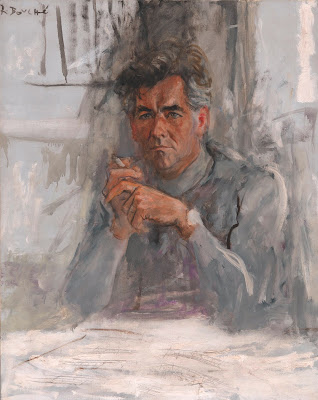
As a composer, pianist, and conductor, Leonard Bernstein made a profound impact on American music by collaborating with the performing arts. His interests ranged from classical music and ballet to jazz and musicals. In an oil portrait of 1960, René Robert Bouché portrayed Bernstein in a moment of reflection, with the papers of the musical score he is writing scattered across the desk in front of him.


Leonard Bernstein by René Robert Bouché, oil on canvas, 1960. National Portrait Gallery, Smithsonian Institution; gift of Springate Corporation. © Denise Bouche Fitch (NPG.92.3)

The composer George Gershwin and his brother, lyricist Ira Gershwin, were also highly versatile, having collaborated on popular musicals and a folk opera. Both brothers also painted interesting self-portraits, which can be viewed in the Gershwin collection in the Music Division of the Library of Congress. In a 1934 oil portrait in the collection of the National Portrait Gallery, George Gershwin represented himself in profile with a musical score and his hand alighting upon the piano keys.


Self-Portrait by George Gershwin, oil on canvas board, 1934. National Portrait Gallery, Smithsonian Institution; gift of Ira Gershwin. © Estate of George Gershwin (NPG.66.48)

The following year, the Gershwin brothers debuted Porgy and Bess, “an American folk opera,” which broke new ground in musical terms. Soprano Leontyne Price appeared in the 1952 revival touring production of Gershwin’s Porgy and Bess, which brought her first major success. Less than a decade later, in 1961, Price became the first leading African-American opera star when she made her debut at the Metropolitan Opera. Bradley Phillips created this formal oil painting of Leontyne Price within a stage setting in 1963. It is one of several portraits he made of the singer. The artist expressed the admiration he felt for her immense talent when seeing her perform onstage.


Leontyne Price by Bradley Phillips, oil on canvas, 1963. National Portrait Gallery, Smithsonian Institution; gift of Ms. Sayre Sheldon (NPG.91.96)

Artists Thomas Eakins and George P.A. Healy also created portraits of singers and musicians. In the medium of painting, these artists were able to convey the intensity and precision of the musicians in their performances. Thomas Eakins asked his model Weda Cook to repeatedly sing a particular phrase from Felix Mendelssohn’s oratorio Elijah, so he could explore the position and movement of her mouth and vocal chords for his portrait Concert Singer (1890-1892). In this manner, he recreated the immediate sense of a formal concert with the contralto singing on the stage and the conductor’s hand and baton raised in the lower corner. https://www.philamuseum.org/collections/permanent/42499.html

George P.A. Healy visited virtuoso Franz Liszt in Rome and created this 1868-1869 oil portrait of him playing the piano in an inspired moment. Healy even convinced the composer to allow Ferdinand Barbedienne to cast his hands in bronze, an artifact Healy later kept in his studio. https://callisto.ggsrv.com/imgsrv/FastFetch/UBER1/ZI-9HFT-2014-JUN00-SPI-142-1 Both artists not only portrayed the physical characteristics of musicians and singers but also the inner passion and mental concentration they brought to their performances. As such, they recreated the emotional spirit of the music for viewers.

James McNeill Whistler thought about his paintings in terms of musical titles and themes. He created not only portraits of musicians but also discussed the subtle tonalities of his more abstract urban scenes and landscapes in musical terms. In 1878, Whistler defended the titles of his paintings: “Why should not I call my works ‘symphonies,’ ‘arrangements,’  ‘harmonies,’ and ‘nocturnes’?...As music is the poetry of sound, so is painting the poetry of sight, and the subject-matter has nothing to do with harmony of sound or of colour.” This analogy between music and painting was Whistler’s primary means for defending his paintings against criticism. Indeed, he published this defense in the journal The World during his libel lawsuit against critic John Ruskin, who referred to Whistler’s 1875 oil painting of fireworks in London, Nocturne in Black and Gold: The Falling Rocket, as “flinging a pot of paint in the public’s face.” https://www.dia.org/art/collection/object/nocturne-black-and-gold-falling-rocket-64931 Whistler’s use of music as a metaphor for painting was intended to build support for the concept that color, form, and painterly technique were the primary elements of an artwork. Whistler brought this correlation of painting and music to public attention with his artworks, which in turn influenced other artists and musicians.  

Regional painter Thomas Hart Benton praised “James McNeill Whistler[’s art]...tone, colors harmoniously arranged…Whether you can distinguish one object from another or not, whether the thing painted looks like a man, woman, or dog, mountain, house or tree, you have harmony and the grandest artistic aim, it is the truly artistic aim.” Benton was a self-taught and performing musician who invented a harmonica tablature notation system used in current music tutorials. He was also a cataloguer, collector, transcriber, and distributor of popular music. He had musical gatherings for family and friends at his home in Kansas City. These sessions were commemorated on a 1942 recording by Decca Records called Saturday Night at Tom Benton’s, which featured chamber and folk music. Benton’s friend, the popular actor and singer Burl Ives, shared his passion for American songs. During the Great Depression, Ives traveled the country gathering and playing folk songs, and Benton made sketches of folk musicians in different regions. In a 1950 lithograph titled the Hymn Singer or the Minstrel, Benton portrayed Ives playing the guitar. 


Burl Ives by Thomas Hart Benton, lithograph on paper, 1950. National Portrait Gallery, Smithsonian Institution. © T.H. Benton and R.P. Benton Testamentary Trusts/Licensed by VAGA, New York, NY (NPG.85.141)

In 1973, Benton was commissioned to paint his last mural, The Sources of Country Music, for the Country Music Hall of Fame and Museum in Nashville, with support from the National Endowment for the Arts. He decided the mural “should show the roots of the music–the sources–before there were records and stars,” and he created a lively, flowing composition of country folk musicians, singers, and dancers.   https://www.arts.gov/about/40th-anniversary-highlights/thomas-hart-bentons-final-gift

Artist LeRoy Neiman featured Duke Ellington, Louis Armstrong, Billie Holiday, Ella Fitzgerald, Charlie Parker, Benny Goodman, and other famous jazz performers in his group portrait Big Band (2005), which is held at the Smithsonian National Museum of American History. It took Neiman ten years to complete this mural-size tribute to eighteen jazz masters, which the LeRoy Neiman Foundation presented to the Smithsonian after the artist’s death in 2012. Neiman frequented jazz clubs, where he befriended and sketched these performers. In 2015, the LeRoy Neiman Foundation donated funds to the Smithsonian towards the expansion of jazz programing during the annual celebration. See the following two part guide to this group portrait of jazz greats:  https://americanhistory.si.edu/blog/neiman-jazz and https://americanhistory.si.edu/blog/neiman-jazz-2

One can discover further portraits and biographies of notable composers, musicians, and singers in the Catalog of American Portraits (CAP). In 1966, the Smithsonian’s National Portrait Gallery founded the CAP, a national portrait archive of historically significant subjects and artists from the colonial period to the present day. The public is welcome to access the online portrait search program of more than 100,000 records from the museum’s website: https://npg.si.edu/portraits/research/search

The Smithsonian is celebrating the Year of Music with a wide variety of collection highlights and programs. To learn more, please visit: https://music.si.edu/smithsonian-year-music

Patricia H. Svoboda, Research Coordinator

Catalog of American Portraits, National Portrait Gallery


Bibliography:
Cheek, Leslie Jr., Director. Souvenir of the Exhibition Entitled Healy’s Sitters. Richmond: Virginia Museum of Fine Arts, 1950.
Coleman, Patrick, ed. The Art of Music. San Diego, CA, and New Haven, CT: San Diego Museum of Art in association with Yale University Press, 2015.
Fargis, Paul, and Sheree Bykofsky, et al. New York Public Library Performing Arts Desk Reference. New York, NY: Stonesong Press, Inc., Macmillan Company, and New York Public Library, 1994.
Fortune, Brandon. Eye to I: Self-Portraits from the National Portrait Gallery. Washington, D.C: National Portrait Gallery, Smithsonian Institution; Munich: Hirmer Verlag, 2019.
Gontar, Cybèle, ed. Salazar: Portraits of Influence in Spanish New Orleans, 1785-1802. New Orleans, LA: Ogden Museum of Southern Art and University of New Orleans Press, 2018.
Henderson, Amy, and Dwight Blocker Bowers. Red, Hot and Blue: A Smithsonian Salute to the American Musical. Washington, D.C.: National Portrait Gallery and National Museum of American History, in association with the Smithsonian Institution Press, 1996.
Kerrigan, Steven J. “Thomas Eakins and the Sound of Painting.” Paper presented at the James F. Jakobsen Graduate Conference, University of Iowa, 2012. https://gss.grad.uiowa.edu/system/files/Thomas%20Eakins%20and%20the%20Sound%20of%20Painting.pdf
Mazow, Leo G. Thomas Hart Benton and the American Sound. University Park, PA: Penn State University Press, 2012: http://www.psupress.org/books/titles/978-0-271-05083-6.html .
Ostendorf, Ann. “Music in the Early American Republic.” The American Historian (February 2019): 1-8.
Phillips, Tom. Music in Art: Through the Ages. Munich and New York, NY: Prestel-Verlag, 1997.
Struble, John Warthen. History of American Classical Music: MacDowell through Minimalism. New York, NY: Facts on File Publishers, 1995.
Walden, Joshua S. Musical Portraits: The Composition of Identity in Contemporary and Experimental Music. New York, NY: Oxford University Press, 2018.
Wilmerding, John, ed. Thomas Eakins. Washington, D.C. and London: National Portrait Gallery and Smithsonian Institution Press, 1993.


Tuesday, October 3, 2017

Before the National Portrait Gallery had a Building

Forty nine years ago this week the National Portrait Gallery held opening ceremonies at its new home in the former Patent Office Building.  While you can visit their current home today, the National Portrait Gallery was established before it found this permanent home and portrait collections at the Smithsonian were among the earliest collections the Smithsonian, acquired in the 1840s. 

Picture Gallery, U.S. National Museum, 1906. Smithsonian Institution Archives, MAH-20026.
In 1919, citizens began active lobbying for a separate gallery devoted to American portraiture.  In the same year, the Smithsonian endorsed the National Art Commission to document a pictorial record of World War I with portraits of American and Allied Nations leaders.  Twenty portraits from this collection were put on exhibit in the Natural History Building in May 1921.  These portraits became the nucleus of the National Portrait Gallery’s permanent collection and highlight the central mission of the National Portrait Gallery. Even at this early date, the National Portrait Gallery was not a fine art museum, it seeks to tell the story of America by portraying the people who shape the nation’s history, development, and culture.

War Portrait Room of National Gallery, 1921. Smithsonian Institution Archives, MAH-8625B
In the museum’s authorization in 1962, Congress established its mission to acquire and display portraits of "men and women who have made significant contributions to the history, development, and culture of the people of the United States." Documenting the history and culture of America every bit as much as the National Museum of American History.  In its first exhibition in the Arts and Industries Building, sixty five portraits by fifty two artists are gathered as The Nucleus for a National Collection, which opened for the bicentennial of James Smithson’s birth.

National Portrait Gallery in the Old Patent Office Building, Smithsonian Institution Archives, 92-1710
Three years later, the National Portrait Gallery finally was able to hold opening ceremonies in its own building. On October 5th, Smithsonian Secretary S. Dillon Ripley and Mayor Walter E. Washington attended a dedication ceremony and opening gala for the new building. Originally, the Patent Office Building, this 330,000 square foot building was begun in 1836, but wasn’t completed until 32 years later. Government agencies occupied the building until 1958, when it was transferred to the Smithsonian to save it from demolition. Though it didn’t officially become a Smithsonian building until 1958, it was the first building to house Smithsonian collections. Prior to the completion of the Smithsonian Institution Building (the Castle) in 1855 the U.S. Patent Office housed and exhibited the Smithsonian Collections. After a ten-year renovation, the National Portrait Gallery and the Smithsonian American Art Museum moved in. On October 6, 1968, an opening is held for the Smithsonian Associates and on October 7, 1968, the Gallery is opened to the public.

You can see more photos of the dedication and opening gala here, here, and here

Lisa Fthenakis, Program Assistant
Smithsonian Institution Archives 

Wednesday, July 20, 2011

John Singer Sargent at the Smithsonian

Lately I've been working on updating the listings of works by John Singer Sargent (1856-1925) in the Inventory of American Paintings, an online database that records the last known locations of American works of art.  As I was working on this project I wondered: What else is in the Smithsonian that is related to Sargent?  We often become so focused on our own work in the rush to get so much done in so little time, that we forget to widen our view a little bit further and see the magnitude of resources available at the Smithsonian.

It turns out that Sargent is one of the most widely represented artists across the Smithsonian, as well as one of the most popular and well-known American artists. (He was born to American parents, but spent most of his life in Europe.)  His paintings are in four Smithsonian collections: Smithsonian American Art Museum, Hirshhorn Museum and Sculpture Garden, National Portrait Gallery, and Freer Gallery of Art. 

There have been many exhibitions and monographs about Sargent, which can be found in the Smithsonian Institution Libraries, including six volumes of the more recent Complete Paintings by the artist's great-nephew Richard Ormond, and Elaine Kilmurray. One of the more interesting books (in my opinion) is a novel written by Countess Eleanor Palffy in 1951: The lady and the painter: an extravaganza, based on incidents in the lives of the two principal characters: Mrs. John Lowell Gardner of the Isabella Stewart Gardner Museum, and the artist, John Singer Sargent. I used Proquest (available on site at Smithsonian Libraries) to look up reviews of the book and, my oh my, it caused quite the scandal in its day.

Over 2000 paintings and 53 sculptures by Sargent are listed in the Inventories of American Painting & Sculpture. These works are in public and private collections around the world.  Did you know that Sargent, who is most well-known for his paintings, in particular his portraits, was also a sculptor? Many of these are plaster studies for his ceiling reliefs in the Museum of Fine Arts, Boston.  Also, about 1700 paintings are listed in the Catalog of American Portraits at the National Portrait Gallery.

You can also find Sargent in the Smithsonian American Art Museum's Photograph Archives, both as an artist and as a subject. Of note is a photograph of the "John Singer Sargent medal" by Paul Manship, photographed by De Witt Ward. The inscription on the reverse reads "Pegasus Liberated. J.M. to J.S.S. 1923."

Finally, the Archives of American Art contains the letters of Sargent and photographs, all of which are digitized and available to view online. Take a look for yourself, though I must admit, I have trouble reading his handwriting!

Now that is a lot of resources!  I had fun looking for them. Did you know that you, too, can search for items across the Smithsonian museums?  Just click on Collections Search Center and begin your journey!

Pictured, top to bottom:


John Singer Sargent, Marble Fountain in Italy, ca. 1907. Smithsonian American Art Museum, Gift of John Gellatly, 1929.6.108


John Singer Sargent, Isabella Stewart Gardner, 1888. Isabella Stewart Gardner Museum, Boston.


Paul Manship, Medal for John Singer Sargent, 1923, photographed by De Witt Ward. American Sculpture Photograph Study Collection, Photograph Archives, Smithsonian American Art Museum.


--Nicole Semenchuk, Research and Scholars Center, Smithsonian American Art Museum