Smithsonian Collections Blog

Highlighting the hidden treasures from over 2 million collections

Collections Search Center
Showing posts with label Collection Spotlight. Show all posts

Monday, October 18, 2021

DAWN V. ROGALA'S CIRCUS PHOTOGRAPHS: A SMITHSONIAN COLLABORATION

By David Haberstich

October is American Archives Month! I’m celebrating it with this backstory and update to an SI Collections Blog post by former Smith College intern Kira Leinwand, published in late 2019. Kira’s insightful post, emphasizing the cultural dimensions of circus traditions, enthusiastically described some of the fascinating photographs in the NMAH Archives Center’s Dawn V. Rogala Circus Photographs and Papers, also the subject of a book entitled When the Circus Came to Town! An American Tradition in Photographs (Photographs by Dawn V. Rogala; Essays by Dawn V. Rogala,  David E. Haberstich, and Shannon T. Perich). Dr. Rogala, now a paintings conservator at the Smithsonian’s Museum Conservation Institute (MCI), was an amateur photojournalist during the years of her self-assigned circus project. See Kira’s article, "The Traditional, International American Circus."

On October 24 this book was awarded the 2021 Stuart Thayer Prize by the Circus Historical Society, so this is a fitting stimulus to update the story of the collection and the book. Don Covington, president of the society, wrote in an email announcing the award, “The award is presented annually by the Circus Historical Society in recognition of superior documentation of circus history. Your book, ‘When the Circus Came to Town,’ was deemed by the selection committee to be the top entry in a crowded field of competitors.”

Early on, Ginger Minkiewicz of the Smithsonian Institution Scholarly Press expressed interest in publishing a book on Dr. Rogala’s circus photographs. At the same time Dawn was concerned about preserving her photographs from this multi-year project in a suitable repository, and engaged in discussions with Shannon Perich of the NMAH Photographic History in the Division of Work and Industry and myself in the NMAH Archives Center. We both wanted Dawn’s photographs! We easily reached an appropriate compromise. Dawn donated her original negatives, work prints, and related papers from her circus project to the Archives Center, but also prepared a new portfolio of 16” x 20” exhibition-quality prints as a gift to the Photographic History Collection, giving new life to the documentary photographs she had created decades earlier.

Dawn was available to consult on the arrangement of her archive, although it was already in a logical, meaningful order when she delivered it to the Archives Center. I emphasize her role as a congenial consultant, as I know archivists and curators with cautionary tales about allowing donors to “curate” their own collections! Dawn worked with me and Kira Leinwand, answering questions, offering suggestions, and explaining how her working methods as a photographer had informed her decisions about arrangement. Processing was completed by Alison Oswald.

Dawn, Shannon, and I simultaneously embarked on a related collaboration, the creation of the lavishly illustrated scholarly book mentioned above, for which we all wrote essays. Dawn recounted her fascinating experiences in photographing a dozen small traveling circuses over a seven-year period, “embedded” with her subjects in much the same sense that war photographers are said to be embedded with the troops they follow and photograph. Shannon wrote about Dawn’s photographs within the historical context of circus, carnival, and entertainment photographs. As Dawn’s images concentrated on circus people and their behind-the-scenes work and relationships, rather than the spectacle of circus performances as entertainment, I chose to write about her images within the context of “work” photography and its history. Her pictures vividly depict the muscle work of practice and rehearsals, of erecting and dismantling tents, training animals, and the myriad efforts of performers and other workers to create a spectacle for audiences. I also contributed a preliminary finding for the archival collection and other reference material to an appendix in the book. All three of us reviewed each other’s texts, trying to meld them into a cohesive, informative, and entertaining volume. To me, our most rewarding collaboration was the selection, sequencing, and layout of the photographs to be reproduced in the book, conducted by all three of us in several long sessions in conference rooms with large tables. We seemed to be of a single mind, with no significant disagreements.

"Kiss, Carson & Barnes Circus, 1995," by Dawn V. Rogala. Copyright © Dawn V. Rogala. Reproduced with permission. Gelatin silver print, Photographic History Collection, National Museum of American History. 


Ephemera from the Archives Center's Rogala Collection: Route Cards for Kelly Miller Circus and Clyde Beatty-Cole Bros. Circus, 1995.

This archival collection contains a rich trove of information beyond the pictorial documentation, including interviews with circus performers and personnel, memorabilia and colorful ephemera, rare publications, travel itineraries, and related documents. One senses the end of an era, as most of the circuses which Dawn lovingly photographed no longer exist, literally having folded up their tents for the last time.

Our book serves as an extension of Dawn’s circus archive, as it contains her biographical commentary, observations, and fond reminiscences of her travels with the circuses. As a paintings conservator at the Smithsonian’s MCI, she employs the keen analytical eyes she developed as a documentary photographer. She also has to her credit a number of scholarly and scientific books and other publications in her field.

Now here’s the shameless plug: our book, When the Circus Came to Town! An American Tradition in Photographs / Photographs by Dawn V. Rogala, Essays by Dawn V. Rogala, David E. Haberstich, and Shannon T. Perich, is available from the usual sources, and would make a great Christmas/holiday gift!   

David Haberstich, Curator of Photography, Archives Center, National Museum of American History

Tuesday, June 1, 2021

Elizabeth Peratrovich: An Early Civil Rights Activist from Alaska

By Mikaela Hamilton and Nathan Sowry

On February 16th, 1945, nearly 20 years before the Civil Rights Act of 1964, the first anti-discrimination law in the United States was signed into effect. The Anti-Discrimination Act of 1945 was created to address discrimination against Indigenous populations within the Alaskan territory by banning segregationist policies based on race. The successful passing of this act has often been credited to the dedicated work of Elizabeth Wanamaker Peratrovich (Tlingit), a prominent figure in the fight for equality and civil rights in the early twentieth century.

As of this month, the Peratrovich family papers are now available online, and will soon be available for research and reference in the National Museum of the American Indian Archives Center. This collection includes photographs, audio recordings, correspondence, and newspaper clippings documenting the life and important civil rights work of Elizabeth and her husband Roy. 

Elizabeth Wanamaker Peratrovich, 1911-1958.
Peratrovich family papers (NMAI.AC.078), NMAI.AC.078_001_01_021.

Elizabeth (Ḵaax̲gal.aat) was born on July 4, 1911, in Petersburg, Alaska, as a member of the Lukaax̱.ádi clan, in the Raven moiety of the Tlingit nation. Elizabeth spent the first decade of her life in Sitka, a coastal city in southeast Alaska, until her family moved further southeast to the Native village Klawock, where Elizabeth met her future husband, Roy Peratrovich (Tlingit). Although Elizabeth and Roy spent their early years at segregated boarding schools, they were able to graduate from Ketichikan High School, which was integrated following a lawsuit won by attorney William Paul (Tlingit). In 1931, Elizabeth married Roy Peratrovich. They had three children: Roy Jr., Loretta Marie, and Frank Allen. 

In 1941, the Peratroviches moved to Juneau, the capital of the Alaska Territory, in search of more opportunities for themselves and their children. Although they encountered hostile white homeowners who refused to rent to Native Americans, they persevered to become one of the first Indigenous families to live in a non-Native neighborhood. They soon took on leadership roles within the Alaska Native Brotherhood and Sisterhood. Throughout Juneau, discrimination was ubiquitous; local businesses commonly displayed signage reading "No Natives Allowed," "No Dogs, No Natives," and “We cater to white trade only." After encountering a “No Natives Allowed Sign” on a local inn just weeks after the attack on Pearl Harbor, Elizabeth and Roy were driven to write a letter to Governor Ernest Gruening in protest, marking the beginnings of their political activism to establish legal protections for Indigenous people in Juneau and beyond. The letter read, in part:

“The proprietor of ‘Douglas Inn’ does not seem to realize that our Native boys are just as willing as the White boys to lay down their lives to protect the freedom that he enjoys. …We as Indians consider this an outrage because we are the real Natives of Alaska by reason of our ancestors who have guarded these shores and woods for years past."

Letter from the Elizabeth and Roy Peratrovich to Ernest Gruening, Governor of Alaska, December 30, 1941.
Peratrovich family papers (NMAI.AC.078), NMAI.AC.078_001_02_001.

Successfully gaining Governor Gruening’s support, Elizabeth and Roy began a campaign to pass an anti-discrimination bill in 1943. With a vote of 8-8 in the House of Alaska’s two-branch Territorial Legislature, it failed to pass. Undeterred, Elizabeth continued to tirelessly campaign across the Alaskan territory. After garnering public support, Elizabeth and Roy, representing the Alaska Native Brotherhood/Sisterhood, brought a new anti-discrimination bill before the Alaska Senate in 1945. In an eloquent two-hour long testimony, Elizabeth stood before a white male majority and eloquently argued for an end to racial discrimination within Alaska. 

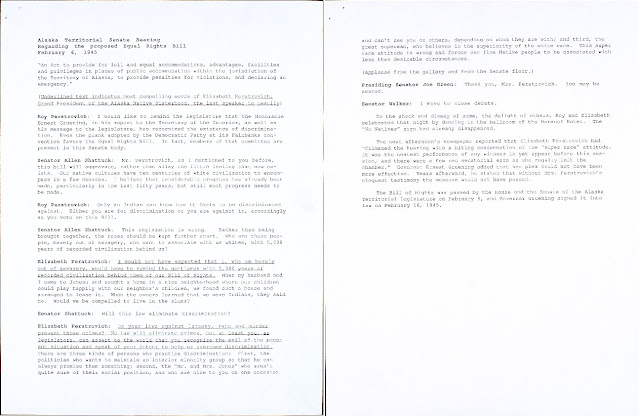
During the hearing, Allen Shattuck, a Juneau territorial senator, asked Elizabeth “Who are these people, barely out of savagery, who want to associate with us whites, with 5,000 years of recorded civilization behind us?” Elizabeth famously responded, “I would not have expected that I, who am ‘barely out of savagery,’ would have to remind gentlemen with five thousand years of recorded civilization behind them, of our Bill of Rights.” A local newspaper printed that she “shamed the opposition into a ‘defensive whisper.’” The Alaska Equal Rights Act of 1945 was signed into law by Governor Gruening on February 16, 1945. The Act provided that all Alaskans be entitled to “full and equal enjoyment” of public areas and businesses and banned signs that discriminated based on race. This marked the end of “Jim Crow” laws within Alaska.

Transcript of Alaska Territorial Senate Hearing regarding proposed Equal Rights Bill, February 6, 1945.
Peratrovich family papers (NMAI.AC.078), NMAI.AC.078_001_02_082 and NMAI.AC.078_001_02_083.

In recognition of her antiracist advocacy to provide equal accommodation privileges to all citizens regardless of race, in 1988 the state of Alaska posthumously established February 16th as Elizabeth Wanamaker Peratrovich Day. More recently, celebrating the 75th anniversary of Alaska’s Anti-Discrimination Law, Elizabeth Peratrovich appeared on the 2020 Native American $1 coin design. That same year, a Google doodle featuring the work of Tlingit and Haida artist Michaela Goade (Sheit.een) commemorated Elizabeth’s life and activism. Elizabeth and Roy’s efforts helped to pave the way for continued Indigenous activism within the United States. 


Mikaela (Mik) Hamilton, Intern, National Museum of the American Indian Archives Center

Nathan Sowry, Reference Archivist, National Museum of the American Indian Archives Center


Thursday, April 16, 2020

Bringing to Light the Career and Correspondence of M.R. Harrington


Letter addressed to M.R. Harrington from the Bureau of American Ethnology, 1911.
Museum of the American Indian/Heye Foundation records, NMAI.AC.001, Box 231, Folder 7
Though now less well-remembered, M.R., or Mark Raymond, Harrington (1882-1971) was a prominent twentieth-century anthropologist who worked for many of the leading anthropological museums of his day. These included Harvard University’s Peabody Museum, the American Museum of Natural History in New York, the Museum of the American Indian, Heye Foundation (the predecessor to the National Museum of the American Indian or NMAI) also in New York, Philadelphia’s University Museum, and later, from 1928 until his retirement in 1966 at the age of 82, the Southwest Museum in Los Angeles.

M.R. Harrington dressed in Haudenosaunee (Iroquois) clothing, ca. 1905.
Mark Raymond Harrington photograph collection, NMAI.AC.001.035, P28198.
The Smithsonian’s NMAI Archives Center staff consider themselves fortunate to steward such a great extent of Harrington’s archival materials, consisting of his ethnological field notes, object lists, and personal and professional correspondence. For many years these materials have served as an invaluable resource for Native and non-Native researchers, linguistic and language revitalization scholars, and community groups conducting repatriation work. Now, however, as the NMAI makes digital versions of Harrington’s correspondence accessible on the Smithsonian Online Virtual Archives and the Smithsonian’s Transcription Center, an even greater number of interested users can learn about this individual’s important life from the comfort of their own homes.

Born in 1882 and commencing his first anthropological work while still a teenager in the late 1890s, Harrington’s career spanned more than sixty years and encompassed wide swathes of the U.S. and North America. Well-respected for his collecting prowess, in the two decades alone (1908-1928) that he worked for Museum of the American Indian, Heye Foundation, founder George Gustav Heye, Harrington collected ethnological and archaeological material from Canada in the north to Cuba in the south, and from New York in the east to California in the west.

Harrington’s correspondence in particular reflects his work throughout North America and his sustained relationships with anthropological leaders in the field like Franz Boas, Frederic Ward Putnam, and Frank G. Speck, his personal relationships with fellow anthropological colleagues Alanson Skinner and Arthur C. Parker, and his dependence on the knowledge, advice, and friendship of Native American collaborators and interpreters in the field like Peoria leader Bill Skye and Otoe community member Grant Cleghorn.

Peoria chief, interpreter, and collaborator with M.R. Harrington, Bill Skye, 1908.
Collection still undetermined, likely part of the Mark Raymond Harrington photograph collection. NMAI P23479.
Harrington was a product of his time, and though his collecting of material culture items (now referred to as salvage anthropology) may have “saved” countless objects for future generations to admire in a museum setting, his collecting also inadvertently robbed many American Indian communities of their cultural heritage, creating a void in Native American cultural identity which in some cases still persists to the present-day.

Further, like his fellow turn-of-the-twentieth-century anthropologists Frank Hamilton Cushing, James Mooney, and Alanson Skinner, Harrington adhered to the anthropological practice of participant observation. Thus, he often dressed in Native clothing, spoke in Native languages, and referred to himself by his adopted Native names, even when away from Native communities. Harrington and Skinner, however, tended to blur the lines between participant observation and what Philip J. Deloria terms “playing Indian,” in which non-Native peoples simulate and appropriate the customs, manners, and lifeways of Native groups. Temporally removed and lacking Harrington’s personal thoughts on his actions at the time, it is difficult to label his and Skinner’s actions as intentional cultural appropriation, when they may demonstrate nothing more than the passion of two men of Euro-American ancestry interested in learning about other cultures. Regrettably, while Harrington’s correspondence is a treasure trove of information, it reveals little further insight into these men’s perspectives on matters such as this. Importantly though, Native American people were more than simply a subject of study for Harrington. They were integral to his life, his identity, and over time became intimate members of his family including his wife and Seneca community member, Endeka (Edna) Parker.

Mrs. Endeka Parker Harrington (Seneca), Don Chiaku (Hopi Pueblo), and M.R. Harrington dressed in Hopi clothing in Arizona, circa 1930. Mark Raymond Harrington photograph collection, NMAI.AC.001.035, P26879.
Harrington worked with more Native communities, at more museums, and for a longer period of time than many of his colleagues in the anthropological world. His Seneca friend, fellow anthropologist, and brother-in-law Arthur C. Parker called Harrington a devoted friend who defended Native peoples from every angle of attack. More recently, present-day scholar and Abenacki museum anthropologist Margaret Bruchac has praised Harrington as a determined researcher with an inclusive and egalitarian bent who advocated for the place of Native men and women in ethnological and archaeological work.

Despite such praise, M.R. Harrington’s name remains relatively unknown to many both within and outside of the museum field. Hopefully by making Harrington’s personal and professional correspondence more widely available to the public, his inspiring and complicated legacy will better be brought to light.

Nathan Sowry, Reference Archivist
National Museum of the American Indian Archives Center

Friday, October 18, 2019

The Traditional, International, American Circus


Walker Big Apple Circus, 1994. Dawn V. Rogala Circus Photographs and Papers, 1992-1999 (NMAH AC 1427). Copyright © Dawn V. Rogala. Reproduced with permission.

As an intern in the Archives Center of NMAH, I spend much of my time familiarizing myself with specific collections. My main project this semester has been looking at the Dawn V. Rogala Circus Photographs and Papers, which does make it easy for me to introduce the collection, since the title makes its contents fairly clear. Originally, I was planning on writing this post about a single item, and when I came across the photograph above, I couldn’t help but find it a bit amusing. There are many beautiful, touching, and unique photos in this collection, and in comparison to many of these, this photo appears at first to be rather unremarkable. It took me a bit of time to understand why I found it so funny, but then I realized that it was the perfect image to represent the American circus. I say this because the entire time that I was perusing the collection, there was one paradox which popped out at me from nearly every page, and I can only describe it as this: the traditional, international, American circus.

Walker Bros. Circus, 1995. Dawn V. Rogala Circus Photographs and Papers,
1992–1999 (NMAH AC 1427).
Copyright © Dawn V. Rogala. Reproduced with permission.

Throughout the ephemera of the collection, the words “American” and “tradition” appear more times than I can count. One Carson & Barnes Circus newsletter states that the goal of its show is to “keep alive the spirit and the traditions that are a part of American History and the American Scene.” An article written about Circus Vargas is titled “Traditions and the American Circus; Elements of Circus Vargas.” One souvenir program from the Clyde Beatty – Cole Bros. Circus proclaims that “the tradition of the tented circus… is indeed an American treasure.” It is clear from the constant repetition of the word “tradition” in these excerpts that these circuses profited from a certain cultural nostalgia. Programs from circuses such as the Big Apple Circus and Circus Vargas even provide brief history lessons to highlight the role of the circus in American history, telling it as though it were the story of an individual, such as an immigrant striving towards that famous “American dream.” Yet despite many of these labels, the animals, the performers, and in some cases even the tent – “…brand new…Big Top freshly imported from Italy!”–were advertised for their exoticism.

Clyde Beatty-Cole Bros. Circus, 1995. Dawn V. Rogala Circus Photographs and Papers, 1992–1999 (NMAH AC 1427). Copyright © Dawn V. Rogala. Reproduced with permission.

According to one Big Apple Circus program, the circus itself started as an arena for equestrian sports. Be that as it may, it is the exotic animals which became the major tools for drawing a crowd. The Rogala collection contains many photographs of these lions, tigers, and bears (oh my!), and it’s clear from the collected papers that each circus wanted to emphasize their “Exotic Animal Menagerie.” Among the ephemera in the collection are the programs from six out of the eleven circuses she traveled with – as well as one from a circus that she didn’t travel with – and a crucial part of many of these programs is a listing of the animals, meant undoubtedly to amaze and overwhelm readers: “…approximately 20 [elephants], both Indian and African… approximately 100 exotic and domestic animals, including giraffe, rhinoceros, hippopotamus, camels, liger, tigers, lions, llamas, and many types of equine.” For this industry, it seems to have been vital to make grand claims about their “rather large variety of animals from various parts of the globe” in order to compete with other shows. Finally, most circuses include exciting images of animals in their programs and on their trailers – not necessarily corresponding to the animals in their actual cast. All this is to advertise the circus as a place to view all types of animals that would never ordinarily be seen in the U.S. – quite  the opposite from our “slice of pure Americana.”

Selection of programs from six circuses (listed clockwise from top-left corner: Culpepper & Merriweather Great Combined Circus Official Program and Souvenir Magazine, Folder 7; Circus Vargas Program of Acts, The 29th Anniversary Edition, Folder 4; Kelly Miller Circus, Folder 9; Clyde Beatty – Cole Bros. Circus Program and Magazine, Folder 6; Carson & Barnes Circus 1993 Official Routebook, Folder 2; Big Apple Circus Carnevale in Venice, 1993-94 Lincoln Center & Tour, Folder 1. All Box 8, Dawn V. Rogala Circus Photographs and Papers, 1992–1999 (NMAH AC 1427).

Carson & Barnes Circus 1993 Official Routebook,
Folder 2, Box 8, Dawn V. Rogala Circus Photographs and Papers, 1992–1999 (NMAH AC 1427).

Just as circus programs include lists of their exotic animals, many also catalogue their foreign performers. Circus Vargas even went so far as to have an entire sheet devoted to their “International Cast,” which includes human performers from Spain, Argentina, Bulgaria, Germany, Kenya, England, and the Philippines, as well as a troupe of dogs from Denmark. Even domestic animals, it seems, needed some international flair. These international casts were also displayed in a way which made them appear even more exotic, through fanciful names, acts, and costumes. Big Apple Circus’s “Carneval in Venice” – from which the top photo is taken – is set in a fanciful version of an entirely different place on the globe. Similarly, photos in programs from Carson & Barnes Circus show performers paying tribute to a different time with their colorful “Aztec” costumes. In order to quench this thirst for variety, some of these circus acts portrayed cultures that were not present in the cast of performers. This certainly appears to be the case in the photo below, where several women are dressed in imaginative Asian-inspired costumes, even donning identical black wigs.

Carson & Barnes Circus, 1995. Dawn V. Rogala Circus Photographs and Papers, 1992–1999 (NMAH AC 1427).
Copyright © Dawn V. Rogala. Reproduced with permission.

The exoticism of the circus seems like a contradiction to its place in American tradition, but I think that nothing explains it better than this excerpt from one Clyde Beatty–Cole Bros. program: “Perhaps no tradition reflects the cultural quiltwork of our nation as does the American circus.” The circuses in this collection take a variety of different nationalities, cultures, and traditions, put them all under one big top – typically in colors of red, white, and blue – and call it American. It makes me think of that old debate as to whether the U.S. is more of a melting pot or more of a salad bowl, with the former arguing that all cultures mix until we can no longer see the differences, and the latter arguing that the cultures may be next to each other but they remain distinct and separate. Since this post is scheduled to go online on National Mulligan Day – yes, I chose the day for a reason–we might also think of the circus as being a reflection of the U.S.– a stew made from various unique odds and ends. This stew retains its individual bites of flavor, but it is the broth which brings together these numerous and varied elements to define it as a stew.

Sterling & Reid Bros. Circus, 1998. Dawn V. Rogala Circus Photographs and Papers, 1992–1999 (NMAH AC 1427). Copyright © Dawn V. Rogala. Reproduced with permission.

For more information on the Dawn V. Rogala Circus Photographs and papers, or – even better – to view the collection yourself, please visit our website. There you will find the contact information to set up an appointment to view items from this or other collections!

All quotes taken from box 8 of the collection (ephemera), various folders, the Dawn V. Rogala Circus Photographs and Papers, 1992-1999, Archives Center, National Museum of American History.

Kira Leinwand
Intern, Fall 2019
Archives Center
National Museum of American History

Tuesday, October 15, 2019

Elaine M. Kilbourne Scrapbooks


The Anacostia Community Museum holds several collections related to Washington, DC educators. Most of these records document the contributions of women who distinguished themselves in their careers as teachers, educators, or administrators. Our Elaine M. Kilbourne Scrapbooks, 1924-2014, document the life and work of Anacostia High School teacher Ms. Kilbourne (1923-2014), and her impact on generations of students.

Ms. Kilbourne, Anacostia High School Chemistry class, undated.

Ms. Kilbourne taught chemistry at Anacostia High School in Washington, DC from 1948 to 1968. Throughout her long career, she earned a local and national reputation for excellence in her teaching  methods. In 1955, she received a special award from the Chemical Society of Washington for her excellence teaching. In 1958 and 1963, Ms. Kilbourne received Principal Awards for Excellence in Science Teaching by the District of Columbia. The American Chemical Society recognized her contribution to the STEM field with numerous awards, including the Second District James Bryant Conan Award in High School Chemistry Teaching.

Ms. Kilbourne created her scrapbooks in 3-ring binders. she used a combination of magnetic album sleeves and grid paper to affix her memorabilia. The scrapbooks contain correspondence, photographs, newsclippings, certificates, and copies of science projects she created while she worked as a Science Education Specialist at the Food and Drug Administration.

All three Kilbourne scrapbooks in the collection are scheduled for imaging thanks to a Smithsonian Women’s Committee Grant to fund the digitization and promotion of select female-authored materials held within six Smithsonian archival units. The digitized materials will then be available in the Smithsonian Transcription Center for digital volunteers to transcribe. This will allow the public to discover and share the story of Ms. Kilbourne’s contribution to the STEM field.

Prior to deconstruction of the scrapbooks each page is photographed and numbered so we don't lose the original order during digitization and rehousing.

To learn more about the accomplishments of Elaine M. Kilbourne view: Ms. Kilbourne:  Chemistry Teacher Extraordinaire.

Jennifer Morris
Archivist
Anacostia Community Museum

Monday, October 7, 2019

Collection Spotlight: Ambrotype of Chief Okemos


Ambrotype of Chief Okemos [Anishinaabe (Chippewa/Ojibwa)]. P12521A,  NMAI.AC.385, National Museum of the American Indian


The NMAI Archives Center is pleased to share this ambrotype depicting Chief Okemos [Anishinaabe (Chippewa/Ojibwa)], photographed by Henry H. Smith of Cheboygan, Michigan in 1858.

Ambrotypes became popular in the mid-1850s as a cheaper alternative to daguerreotype photographs. These underexposed collodion negatives on glass were usually placed against a dark background such as paper, cloth, or paint in order for the ambrotype to appear as a positive image. Most ambrotypes, like this one, were housed in a leather or thermoplastic case with a brass mat and a preserver in order to protect the photograph from scratches or peeling emulsion. By 1865, tintype photographs replaced ambrotypes in popularity because they were even cheaper and easier to produce.

Newspaper clipping inside Chief Okemos' ambrotype case. P12521B,  NMAI.AC.385, National Museum of the American Indian

What makes this photograph particularly interesting is that someone, possibly the collector, included in the case a newspaper clipping referencing the ambrotype. How meta! The article describes Okemos’ initial hesitation of having his photograph taken. In the early days of photography, some American Indian communities believed that the photographers were “shadow catchers” who could capture parts of their being via the camera. It seems that Chief Okemos changed his mind in later years, as there are three other known photographs of him. Two are in private collections and the third is an ambrotype held in the Archives of Michigan (Record Group 2005-13).

There is conflicting information about the details of Chief Okemos' biography including his birth year. It is believed that Chief Okemos was born circa 1769 possibly in the Anishinaabe (Chippewa/Ojibwa) settlement of Ketchewandaugoning on the Shiawassee River (near present-day Bloomfield, Michigan). Other spellings of his name included Okemus, Okemans, Ogimaus, O-ge-mah, and O-Gee-Manse.

He fought in several battles including the battle of Tippencanoe, Indiana (1811), the War of 1812, the Battle of Sandusky (1813), and the Battle of the Thames (1813). During the War of 1812, Okemos suffered an injury, which left him with a large scar on his forehead. Chief Okemos also signed several treaties on behalf of the Anishinaabe including the Treaty of Saginaw (1819).

His family included his wife Waindegoquayzance; his son Paymechewaysawdung (1829-1899; also known as John); his son Waygeshegome (1845-1902; also known as James); his daughter Kawbaishcawmoquay (1845-1896); and his daughter Shawusquahbenoquay (d.1852). Chief Okemos died on December 5, 1858 in Michigan.

Want to check out more ambrotypes held in NMAI’s collection? Check out these images of Potawatomi Chief Shabonna

Emily Moazami, Assistant Head Archivist
National Museum of the American Indian

Tuesday, October 1, 2019

A Princely Visit: Photographs from British Columbia


One hundred years ago the Prince of Wales, and future King Edward VIII, made a long and highly publicized visit to Canada during his 1919 tour of the British Empire. The trip lasted from August 11th, when the Prince arrived by ship in Newfoundland, through November 10th, crossing westward and then back eastward across the continent. Photographers and journalists, alongside ordinary Canadians, gathered in cities and towns to catch a glimpse of the Prince. According to Library and Archives Canada, it was one of the first major cross-Canada events covered by the motion picture newsreels (see their blog post and video here). The Prince was photographed giving speeches, meeting with veteran soldiers from WWI, and shaking hands with dignitaries, as well as being greeted by leaders of First Nations communities across Canada. Many of these photographs were turned into postcards and have ended up in various Canadian Institutions such as the Library and Archives Canada and the Royal BC Archives, this one (below) however, made its way to New York City before landing in Suitland, Maryland in the NMAI Archives.


Prince of Wales, later King Edward VIII, being greeted by Kwakwaka'waka (Kwakiutl) and Coast Salish leaders in Victoria on Vancouver Island, British Columbia, 1919. Trio Photograph and Supply Company photographs (NMAI.AC.134), P00746. National Museum of the American Indian, Smithsonian Institution. 
One of the photographers present at the prince’s arrival in Victoria, British Columbia was Ernest Crocker. Crocker, along with two other English emigrants to Canada, had co-founded “Trio Photograph Company and Supply” in Victoria sometime around 1903. Though the original partnership was later dissolved and Crocker took over the main operations, Trio continued to flourish as a military photography company, photographing soldiers and personnel from WWI and WWII. The company also photographed local landscapes and indigenous communities in and around Victoria. In the early years of the company, some of these photographs were made into scenic postcards and sold at a cigar-stand at the Canadian Pacific Railway’s Empress Hotel in Downtown Victoria. 


Postcard featuring a Kwakwaka'waka (Kwakiutl) totem pole in Cape Mudge Village on Quadra Island, British Columbia, circa 1920. This postcard was stamped with "Trio" on the back. Trio Photograph and Supply Company photographs (NMAI.AC.134), P06408National Museum of the American Indian, Smithsonian Institution. 
Though it is unclear exactly when the photographs were acquired, H. B. “Barney” Olson, an employee of the Empress Hotel at the time, must have either bought (or was given) several Trio photographs and postcards from the cigar-stand. These photographs included the first image of the Prince of Wales being greeted by the Governor of British Columbia along with leaders from the Kwakwaka'wakw (Kwakiutl) and Coast Salish communities, in addition to views of several Kwakwaka'wakw (Kwakiutl) villages on Vancouver and Quadra Islands. 

In 1924, Olson donated his collection of Trio photographs to the Museum of the American Indian, Heye Foundation (the National Museum of the American Indian’s predecessor institution) which is how they became a part of NMAI’s archival collections. Although the initial cataloging of the photographs did not include a photographer, many of the prints had the word “Trio” stamped on the back. 


View of a Kwakwaka'waka (Kwakiutl) totem pole in Cape Mudge Village on Quadra Island, British Columbia, circa 1920. The same totem pole can be seen in the postcard above. Trio Photograph and Supply Company photographs (NMAI.AC.134), P06412. National Museum of the American Indian, Smithsonian Institution. 
Thanks to the many resources available online today we were able to quickly find information on Trio Photographic Supply through the directory "Camera Workers British Columbia, 1858-1950", by D. Mattison, as well as information on Crocker himself from the BC (British Columbia) Archives. (See guide to the Ernest Crocker Fonds).

Now, the “Trio Photograph and Supply Company photographs from British Columbia” (NMAI.AC.134) can be found digitized and online through the Smithsonian Online Virtual Archives or at the Smithsonian’s Collection Search Center.

Rachel Menyuk, Processing Archivist
National Museum of the American Indian, Archives Center

Monday, September 9, 2019

Collection Spotlight: Fred Miller photograph collection


Portrait of Shows All The Time and her two children. Fred E. Miller photograph collection, NMAI.AC.108, N13744.


The National Museum of the American Indian is pleased to share with you a newly processed and fully digitized collection of historic photographs. The Fred E. Miller photograph collection depicts Apsáalooke (Crow/Absaroke) families on the Crow Indian Reservation in Montana circa 1898-1910.

Photographed by civil service clerk Fred E. Miller, the photographs reveal an intimate look at the Crow Nation during a period of forced acculturation and the transition from nomadic to sedentary reservation life. By 1883, the Crow peoples had lost millions of acres of land and around the following year all three Crow bands (Mountain Crow, River Crow, and Kicked in the Bellies) were forcibly relocated to the Crow Indian Reservation in south-central Montana.

Portrait of White Hip and Always Takes The Lead. Fred E. Miller photograph collection, NMAI.AC.108, N13667.


Twelve years later, in 1896, Fred Miller accepted a position as a civil service clerk for the Bureau of Indian Affairs and moved to the Crow Indian Reservation. Despite being a government agent, Miller advocated for the rights of the Crow people. For nearly a dozen years, he lived with and photographed the Apsáalooke peoples, learned to speak their language, and was officially adopted into the Crow Nation. He was nicknamed Boxpotapesh, or “High Kicker,” because of his skills at football - a game that he taught to the Crow children. He would also entertain the children with his elaborate ice skating routines on the frozen Little Bighorn River.

Outdoor portrait of Apsáalooke (Crow/Absaroke) Chief Black Hair (1849-1905) with daughter Mary Black Hair (1896-1953). Fred E. Miller photograph collection, NMAI.AC.108, N13777.

Prior to arriving in Montana, Miller had learned photography in Iowa and operated a photo studio in both Nebraska and Iowa. Despite being a trained professional portrait photographer, Miller’s photographs of the Crow community were very candid and informal in nature. Unlike many of his contemporaries, Miller’s style of photographs appear to be devoid of romanticism or of “dying race” narratives. Rather than people depicted as anonymous archetypes, Miller’s photographs document individuals with names and personal stories. While we can only speculate about Miller’s intentions for photographing, his images capture diverse aspects of day-to-day life of the Crow peoples living on the Reservation. Because of his adoption into the tribe, the Crow permitted Miller to photograph all activities on the reservation, some of which were off-limits for other photographers.

Photograph depicting Chief Medicine Crow [Apsáalooke (Crow/Absaroke)]. Fred E. Miller photograph collection, NMAI.AC.108, N13649.


According to Joe Medicine Crow (1913-2016), the late Crow Chief and Tribal Historian, Miller did not pose people or dress them up for photographs. Instead, he documented people as he came across them on the Reservation. Chief Joe Medicine Crow further commented, “High Kicker photographed every facet of Crow life during the harsh years of the government’s unilateral acculturation program. His subjects represented all ages from infants to octogenarians, the latter proudly clinging to the last vestiges of their days of glory. The faces vividly reveal sadness, futility and anger, but also happiness, optimism and love.” Among the many faces represented in Miller’s photographs is Joe’s grandfather, Chief Medicine Crow (1848-1922), whom Miller photographed circa 1898-1910.

Outdoor portrait of three generations: grandmother Clara White Hip, her daughter Clara White Hip, and her granddaughter Agnes White Hip. Fred E. Miller photograph collection, NMAI.AC.108, N13729.

Miller’s other photographs include candid family portraits such as a photo of three generations of the White Hip family standing alongside a creek - grandmother Clara White Hip, daughter Clara White Hip, and granddaughter Agnes White Hip. Many other photographs depict Chiefs in traditional regalia such as war shirts and headdresses, as well as women and girls in elk tooth dresses about to partake in special events. On the opposite end of the spectrum, Miller also captured quieter moments, such as his photograph of Points The Gun braiding her hair with the aid of sunlight from a nearby window.

Photograph depicting Points The Gun braiding her hair. Fred E. Miller photograph collection, NMAI.AC.108, N13736.

Before his death in 1936, Miller was working on a narrative about his experiences living among Crow peoples, but unfortunately his writings have since disappeared and their whereabouts remain unknown. Fortunately, his visual record has survived, and can provide a glimpse into various aspects of everyday life on the Crow Indian Reservation at the turn of the twentieth century. Even more importantly, these photographs of Crow ancestors can be shared with descendants and future generations.


Emily Moazami, Assistant Head Archivist
National Museum of the American Indian


Thursday, August 29, 2019

Abroad with Buffalo Bill in 1890-1891

Wild West performers on horseback
Frank Lehner photographs of Buffalo Bill’s Wild West show, NMAI.AC.147, P10202
William F. “Buffalo Bill” Cody opened the first Wild West show in Omaha, Nebraska, in 1883. Within four years the fame of the Wild West had grown so great that Cody took his fellow performers on an international tour of Europe, performing between 1887 and 1906 in the United Kingdom, France, Spain, Germany, Austria, Italy, and a host of other countries.

Undeniably, Cody’s Wild West constructed and promoted inaccurate views of Native Americans, defining “real Indians” as only those who lived in tipis, rode horses, and wore feather headdresses. Such stereotypes have sadly been perpetuated in dime novels, television shows, and major motion pictures down to the present, ignoring the staggering cultural diversity of the Indigenous peoples of North America.

Buffalo Bill Cody and Wild West performers on horseback
Frank Lehner photographs of Buffalo Bill’s Wild West show, NMAI.AC.147, P10203
In spite of the Wild West show’s culpability in creating and perpetuating narrow views of who Native peoples are and what they look like, several recent scholars have argued that there were some upsides for those Native Americans who chose to perform with this traveling show. One of the major bonuses was the relative freedom Wild West performers experienced compared with their community members who had to remain on the reservations. L.G. Moses in Wild West Shows and the Images of American Indians, 1883-1933 and Michelle Delaney in Buffalo Bill’s Wild West Warriors both note Native performers’ opportunities to not only see the world and earn an income, but also to practice their beliefs and live their days free from the interference of the ever-present missionaries, politicians, and BIA agents back at home.

Wild West show performers in camp
Frank Lehner photographs of Buffalo Bill’s Wild West show, NMAI.AC.147, P10208
In addition, Wild West performers experienced opportunities otherwise unimaginable to many Americans of their day, including being presented to Queen Victoria at her Golden Jubilee in London in 1887, attending the 1889 World’s Fair in Paris with its debut of the newly constructed Eiffel Tower, and having their photograph taken by the daughter of the future King of Bavaria, Ludwig III, in Munich in 1890.

Princess Maria Ludwiga Theresia of Bavaria photographing performers in Wild West camp
Frank Lehner photographs of Buffalo Bill’s Wild West show, NMAI.AC.147, P10218
A recently processed photograph collection in the National Museum of the American Indian’s Archive Center provides a glimpse into this world: Frank Lehner photographs of Buffalo Bill’s Wild West show.

While few of the images include descriptions of a date or location, most can be attributed to 1890 or 1891 and related to one of the Wild West show’s European tours. A handful of the photographs, however, can be definitively placed in Munich, Germany, in 1890, between approximately April 19 and May 5 of that year. As the Wild West tour for Germany included visiting cities from Hamburg in the north to Munich in the south, and from Dresden in the east to Cologne in the west, the performers were usually in one place for only a few days or a few weeks at a time. According to Julia S. Stetler in her article “Painting the Town Red: Buffalo Bill’s Indians in the German Media,” daily performances in Munich alone often attracted more than five thousand spectators, with shows consistently being sold out.

King Ludwig III of Bavaria with Buffalo Bill and Wild West performers
Frank Lehner photographs of Buffalo Bill’s Wild West show, NMAI.AC.147, P10215
Although the identities of the original photographers remain in question, the photographs themselves nevertheless reveal much about camp life for the Native and non-Native Wild West show performers.

Portrait photograph of Wild West performer and son of Trapper John Nelson and unidentified Sioux woman
Frank Lehner photographs of Buffalo Bill’s Wild West show, NMAI.AC.147, P10219
Cody, in his showman-like manner of balancing historical authenticity and outright fabrication in his shows, even recruited a number of Sioux Ghost Dance performers in the immediate aftermath of the 1890 death of Sitting Bull and the Massacre at Wounded Knee. These men would later accompany the Wild West as it toured Germany and other European countries throughout 1891 and 1892.

Sadly, the identities of many of the Native performers themselves were not included with the original photograph descriptions when donated. Because of this, we as archivists need to rely on the public to aid us in correctly identifying the individuals featured in many of these images. Please reach out to us at the NMAI Archive Center at NMAIArchives@si.edu if you believe you can provide any further cultural or descriptive information for the Native and non-Native performers in these photographs. In this way we can work together to correct the historical record, and to give a name and a voice to those who have otherwise been silenced.

Wild West show performers in camp
Frank Lehner photographs of Buffalo Bill’s Wild West show, NMAI.AC.147, P10195
Nathan Sowry, Reference Archivist
National Museum of the American Indian Archive Center

Wednesday, April 10, 2019

Excavations at Zawi Chemi Shanidar: An Example of Human Innovation

Ralph Solecki’s discovery of Neanderthal burials at Shanidar Cave in Iraq changed the way that anthropologists understand Neanderthal culture. What many may not know is that during those years (1956-1957, 1960) Rose L. Solecki focused her research on the Proto-Neolithic site of Zawi Chemi Shanidar. The Proto-Neolithic part of the site dated from the 11th millennium BC to the 9th millennium BC, when climate change throughout this region gave way to cultural advancements such as behaviors that archaeologists believe to be the predecessors of agriculture. In the middle of the rocky terrain of the Zagros Mountains in Northern Iraq, Zawi Chemi Shanidar sat in Shanidar Valley, where a branch of the Tigris River created fertile plains [1]. The Smithsonian’s newly acquired artifacts and archival materials will give researchers the opportunity to access field notes, maps, illustrations, and artifacts from Rose Solecki’s excavations at Zawi Chemi. 

Ralph S. and Rose L. Solecki posing together in front of their accommodations at a police station nearby the Shanidar Cave and Zawi Chemi Shanidar sites, circa 1956-1960. [2]
The site of Zawi Chemi Shanidar is rich with information about the first semi-permanent sedentary communities in human history. Up until this point, humans lived a hunter-gatherer lifestyle that did not allow them to settle in any single place for long. The location of Zawi Chemi Shanidar on the left bank of the Greater Zab River allowed for the Proto-Neolithic people to cobble together a stable and sustainable subsistence economy based on a broad array of collected plants including wild cereals and grasses as well as fruits and nuts [2]. Zawi Chemi residents also hunted and collected a wide range of different animal species that included wild sheep and goats, wild boar, various species of birds, and thousands of land snails. Rose excavated an amazing example of early human civilization during the transition from nomadic lifestyles to sedentary settlements that points to the later practice of domestication of animals and plants [2].

Notebook from 1956-1957 excavations, “Zawi Chemi Shanidar and Shanidar Cave (Descriptions of Miscellaneous Stone Artifacts).” [3]
The transition of the people at Zawi Chemi to this semi-permanent lifestyle led to a spur of technological innovations and cultural advancements. One of the most notable aspects of the finds at Zawi Chemi is the variety of tools that were uncovered. The site seemed to be a center of production for the chipped-stone industry [1]. In addition to a production center for chipped stone, the site has a vast variety of other tools that show artistic and technological innovations. This variety of tools indicate experimentation with tool production among the people of Zawi Chemi Shanidar. During the past year, the Solecki Project has been working to catalog such tools, like the ones pictured below [2]. Other bone tools have etchings and carvings as decoration and are the first evidence of artwork found in the Zagros region alongside beads and stone pendants. These finds indicate a growing elaboration of culture in this region of modern-day Northern Iraq [1]. Many of the tools uncovered were used for plant processing indicating the community’s increasing investment in locally available plant resources [2].

Artifacts from the Zawi Chemi Shanidar site in storage. [4]
Ralph and Rose Solecki’s contributions to the field of paleo-archaeology and their dedication to preserving their work will help researchers further study these incredible sites [3 & 4]. Even now, studies of Shanidar Cave and Zawi Chemi are revealing new things about this transitional period of human history.

For more information about Zawi Chemi, Shanidar, or the Soleckis, check out previous blog posts about the Solecki collections: Collection in Process: A Poem from the Ralph and Rose Solecki Papers; A Year-in-Review: The Ralph S. and Rose L. Solecki Papers and Artifacts ProjectConnecting Archives and Artifacts: Year Two of the Ralph S. and Rose L. Solecki Papers and Artifacts Project; Reuniting a Collection: The Ralph S. and Rose L. Solecki Collection Storage Integration; The Shanidar III Neanderthal: A Mousterian Murder Mystery. The Ralph S. and Rose L. Solecki Papers and Artifacts Project was made possible by two grants from the Smithsonian Institution’s Collections Care and Preservation Fund.

Sophia Carroll, Intern, Fall 2018
Department of Anthropology, National Museum of Natural History


Sources
[1] Rose L. Solecki, Biblioteca Mesopotamica Volume Thirteen: An Early Village Site at Zawi Chemi Shanidar (Malibu, CA: Undena Publications, 1981).
[2] Melinda A. Zeder, "The Origins of Agriculture in the Near East." Current Anthropology 52, no. S4 (2011): S221-235. doi:10.1086/659307.
[3] The Ralph S. and Rose L. Solecki Papers, National Anthropological Archives, Smithsonian Institution.
[4] Accession 220078, Department of Anthropology, National Museum of Natural History, Smithsonian Institution.