By Haley Steinhilber
Writing? On an archival document?! Traditionally, archives are known for their dedication to preserving original photographs, documents, and visual materials in their original condition and order—but what happens if the donor invites collaboration?
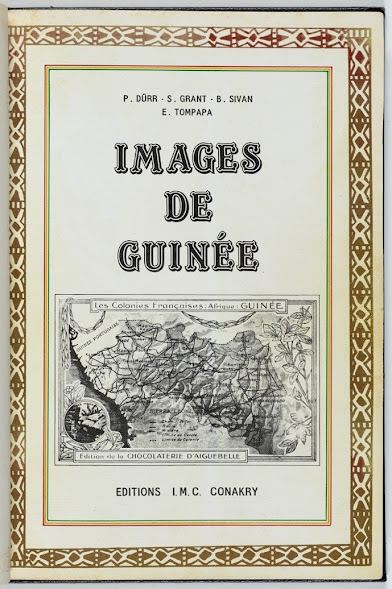
When former USAID Foreign Service officer Stephen Grant donated his annotated copy of Images de Guinée (1991) to the Eliot Elisofon Photographic Archives (EEPA) in 2020, he hoped that the book should remain open for others—specifically Guineans and those with ties to Guinea—to share in the margins their own reflections of the historic postcards.
Adding to a collection is not a rare occurrence. In fact, Grant himself has donated over 10,000 photographic postcards from Côte d’Ivoire, Egypt, Senegal, and the Republic of Guinea in separate instances in 2001, 2018, and 2020. The EEPA also accepts new donations to the African Postcard collection (EEPA.1985-014) every year, continuously altering the make-up of the collection. One of the many things that makes Images de Guinée unique is the concept of a typically static item (a book) remaining active in a concept known as a “living” document.
A living document is a text that is continually edited and updated, and perhaps limited by a set of frameworks.(1) This term has been applied to materials like the United States Constitution, but it can also refer to a website like Wikipedia, the digital encyclopedia that allows account holders to update articles freely.(2) In the context of the archive, a living document can be a way for visitors to connect in a more personal way—no longer an observer, but an active participant in history making.
In a 2020 interview with museum staff, Grant explained how postcards helped him relate to others in the countries where he lived:
I learned something about introducing oneself when you go abroad for the U. S. government. You can say your name, and shake hands, and that’s it. Or, soon after you meet someone, you can surprise them by pulling out of your pocket a small stack of picture postcards of the country and see how your new friend or colleague reacts. There will be astonishment that you have these items in the first place; most people throw away postcards.
Secondly, the person will invariably make a comment comparing what the scene looked like in the past, and looks like today. Thirdly, for more impact, show the postcards simultaneously to children, young adults, and older adults, and listen to their different reactions! Picture postcards open up conversations. They provoke the beholder to compare the past with the present. They prompt unsuspectedly rich exchanges in a family setting.
When Grant helped put together the book of postcards in 1991, he had already been collecting postcards for over 10 years. He was inspired by an exhibit at the National Library in Abidjan, Côte d'Ivoire, in 1980, which featured hundreds of old picture postcards of the country. In turn, while living in Guinea as a USAID officer, Grant inspired others with his own postcard exhibit, which took place at the Franco-Guinean Cultural Center in Conakry. The exhibit attracted around 1,700 visitors in March 1991.
German Ambassador to Guinea, Dr. Hubert Beemelmans, was so taken with the exhibit that he approached Grant about turning it into a book. They could repair and use a printing press at the Catholic Mission in Conakry—they only needed the staff and supplies.(3) Beemelmans requested money from the Ministry of Foreign Affairs in Bonn, Germany to buy paper, ink, materials for binding, and to train additional local staff on the printing press. Postcard collectors from France, Bernard Sivan and Pierre Dürr, also provided images from their large collections. The resulting publication became the first book published in Guinea in the private sector. All previous publications had been printed by the Patrice Lumumba National Printing Office, according to Seydouba Cissé, the Assistant Director of National Archives in Conakry.
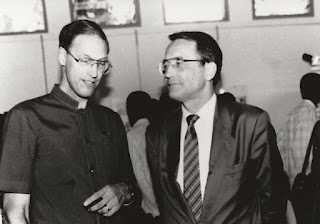 |
Stephen Grant (left) speaking with German Ambassador to Guinea, Dr. Hubert Beemelmans, at the postcard exhibit, 15 March 1991, Conakry, Guinea. |
From the beginning, the book was grounded in remembering Guinea’s past. As Dr. Beemelmans writes in the preface (translated from French):
The past is the foundation of the present and future. Humankind and nations that ignore their past do not know each other and do not know where they are going. One can criticize the past, but at the end of the day one must accept it or at least come to terms with it...This book is the memory and the messenger from the past...This book is intended to appeal to those Guineans and foreigners who love Guinea and want to know its past in order to better understand its present and be able to accompany its future.
At first, only Grant’s fellow contributors wrote in the book: the collectors Sivan and Dürr, printer Augusto Bindelli, and Seydouba Cissé, Assistant Director of the National Archives in Conakry. But soon, Grant began inviting others to leave inscriptions before he departed for his next assignment in Indonesia.
What resulted was an assortment of experiences, from fellow USAID officers to local politicians and educators to a descendant of one railroad family in Conakry. The inscriptions date from 1991 to 2020, when Grant invited the current Ambassador from Guinea to add his own recollection to the book.
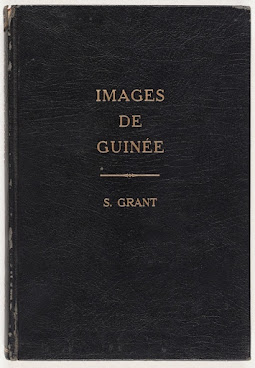 |
Stephen Grant’s leather-bound annotated copy of Images de Guinée, 1991.
The cover was designed by Annick Grant.
From the Pages of History Education For All
|
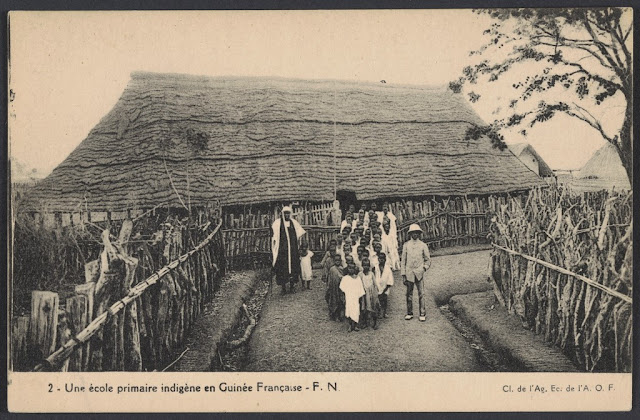 |
Une école primaire indigène en Guinée Française - F.N. [An indigenous primary school in French Guinea], Ag. Ec. De l’A. O. F., c. 1910, Postcard, collotype, EEPA 2001-001-0940, Stephen H. Grant Postcard Collection, Eliot Elisofon Photographic Archives, Smithsonian Institution. |
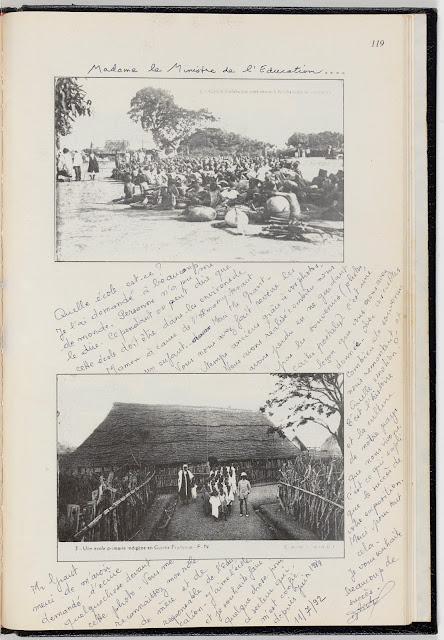 |
| Page 119 of Images de Guinée, featuring postcard and text from inscription by Aïcha Bah Diallo, 2. Une école primaire indigène en Guinée Française - F.N. [An indigenous primary school in French Guinea], Ag. Ec. De l’A. O. F., c. 1910, Postcard, collotype, EEPA 2001-001-0940, Stephen H. Grant Postcard Collection, Eliot Elisofon Photographic Archives, Smithsonian Institution. |
Mr. Grant, thank you for asking me to write something about this photo. You recognize my role as mother and responsible for education. I love school and aim to do something significant for this sector with which I have been entrusted.
Which school is this? I’ve asked a lot of people. Not one could tell me. Nevertheless, I am leaning toward the region of Mamou because of the Moslem leader (almamy) holding a child.
Thank you, Mr. Grant. You have led me to relive the olden days thanks to your photos. We realize how much we have lost by not saving mementos (photos, postcards). With your cards, how many memories come back, and with what emotion! It is the history and the culture of our country that we relive. This is what explains the triumph of your exhibit. Thank you for that. I wish you good luck.
--Aïcha Bah Diallo, President of the Network for Education for All in Africa, and former Minister of Education of Guinea. Original French:
Mr. Grant, Merci de m'avoir demandé d'écrire quelquechose devant cette photo. Vous me reconnaissez mon rôle de mère et de responsable de l'Education. J'aime l'école et je souhaite faire quelquechose pour ce secteur qui m'est confié depuis Juin 1989.
Quelle école est-ce? Je l'ai demandé à beaucoup de monde. Personne n'a pu me le dire. Cependant on peut dire que cette école doit être dans les environs de Mamou à cause de l'Almamy tenant un enfant. Merci Mr. Grant. Vous nous avez fait revivre les temps anciens grâce à vos photos.
Nous avons realisé combien nous avons perdu en ne gardant pas les souvenirs (photos, cartes postales). C'est une leçon que vous nous avez donnée. Avec vos cartes combien de souvenirs nous remontent et quelle émotion! C'est l'histoire et la culture de notre pays que nous vivons. C'est ce qui explique le succès de votre exposition. Merci pour tout cela. Je vous souhaite beaucoup de succès.
Diallo braids several themes into her inscription—her role as a mother, a friend to Grant, and an elected local official entrusted with the education of the community. She writes about connecting with others around her and asking about the history of the school, which further highlights Grant’s observation that the postcards inspire conversation.
Nostalgia of the Railroad
During the 1930s when the Conakry-Niger Railway was a real railroad, you could count more than ten trains per day from Conakry to Kankan and back. My father was a station master at Kolenté where I was born. My father trained five other members of our family as station masters. Of the thirty or so stations in the Conakry Niger, my parents occupied half a dozen.
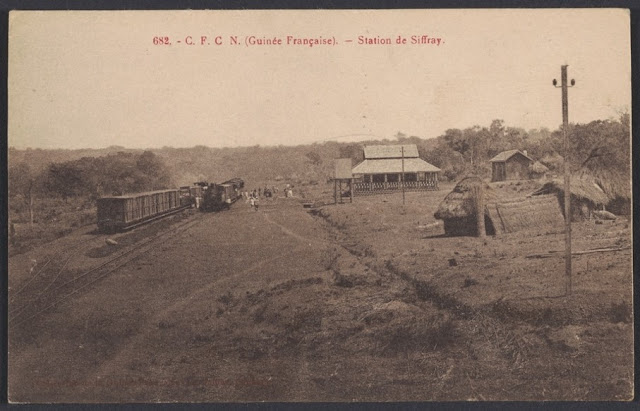 |
Image Caption: 682. C.F.C.N. (Guinée Française) - Station de Siffray [ C.F.C.N. Chemin de fer, Conakry, French Guinea - Siffray Station, Collection de la Guinée Francaise, A. James, Postcard, collotype, c.1907, EEPA 2001-001-1032, Stephen H. Grant Postcard Collection, Eliot Elisofon Photographic Archives, Smithsonian Institution. |
I spent several vacations at Siffray station (Dagomet) where my father's last little brother served as a station master for a long time. In short, I experience a great admiration for this beautiful collection characterized by discipline and perseverance exceptionally moving for connoisseurs.
I like the rails, I like the train, I like the stations, I like everything related to the railroad because I belong to the family of railway workers. Thank you, Mr. Grant, for this beautiful work which makes me very nostalgic. Thank you for your warm friendship.
[El Hadj] Tafsir H. Thiam, 6/30/92, Deputy Director of Peace Corps in Conakry and child of prominent railroad family in Guinea
 |
Guinée - Une Station de chemin de fer. [A railway station.], unknown photographer, c. 1910, Postcard, collotype, EEPA 2001-001-1057, Stephen H. Grant Postcard Collection, Eliot Elisofon Photographic Archives, Smithsonian Institution. |
Pendant les années 30 lorsque le Chemin de fer Conakry-Niger était un vrai chemin de fer, lorsqu'on pouvait compter plus d'une dizaine de trains par jour de Conakry à Kankan et retour. Mon père était chef de gare à la Kolenté où je suis né. Mon père a formé cinq autres membres de notre famille comme chef de gare. Sur la trentaine de gares que comptait le Conakry Niger, mes parents en occupaient une demi douzaine.
J'ai passé plusieurs vacances à la gare de Siffray (Dagomet) où le dernier petit frère de mon père a servi pendant longtemps comme Chef de gare. En bref, j’éprouve une grande admiration devant cette belle collection caracterisée par une discipline et une perseverance exceptionellement émouvantes pour les connaisseurs.
J'aime les rails, J'aime le train, j'aime les gares, j’aime tout ce qui est lié au chemin de fer car j'appartiens à la famille de cheminots. Merci Mr. Grant pour cette belle d’oeuvre qui me rend très nostalgique. Merci pour votre chaude amitié.
In this recollection, nostalgia infuses every word Thiam writes. From the Siffray station where he spent several vacations with his uncle, to the crowded platform that reflects a typical day on the railroad, the impact of these two postcards of the railroad draws memories of his family history that may not have been written down elsewhere.
The Familiar Crocodile
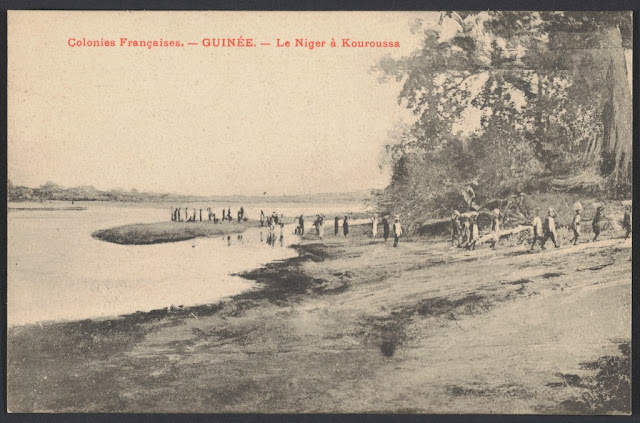 |
Colonies Françaises-- Guinée - Le Niger à Kouroussa [French Colony – Guinea - Niger river at Kouroussa], unknown photographer, c. 1910, Postcard, Collotype, EEPA 2001-001-1135, Stephen H. Grant Postcard Collection, Eliot Elisofon Photographic Archives, Smithsonian Institution. |
Boda Kudu:
A little downstream, there was a familiar crocodile, guardian of all the children of Kouroussa. He hunted any foreign crocodile, but alas! also munched on the foreign children who ventured into his domain.
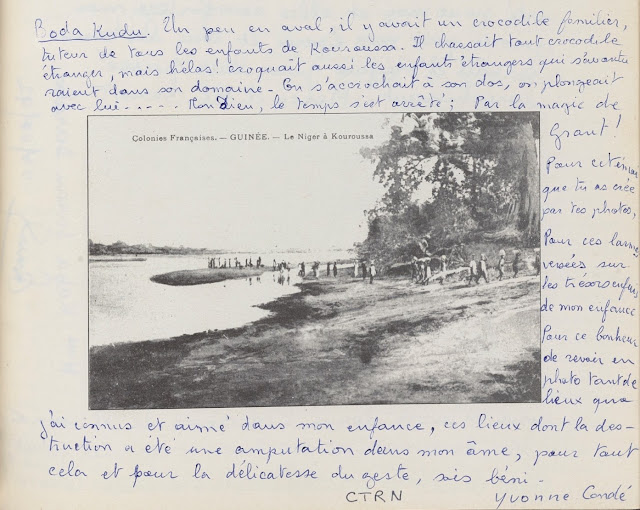 |
Page 89 of Images de Guinée, featuring postcard and text from story by Yvonne Condé, Colonies Françaises- Guinée - Le Niger à Kouroussa [French Colony – Guinea -- Niger river at Kouroussa], EEPA 2001-001-1135, Postcard, Collotypes, Stephen H. Grant Postcard Collection, Eliot Elisofon Photographic Archives, Smithsonian Institution. |
We would hang onto his back; we would dive with him ... My God, time stood still. By Grant‘s magic! For this emotion that you created by your photos, for these tears shed on the fled treasures of my childhood, for the happiness of seeing again in photos all the places that I knew and loved in my childhood, those places whose destruction has been an amputation in my soul, for all that and for the delicacy of the gesture, you are blessed." - Yvonne Condé - Key member of the Comité transitoire de redressement national (CTRN). She is also responsible for the writing of Loi fondamentale in 1990.
Un peu en aval, il y avait un crocodile familier, tuteur de tous les enfants de Kouroussa. Il chassait tout crocodile étranger, mais hélas! croquait aussi les enfants étrangers qui s’avanturaient dans son domaine.
On s'accrochait à son dos, on plongeait avec lui... Mon dieu, le temps s'est arrêté; Par la magic de Grant! Pour cet émoi que tu as créé par tes photos, pour ces larmes versées sur les trésors enfuis de mon enfance, pour ce bonheur de revoir en photo tant de lieux que j'ai connus et aimés dans mon enfance, ces lieux dont la destruction a été une amputation dans mon âme, pour tout cela et pour la délicatesse du geste, sois béni. - Yvonne Condé
This entry is particularly interesting in the context of Guinean politics. Condé, a key member of the Comité transitoire de redressement national (CTRN), shares a story almost like a fairy tale--about a place that may not exist anymore, or perhaps she is far from home. As a member of the organization trying to establish democracy in Guinea, Condé describes this allegory of a territorial crocodile.
Into the Future, As We Look Towards the Past
Although these are just a few examples, each of these inscriptions marks a separate significance to the postcards. The work for improving education, steady livelihood through a stable career on the railroad, or the treasures of childhood and reflecting on change in Guinea. How many other countless memories of the past could be provoked by these images?
Advances in technology and digitizing collections provide more options for archives to connect with the communities they serve, to preserve history, and invite collaboration. Over the last few years, EEPA has worked to digitize and catalog postcards from Grant’s postcard donations in 2001 and 2019. In the future, the EEPA will provide access to the full collection of historic postcards from Guinea and other African countries for folks to inscribe. Soon, anyone with access to the Internet (and a device) can view the historic postcards.
If you are interested in sharing your own memories of Images de Guinée or sending a message to the EEPA about the postcards below, please send an email to elisofonarchives@si.edu with the subject line “Images of Guinea.”
Due to Covid-19, the EEPA is currently closed to the public. In accordance with Smithsonian Libraries and Archives, it will reopen to visitors and researchers projected January 2022. Please email the Eliot Elisofon Photographic Archives to set up a visit to view the physical Images de Guinee.
Notes:
1. Shanahan, D.R. A living document: reincarnating the research article. Trials 16, 151 (2015). https://doi.org/10.1186/s13063-015-0666-5
2. Marshall, Thurgood. "The Constitution: A living document." Howard LJ 30 (1987): 915. Kitchin, Heather A. "The Tri-Council Policy Statement and research in cyberspace: Research ethics, the Internet, and revising a ‘living document’." Journal of Academic Ethics 1, no. 4 (2003): 397-418.
3. Phone call with Stephen Grant, October 2021.
Eliot Elisofon Photographic Archives, National Museum of African Art
Also
visit Stephen’s website at www.stephenhgrant.com
More
from the Stephen Grant Postcard Collection
Collection de la Guinée -
A. James, Conkary. 82 – Conakry (Guinée Française). Le Ramadam: Le Salam (4e
phase). [Guinea Collection – A. James, Conakry.
82- Conakry (French Guinea) Ramadan: Salam (4th phase).] Photograph
by A. James, c. 1932. Postcard, Collotype, EEPA 2001-001-0917. Stephen Grant
Postcard Collection, Eliot Elisofon Photographic Archives, National Museum of
African Art, Smithsonian Institution
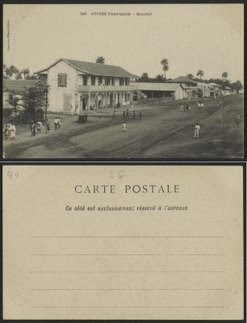 |
549. Guinée Française - Konakry
[French Guinea, Conakry], Collection Fortier Dakar,
c. 1906, Postcard, Collotype, EEPA 2001-001-0972, Stephen Grant Postcard
Collection, Eliot Elisofon Photographic Archives, National Museum of African
Art, Smithsonian Institution
|
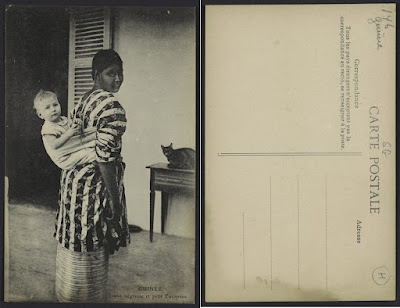 |
"Jeune négresse et
petit Européen," French Guinea, unknown photographer, c.
1910, Postcard, Collotype, EEPA 2001-001-0981, Stephen Grant Postcard
Collection, Eliot Elisofon
Photographic Archives, National Museum of
African Art, Smithsonian Institution
|
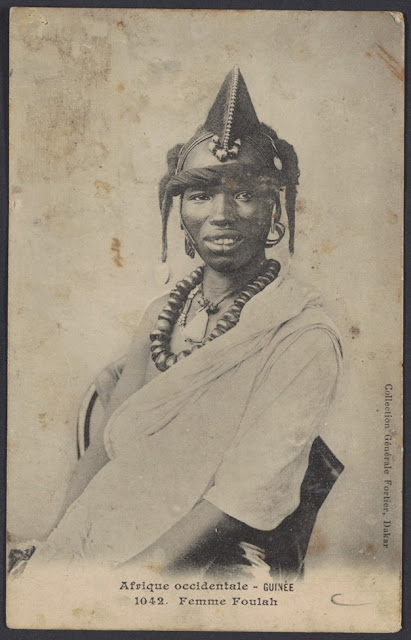 |
Afrique occidentale -
Guinée[,] 1042. Femme Foulah [West Africa, Guinea,
1042. Foulah Woman]
Collection Générale
Fortier, Dakar, c. 1911, Postcard, Collotype, EEPA 2001-001-1176, Stephen Grant Postcard
Collection, Eliot Elisofon Photographic
Archives, National Museum of
African Art, Smithsonian Institution
|


 Posts
Posts


